


Teresa of Ávila's Second Conversion
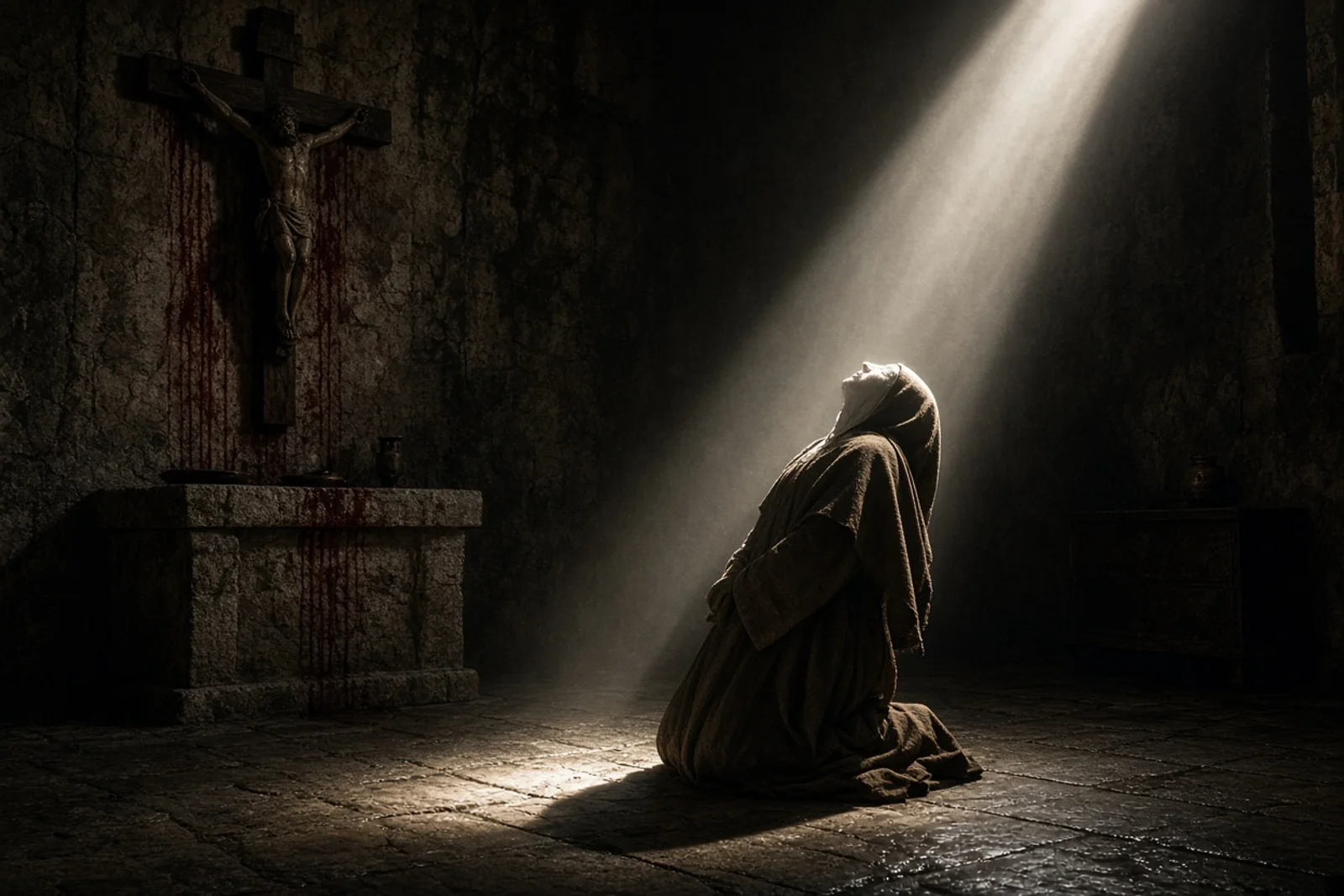
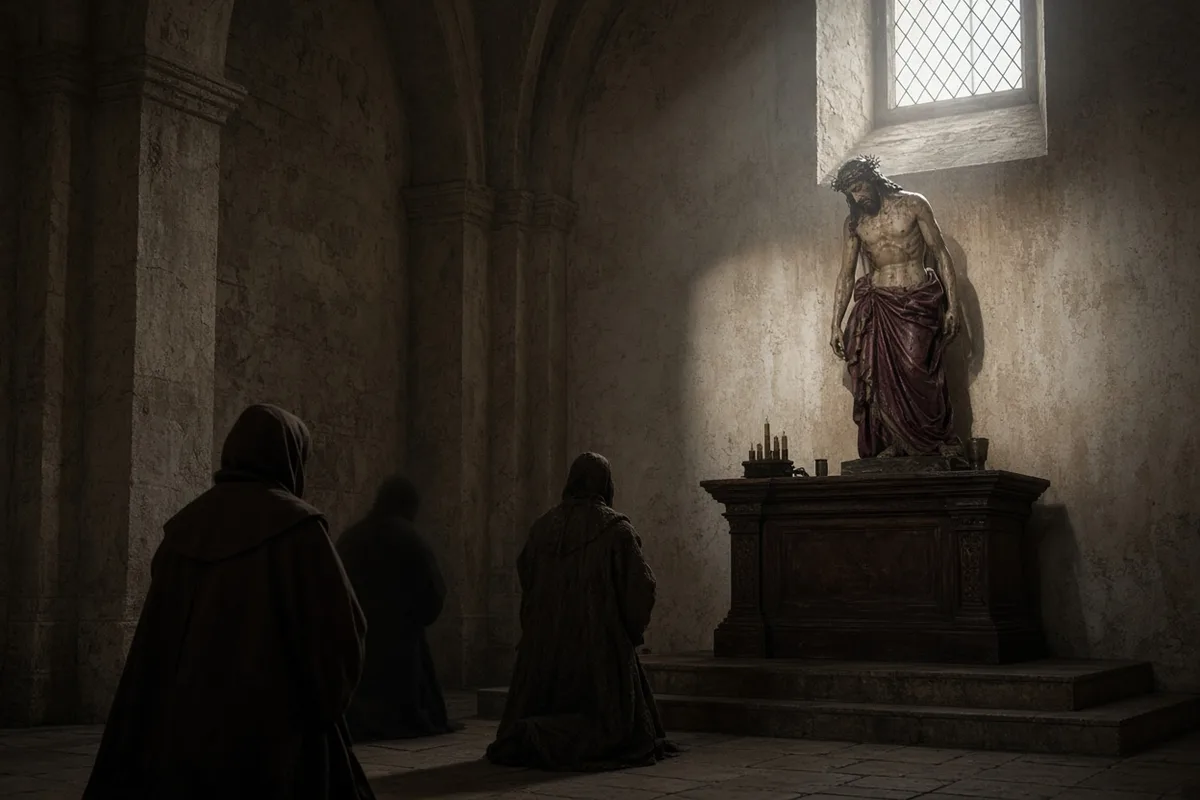
The picture had been leaned against the wall in the oratory that morning, still wrapped in the cloth the sacristan used for feast-day images. I carried the last of the candles in and set them on the ledge, then stepped back to judge the light. The frame was plain, the wood darkened from years of smoke. When the cloth came away the figure inside stopped me where I stood. The wounds were not painted for show. They looked opened and raw, the head tilted so the weight of it pulled at the neck.
Teresa came in not long after, her habit still damp at the hem from the morning chores. She did not speak at first. She stood a few paces inside the door and looked. I saw her shoulders drop as if someone had cut a cord. Then she moved forward, dropped to her knees on the stone, and stayed there without moving for what felt like a long time. When the tears came they were quiet at first, then heavier, until I could hear them hit the floor. She pressed her forehead to the ground beside the frame and stayed low.

I left her there. The bell for the next office would ring soon and someone had to see to the linen. When I passed the door again an hour later she was still on the floor, one hand now resting on the edge of the picture as if she meant to keep it from being taken away. Two other sisters glanced in and moved on without speaking. We had all grown used to her long prayers, but this was different. She did not rise when the bell rang.
That night she ate little. In the refectory she kept her eyes on her bowl. When one of the younger nuns tried to draw her into talk about a visitor who had come that week, Teresa answered only that she had nothing to add. The next morning she asked the portress to turn away two gentlemen who had come to speak with her through the grille. She had been seeing them every month for years. She gave no reason.

She began to spend more time alone in the oratory. Sometimes she would take the picture down and carry it to a corner where the light was poorer, as if she wanted fewer eyes on it. When she returned to the common rooms her face looked older, though nothing in her work had changed. She still swept, still copied the accounts when asked, still walked the cloister at the same hour each afternoon. Only the conversations stopped. The visitors who used to wait for her now waited for others.
She spoke once of the Magdalene in the hearing of three of us. It was after Compline, and she was folding the towels. She said the saint had known how to stay at the feet even when everything else had been taken. Then she went back to the folding as if she had said nothing of importance. We did not ask her to explain.
The change held through the winter. She refused the small gifts that used to come from outside, the sugared almonds and the letters that asked for her prayers in return for news. When the new Jesuit fathers arrived in Ávila she was among the first to ask for confession with them. She went regularly after that, sometimes waiting in the cold corridor until Father Juan de Padranos could see her. She never spoke of what passed between them.
By spring she had begun to walk the garden alone at times when the rest of us were gathered. She would stop at the olive tree near the wall and stand with one hand on the bark, looking at nothing in particular. Once I saw her press her thumb against a thorn on a low branch until the skin broke. She wrapped the cut in her sleeve and went inside without comment.
The picture stayed in the oratory. No one moved it to the feast-day storeroom when the season changed. Teresa would sometimes stand before it again, though she no longer threw herself down. She would look for a few minutes, then turn and continue with whatever task waited. Her voice in choir grew steadier. She missed fewer of the hours.
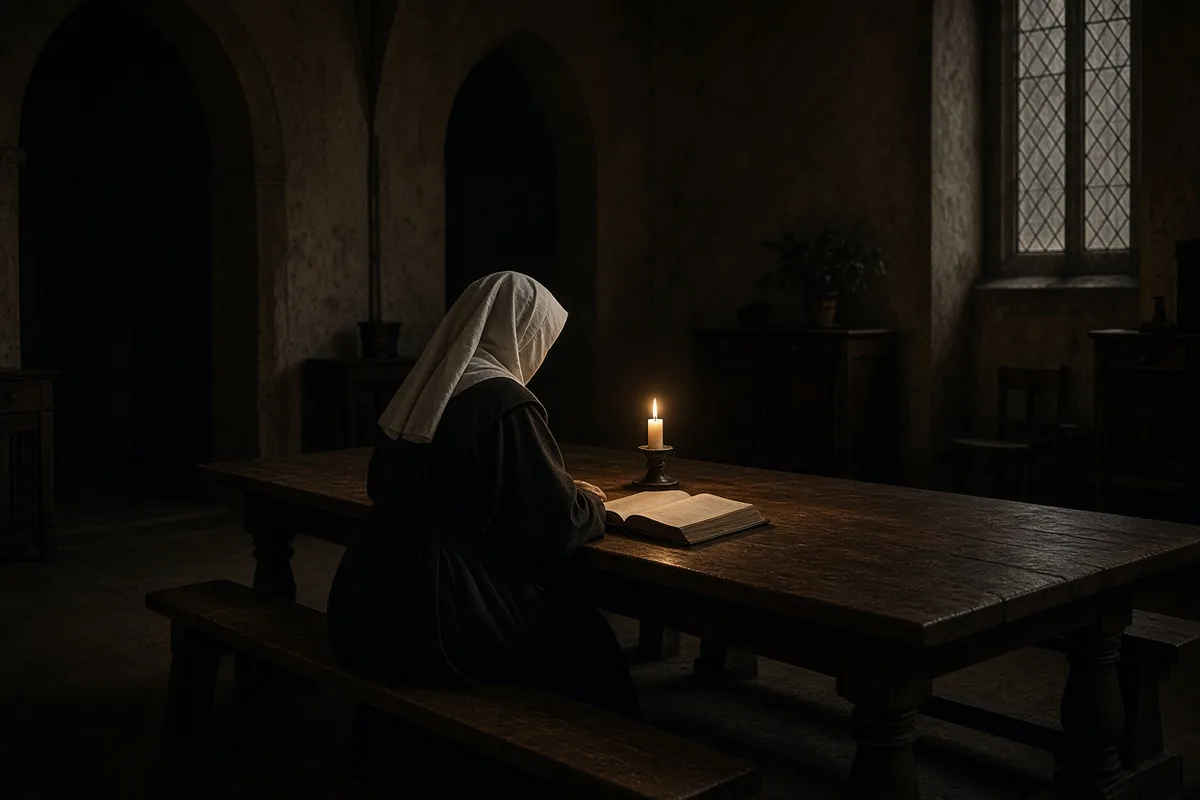
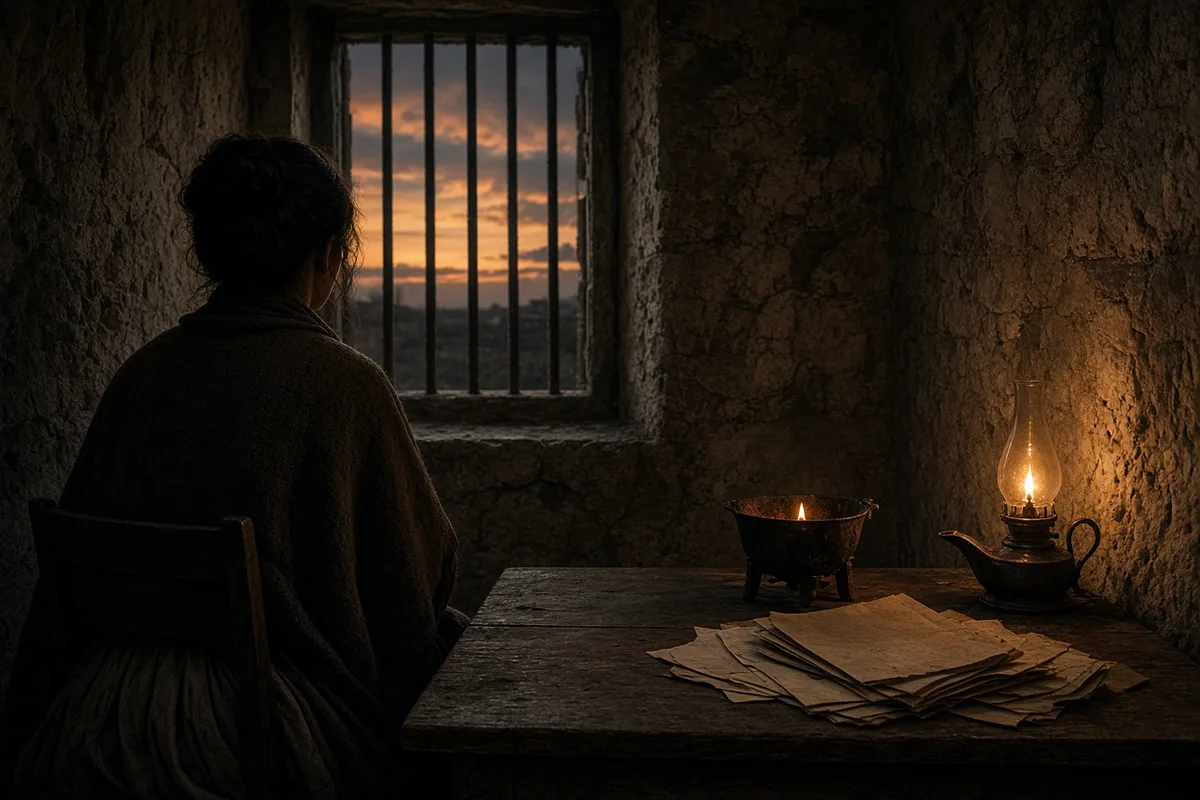
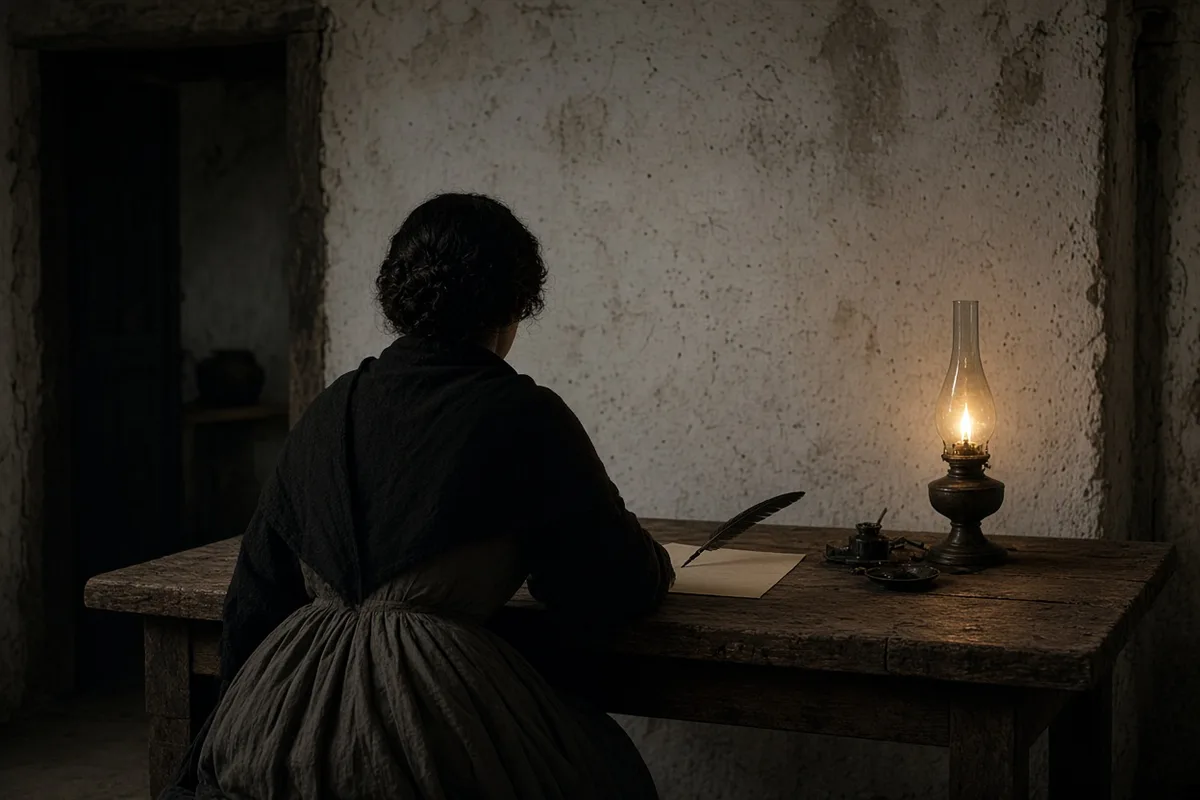
Years later, when she began to speak of a smaller house with stricter rules, the same steadiness was still there. She would sit at the long table after supper and draw lines on paper with a piece of charcoal, marking where the cells would stand and how far the chapel would reach from the street. She never raised the old picture again in our hearing, but the mark of it stayed in the way she measured every new thing against what she had seen that day on the floor.
The last time I saw her before she left for the new foundation she was carrying a bundle of habits to be mended. She paused at the oratory door, looked in, and gave a small nod as if answering someone who had spoken. Then she walked on down the corridor, the bundle balanced on one arm, the free hand brushing the wall for balance in the dim light.
She departed the Incarnation on the twenty-fourth of August in 1562 with four companions and a license from the bishop of Ávila, don Álvaro de Mendoza, carrying only the rule of the Carmelites and a copy of the constitutions drawn up the year before. The new house of San José stood at the end of the calle de la Cruz, its chapel measuring twelve varas by eight, its cells six in number, each furnished with a straw mattress, a wooden cross, and a single blanket of undyed wool. Teresa wrote to her sister Juana de Ahumada that the foundation cost four hundred ducats in all, paid from alms collected by Gonzalo de Yepes and the first Mass said by Father Julián de Ávila on the feast of Saint Bartholomew. She returned to the Incarnation only once that autumn to settle accounts, then remained at San José through the winter of 1563, rising at midnight for Matins and reciting the full Divine Office without the mitigation that had been granted at the larger convent since 1436.
By 1567 she had opened a second house at Medina del Campo on the fifteenth of August, using a rented dwelling near the church of San Pedro until the permanent building on the plaza de la Cruz was completed with funds from the merchant Alonso de la Madre de Dios. The following year she established the first monastery of Discalced friars at Duruelo on the feast of the Holy Trinity, where Fray Juan de Yepes, later known as John of the Cross, and Fray Antonio de Heredia took possession of a thatched farmhouse containing three cells and a chapel no larger than the oratory at the Incarnation. Teresa recorded in a letter to Father García de Toledo that the friars walked barefoot from Medina to Duruelo, a distance of twelve leagues, carrying the Blessed Sacrament under a canopy of branches. In 1569 she founded at Toledo with the assistance of Doña Luisa de la Cerda, the house containing nine nuns and supported by an annual income of three hundred ducats settled on the foundation by the testament of the Countess of Oropesa.
She met Fray Juan de la Cruz again in 1571 when he was appointed confessor to the nuns at the Incarnation, where she herself served as prioress from 1571 to 1574 by order of the apostolic visitor, Father Pedro Fernández. During those years she wrote the greater part of The Way of Perfection, completing the final redaction in 1577 at the request of the sisters who asked for instruction on prayer after the disturbances caused by the separation of the Discalced from the mitigated Carmelites. In a passage dated the twenty-eighth of November 1577 she noted that the soul must keep its eyes fixed on Christ crucified, using the exact words she had spoken years earlier when the picture remained in the oratory. The book was copied by hand and circulated among the five houses then existing, reaching Malagón in 1579 and Valladolid in 1580.
Further foundations followed in rapid succession: Pastrana in 1569, Salamanca in 1570, Alba de Tormes in 1571, Segovia in 1574, Beas de Segura in 1575, Seville in 1575, Caravaca in 1576, Villanueva de la Jara in 1580, Palencia in 1580, Soria in 1581, and Granada in 1582. Each house was established with a dowry of at least one thousand ducats or an equivalent income from rents, and each required a separate license from the local bishop and from the nuncio, Monsignor Sega. Teresa traveled these distances in a covered wagon drawn by mules, accompanied by her niece Teresa de Cepeda, the lay sister Ana de San Bartolomé, and usually two or three priests. She noted in her accounts that the journey from Seville to Toledo in 1576 took twenty-three days and cost eighty-six reales in tolls and lodging.
Her health declined after the foundation at Burgos in 1582. She suffered from dropsy and frequent hemorrhages, yet continued to dictate letters until the end of September. On the fourth of October she received the last sacraments at the monastery of Alba de Tormes, where the community numbered fifteen nuns. Father Antonio de Heredia administered Viaticum at nine in the morning, and she died that afternoon at the hour of Compline, her body placed in the choir according to the custom of the order. The community recorded that the room measured four varas square and contained only a wooden crucifix and a small image of Our Lady of the Pillar brought from Zaragoza.
After her death the Discalced Carmelites numbered seventeen convents of nuns and fifteen of friars. Her remains were translated to a new tomb in 1585 at the order of the Duke of Alba, and portions of the habit and veil were distributed to the houses she had founded. The original picture that had remained in the oratory at the Incarnation was moved in 1591 to the sacristy of San José, where it was listed in the inventory as an Ecce Homo on panel, two spans in height, with the frame renewed in 1604 at a cost of twelve reales. The convent of the Incarnation itself retained its mitigated rule until 1605, when it adopted the reform under the prioress María de San José.
The house at San José still stands on the same site, its chapel enlarged in 1607 and its cloister rebuilt after the earthquake of 1755. The cell used by Teresa contains the wooden cross she carried and the account book she kept from 1563 to 1567, showing entries for bread at four maravedís the loaf and oil at thirty maravedís the azumbre. In Alba de Tormes the body lies in a silver urn within the chapel, examined and declared incorrupt in 1593 and again in 1760. The last record of any sister who had known her personally dates to 1610, when Ana de los Angeles, then aged eighty-four, described the manner in which Teresa had carried the bundle of habits along the corridor on the morning she left the Incarnation for the final time.
The remains of Ana de los Angeles were examined at the Incarnation on the twelfth of March 1611 by the vicar general, don Francisco de Salcedo, who noted in the register that she still wore the same brown habit she had received from Teresa in 1561 and that her rosary contained sixty-three beads of boxwood, one for each year of the older nun’s life after the oratory incident. In 1622, when Pope Gregory XV issued the bull of canonization on the twelfth of March, the Discalced province of Castile sent to Rome a certified copy of the 1577 passage from The Way of Perfection together with the original Ecce Homo panel, which arrived at the Vatican on the twenty-second of June and was examined by the cardinal prefect of the Congregation of Rites, Antonio Barberini.
The panel was returned to San José on the eighth of October 1623 and placed above the main altar, where it remained until the French occupation of Ávila in 1809, when General Lasalle’s troops removed the silver lamps but left the painting untouched after the sacristan, Sister María de los Dolores, produced the 1604 receipt for the renewed frame. During the Carlist wars the same painting was carried for safekeeping to the episcopal palace on the fourteenth of July 1836 and restored there in 1841 by the painter José María Rodríguez, who recorded that he replaced only the lower right corner measuring three inches by two and used pigment mixed with walnut oil.
In 1873 the Discalced nuns of Alba de Tormes opened the silver urn on the feast of Saint Teresa and found the body still entire, the right hand holding a small crucifix of ebony given by the Duke of Alba in 1585; the apostolic notary, don Juan de la Cruz Martínez, counted twenty-seven teeth remaining in the upper jaw and measured the height of the corpse at five feet two inches. The last nun who had entered the order while Teresa was still alive, Sister Isabel de San José of Medina del Campo, died on the twenty-ninth of April 1624 at the age of ninety-one, having dictated to her confessor that Teresa’s bundle of habits had been tied with a single cord of hemp rather than the usual two.
The original manuscript of the constitutions drawn up in 1561 is preserved today in the archive of the Carmelite monastery at Valladolid, bound in vellum with the seal of Bishop Álvaro de Mendoza still attached, its first page bearing the entry “twelve cells, six varas each, straw and wool only.” At the convent of San José the account book from 1563 to 1567 lies open under glass in the cell, its ink entries showing on the tenth of February 1565 the purchase of three azumbres of oil at thirty maravedís and on the third of May the payment of four maravedís for a loaf of bread to the baker Pedro de la Cruz.
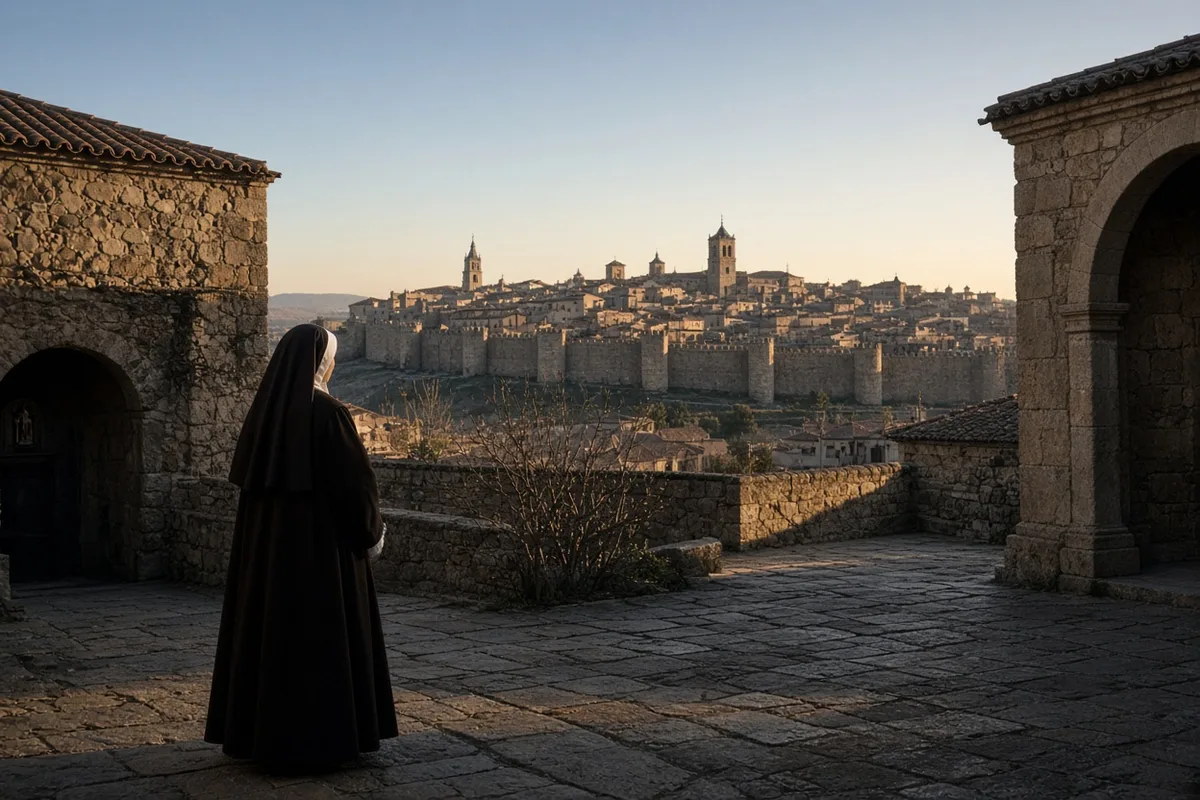
The calle de la Cruz in Ávila retains the same paving stones laid in 1562, now numbered 12–14, and the chapel measures exactly twelve varas by eight as recorded in the foundation document; visitors may still stand at the spot where the olive tree once grew against the garden wall, though the tree itself was replaced in 1924 after the original trunk split during a storm. In 1962 the Spanish government declared the entire site a national monument, and the last private resident of the adjoining house, doña Carmen Ruiz de la Peña, vacated the premises on the fifteenth of September of that year so that the cloister could be extended by two additional bays.
The final eyewitness account of any living person who had seen Teresa appears in a letter dated the fourth of June 1610 from Ana de los Angeles to her niece in Toledo, in which she wrote that the bundle of habits had been balanced “on the left forearm, the free hand touching the wall at every third step,” after which the corridor at the Incarnation remained empty for the rest of that morning except for the sound of the bell for Terce.