


The Berlin Wall Falls
My hands were cold on the barrier at Bornholmer Strasse when the radio crackled again, and I remember thinking: something in this night has already broken loose, and none of us in this booth know how to stop it.
I had worked passport control on that bridge for six years. Long enough to know the rhythm of the checkpoint the way you know a familiar room in the dark — the hiss of the gate motor, the smell of diesel and wet concrete, the particular silence that fell over the waiting cars after curfew. That silence was gone by nine o'clock. In its place was a sound I had never heard there before: voices, hundreds of them, low and rising, pressing against the checkpoint from the eastern side like water testing a dam.

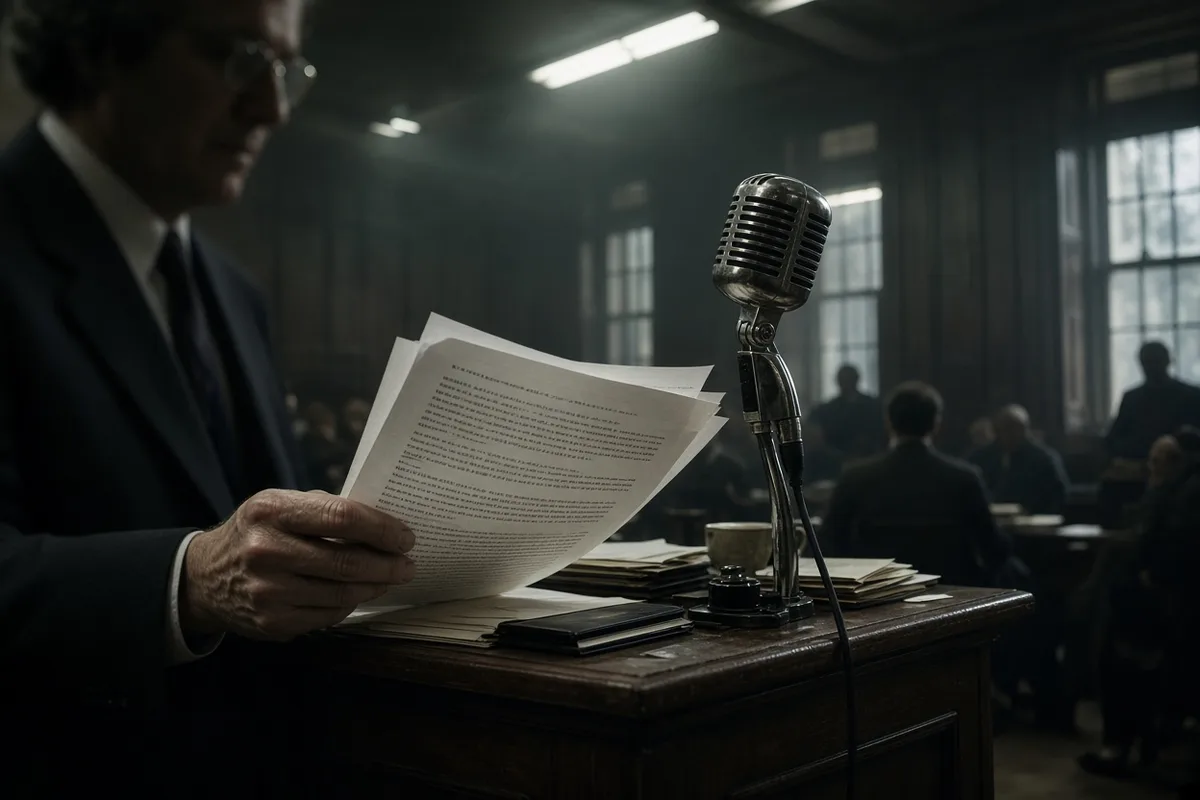
Earlier that evening, in the duty room, someone had the television on low, tuned without much thought, the way you leave a radio playing while you eat. Günter Schabowski's face filled the screen, flat and tired under the studio lights, reading from papers he did not seem entirely to understand himself. He said the words about private travel, about no special conditions, about visas issued without delay. Someone in the back of the press room asked when this would take effect, and he said, almost as an afterthought, immediately, as far as he knew. I watched my colleague set down his cup. Neither of us said anything. We had received no cable, no telex, no order from above telling us this was real, or how it was to be carried out, if it was to be carried out at all.
By eight that night the West German broadcast had already carried it as its lead story — the border is open, the anchor said, plain as that — and somewhere across the city people were rising from their sofas and reaching for their coats. We did not know that yet. We only knew that our telephone, usually silent after dark, would not stop ringing, and that each call from headquarters told us less than the one before.
The first people appeared at our checkpoint a little after nine, small clusters at first, tentative, the way you approach a dog you are not sure is friendly. They had heard the broadcast, or heard someone who had heard it, and they wanted to know if it was true. We told them what we had been told, which was almost nothing. Wait. Go home. We have received no instructions. But they did not go home. More came behind them, and more behind those, until the street leading up to the bridge was no longer a street but a crowd, packed shoulder to shoulder under the sodium lights, breath rising off them like smoke off a river in winter.
I was not the one standing at the head of that crowd. That was Harald Jäger, the officer in charge of our shift, a man I had watched grow more tired and more furious with each hour that passed without word from his superiors. He was not well that autumn — something in his body was wrong, something he feared was cancer, though none of us spoke of it directly — and the strain of the night seemed to sit on him like a second illness. He kept dialing his superiors, kept getting the same answer, kept being told to wait, to hold, to manage the crowd without opening the gate. Each time he hung up the phone his jaw was tighter than before.
At half past nine, unable to bear the pressure building against the barrier, he made his first concession. He let a small number through, one at a time, on the condition that their passports be stamped in a particular way — a stamp that invalidated the document, that stripped its holder of citizenship without their knowing it, a bureaucratic trick to make the crossing look like an expulsion rather than a defection. It satisfied no one. It solved nothing. The crowd behind those first few only grew louder, sensing that the gate could open, had opened, if only a crack, and that crack was enough.
I stood near enough to see Jäger's face when he picked up the phone for what must have been the twentieth time that night. Whoever answered him this time offered no comfort, no order, only what sounded like contempt for a man asking too many questions about a situation no one above him wanted to own. Something in him changed after that call. I have thought about that moment more than almost any other in my life — the exact second a man who has spent decades following orders decides the orders no longer deserve to be followed.
By eleven the crowd at the barrier had swollen past counting. Thousands, pressed so close together that individual faces blurred into one long restless shape under the arc lights, chanting for the gate, for the border, for the simple word open. Our few dozen guards, armed, trained, accustomed to authority, stood facing that shape and understood, I think all of us at once, that authority had run out. There were no orders that could have turned that crowd back without blood, and no one, not Jäger, not any officer on that bridge, wanted to be the man remembered for spilling it.
At eleven-thirty, Jäger gave the order himself. Raise the barrier. Let them go.
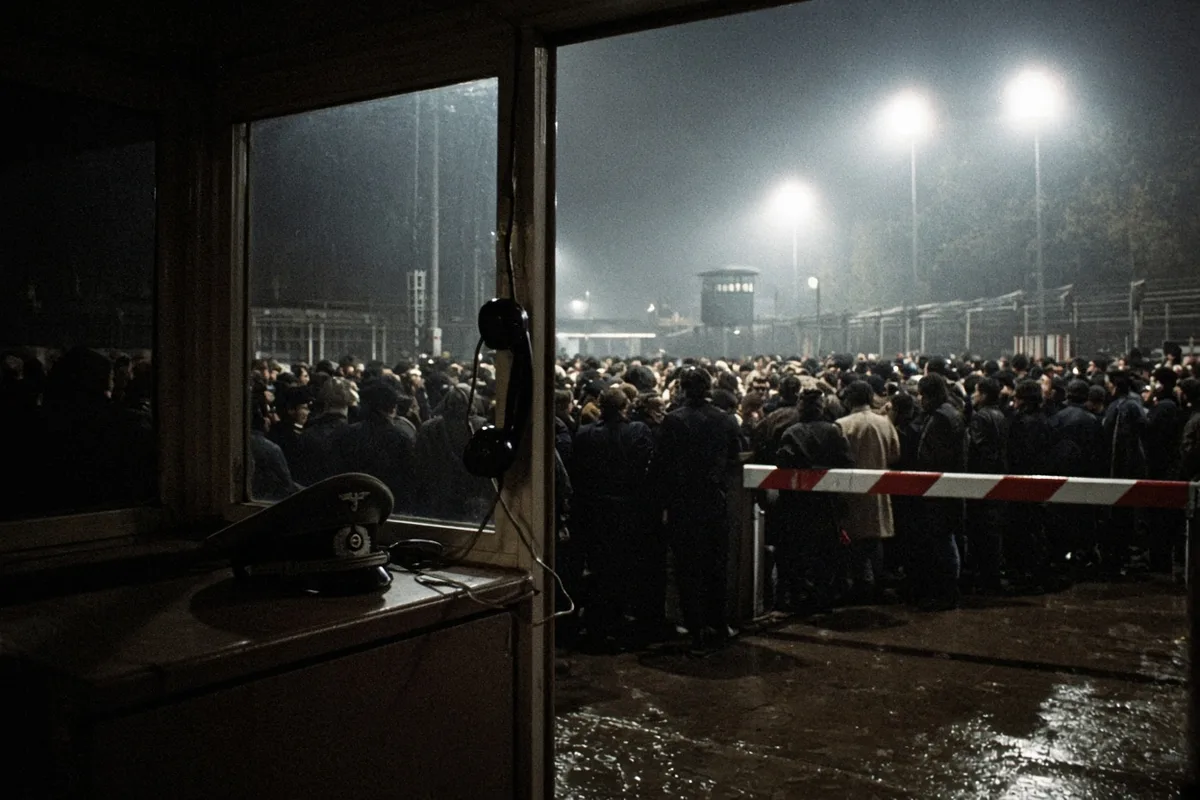
I want to tell you what that looked like, though I am not sure language holds it well. The gate went up, and the crowd did not so much walk forward as pour, the way grain pours from a torn sack, fast and total and impossible to slow. Twenty thousand people crossed the Bösebrücke bridge in the hour that followed, and no one checked a single passport. We simply stood aside. I remember an old man near me, in uniform, lowering his rifle without being told to, the way you set down something you have carried so long you have forgotten it has weight.
The sound on the far side reached us before the people did — a roar rising from West Berlin, car horns, human voices, something like a stadium at the moment of a winning goal, except it did not end after a moment. It went on. It went on for hours. West Berliners had gathered at the crossing point once word spread — and word spread fast, because the West German broadcast had already told half the city that the border was open, so that watching the news become true was, for many of them, the whole experience of that night — and they stood there with bottles of sparkling wine, arms open, weeping in a way I had only ever seen at funerals, except this was the opposite of a funeral.
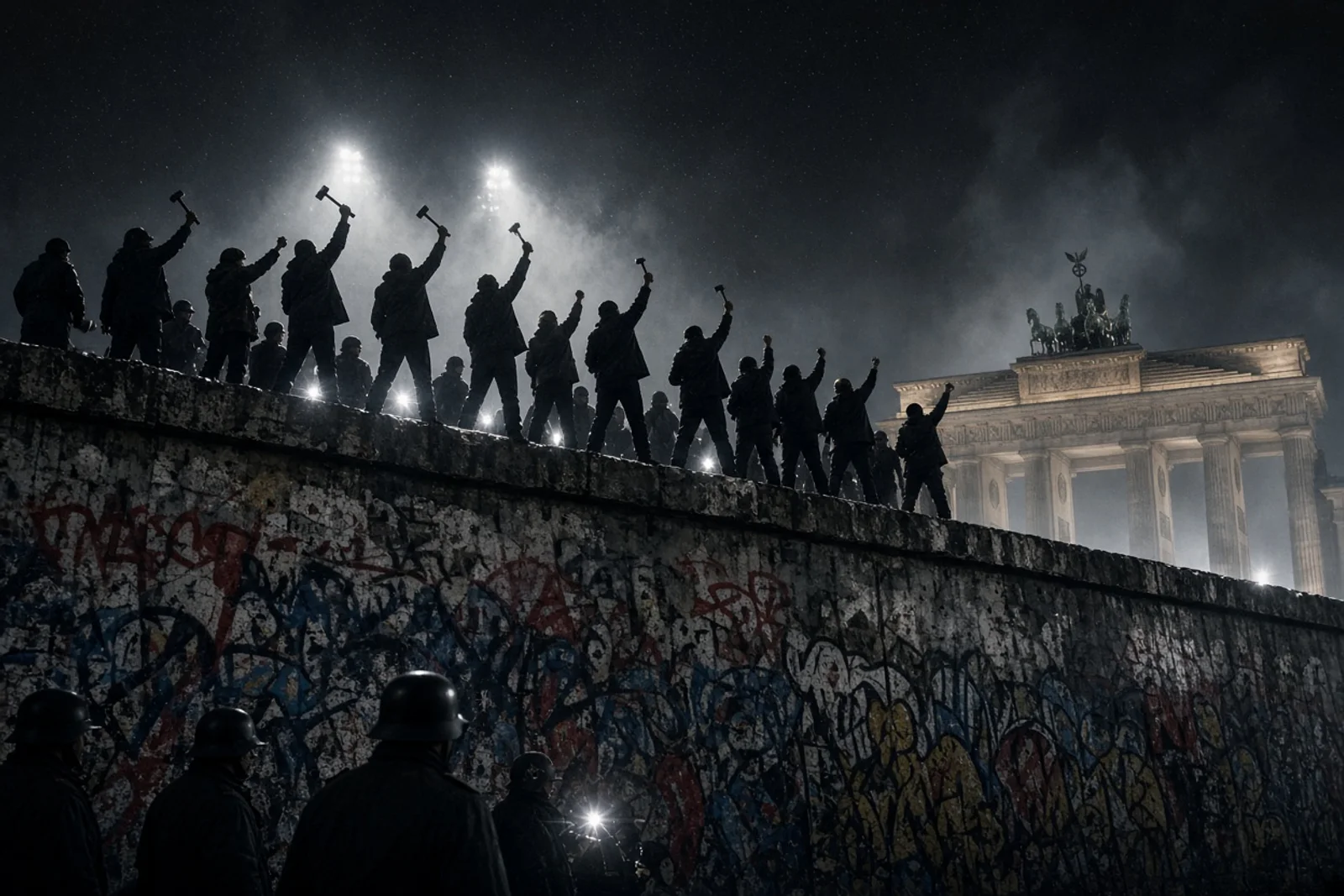
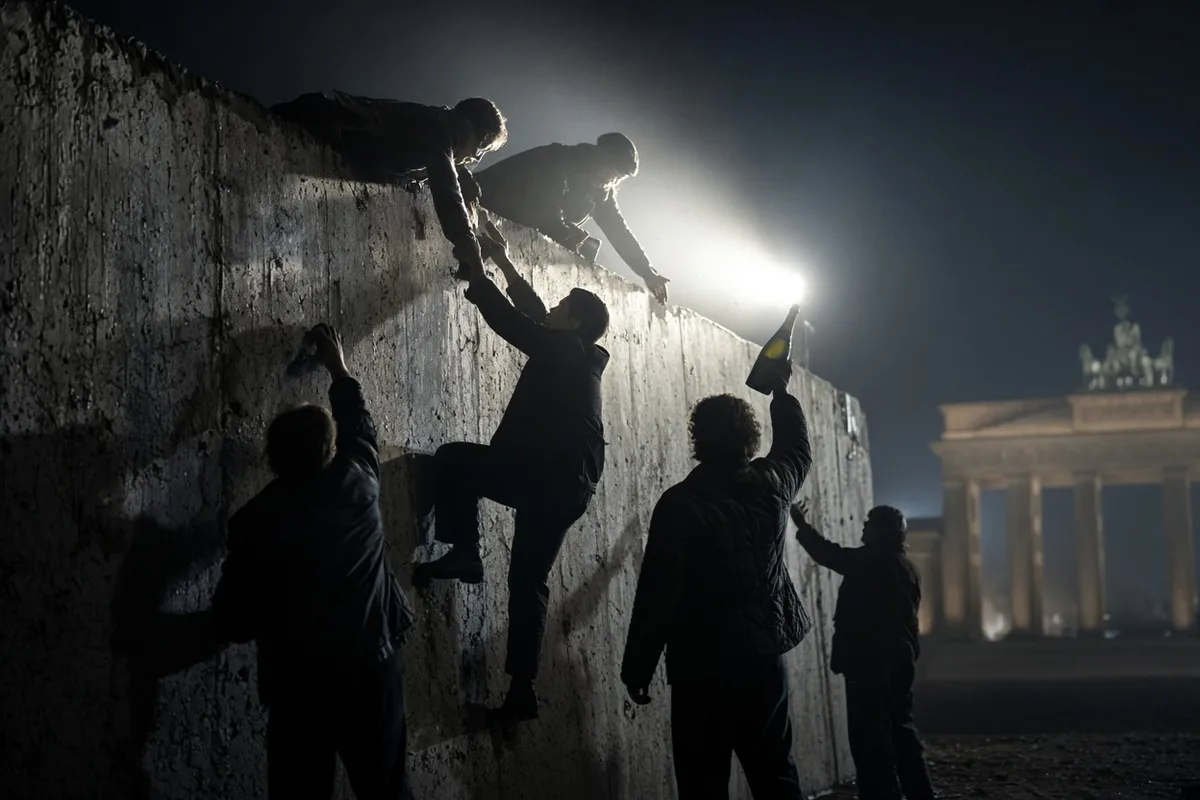
I crossed the bridge myself sometime after midnight, on a pretext I no longer remember clearly, and stood for a moment amid people I had spent my working life keeping apart from one another. A woman near the western railing kept saying a single word over and over, unbelievable, unbelievable, to no one and everyone. Someone had climbed onto the Wall itself near the Brandenburg Gate — that would come more fully two nights later, though even that first night people were finding ways up onto the concrete, finding footing on ledges that had never been meant to hold weight — and from a distance I could see silhouettes against the floodlights, arms raised, small black shapes against all that white glare, dancing on the thing that had stood between us for twenty-eight years.
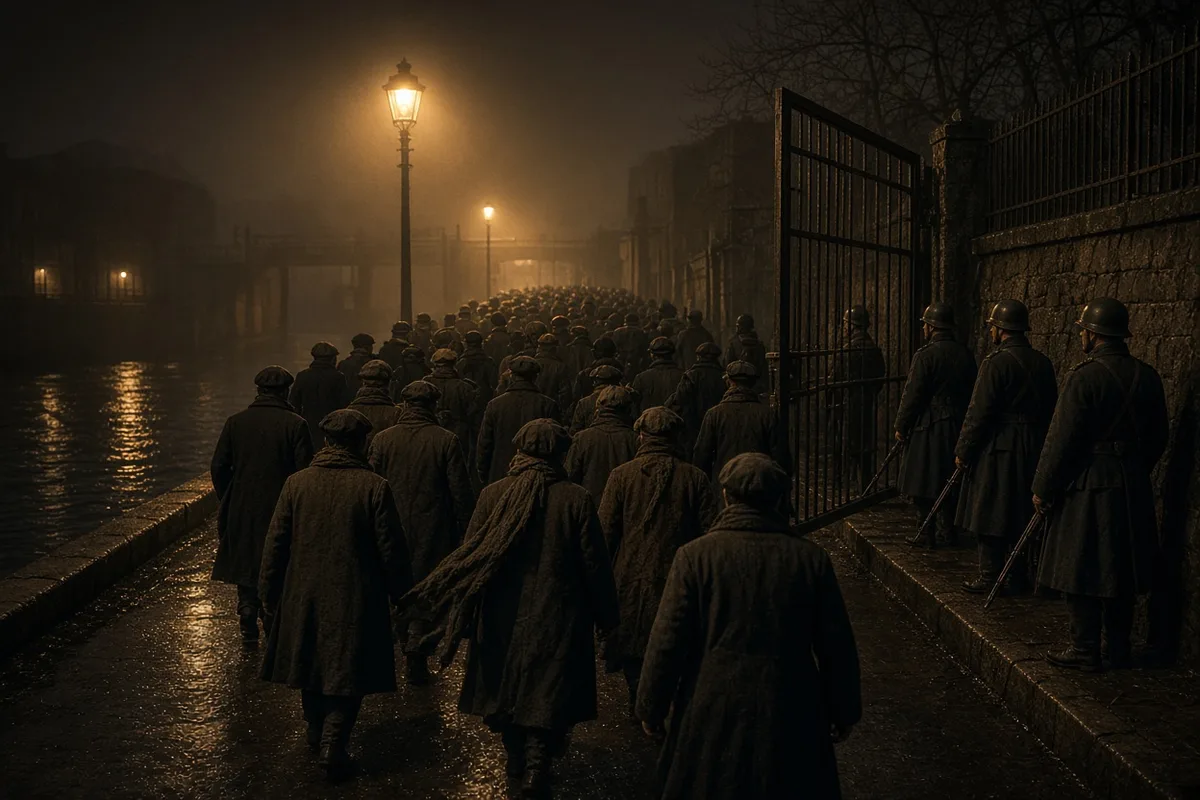
Twenty-eight years. I had been a child when the barrier first went up in August of 1961, too young to understand what was happening except that certain streets no longer led anywhere, that certain relatives stopped visiting, that the word West became something spoken carefully, if at all. I grew into a job guarding that same barrier without ever quite deciding to. It is strange, standing at the end of something, to realize how much of your life was spent maintaining what turned out, in the end, to depend on so little — a rushed answer at a press conference, a tired man's decision not to make one more phone call.
Because that is what it was, in the end, however much larger history stood behind it. Mikhail Gorbachev had spent that summer speaking of a common European home, telling reporters after his visit to Bonn that nothing under the moon was permanent, words that drifted back to us secondhand and meant little until they meant everything. Hungary had already cut its border wire that spring, and by August East Germans were flooding through Czechoslovakia and Hungary toward Austria in numbers too large to hide, camping outside the West German embassy in Budapest until it had to close its doors. Leipzig had been marching for weeks by November, crowds so large the government dared not fire on them. All of that pressure had been building for months, quietly, underground, like water finding cracks in stone. But the night it broke through was not a plan. It was an accident of language at a podium, amplified by a television broadcast, brought to its final point by one exhausted man on a bridge who decided he had absorbed enough insults for one evening.
Jäger did not sleep that night, nor I think for several after. Command did eventually call back, hours too late, with instructions on how the crossing should have been managed, orders that arrived to find the thing they were meant to prevent already finished, complete, irreversible. There is a particular kind of order that becomes comic the moment it is issued, and that was one of them.
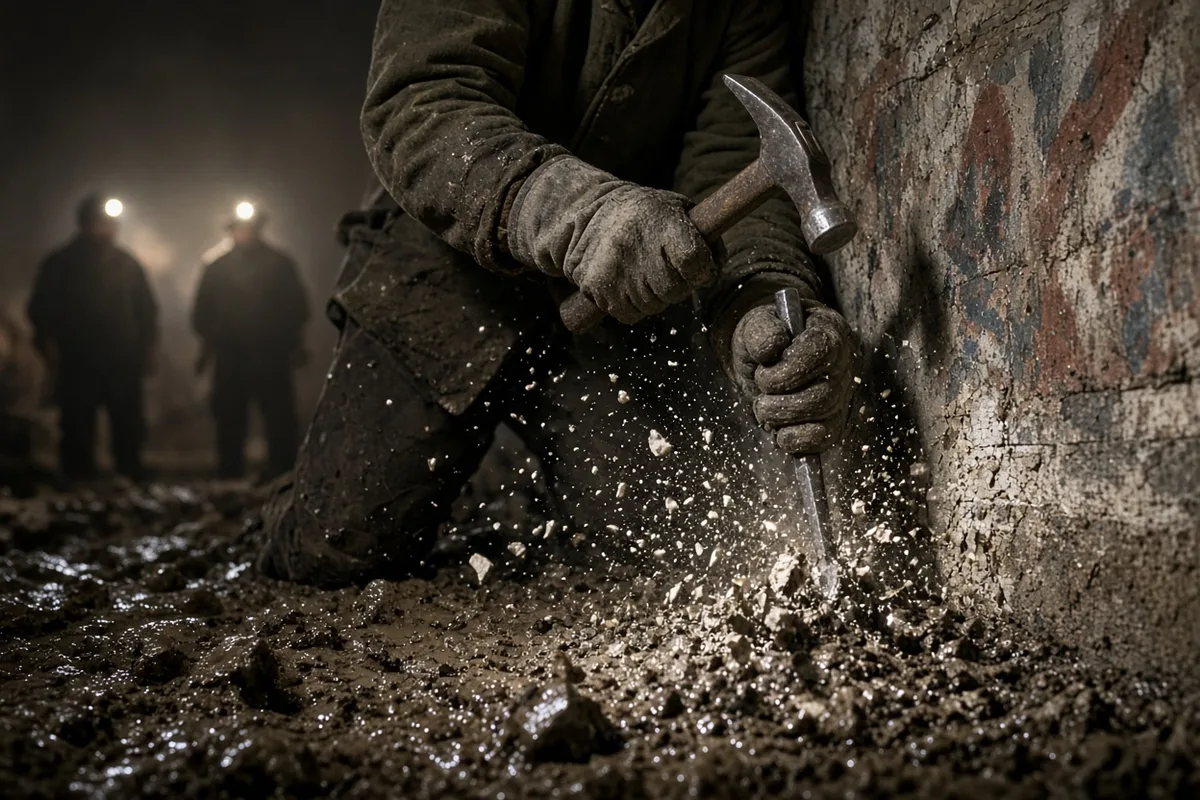
In the days after, more checkpoints opened along the length of the city, guards elsewhere following the example set at Bornholmer Strasse rather than any directive from above. People came through with hammers and chisels, taking chips of concrete as souvenirs, and the Wall that had seemed permanent as weather began to look, within days, like something merely large — large the way a building under demolition is large, already smaller in the mind than it had been the week before.
I watched a convoy of small East German cars, the boxy Trabants everyone had joked about for years, roll across the bridge in the days that followed with West Berliners lined up along the road cheering them through as though they were athletes finishing a race. Restaurants along the Kurfürstendamm handed out drinks to anyone who came from the other side. The city, split for so long it had almost forgotten it was ever one thing, spent that winter relearning how to be a single place.
The Brandenburg Gate itself did not open as a crossing until near the end of December, the twenty-second, with cold enough that breath hung visible over the crowd gathered to watch it happen, and by New Year's Eve people were standing on top of the Wall itself to watch fireworks over a Berlin that no longer had two halves in any way that mattered.
I think sometimes about the stamp Jäger ordered pressed into those first passports that night, the one meant to expatriate people without their knowledge, a small cruelty built into a system already collapsing around it. Within hours it meant nothing. Within a generation, most of the people who received it had probably forgotten they carried it at all, the ink fading the way so much of that old apparatus faded — not with a single dramatic ending, but through thousands of small refusals like the one made on a bridge by a man too tired and too angry to wait any longer for permission.
I still walk sometimes along the stretch where the checkpoint used to stand. There is little to mark it now — a line of cobblestones set into the pavement where the Wall once ran, easy to miss if you are not looking for it, easy to step over without feeling anything at all. But I remember the particular cold of that November night, and the sound the crowd made when the barrier finally lifted, a sound less like celebration at first than like a very long breath finally let out.