


The Candy Bomber of the Berlin Airlift
I felt the flour dust before I heard the engines, a fine white grit that got into everything — my collar, my coffee, the crease of my knuckles. We loaded sacks by hand onto pallets at Rhein-Main that summer of 1948, and by the time a C-54 taxied out you could see a man's handprints on the fuselage like he'd been kneading bread instead of stacking cargo. Berlin needed everything: flour, coal, dried milk, medicine. The Russians had shut every road and rail line into the city that June, cut the barges on the canals too, and told the world that two and a half million people in the western sectors could just do without. Nobody in Washington or London believed we could feed a city from the air. We were about to find out.
I was ground crew, later worked cargo runs myself, based first at Rhein-Main and then up at Wiesbaden and out to the little strip at Zeppelinheim where a lot of us bunked in whatever was standing — tar paper shacks the Germans had built for forced laborers under Hitler, and one pilot I knew slept in the attic of an old farmer's barn because there wasn't a bed to be had anywhere else. We flew and worked in shifts that didn't know day from night. Three round trips to Berlin in twenty-four hours was normal, then seven hours to sleep if the weather let you, then back into it. Ice on the wings in October. Fog so thick a man swore he could feel it inside the cockpit glass. We were feeding a city that not three years before had been the capital of the country trying to kill us, and there wasn't much time to think about the strangeness of that, not with the flour sacks stacking up and the engines never really going cold.

Halvorsen came through in early July, one more transport pilot among hundreds, a lieutenant who'd left a new red Chevrolet parked under a tree back at his base in Mobile, Alabama, with less than an hour's notice to report. He told it later like a joke — how he figured he'd be back in a couple of weeks, how he never even sent for the car, how it just sat there under those Alabama trees until somebody else's problem. He'd grown up on a farm in Utah watching yellow training planes pass overhead and wanting up there with them, got his pilot's license before the war, trained fighters with the RAF, then got shuffled into transports when the fighter slots filled up. By the time the Berlin call came he'd flown supply routes over half the world and settled into believing his flying days would be routine from here on. Nothing about routine was waiting for him in Germany.
I first heard his name the way most of us did on base — not from a briefing, but from talk in the mess about a pilot who'd been seen out at Tempelhof on his time off, standing at the barbed wire fence with a crowd of children.
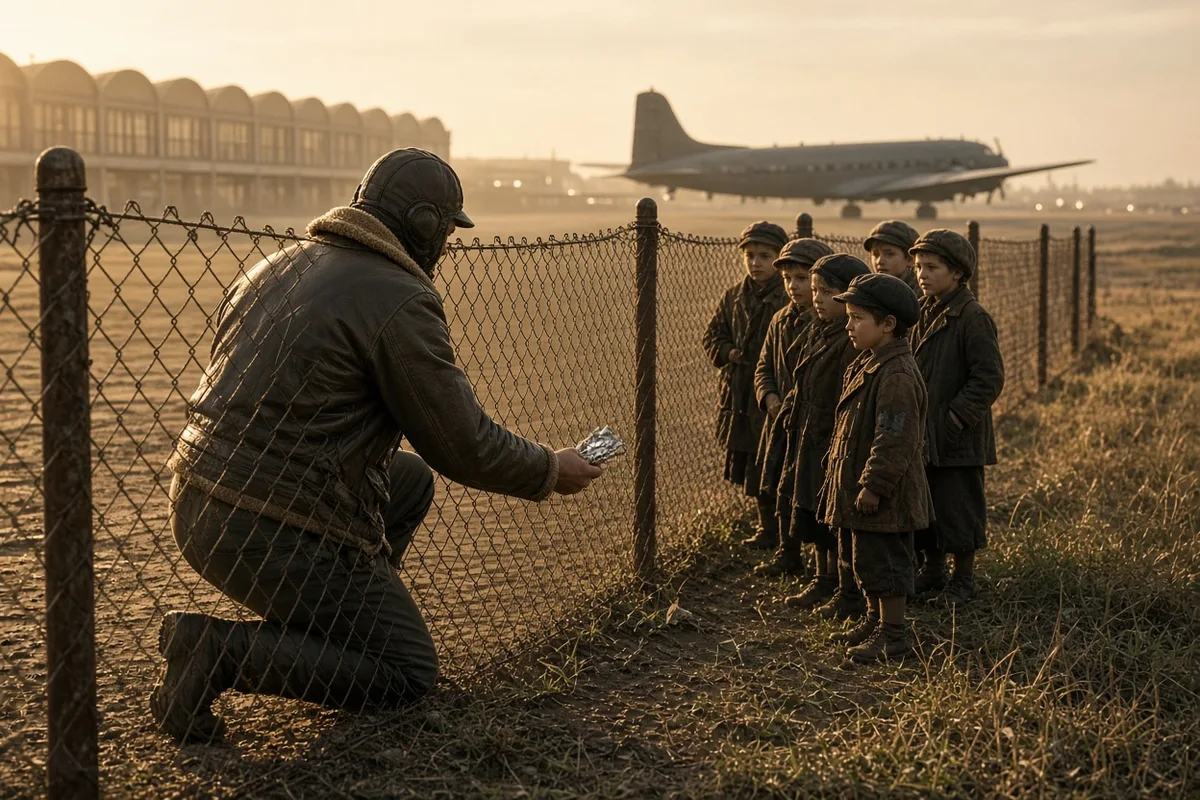
It happened on one of his rest stretches in the middle of July. He'd hitched a ride into the American sector just to see the city he'd been flying into blind, night after night, without ever really looking at it. At Tempelhof he found a gap in the fence where kids gathered to watch the planes land, and he went over, the way he always did around children — he'd been chased by begging kids overseas before, knew the routine, expected the usual noise and grabbing hands. Instead he found something quieter. These children weren't asking for anything except one thing: that the flights keep coming, even when the weather turned bad, even through the winter everybody knew was coming. One of them told him they could do without enough to eat for a while. Losing their freedom was different — that, they said, they might never get back.

He had two sticks of gum in his pocket. He broke them as many ways as gum can be broken and passed the pieces through the wire, and even that small thing nearly started a stampede of grateful children fighting over crumbs of foil and Juicy Fruit. He told them to wait — tomorrow, he'd bring more. They asked how they'd know his plane apart from all the others thundering into Tempelhof around the clock. He said he'd wiggle the wings. Just watch for that.
Back at the barn that night I heard he sat working with what he had — handkerchiefs from his own bag, string, whatever chocolate and gum his crew could scrounge from the commissary — tying little parachutes by hand, corner to corner, string to candy bar, the way a boy ties fishing knots. It wasn't complicated. It wasn't supposed to be more than a kindness paid once and then forgotten.

I watched him rig two or three of those little chutes myself before that second flight, sitting on an upturned crate with his knees together, working the knots slow and careful like it mattered whether they held. He didn't say much about why he was doing it. He didn't have to. Everybody on that ramp who'd flown low over the ruins of Berlin — the flattened blocks, the burned-out shells of buildings that used to be somebody's home — carried some version of the same ache, whether or not we'd ever stood at a fence and had a child tell us not to abandon them.
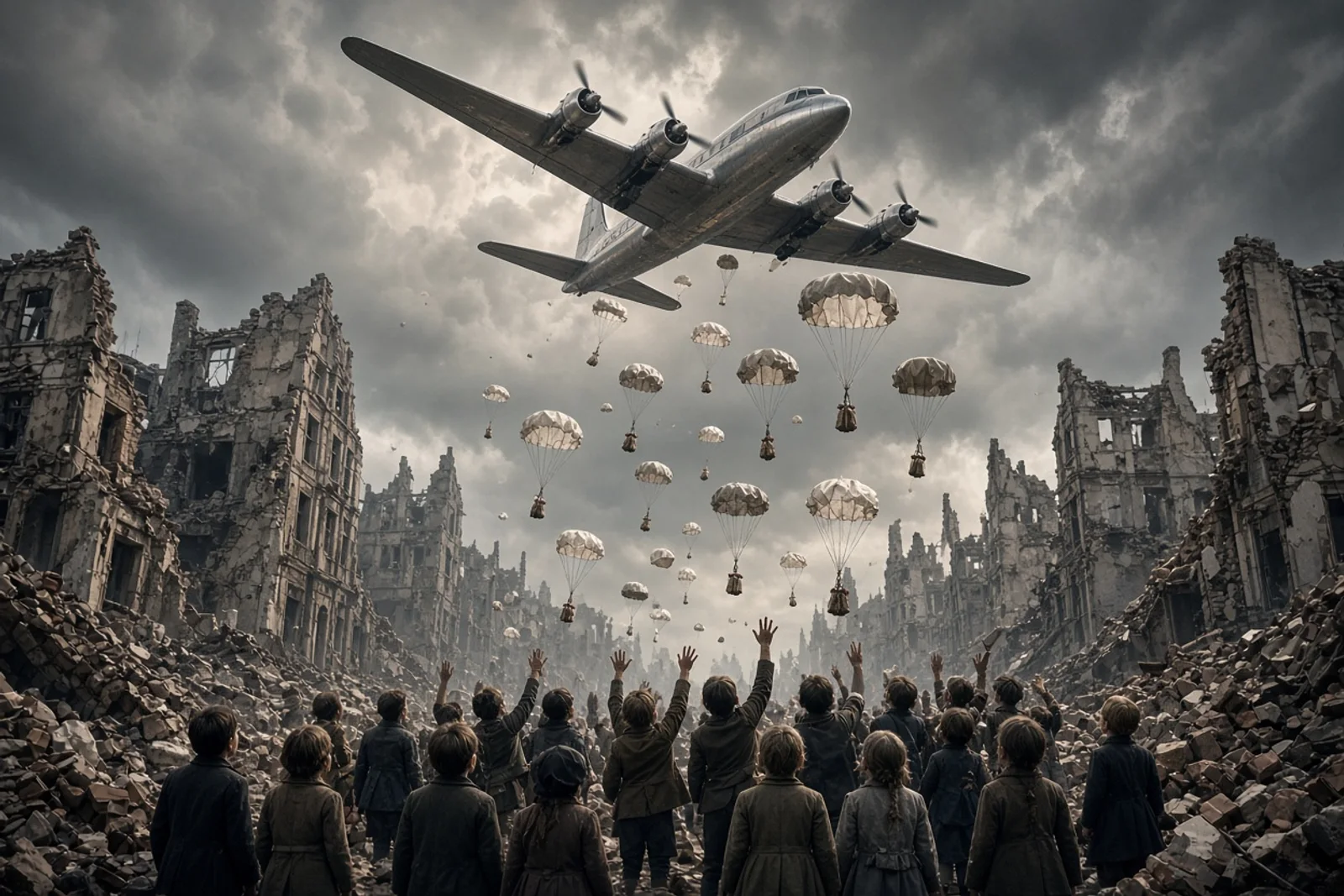
The next day he came in low on his approach the way he always did, and at the last stretch before touchdown he rocked the wings, once, twice, and let the little parachutes go out the flare chute. From the ground you could see them catch the air and drift, white against all that gray rubble, and you could hear — even over engine noise, even from a distance — kids shouting and running under them like it was Christmas morning dropped straight out of the sky.
It grew faster than anybody planned for. Word got around Tempelhof, then around Berlin, the way word does among children who have almost nothing else to talk about. Within a couple of weeks Halvorsen was getting mail — actual letters, addressed care of the base, to "Uncle Wiggly Wings" and "The Chocolate Flier" — from kids who couldn't have known his real name if they tried. He hadn't cleared any of it with anyone above him. It was, plainly, against regulation to be dropping objects from military aircraft over a foreign city, however small and however sweet, and when his commanding colonel found out, Halvorsen got called in and given the kind of talking-to a man remembers for the rest of his life.

But by then the Berlin papers had the story, and stories like that don't stay contained by a colonel's office door. It reached General William Tunner, who was running the whole airlift by that point, a man not known for sentiment when it came to operational discipline — and Tunner looked at what was happening and decided the thing wasn't a violation so much as it was, in its own small way, doing exactly what the airlift itself was supposed to do. He let it stand. More than that, he let it grow. What had started as one lieutenant's handkerchiefs became something with an actual name: Operation Little Vittles, running alongside Operation Vittles itself, the official codename for the whole massive feeding of the city.
I started seeing it everywhere on base after that. Men who'd never given a child a second glance were suddenly hoarding their PX candy rations, sitting around at night after their shifts tying string to handkerchief corners with the same care Halvorsen had shown that first evening. Twenty-five men in his squadron alone were doing it before long, and it kept climbing from there. Somebody's commanding officer back home — I heard it was Halvorsen's original base — put out word that any handkerchief spotted on the premises was liable to be requisitioned for Little Vittles, and I don't think a single man objected.

Then the candy itself started arriving in quantities no crew's commissary allowance could account for. The American Confectioners Association got wind of what was happening overseas and began shipping candy by the ton, more chocolate than any of us could have tied into parachutes ourselves even working around the clock. It landed at Westover Air Force Base out in Chicopee, Massachusetts, and there, schoolchildren — kids who'd probably read about the whole thing in their local paper — sat down at tables and tied the little chutes themselves, hundreds and then thousands of them, packing them into crates bound back across the Atlantic to feed straight back into the operation that had started with two sticks of gum through a fence.
There is something about that loop that still catches me when I think of it. American kids in Massachusetts, tying string to candy for German kids in Berlin, four years after Berlin had been the enemy's capital and Massachusetts boys had been dying to bring it down. Nobody planned that as a message. It just happened, the way the whole thing had just happened, one gesture answering another until it built into something bigger than anyone at Tempelhof that first afternoon could have imagined.
By January of 1949, the count stood near a quarter million parachutes dropped over that city — two hundred fifty thousand small white silhouettes drifting down out of C-54s that were also, in the same hour, hauling coal and flour and dried milk to keep two and a half million people from starving or freezing through a blockade the Soviets had bet the West wouldn't have the stomach to break.

I flew my own runs that winter same as always, watched fog close over the Rhein-Main runway like a hand closing, watched ice form on leading edges at altitudes where it wasn't supposed to form so fast. The candy drops were a small thing set against tonnage figures that ran into the millions over the length of the airlift, small against coal dust and frozen fingers and pilots who didn't come home from bad weather. But small things, in a place stripped down to its studs the way Berlin was that year, carry more weight than they would anywhere else. A child standing at a fence doesn't measure hope in tons. She measures it in whether the plane with the wiggling wings comes back tomorrow the way it came today.
One of those children, grown decades past that winter, told Halvorsen once that it hadn't really been about the chocolate at all. It was hope, she said. That was the whole of it — not the taste, not even the getting, just the proof, repeated and repeated through a year of fear, that somebody on the other side of that fence hadn't forgotten they existed.
The blockade broke in the spring of 1949, the Soviets lifting it in May after eleven months of watching the airlift do exactly what they'd wagered it couldn't. The planes kept flying supplies for a while afterward, building up a reserve against the chance the roads might close again, and then, gradually, the tents came down and the barn attics emptied out and men like me started thinking about home in a way that felt almost unfamiliar after so long living by engine schedules instead of clocks.
Halvorsen rotated back to the States eventually, though Berlin never really let go of him, and he never really let go of it either — he'd return to the city again over the years that followed, an old man by then to the children who remembered him young, the ones who still called him by the name they'd given him at the fence. He lived to be a hundred and one, and when his hundredth birthday came around in October of 2020, cards and video messages arrived from grown men and women in their eighties who'd once run beneath a drifting handkerchief on a strip of cracked pavement at Tempelhof, still calling him Uncle Wiggly Wings after seventy-two years, still remembering exactly what it felt like to watch a stranger's wings dip toward them out of a gray sky and mean, unmistakably, that someone was coming back.
I think about the ramp at Rhein-Main sometimes still, the flour dust on my hands, the drone that never fully stopped for fourteen months. But mostly I think about that first afternoon nobody planned — two sticks of gum broken into pieces small enough to share, a promise made through barbed wire, and a whole operation growing up around a man's decision to wiggle his wings instead of just flying past.