


The Christmas Truce of 1914
The frost had come down hard by the time the light failed, and my knees ached from three days of standing in water that had frozen thin skins at the edges of the duckboards. I was a private with the rifles somewhere along that low stretch of Flanders clay, close enough to Ploegsteert that the men called it Plugstreet, and by Christmas Eve I had stopped believing the war would end the way the newspapers had promised in August. Six months. That was all it had taken to turn certainty into a joke nobody bothered to finish anymore.
We had our tins. The King and Queen had sent them round weeks before, brass boxes stamped with the profile of Princess Mary, and inside mine there was chocolate gone slightly soft, a twist of tobacco, and a printed note wishing that God would protect us and bring us home safe. I kept the note folded in my breast pocket next to a photograph, not because I believed in its promise but because paper felt like something to hold onto when the ground itself kept trying to swallow your boots.
Word had come along the line that the Germans opposite had received gifts too, cigars from the Kaiser for their officers, pipes for the men, and I remember thinking it was strange to imagine them opening parcels forty yards away while we opened ours, both sides chewing the same kind of homesick chocolate under two different flags.

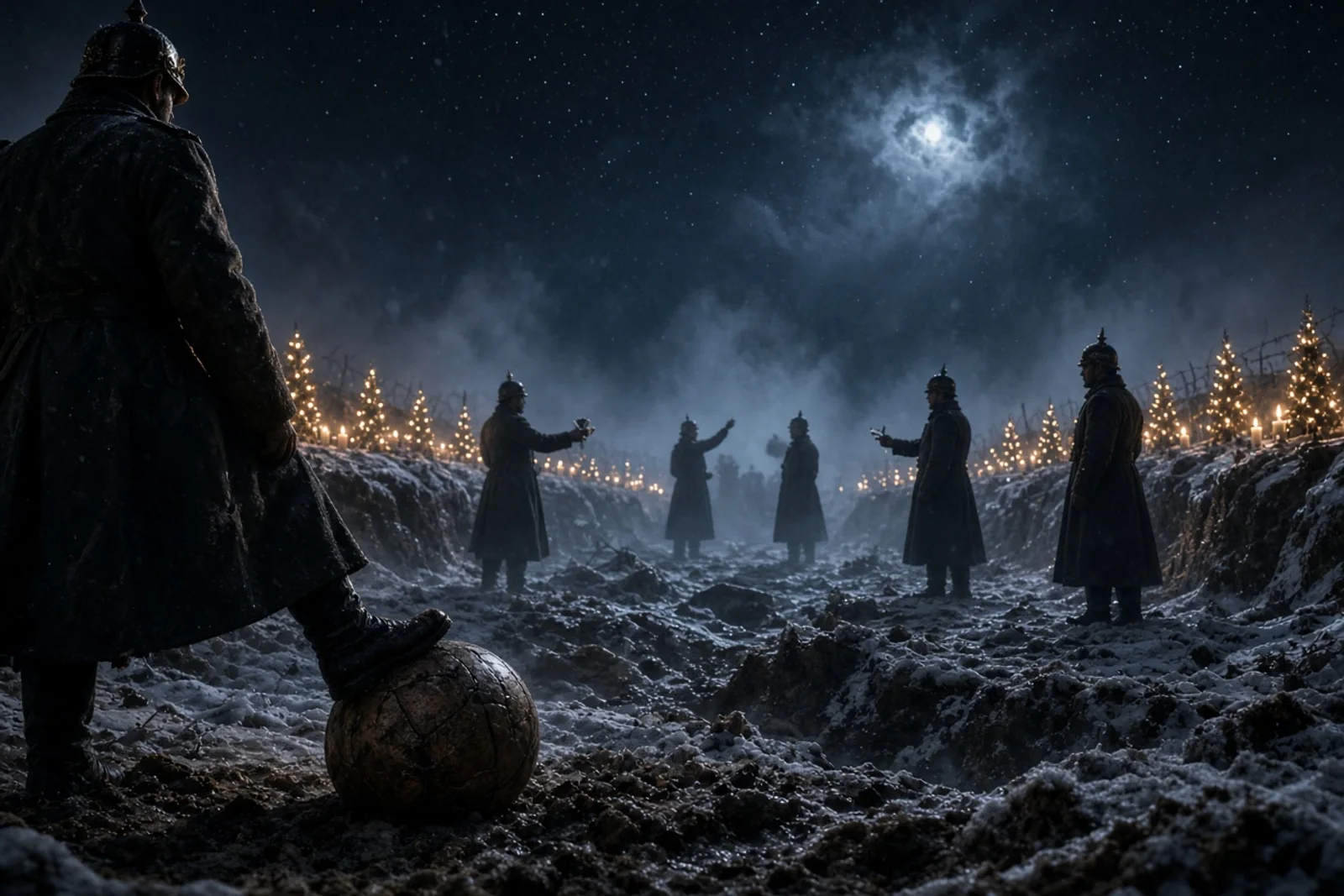
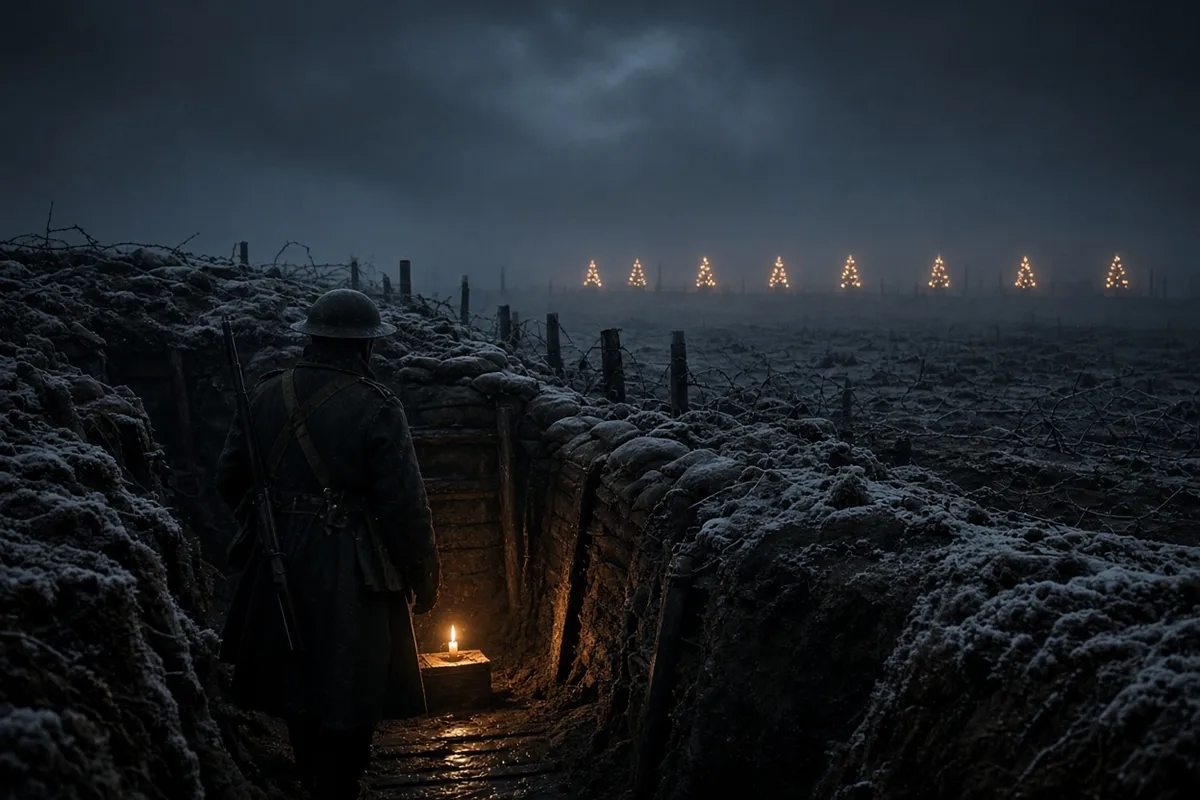
It was Rifleman Graham Williams, on sentry near me that night, who saw it first. Lights, small and trembling, strung along the top of the German trench where there should have been nothing but sandbags and darkness. He called it a funny thing, and it was, because for a moment none of us could work out what we were looking at. Lanterns. Little fir trees, some of them, set up along their parapet like a street of shopfronts closing for the holiday. Then the voices started.
Stille Nacht. Heilige Nacht. It came across no man's land thin and clear in the cold air, and every man who'd been dozing on the fire step was suddenly awake and pressed against the cold earth, straining to listen. Nobody fired. That in itself felt like the strangest thing, the guns simply silent while a hymn drifted over ground that had been killing men by the dozen only days before.
When they finished, we clapped, actually clapped, out there in the mud, and then somebody decided we ought to answer in kind. We gave them The First Noel, ragged and off-key, and when we finished there was a pause and then, unmistakably, applause coming back from their side. Carols went back and forth after that, English and German alternating, until the shouting started, men calling out across the gap in whatever fragments of each other's language they could manage, testing whether the goodwill in the singing might hold if put to a plainer kind of use.
Further along, near Armentières, a young officer named Scott Shepherd was dealing with a different kind of gift from the weather. Christmas morning came in behind a fog so heavy that a man could lose his own hand in front of his face, and the order went along his section to use the cover for trench repair, filling sandbags, shoring up a parapet that had been slowly dissolving under weeks of rain. Then the fog lifted, and lifted fast, the way weather sometimes does when it has made its decision, and there in plain view were German soldiers doing exactly the same work, out in the open, spades in hand, staring back at men staring at them.

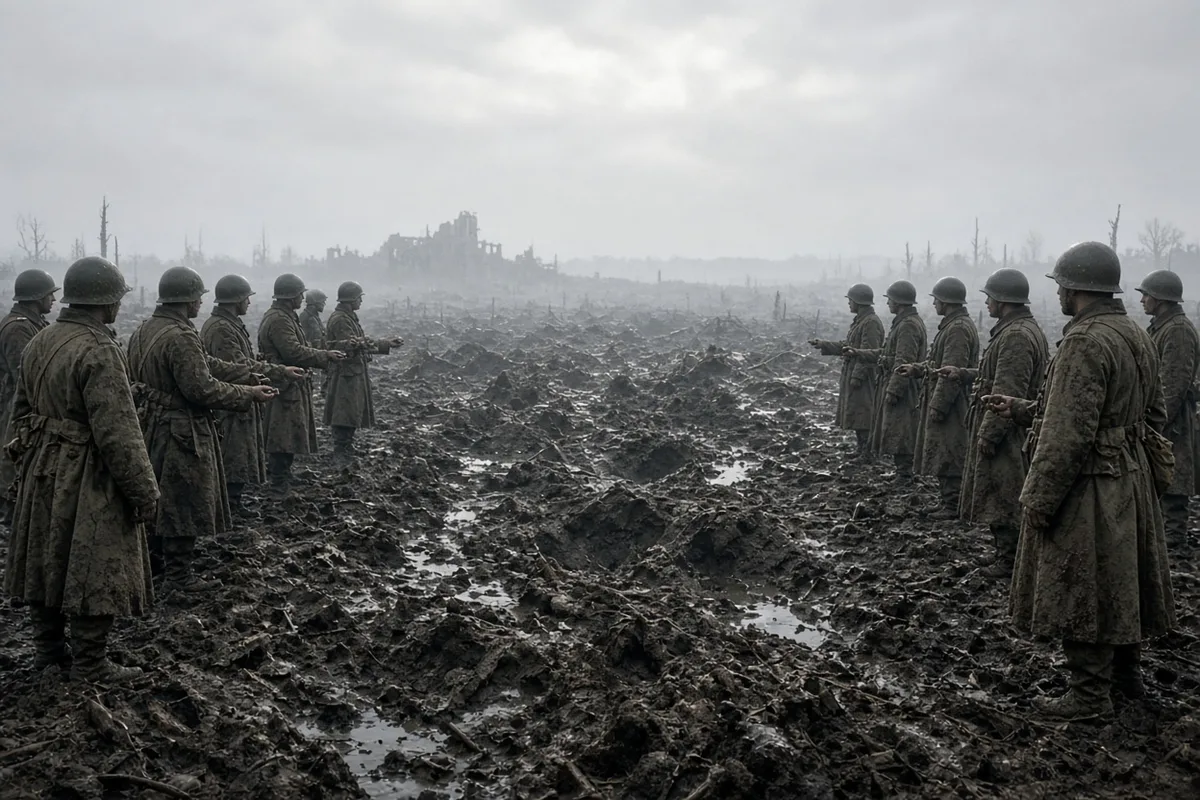
Nobody shot. That was the whole of it, in the first instant. Both lines simply stood there in the thin grey light with sandbags in their arms, looking at one another, and then, without an order from anyone, a few men on each side put down their tools and started walking.
They met somewhere in the middle. Hands were shaken. Cigarettes changed pockets. And from that first meeting, up and down long stretches of the line, the standstill spread the way word spreads in a crowd, one man calling to the next.
General Walter Congreve, who commanded the brigade near there, wrote to his wife that same day, calling it an extraordinary state of affairs, and it was, because the trenches ran close enough in places that men could simply shout across and be heard. A German called over asking whether one man would come out if he did, and Congreve described how cautiously, almost comically slow, one of ours lifted himself above the parapet, and saw a German rising to meet him in the same careful way, both of them waiting for the shot that never came. Then they climbed all the way out. Then more followed. By his account they were walking about together the whole day, trading cigars, singing.

In my own stretch of the line, we came out not long after the carols ended and the grey morning proper set in. The ground between us, the churned strip we had learned to call no man's land as though it belonged to nobody living, was suddenly full of men in two different colours of coat, breath steaming in the cold, none of them carrying a rifle raised. It felt unnatural to stand upright without hunching. I hadn't realized how much my back had learned to bend from months of keeping low.
We swapped what we had. Cigarettes for cigarettes, our tobacco for their cigars, buttons cut from coats, badges, the little metal insignia that a man wears without thinking about until a stranger offers to trade for it. Someone produced a camera and there was a scramble to arrange men shoulder to shoulder for a photograph, British and German both grinning in a way that had nothing soldierly about it at all. A group of ours came away wearing German helmets, holding them up afterward like trophies from a fair rather than the enemy's own steel.
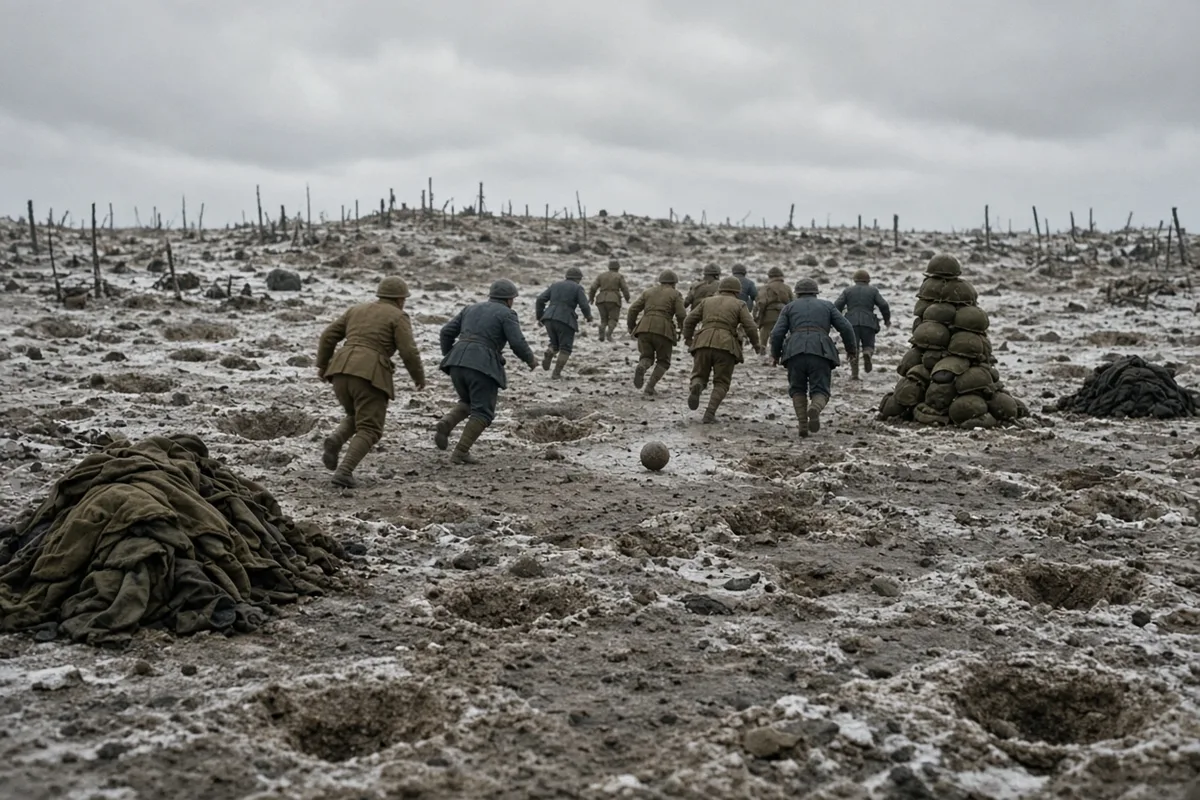
Then somebody produced a ball. I don't know exactly where it came from, whether it had been kicking around a support trench for weeks or whether some quartermaster's crate had yielded it up that morning, but within minutes there were men chasing it across the frozen ruts, slipping, laughing, playing without markings for a pitch or any interest in the score. It wasn't organized the way a proper match would be. It was closer to boys let out of a schoolroom, using whatever flat ground there was, shouting in two languages that didn't need translating for a man to understand a goal had gone in.
Not every stretch of the front saw anything like it. Along other parts of the line the guns kept firing straight through the day, and seventy-seven British soldiers were killed in action on Christmas itself, a fact that sat uneasily beside the football and the carols even as we heard of it later, a reminder that the standstill was a patchwork, generous in some places and entirely absent thirty miles along where officers held their men close and the shelling never paused.
Where it did happen, though, there was other work besides the games. Bodies that had lain out in the open for days, some since earlier actions in the autumn, were finally recoverable, and men from both sides carried their own dead back behind their lines under a truce that nobody had signed but everyone seemed to trust. Burial parties worked within sight of each other, and in places officers from opposing armies stood together at the edge of a grave, heads bare in the cold, saying words over men neither side had killed that day.
We patched what we could of our trenches too, the parapets that had slumped from the rain, and I remember a German soldier lending a hand hauling a sandbag that had slipped from a British soldier's grip, both of them working the mud together as if the only enemy either had that morning was the weather.
Not every officer welcomed it. There were men in command up and down the line who watched this fraternizing with real unease, worried that soldiers who had shared cigars and photographs with the other side would find it harder to aim at them come the twenty-seventh, that whatever had loosened in the men's resolve might not tighten back easily. Word of the standstill reached headquarters quickly, and it did not sit well there either, official displeasure filtering down through the ranks even as the truce, in places, carried on regardless.
Because it did carry on, in pockets, past Christmas itself. In some stretches the quiet held through Boxing Day, men still meeting in the open, still trading small things, before the slow return of orders and discipline pulled them back behind their own sandbags. In a few isolated places, men later said, some understanding lingered almost to the new year, an unofficial patience that nobody wanted to be the one to break.
I heard afterward what had gone on behind the lines while we stood out there in the mud. In hospitals nurses had done what they could to make the day feel like something other than another ward round; an American volunteer with the Red Cross, Mary Dexter, wrote of stitching gauze stockings for two hundred men, each one meant to carry fruit and jam and a twist of tobacco, small comforts assembled in odd minutes between duties. An English nurse named Louie Johnson remembered simple presents passed to her for the wounded, a packet of cigarettes, a scarf, nothing grand, but given with real feeling. In Berlin a nurse called Anna von Mildenburg spoke of standing among wounded soldiers with hands folded, candlelight catching on a small fir tree, singing softly a carol that asked, in words that meant the same thing in either language, for peace on earth.
None of that reached us as it happened. We only had the ground in front of us, the ball skidding over frozen ruts, and men from Saxony standing close enough that I could see the frost in their breath.
It could not last, and everyone out there in the open that day seemed to understand it even as they shook hands and posed for photographs. The war had not ended. It had simply gone quiet in places, briefly, the way a held breath goes quiet before it has to be let out again.
When the fires resumed, they resumed unevenly, some sectors easing back into hostility with almost an apology in the first shots, warning fired high before anyone aimed to kill, as though neither side wanted to be first to break faith completely. Other sections returned to shelling as if nothing at all had happened, the truce erased the moment new orders came down.
Command on both sides took the lesson seriously enough to act on it. In the years afterward, generals worked to make certain nothing on that scale could happen again, rotating units more often at Christmas, tightening discipline around fraternization, treating the memory of that morning less as a curiosity and more as a danger to be managed. It never did happen again, not like that, not with whole stretches of front standing down together in open ground.
And yet something of it persisted in smaller forms, quieter arrangements that never made the newspapers. In certain calm sectors, men on both sides settled into what became known among themselves as a live and let live understanding, brief unspoken pauses that let each side gather its dead or patch a trench without drawing fire, a kind of private truce renewed almost daily by men who had learned, that one Christmas, what the alternative felt like when it was lifted even for a few hours.
I think of it now less as a single afternoon and more as a seam running through a much longer darkness, a place where the fabric of the war briefly showed its other side, ordinary men in different uniforms handing each other cigarettes across ground built for killing them both. It did not stop the war. It did not even slow it for long. But for one cold morning, with fog burning off a ruined field and a ball rolling crookedly over frozen earth, the guns simply had nothing to say, and neither did we, except to each other.