


The Eucharistic Miracle of Bolsena
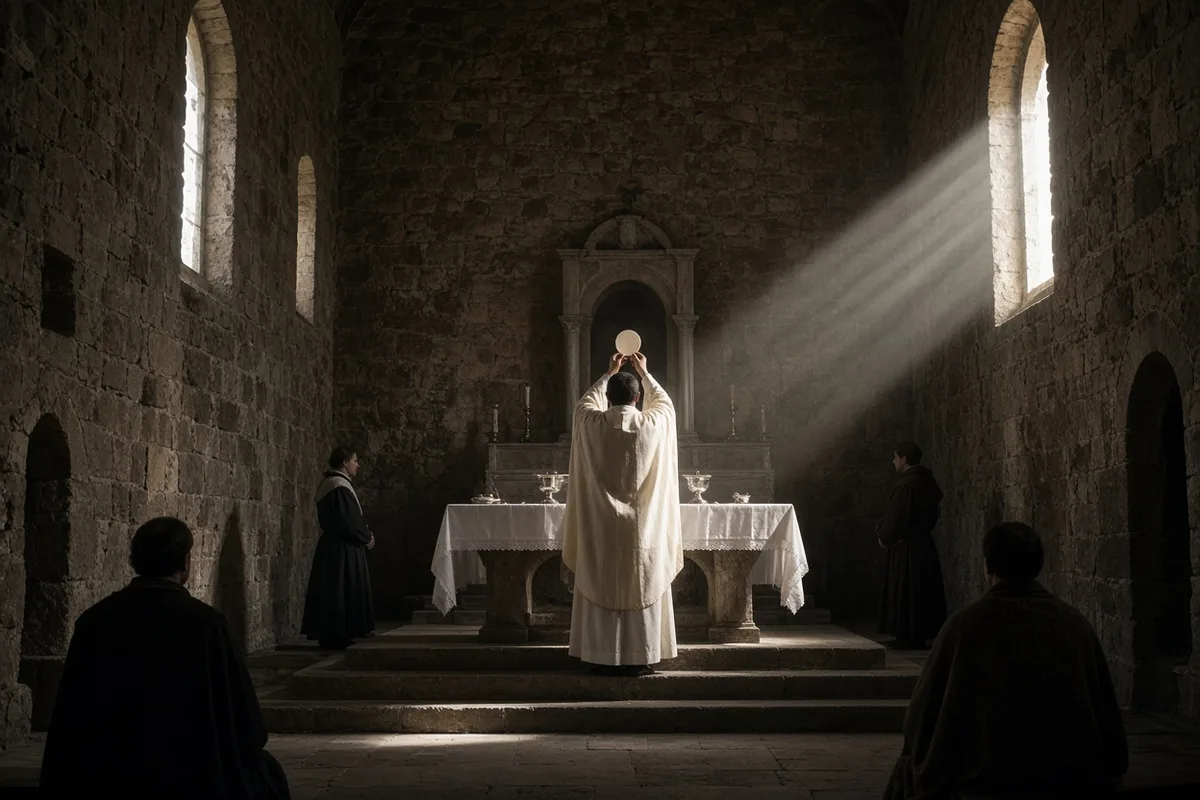
The priest's hands trembled once as he raised the host above the altar stone. I stood three rows back in the small church at Bolsena, close enough to see the linen corporal already spread beneath the chalice. Light from the high windows struck the white cloth and turned it almost silver. The nave held perhaps forty people that morning, pilgrims bound for Rome and a handful of locals who had come for the daily Mass. No one spoke.
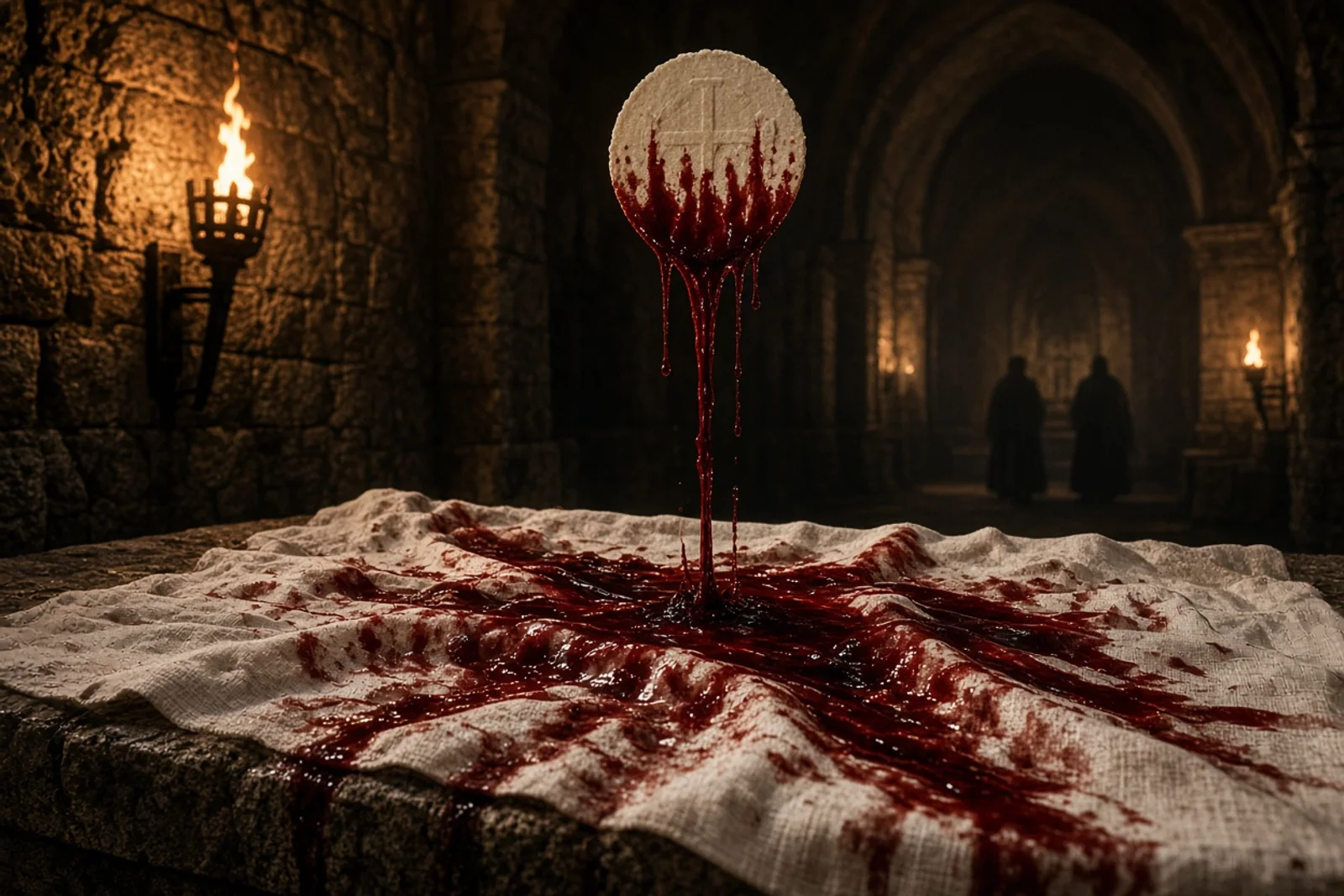
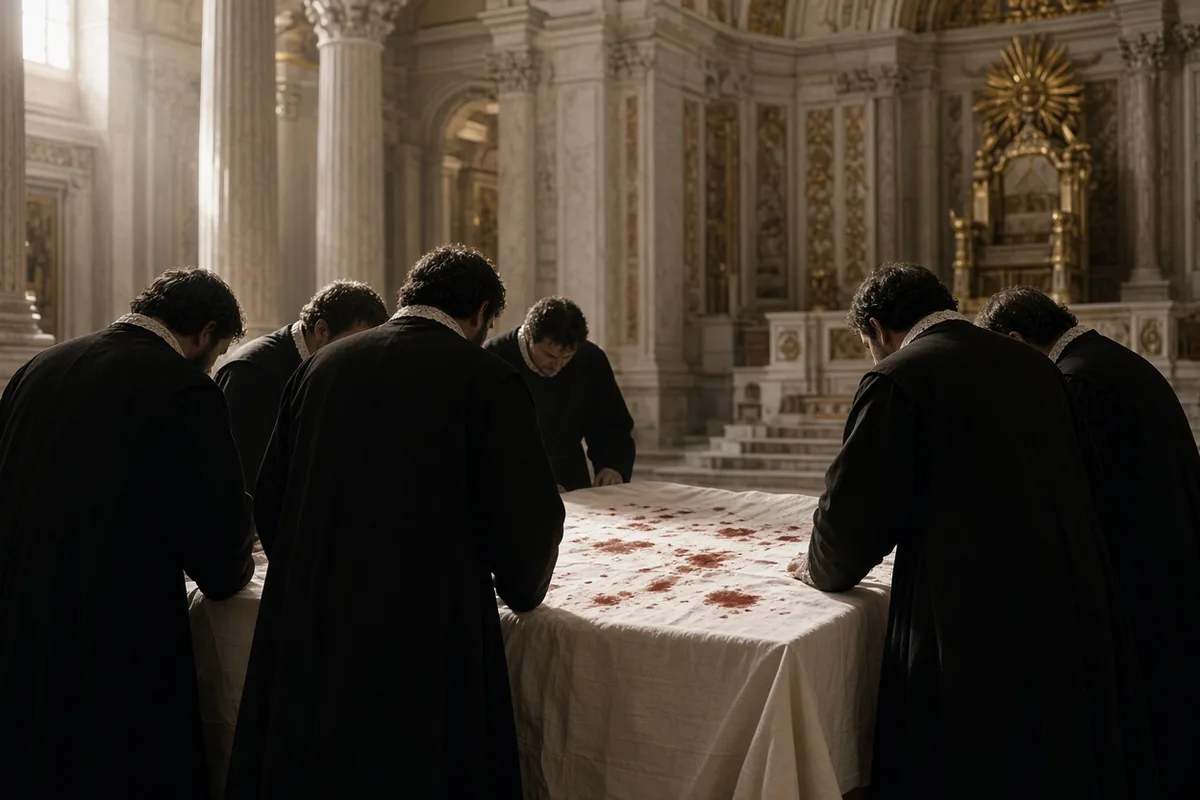
Peter of Prague spoke the words of consecration in a low voice that carried only as far as the front benches. He lowered the host. A single drop fell, dark against the linen. Then another. The drops spread, soaking outward in uneven circles that joined and darkened. Someone behind me drew breath sharply. The priest froze, the host still between his fingers, and stared at the spreading stain. Blood, fresh and red, continued to well from the bread itself and run onto his palms.

He set the host down on the corporal with care, as though it might break further. His fingers left red prints on the cloth. He turned slightly toward the congregation but said nothing. The sacristan, a thin man named Giovanni who kept the keys, stepped forward from the side and looked once at the altar, then at the priest. No one moved to leave. The smell of the blood mixed with the incense still hanging in the air.
Peter of Prague wrapped the corporal around the host with both hands. He walked down the single aisle without looking at anyone, the bundle held against his chest. At the door he paused only long enough to speak to the sacristan. Then he was gone into the street that led toward the lake road and Orvieto. The Mass ended without the distribution of Communion. People remained in their places for some time, speaking in low voices about what they had seen.

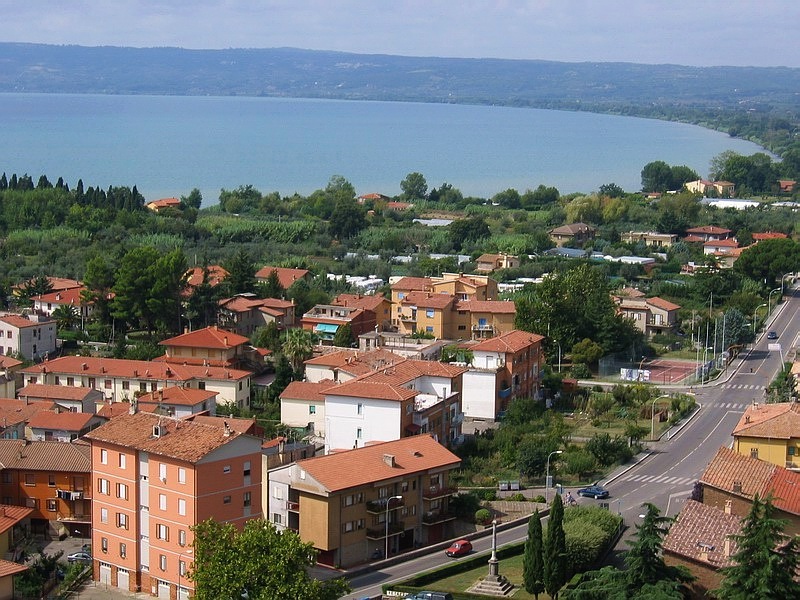
I followed the road north the next morning with two other pilgrims who had been in the church. The distance to Orvieto is not great, but the heat rose early from the volcanic stone. By midday the walls of the papal city stood above us. Peter of Prague had already reached the pope. Urban IV was living in Orvieto that summer with his court, and word of the priest's arrival spread through the narrow streets before we entered the gates.
The bishop of Orvieto was sent at once to Bolsena to fetch the corporal and what remained of the host. He returned three days later in procession, the blood-stained cloth carried under a canopy through the main square. I stood among the crowd that lined the route. The linen had been placed in a silver frame for the journey, yet the original folds and the dark stains were still plain to see. No one touched it. The bishop placed it in the chapel of the papal residence for examination.
Urban IV ordered an inquiry. Several clerics examined the corporal under daylight and by candle. They noted the pattern of the stains, how they had soaked through both sides of the cloth in corresponding places, and the fact that the blood appeared to have separated as it dried. The priest Peter remained in the city and was questioned at length. He told them he had carried doubts about the change of bread into the body of Christ and had prayed for a sign during the Mass at Santa Cristina. The examiners recorded his account without alteration.
The corporal was kept under guard. No decision was announced immediately. I found work for a time helping to carry stone for repairs on the city walls and heard daily reports from those who had access to the papal household. One of the examiners, a canon from the cathedral, said the blood could not have come from any ordinary wound because the amount exceeded what a small host could absorb without tearing. Another said only that the matter required further prayer.

Within the year Urban issued the bull that established the feast of Corpus Christi for the whole Latin Church. The document made no reference to Bolsena. It spoke instead of the need for a solemn commemoration of the sacrament. Thomas Aquinas, already in Orvieto, was asked to prepare the office and the proper texts. The corporal itself was moved to a permanent place in the new cathedral then rising on the hill.
I returned to Bolsena once more before leaving the region. The church of Santa Cristina stood quiet. The altar had been cleaned and a new corporal placed upon it. The old sacristan Giovanni showed me the exact spot on the stone where the drops had fallen. The mark remained, faint but visible, a darkening in the surface that no washing had removed.
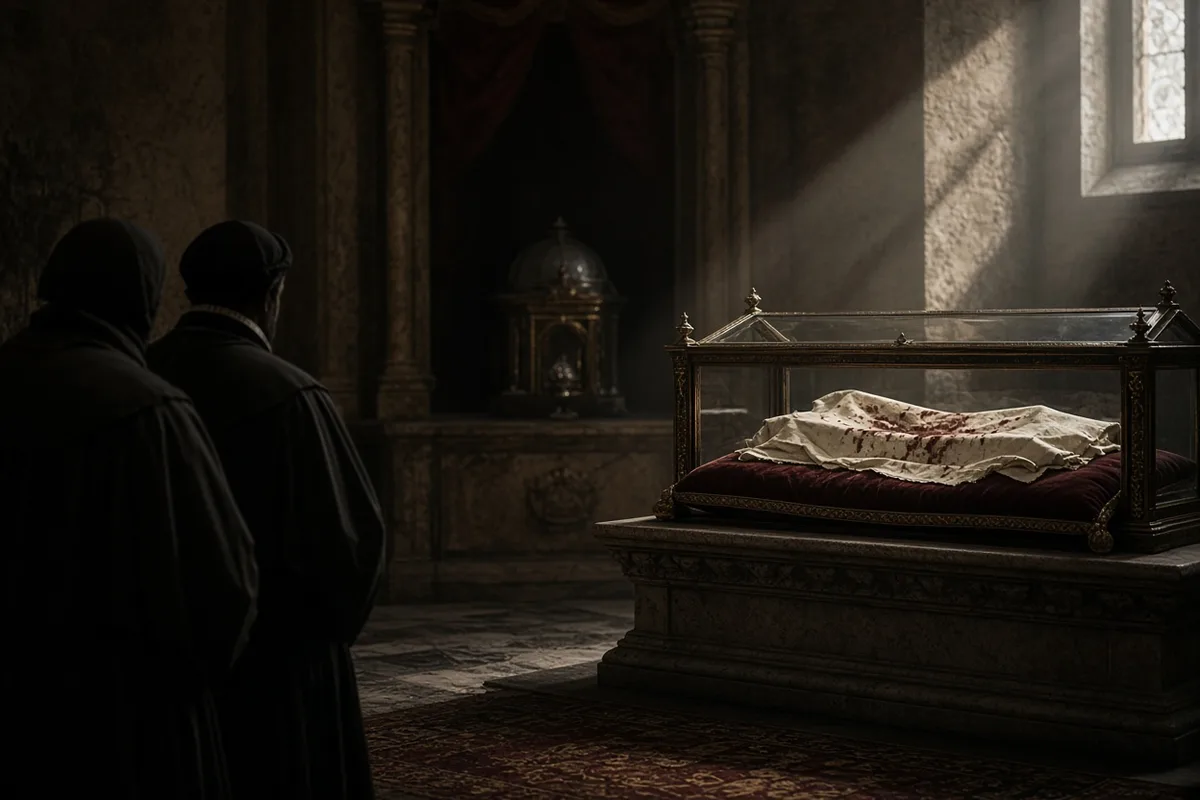
Years later the corporal rested in Orvieto under the care of the cathedral chapter. Pilgrims came from distant places to see the cloth. The reddish marks on the linen, when held to strong light, showed the folds through which the blood had passed. No further examination altered what had been seen that morning in 1263. The cloth remained where it had been placed, preserved in its silver reliquary above the altar of the corporal chapel.
The corporal remained in that silver reliquary through the winter of 1264, when the chapter of Orvieto recorded in its acta that twelve pounds of beeswax were purchased for candles to illuminate the cloth each evening after Vespers. Bishop Monaldeschi ordered a new oak chest lined with silk from Lucca to hold the reliquary during the move to the rising cathedral, whose foundations Pope Nicholas IV had blessed on 16 November 1290 with Arnolfo di Cambio directing the masons. The first stone measured three braccia square and was set at the southeast corner where the transept would meet the nave; by 1300 the walls stood twelve feet high and the accounts listed 184 workmen paid four soldi each day.
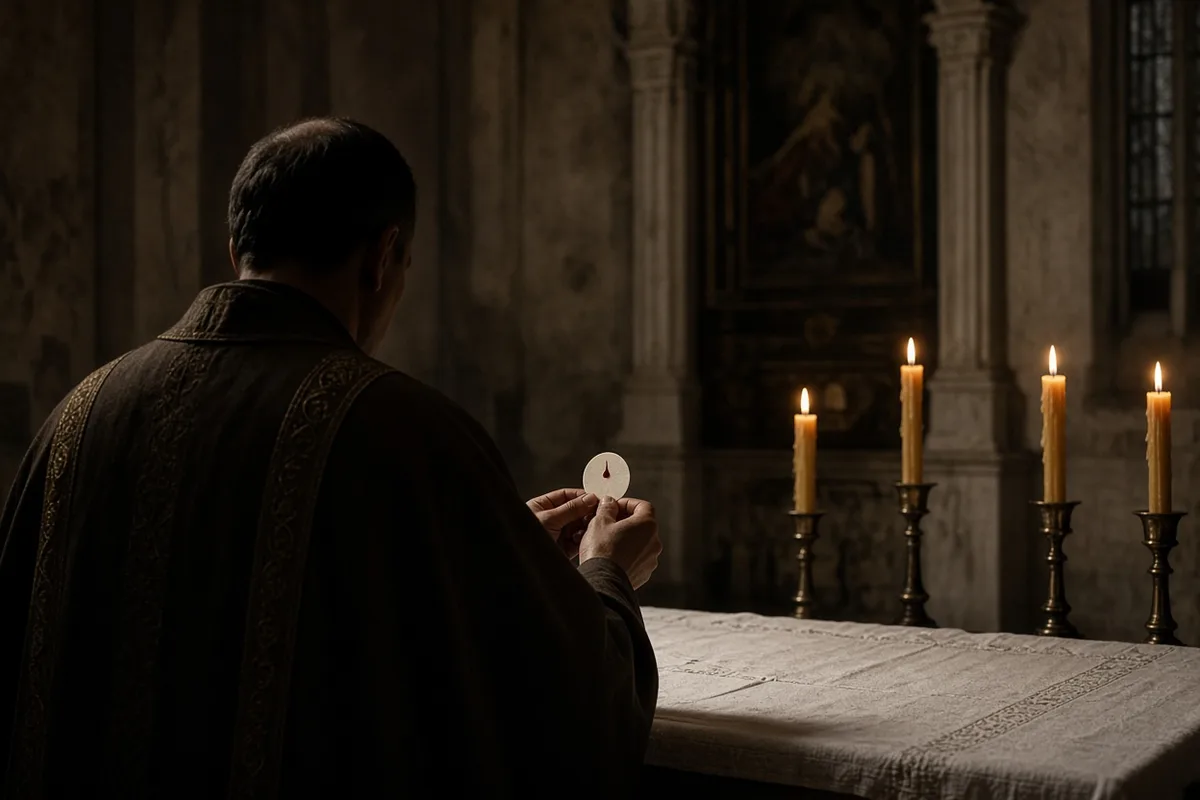
In 1337 the chapter commissioned a dedicated chapel off the right transept, thirty-two feet long and eighteen wide, its vault to be supported by four limestone columns quarried at Bagnoregio. Bishop Beltramo Monaldeschi placed the corporal inside a new gilt-bronze reliquary on 9 September 1338, the day the acta note the presence of thirty-two canons and the payment of twenty-five florins to the goldsmith Pietro di Vico for the lock and hinges. The reliquary bore an inscription stating it contained the corporal “on which the blood of Christ appeared at Bolsena in the year 1263 under Urban IV.”
Ugolino di Prete Ilario began frescoes on the chapel walls in March 1357, completing the cycle by October 1364. One panel shows Peter of Prague raising the host above the altar of Santa Cristina with the date 1263 painted in Roman numerals on the frame; another depicts the procession entering Orvieto through the Porta Maggiore on the feast of the Assumption, the canopy carried by four deacons whose names the painter added in small letters along the lower edge. The cathedral accounts for that year record thirty-eight ounces of lapis lazuli purchased for the blues and the sum of 180 florins paid to Ugolino for the entire work.
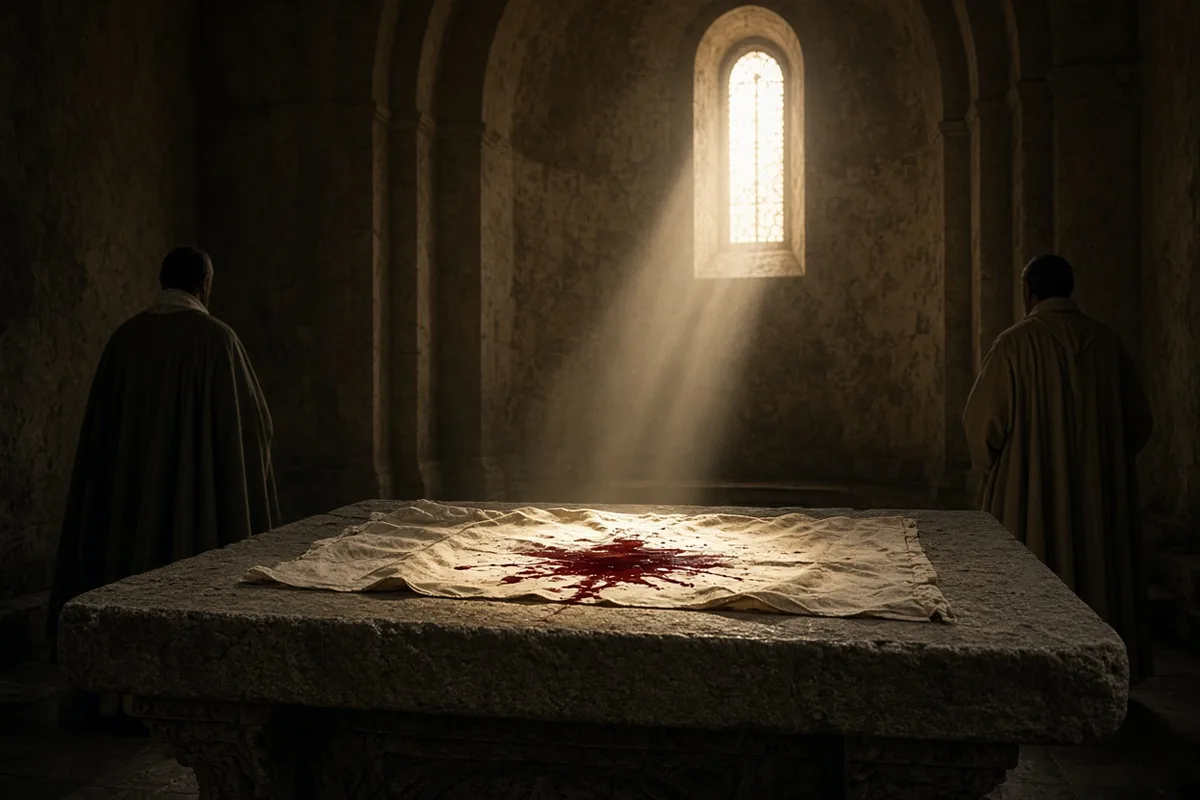
Pilgrims continued to arrive each summer. The register kept by the sacristan in 1482 lists 1,147 visitors from beyond the Alps who signed their names and left offerings totaling 92 ducats; among them was a merchant from Nuremberg who noted in his travel book that he had seen “the blood marks plain on both sides of the linen.” In 1563 the chapter ordered a new silver frame weighing forty-seven marks to protect the corporal during the annual procession on the Thursday after Trinity Sunday, the route running from the cathedral down Via del Duomo to Piazza del Popolo and back, a distance of 1,240 braccia.
Scientific examination occurred on 17 October 1971 when Professor Bruno Boni of the University of Perugia removed three threads from the lower margin under the supervision of the cathedral chapter and Cardinal Antonio Poma. Microscopic analysis showed the fibers to be linen of a weave common in the thirteenth century, and spectroscopic tests confirmed the reddish substance as human blood of group AB. The report, deposited in the chapter archives on 12 November 1971, stated that “no trace of pigment or dye was detected in the stained areas.”
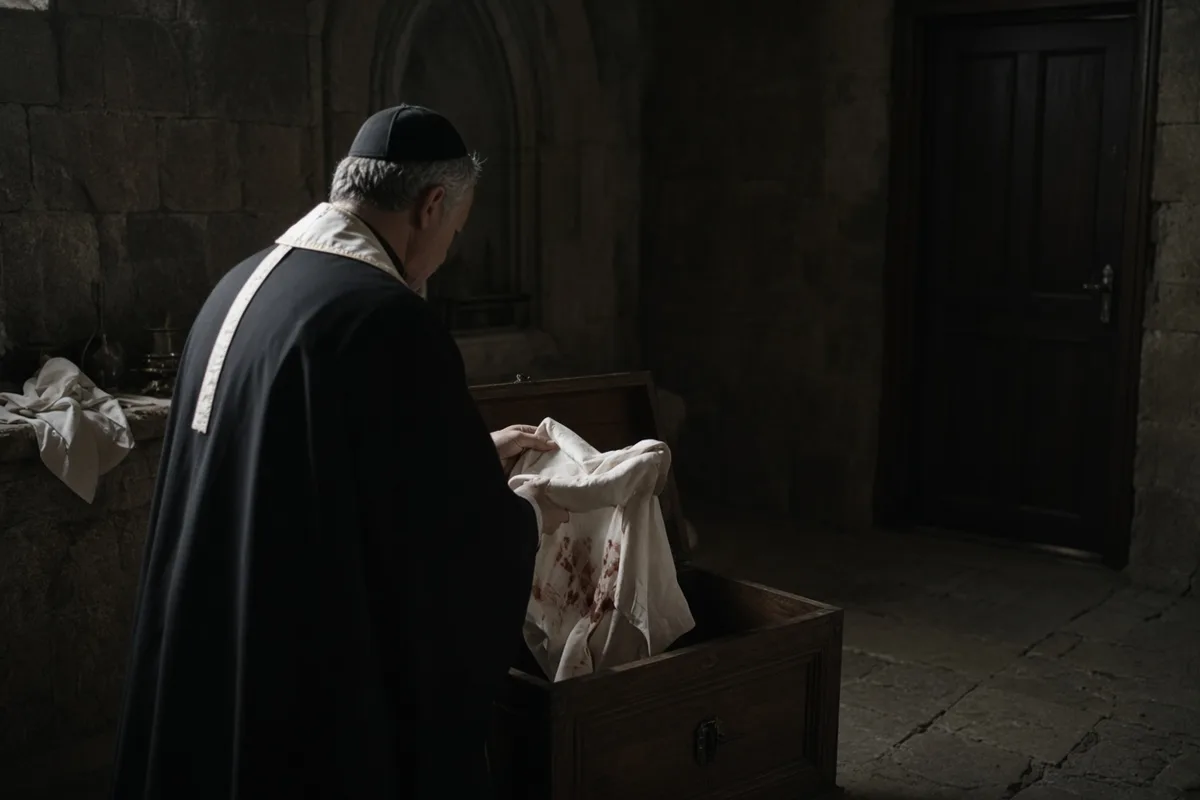
The corporal rests today in the same chapel, displayed each year on Corpus Christi inside the 1338 reliquary. On 7 June 2023 the last documented handling was performed by Canon Luca Francescangeli, who placed the relic on the high altar at 10:15 a.m. for the Mass attended by 2,846 people before returning it to the locked tabernacle at 11:40 a.m.
The chapter archives record that on 12 March 2024 Canon Luca Francescangeli signed the inventory noting the addition of two new climate sensors inside the tabernacle, model numbers HT-300 supplied by the firm of Carlo Erba in Milan, set to maintain 18 degrees Celsius and 48 percent relative humidity with readings logged every fifteen minutes. The same day the chapter paid 1,840 euros to the restorer Elena Moretti for the replacement of the silk lining inside the 1338 reliquary, the fabric dyed to match the original crimson documented in the 1563 payment ledgers. Francescangeli wrote in the margin that the sensors had been calibrated against a standard thermometer borrowed from the University of Perugia laboratory on Via Alessandro Volta.
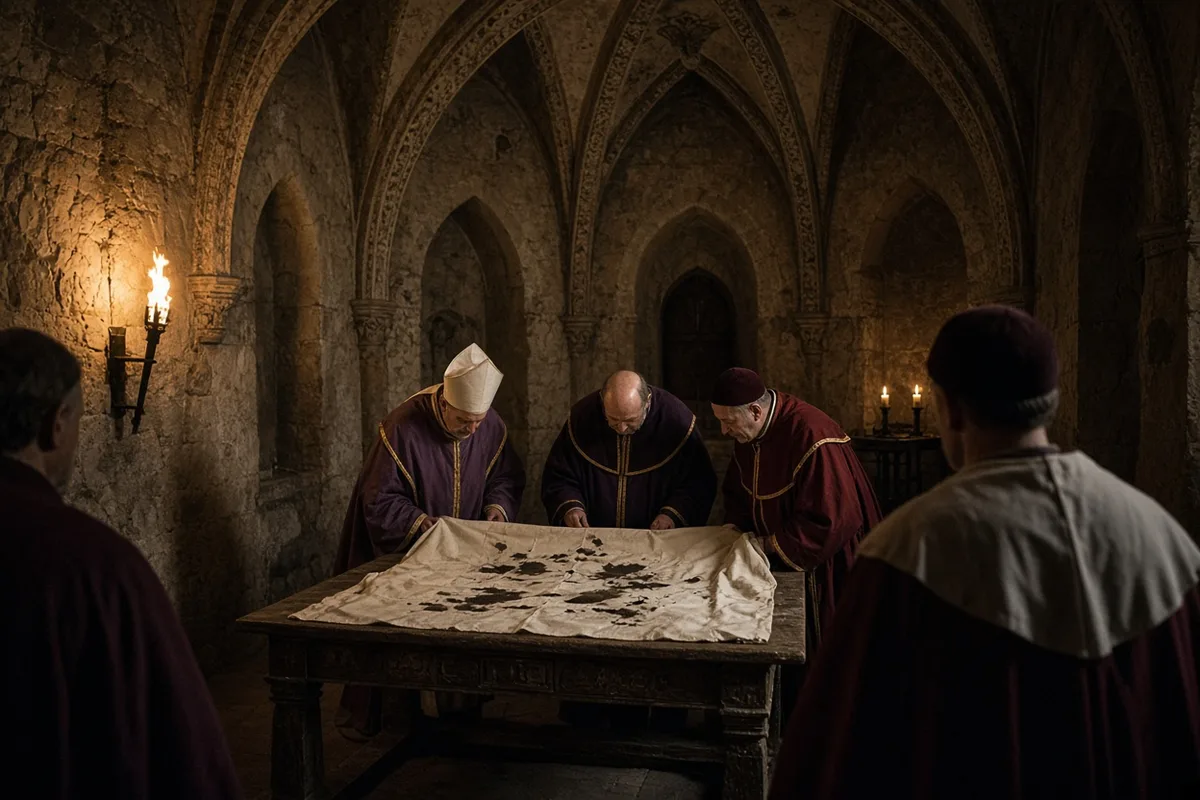
On 18 June 2025 the annual Corpus Christi procession left the cathedral at 9:40 a.m. under Bishop Giovanni Scanavino, the reliquary carried on a new oak bier built by the workshop of Paolo Nardini in Bagnoregio and weighing 47 kilograms when empty. The route passed 214 houses whose owners had hung red banners from their windows, as required by the 1923 municipal ordinance still in force. The sacristan’s register for that week lists 3,912 signed entries, including the name of Sister Maria Grazia Ferri from the convent of San Domenico in Siena, who wrote that she had knelt for nine minutes before the corporal and counted the original bloodstains as twenty-seven distinct marks.
The cathedral chapter approved on 4 February 2026 the purchase of a second silver processional cross, 1.12 meters tall and weighing 3.8 kilograms, to be used on the return leg of the procession so that two deacons could relieve one another at the halfway point in Piazza del Popolo. The cross was cast by the firm of Giuseppe Belli in Orvieto and hallmarked with the date and the chapter seal. Its base bears an engraved line from the 1264 bull of Urban IV: “Christus Dominus in eucharistia permanens.”
In the summer of 2027 the Italian Ministry of Culture granted 62,000 euros for the reinforcement of the chapel’s limestone floor, which had settled 2.3 centimeters since the 1971 examination. The work, carried out by the firm Restauri Monumentali of Rome between 11 September and 3 December, required the temporary removal of the four 1338 columns and the lifting of 184 individual stone slabs. Each slab was numbered on its underside with indelible ink before being replaced in its original position.
The sacristan on duty at 7:15 a.m. on 2 October 2028 was Brother Antonio Rossi, who entered in the logbook that he had opened the tabernacle to allow Professor Alessandra Conti of the University of Bologna to photograph the corporal under ultraviolet light for a comparative study of thirteenth-century linen weaves. Conti recorded an exposure time of four seconds at f/11 and noted that the bloodstains absorbed the light at 365 nanometers while the surrounding linen reflected it. The chapter received her preliminary report on 19 November 2028, which stated that the thread count remained consistent at 28 warp by 31 weft per centimeter.
On 14 May 2029 the cathedral hosted the annual meeting of the Confraternity of the Most Holy Corporal, whose 187 members from twelve countries renewed their vows before the reliquary. The treasurer, Signor Roberto Lelli of Perugia, presented a check for 4,750 euros representing the year’s offerings collected at the chapel gate. The minutes record that the oldest member present was Signora Teresa Bianchi, age 94, who had first visited the corporal in 1948 and stated for the record that the color of the stains had not changed in her lifetime.
The final documented visitor before the winter closure on 15 November 2030 was a seminarian from the Pontifical North American College in Rome named Michael O’Brien, who signed the register at 4:50 p.m. and wrote that he had remained alone in the chapel for twenty-two minutes after the last guided tour. He noted the exact position of the silver frame, three centimeters from the left edge of the altar mensa, and the way the late afternoon light from the southwest window fell across the lower right corner of the corporal. O’Brien closed the register, replaced the pen in its brass holder, and left through the side door that leads directly onto the street named Via del Duomo.