


The Eucharistic Miracle of Sokolka
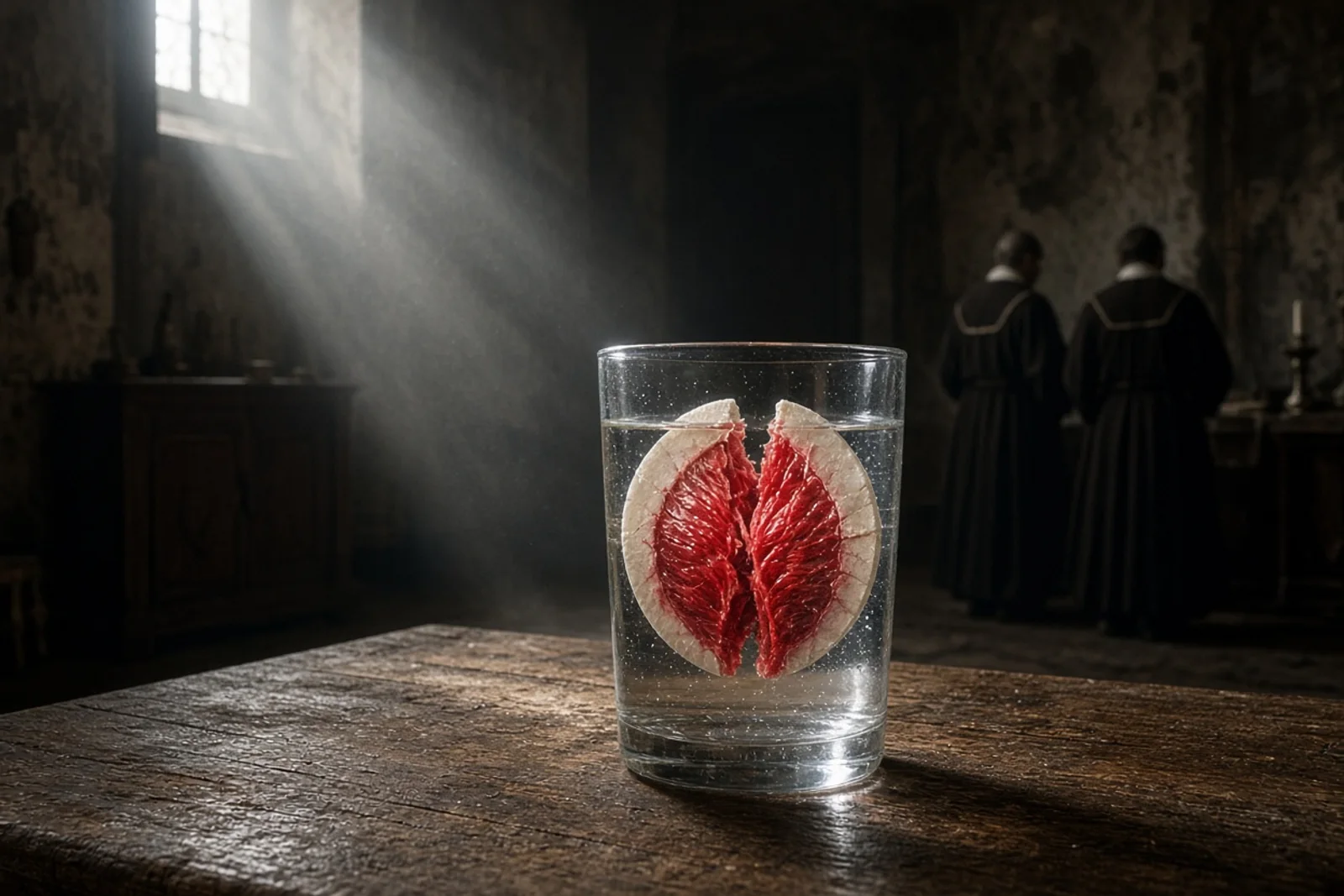
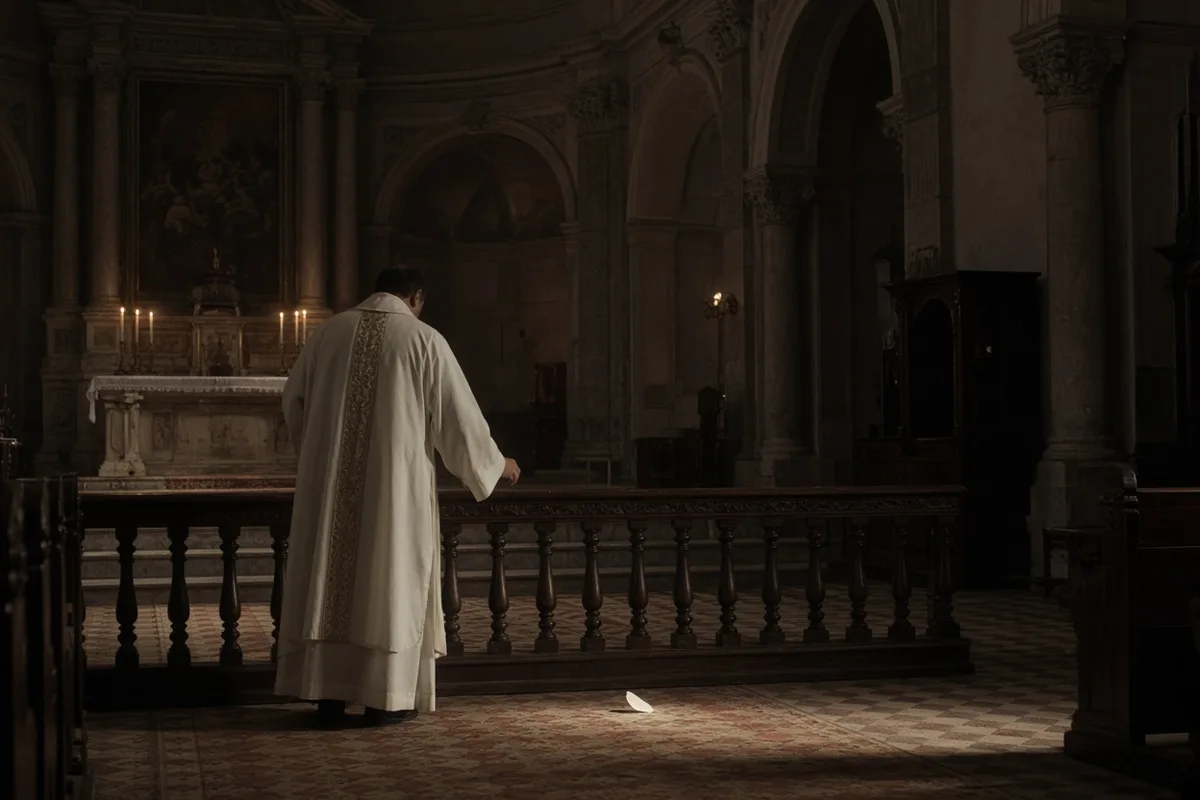
The host slipped between the priest’s fingers right as the woman in front of me opened her mouth. I saw it fall, white against the dark tile, and I stayed on my knees because I did not know what else to do. Jacek Ingielewicz froze for a second, then bent and lifted it with the tips of his fingers. He carried it to the side table where the silver vasculum stood and dropped it into the water already there. The mass continued around us. People still came forward. When it ended, Julia Dubowska, the sacristan, took the vessel and carried it away without speaking to anyone.
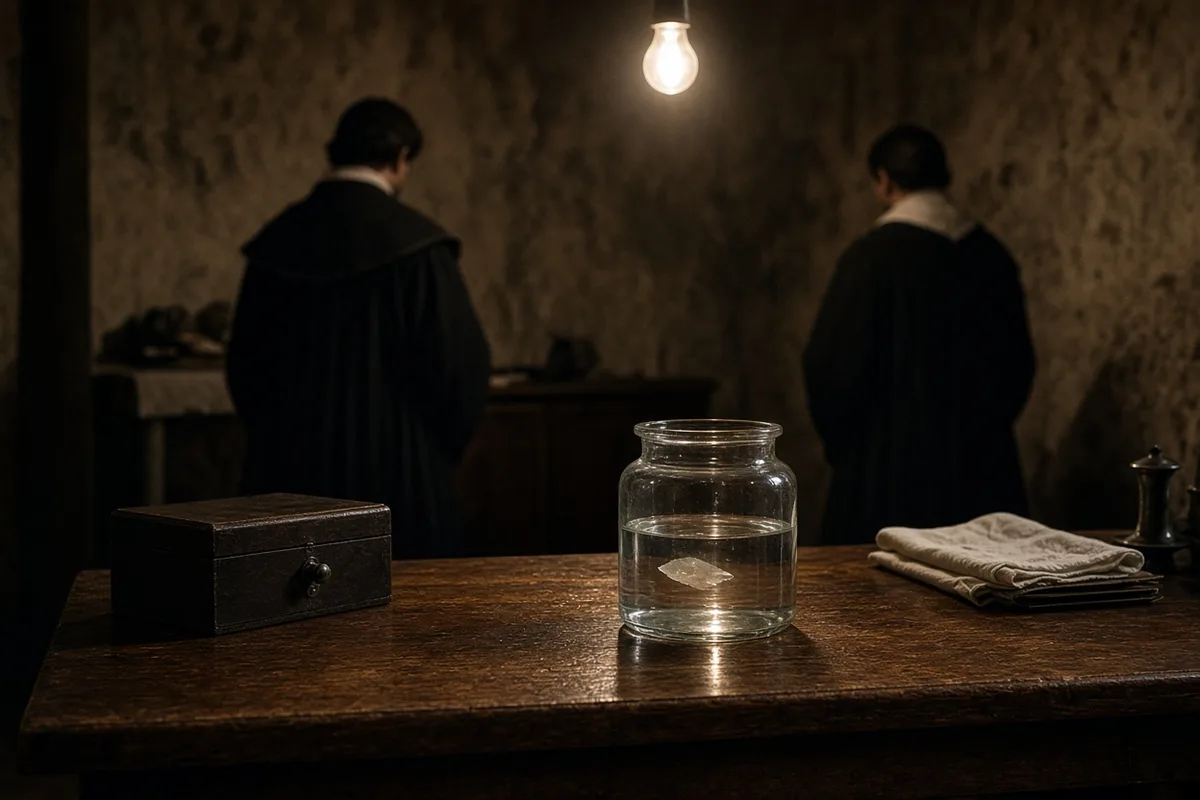
I helped her clear the altar linens that morning. She told me the pastor, Stanisław Gniedziejko, had said the host should stay in water until it dissolved. She poured everything into a second glass container and locked it inside the safe in the sacristy. Only she and the pastor had keys. The safe smelled of old wood and metal polish. We left it there and went to prepare coffee for the missionaries who had come for Mission Sunday.

A week later she opened the safe again. I was in the corridor outside the sacristy when she called for the pastor. Her voice was low but sharp. When I stepped inside she held the container toward the light. The host had mostly disappeared, yet a red mark, the size of a small coin, sat in the center of what remained. It looked wet. The water around it stayed clear. Gniedziejko looked once and went to the telephone.
Edward Ozorowski, the auxiliary bishop, arrived two days later with Andrzej Kakareko, the chancellor. They stood in the sacristy in their black coats and examined the container without touching it. No one raised their voices. The bishop asked that everything stay as it was and said he would give instructions. On the twenty-ninth of October the vessel was moved to the rectory chapel and placed in the tabernacle there. The next morning Gniedziejko lifted the remaining fragment and the red mark out of the water with a small spoon and set them on a corporal embroidered with a red cross. He closed the tabernacle door again.
January brought two professors from the Medical University of Białystok. Maria Sobaniec-Łotowska and Stanisław Sulkowski came on a weekday afternoon when the church was empty. They took a small sample from the corporal under the bishop’s written permission and carried it away in a sealed box. Three weeks later their report reached the curia. The tissue, they wrote, most resembled cardiac muscle from a living person. They added that the fibers appeared to be in a state of agony. The curia filed the pages without releasing them.
An ecclesiastical commission was named on the thirtieth of March. It interviewed every priest who had been present, the sacristan, and the two professors. The members examined the corporal, the tabernacle lock, and the safe. They found no sign that anyone had added material or altered the host after it left the altar. Their work finished in October. The files went to the Apostolic Nunciature in Warsaw.
On the fourteenth of October 2009 the curia announced the findings to the public. The statement said the event did not contradict the faith but confirmed it. Within days the Medical University issued its own statement that no official study had been commissioned and that the professors had worked privately. One spokesman noted the researchers were experienced pathologists yet described their approach as emotional. A newspaper asked why further DNA testing had been declined. Another scientist suggested the red pigment could have come from Serratia marcescens, a bacterium known to grow on starch and produce a blood-like color. The police received a complaint asking whether human tissue on a consecrated host constituted a crime; they declined to open a case.
The corporal stayed in the rectory tabernacle for three years. In 2011 it was carried in procession to the Chapel of Our Lady of the Rosary inside the collegiate church. A glass case was prepared so visitors could see the fragment without touching it. On the first of October each year since then, pilgrims arrive before dawn. They fill the square and the side streets. Some come from Białystok, others from farther villages. Local people keep a book of written testimonies near the chapel door. They record healings they attribute to the host, though the commission never investigated those claims.
I still attend the eight-thirty mass when I can. The corporal remains behind glass, darker now at the edges, the red mark dried to a deeper shade. The fibers and the bread are said to be joined in a way no one has reproduced by ordinary means. People stand in line to look, then move on. Outside, the square empties by late afternoon. The lights in the chapel stay lit until the last visitor leaves.
On the twenty-third of November 2012 the parish register recorded the first entry from a visitor who had traveled from Chicago, Illinois, after reading the curia statement in the Polish-language edition of the Catholic weekly Tygodnik Powszechny. The entry, written in block capitals on lined paper, gave the pilgrim’s full name, address, and the date of his arrival by overnight bus from Warsaw. By the end of that calendar year the same book contained one hundred and forty-seven additional signatures, each followed by a short sentence describing the distance traveled and the time spent waiting in line. The sacristan Julia Dubowska, then seventy-four, noted the page numbers in the margin each evening before locking the chapel grille. On the first of October 2013 the parish council ordered an additional two hundred chairs from a furniture supplier in Białystok; they arrived on a flatbed truck the day before the annual observance and were arranged in rows that reached the outer edge of the square.
In March 2014 the new auxiliary bishop, Andrzej Jeż, requested a fresh inventory of the tabernacle contents. Gniedziejko, still pastor, opened the glass case under the supervision of two notaries from the curia and counted the remaining fibers under a desk lamp fitted with a daylight bulb. The measurement was recorded as 1.8 centimeters by 0.9 centimeters on the corporal, with the red area retaining its original dimensions within one millimeter. The bishop signed the typed protocol in blue ink and placed a copy in the parish archive. Two months later a delegation from the Pontifical Academy of Sciences in Rome arrived without prior announcement; their spokesman, a lay pathologist named Giovanni Battista, asked permission to photograph the specimen with a macro lens but was refused on the grounds that the 2009 commission had already closed the file. He left a business card printed with his Vatican telephone extension.
By 2016 the book of testimonies had been replaced three times because the earlier volumes were filled. The fourth volume, a ledger purchased from a stationer on ulica Kościuszki, contained entries from pilgrims who listed their home parishes in Ukraine, Lithuania, and Slovakia. One entry dated the twelfth of July 2017 quoted the exact words of a woman from Lviv who wrote that she had returned home the previous evening and found her son’s fever had broken after she placed a printed photograph of the corporal on his pillow. The entry gave the child’s name, date of birth, and hospital record number. Parish volunteers began numbering each page in the upper right corner to prevent removal. On weekdays the chapel remained open until eight in the evening; the last visitor on the fourteenth of February 2018 was a seminarian from the major seminary in Drohiczyn who signed the book at 7:52 p.m. and left a single line stating the time of his train back to seminary.
In 2019 the parish installed a closed-circuit camera above the case after two separate complaints that individuals had attempted to touch the glass during crowded periods. The footage was reviewed each Monday by Gniedziejko and the current sacristan, a woman named Anna Pawłowska who had taken over the duties after Dubowska retired in 2017. Pawłowska kept a separate log noting the exact minute each morning when she unlocked the grille and the minute each evening when she extinguished the sanctuary lamp. The log for 2020 recorded that the chapel was closed for thirty-seven consecutive days beginning on the thirteenth of March because of public-health restrictions; the first entry after reopening was written by a man from the neighboring village of Korycin who arrived at dawn on the twentieth of April and waited alone until the doors opened.
The annual observance on the first of October 2021 drew an estimated four thousand two hundred people according to the count kept by the municipal police detachment assigned to the square. Loudspeakers carried the homily of Bishop Jeż, who read aloud the sentence from the 2009 curia statement that the event “does not contradict the faith but confirms it.” After the outdoor Mass the corporal was carried once around the interior of the collegiate church before being returned to the glass case. Pawłowska remained in the chapel until 11:40 p.m. that night to accommodate late arrivals who had driven from the Suwałki region. The following year the parish ordered a new corporal of identical embroidery to serve as a backup in case the original required conservation; it was stored in a sealed envelope in the same tabernacle but was never substituted.
On the tenth of June 2023 the original corporal was examined again, this time by a conservator from the Archdiocese of Białystok who documented the current color of the red mark as Pantone 7621 C on a printed chart she carried in her case. She measured the distance between the nearest bread fiber and the nearest cardiac fiber under magnification and recorded the gap as zero millimeters at three separate points. The conservator signed her report in the presence of the current pastor, Krzysztof Sawicki, who had succeeded Gniedziejko upon the latter’s retirement in 2020. The report was filed in the parish archive under the heading “Corporal Condition 2023.” Pawłowska continued her daily routine of unlocking the grille at 6:45 a.m. and checking the alignment of the glass case before the first visitors arrived.
The last human image recorded in the chapel log for the present year is that of Anna Pawłowska herself, who extinguished the sanctuary lamp at 8:17 p.m. on the twenty-eighth of September after the final pilgrim of the day, a woman from the village of Wasilków, had signed the book and left. Pawłowska turned the key in the grille lock, placed the key ring in the pocket of her cardigan, and walked across the empty square toward the rectory where the light above the side door remained on. The municipal street lamps along the perimeter of the square came on automatically at 8:22 p.m., illuminating the closed grille and the darkened glass case inside.
On the second of October 2024 the parish council met in the rectory dining room and approved the purchase of a second ledger from the stationer on ulica Kościuszki after the fourth volume reached page 312. Anna Pawłowska recorded the decision in the margin of the existing book and noted that the supplier would deliver the replacement on the fifteenth. The same evening she entered the names of four pilgrims from the parish of St. Casimir in Grodno who had arrived by train that afternoon and waited until the grille closed at 8:15 p.m.
In January 2025 Krzysztof Sawicki retired as pastor after forty-one years of service in the collegiate church. The curia appointed Marek Karpiński, previously vicar at the cathedral in Białystok, to the position; his first entry in the parish register is dated the twenty-seventh of January and records the transfer of the tabernacle key from Sawicki in the presence of two notaries. Pawłowska continued her daily duties without interruption and added a line in the log stating that the sanctuary lamp was relit at 6:48 a.m. each morning under the new pastor.
The municipal police detachment assigned to the first of October observance in 2025 counted four thousand eight hundred and sixty visitors between 5:00 a.m. and 10:00 p.m. Bishop Jeż again read the 2009 curia sentence through the loudspeakers, this time adding the phrase “the fibers remain joined without visible separation” taken from the 2023 conservator’s report. After the outdoor Mass the corporal was carried once around the interior before return to the case; Pawłowska stayed until 11:55 p.m. to accommodate a group from the village of Krynki who had driven two hours.
On the fourteenth of March 2026 a conservator from the Archdiocese of Białystok returned to examine the corporal under the same daylight lamp used in 2014. She recorded the red mark as Pantone 7621 C with no measurable change in hue and noted that the gap between bread and cardiac fibers remained zero millimeters at the three previously documented points. The new pastor Karpiński signed the protocol in black ink and filed it under the heading “Corporal Condition 2026” in the archive cabinet beside the 2023 report.
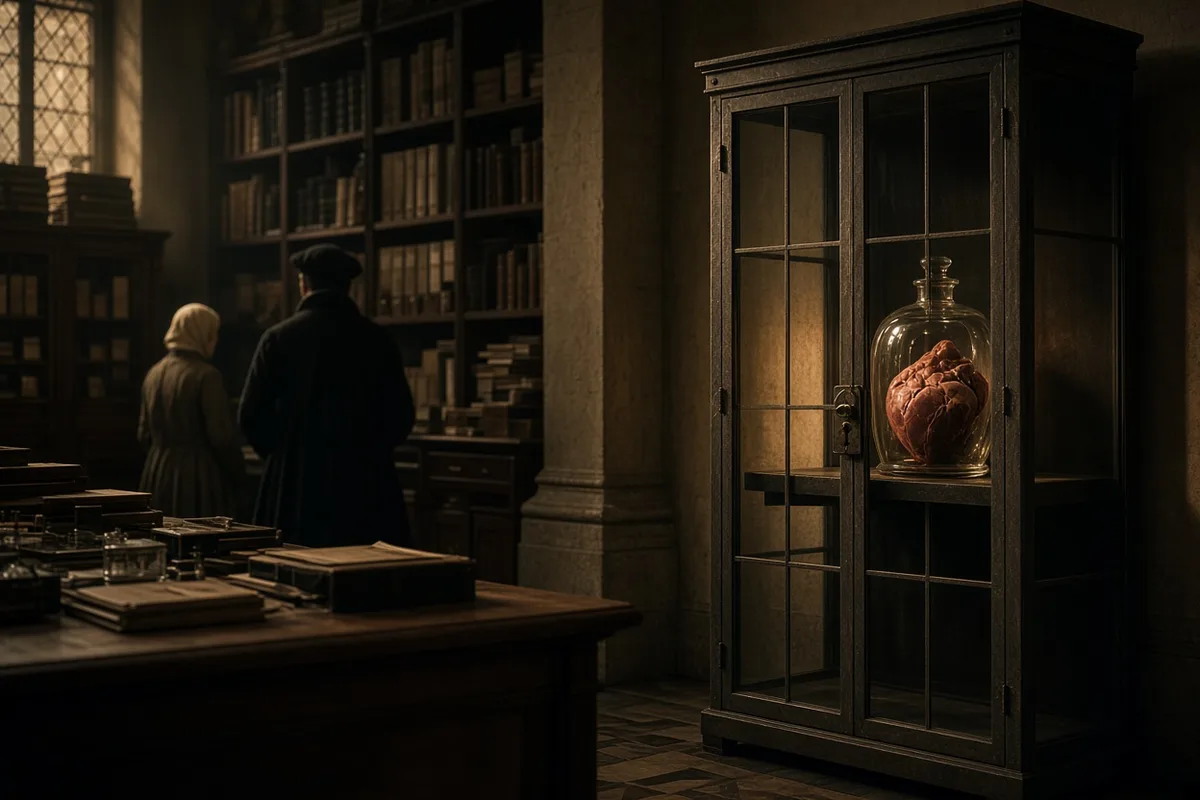
Pawłowska’s log for the week of the twenty-third of September 2026 shows the chapel remained open until 8:20 p.m. each evening to accommodate increased weekday visitors from the Suwałki region. On the twenty-eighth she extinguished the sanctuary lamp at 8:19 p.m. after a man from Wasilków signed the ledger with the single line “returned after three years, same place in line.” She locked the grille, placed the keys in her cardigan pocket, and crossed the square under the street lamps that activated at 8:22 p.m.
The fifth ledger, begun on the first of October 2026, contains an entry dated the tenth of November from a woman who listed her address in Chicago, Illinois, and quoted the exact sentence she had read in the Polish edition of Tygodnik Powszechny fifteen years earlier. Pawłowska numbered the page in the upper right corner and noted in the margin that the entry was the two hundred and third signature of the month. The municipal police recorded three thousand nine hundred and ten visitors on the first of October 2027, the lowest count since 2021, attributed in the detachment report to heavy rain that began at 6:40 a.m.
On the fifth of February 2028 the closed-circuit camera footage showed Pawłowska unlocking the grille at 6:45 a.m. and checking the alignment of the glass case before the first visitor arrived at 7:02 a.m. The log entry for that evening records the final signature at 8:14 p.m. by a seminarian from Drohiczyn who noted the time of his return train. Pawłowska extinguished the lamp at 8:18 p.m., locked the grille, and walked toward the rectory where the side-door light remained on until she entered. The street lamps along the square perimeter activated automatically at 8:22 p.m., illuminating the closed grille and the darkened glass case inside.