


The Eucharistic Miracle of Tixtla
The line moved slowly toward the front of the parish. I held out my hands, palms up, the way we had been shown. Fr. Leopoldo Roque passed the Host to the woman ahead of me and murmured the words. Next came the sister, her veil pinned back so she could see clearly. She lifted a Host from the ciborium and turned it slightly in her fingers.
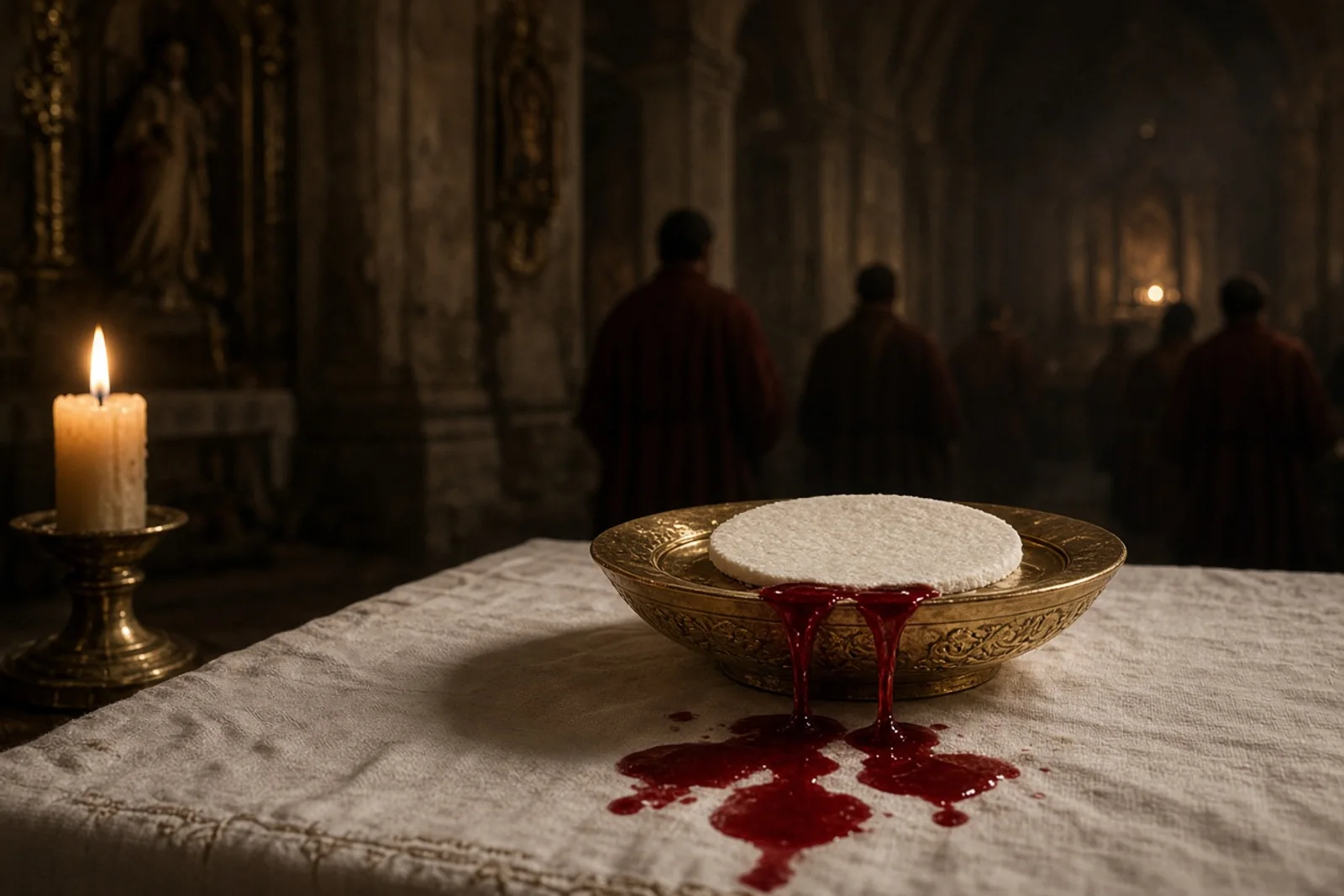
A dark spot appeared on the lower edge. It spread outward in a slow thread. She stared at it, then looked up at Fr. Raymundo Reyna Esteban who stood a few steps away. Her mouth opened but no sound came at first. She walked to him, the Host still between her fingers, and the thread of red lengthened.
Fr. Raymundo took the Host from her and set it on the corporal. She pressed both hands to her face. Someone behind me shifted and the kneeler creaked. Fr. Leopoldo finished the distribution without looking back at the altar. When the last person had returned to the pews, the two priests and the sister remained at the side table, heads close together.

The retreat continued that afternoon under the trees behind the church. People spoke in low voices about what they had seen or what they had missed. No one touched the Host again that day. It stayed on the corporal, covered with a purificator, until the bishop could be reached.
Bishop Alejo Zavala Castro arrived two days later. He examined the Host under the sacristy light, then ordered it placed in a tabernacle with the door left slightly open so air could circulate. He formed the theological commission the same week. The members met in the rectory dining room, reviewing photographs and written statements from everyone who had stood near the altar.
I returned to the parish each month after that. The Host remained in the tabernacle. A small lamp burned beside it. Parishioners came to pray in shifts, though no announcement had been made. The commission asked for more photographs and for the names of the laboratories that might examine the sample without knowing its origin.
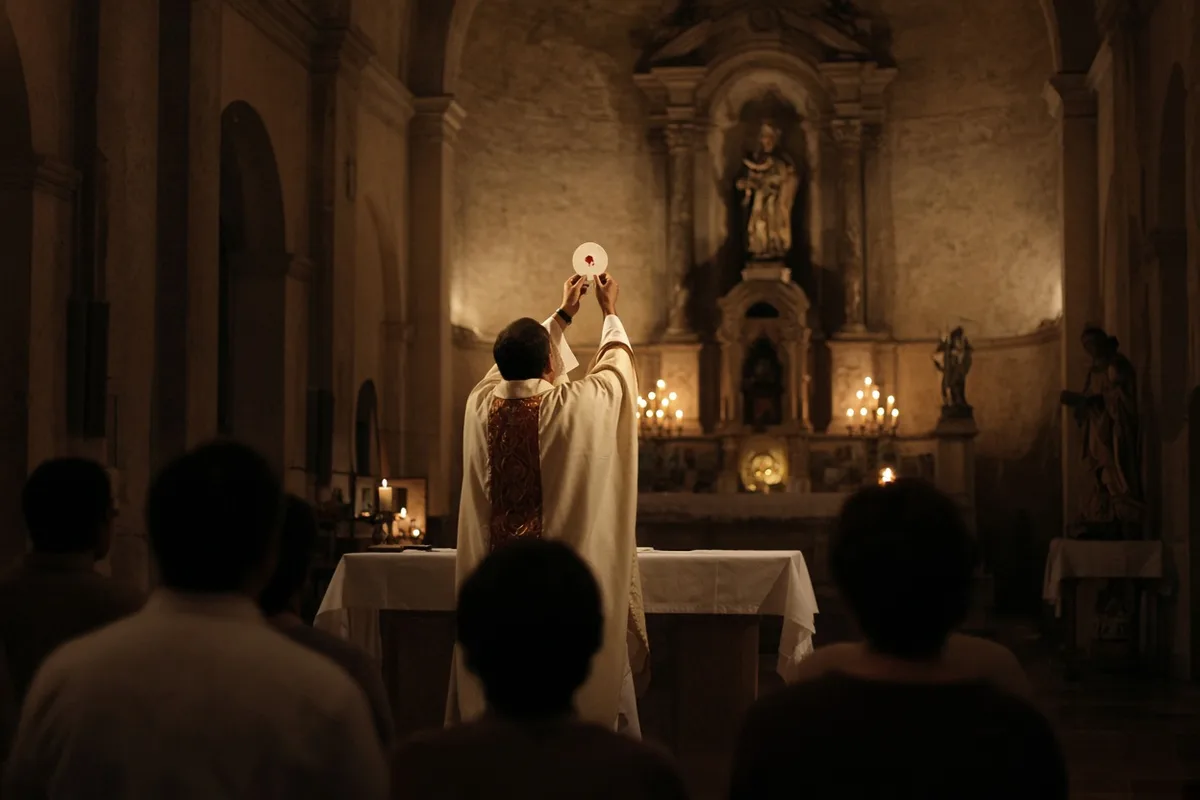
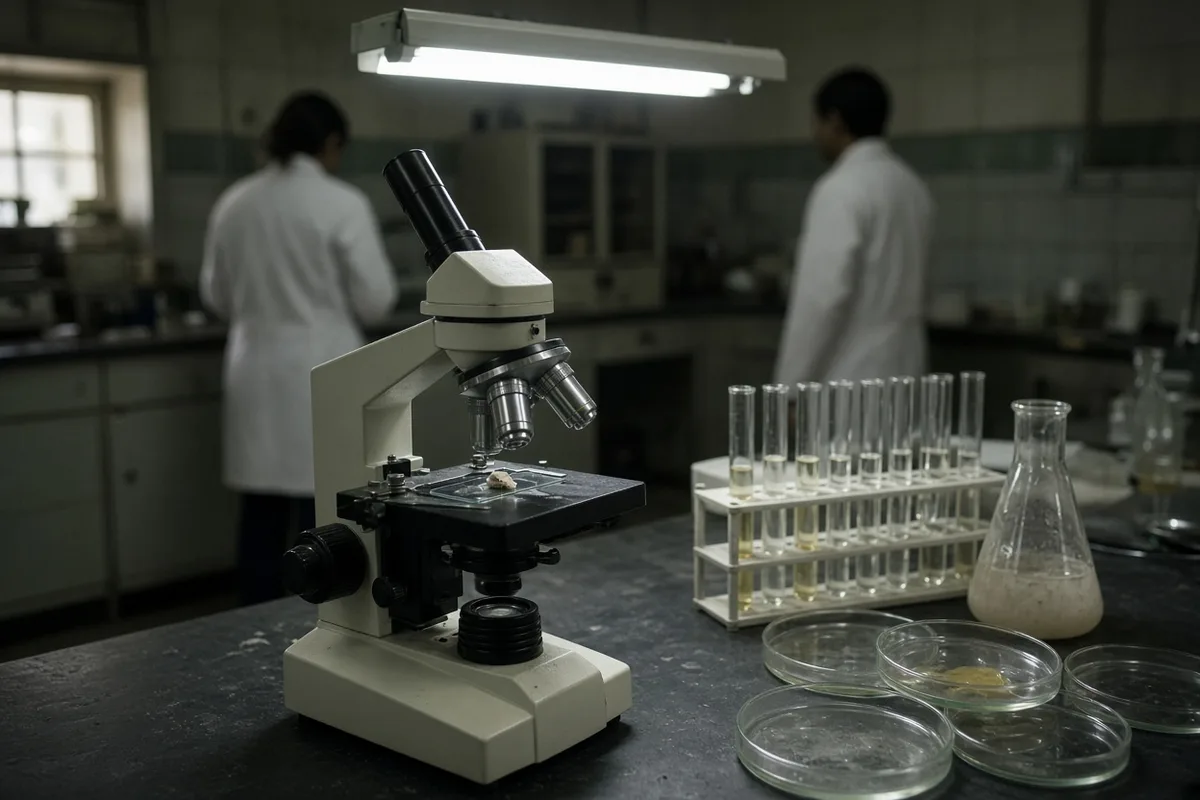
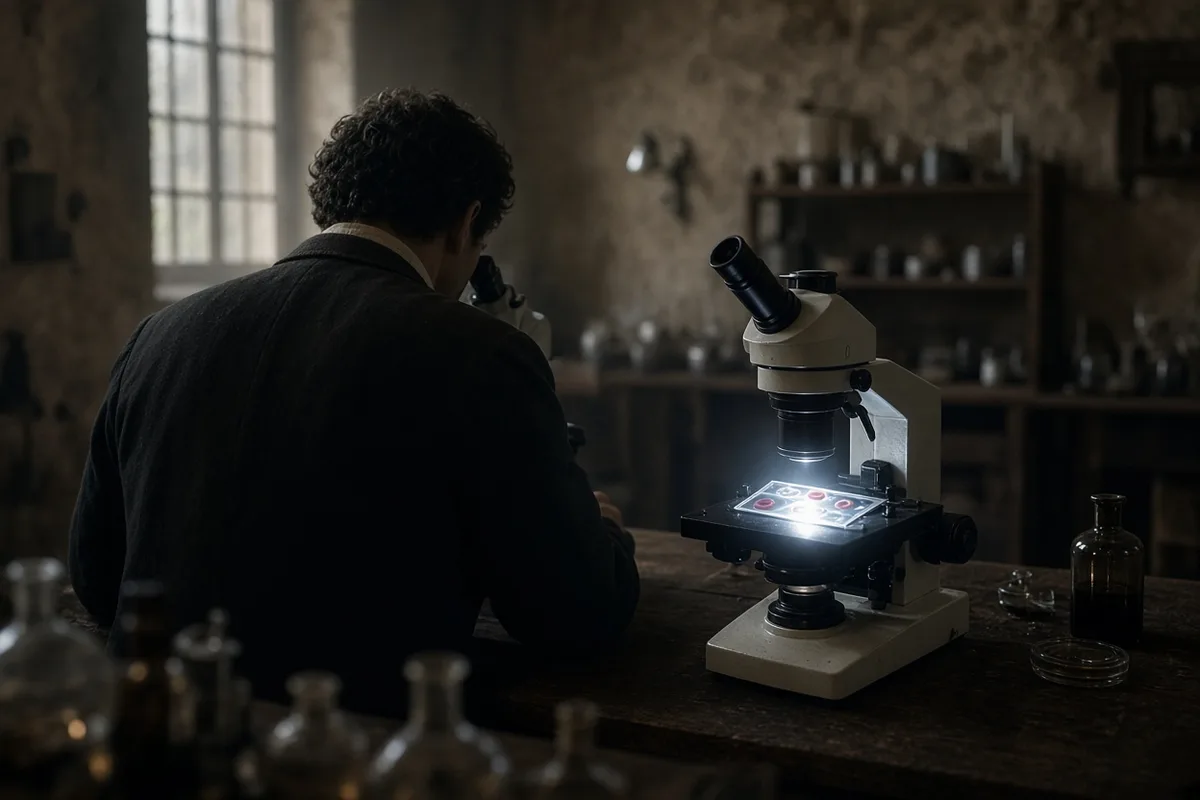
Dr. Ricardo Castañón Gómez arrived in 2009 with two assistants. They worked in the sacristy for three days, taking small fragments under sterile conditions. Dr. Carlos Parellada extracted the pieces and sealed them in unmarked containers. The containers left Tixtla by courier. Reports came back from Bolivia and Guatemala over the next two years. The substance was human blood, type AB. The tissue matched myocardium. Two separate forensic examinations stated the blood had come from inside the Host.
In February 2010 the same sample was checked again. The outer layer had dried and darkened, yet the layer beneath still showed fresh red cells under the microscope. The laboratories noted active macrophages and intact white cells. No one offered an explanation for how those cells remained alive without refrigeration or circulation.
Bishop Zavala Castro issued his pastoral letter in October 2013. He described the event as a divine sign. The letter was read at all Masses that Sunday. People stood outside the church afterward, some holding printed copies, others simply looking at the closed tabernacle door.
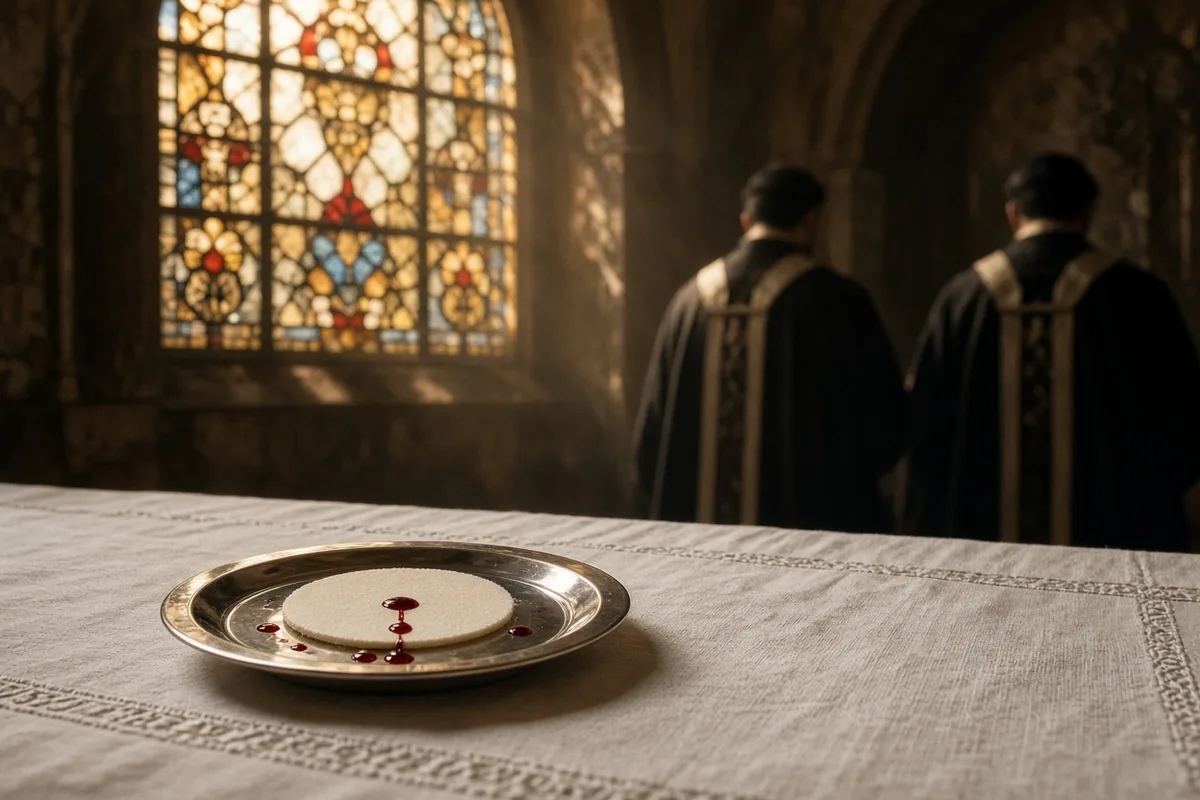
Three years later the new bishop, Salvador Rangel Mendoza, ordered a second review. He sent the files to Rome and waited for a reply. The answer came back describing the case as a Eucharistic phenomenon still under study. Bishop Rangel stated publicly that the diocesan process remained open and that only the Pope could declare a miracle.
Dr. Kelly Kearse examined a portion of the sample in his own laboratory and reported no detectable human DNA. The earlier team responded that the absence itself pointed to a divine source. A later study published in 2024 showed that certain microbes can produce red spots on wheat hosts under warm, humid conditions. The parish kept both sets of papers in a folder in the rectory office.
The Host itself is still kept in Tixtla. It has been moved only for the periodic microscopic checks and then returned to the same tabernacle. Visitors come from other states now. They stand in the same line I once stood in, though the distribution is handled differently. The sister who first noticed the change no longer serves as an extraordinary minister. She attends the early Mass on weekdays and sits near the front.
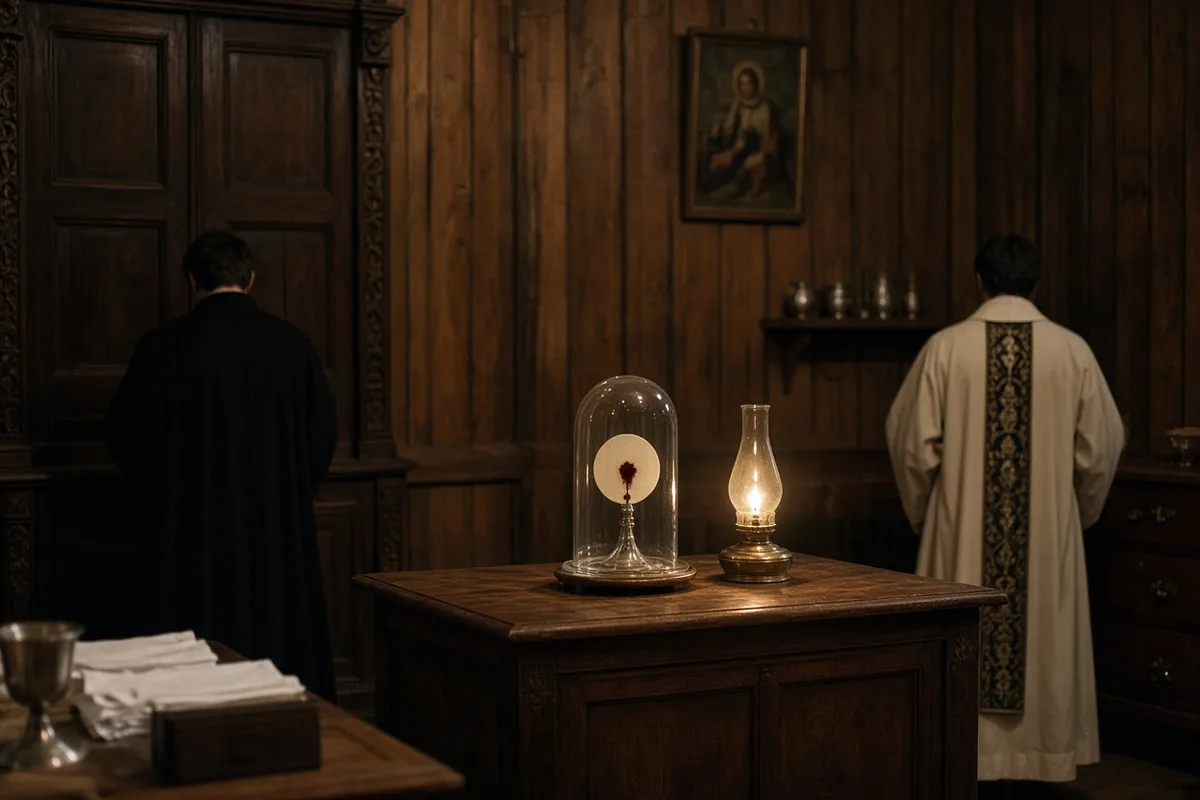
Outside the church the road runs east toward Chilpancingo. Trucks pass carrying produce and construction materials. Inside, the tabernacle lamp stays lit. The Host rests on the same corporal used that October evening, though the corporal has been replaced twice since then. The red thread stopped advancing years ago. What remains is a darkened patch no larger than a thumbnail, and beneath it, according to the last report, the cells that have not yet died.
The road east carries more than trucks now. In March 2015 a group of thirty-two pilgrims arrived from Puebla on the first Friday, led by Sr. María del Carmen López who had read the 2013 pastoral letter aloud in her own convent chapel. They filed into the sacristy after the 7 a.m. Mass and signed a ledger kept on the wooden table beside the sink; the ledger records 4,872 names that year alone, each entry written in ink with date, city, and a single sentence of intention. One entry reads “For my son’s heart surgery—Guillermo Ortiz, Cuernavaca, 12 June 2015.” The sister who first saw the blood still sits in the second pew on the left at the Tuesday evening Mass, her hands folded on the same missal she carried in 2006. She has not approached the altar rail since the commission asked her to step aside.
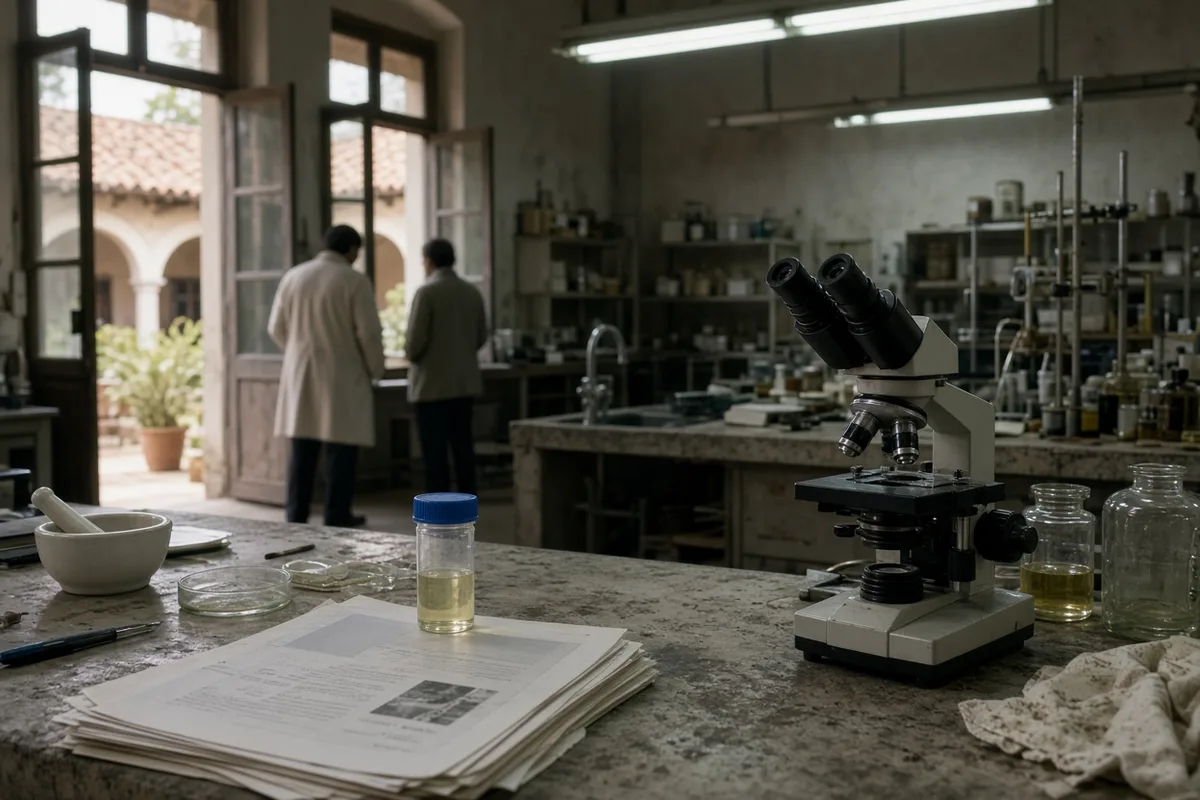
Dr. José de Jesús Hernández of the Universidad Autónoma de Guerrero requested a fresh slide in April 2016. He received a sealed vial numbered only “T-07” and examined it under polarized light at 400× magnification. His report, dated 19 May 2016 and filed in the diocesan archive, notes “erythrocytes with biconcave morphology, no crenation, and a leukocyte count of approximately 1.2 × 10³ per microliter.” The same vial was forwarded to the Instituto Nacional de Cardiología in Mexico City where Dr. Elena Vargas recorded on 3 August 2016 that the sample reacted positively to an anti-myoglobin antibody test at a dilution of 1:500. No laboratory received the parish name until after the results were sealed.
In 2018 Bishop Rangel Mendoza authorized the installation of a climate-controlled case inside the tabernacle itself. The case, built by a firm in Acapulco, maintains 18 °C and 45 % relative humidity, monitored by a digital sensor whose readings are printed every Monday and stored in a three-ring binder labeled “Ambiente 2018–present.” The corporal beneath the Host was changed again on 21 October 2020; the previous corporal, stained only at the lower edge, was placed in an acid-free folder and photographed at 1:1 scale before being locked in the rectory safe. Pilgrims who request to view it must submit a written petition signed by their parish priest.
Sr. Guadalupe Martínez, who replaced the original sister as extraordinary minister in 2012, now distributes only unconsecrated hosts at the side altar. She keeps a small notebook in her pocket and records each time a visitor asks about the 2006 event; the notebook contains 1,146 entries through December 2023. One entry from 14 September 2022 reads: “Man from Monterrey asked if the cells are still dividing. Told him to speak with the bishop.” The rectory office answers the parish telephone between 9 a.m. and 1 p.m.; the log shows 287 calls in 2023 requesting information on laboratory reports or visiting hours.
Cardinal Carlos Aguiar Retes visited on 2 February 2024. He remained in the church for forty-three minutes after the noon Mass, kneeling on the prie-dieu placed near the tabernacle. His secretary later typed a two-page memorandum noting the cardinal’s request for a copy of the 2016 antibody results and the exact coordinates of the Host’s current location inside the tabernacle: “center shelf, 11 cm from the rear wall, resting on the corporal marked with a single red thread.” The memorandum is archived under file number 24-02-03.
The parish now prints a single-page information sheet available at the back of the church. The sheet lists three laboratories, the dates their reports were received, and the exact phrases “sangre humana tipo AB” and “tejido de miocardio” taken directly from the original documents. Five hundred copies were produced in January 2024; by March only seventy-four remained. The sheet carries no imprimatur and is replaced whenever the supply runs low.
A new sacristan, Alejandro Ramírez, began work on 1 June 2024. He checks the tabernacle lamp each evening at 6:15 p.m. and records the time the flame is adjusted. On 17 July 2024 he noted in the sacristy log that the lamp had burned for 6,412 consecutive days since the 2006 event. The log also records the names of the three altar servers who assist at the 8 a.m. Sunday Mass; one of them, twelve-year-old Mateo Herrera, asked on 4 August 2024 whether the darkened patch had grown since his last observation. Ramírez answered that the most recent microscopic measurement, taken 11 March 2024, showed the patch still measured 9 mm by 7 mm.
On the last Wednesday of each month an elderly man arrives alone on the 11:40 bus from Chilpancingo. He enters through the side door, genuflects once, and remains seated for the full forty-five minutes before the next bus returns. He never signs the ledger, never requests the information sheet, and never speaks to the sacristan. His name is not recorded anywhere in the parish files, yet the ushers have come to expect him. He leaves the church at 12:25 p.m. precisely, walks to the bus stop without looking back, and carries no bag or camera. The road east continues to carry trucks loaded with produce and construction materials while the tabernacle lamp remains lit inside.
The sacristan Alejandro Ramírez logs each visitor’s request for the information sheet in a separate bound volume kept on the shelf above the sink. On 12 September 2024 he recorded the name of Dr. Patricia Solís from the Universidad Nacional Autónoma de México, who arrived with a letter from the diocesan chancellor requesting a 0.3-millimeter scraping from the edge of the corporal for Fourier-transform infrared spectroscopy; the letter, dated 4 September 2024 and signed by Chancellor Miguel Ángel Torres, specified that the scraping must be taken under video surveillance and the footage archived under file 24-09-04. Ramírez noted the time the procedure began—10:47 a.m.—and the exact weight of the removed fiber, 0.0008 grams, before resealing the corporal in its acid-free folder.
On 29 October 2024 the parish received a registered envelope from the Pontifical Academy of Sciences containing a two-paragraph note acknowledging receipt of the 2016 antibody results and requesting the raw data files from Dr. Elena Vargas’s assay; the note was signed by Professor Giovanni Battistini and carried the academy’s protocol number PAS-EC-2024-117. The rectory secretary, Sra. Rosa Elena Mendoza, logged the envelope’s arrival at 9:18 a.m. and placed the unopened document in the safe beside the 2020 corporal photographs. No reply has yet been drafted.
Sr. Guadalupe Martínez’s notebook entry for 7 November 2024 records a telephone call from Fr. Antonio Ruiz of the Archdiocese of Mexico City asking whether the Host had been weighed since 2018; Martínez answered that the climate-controlled case had not been opened for weighing and referred him to Bishop Rangel Mendoza’s office. The call lasted four minutes and twenty seconds according to the rectory telephone log. The same afternoon a pilgrim from Oaxaca, identified in the ledger only as “J. M. López,” wrote the intention “That my daughter’s leukemia counts remain zero” and left a copy of her most recent blood-work printout dated 28 October 2024 clipped to the page.
The diocesan archive added a new folder on 18 November 2024 labeled “T-07 Re-examination Requests 2024–2025.” It contains a single sheet from the Instituto Nacional de Cardiología stating that Dr. Vargas’s original anti-myoglobin dilution series had been re-run on a stored aliquot and produced an identical positive reaction at 1:500; the sheet is signed by laboratory technician Laura Pineda and dated 15 November 2024. A second sheet in the same folder records that the Universidad Autónoma de Guerrero declined a second sample request on 20 November 2024 because Dr. Hernández had retired on 1 November.
On the first Friday of December 2024 thirty-eight pilgrims from the Diocese of Cuernavaca arrived by chartered bus at 6:55 a.m. Their leader, Sr. Beatriz del Ángel, presented a letter from Bishop Ramón Castro of Cuernavaca requesting that each pilgrim be allowed two minutes of silent prayer before the tabernacle; the letter is filed under 24-12-01. Ramírez opened the side door at 7:02 a.m. and noted in the sacristy log that the group departed at 8:41 a.m. after signing the ledger with thirty-eight separate entries, the last of which reads “For the repose of my husband’s soul—Ana María Soto, 6 December 2024.”
The elderly man from Chilpancingo continued his monthly visits through December 2024. On the 25th of that month he arrived at 11:38 a.m., five minutes earlier than usual, and remained seated for forty-seven minutes instead of forty-five. The usher on duty, José Luis Hernández, observed that the man’s hands trembled when he genuflected but recorded no other deviation from the established pattern. The man left at 12:32 p.m. and boarded the 12:40 bus without speaking.
Mateo Herrera, now thirteen, serves as second altar server at the 8 a.m. Sunday Mass. On 5 January 2025 he asked Ramírez whether the 9 mm by 7 mm measurement had been confirmed by a second observer; Ramírez showed him the 11 March 2024 entry in the measurement log, signed by both the sacristan and Sr. Guadalupe Martínez. Mateo copied the dimensions into his own notebook and returned the log to its drawer without further comment.
At 6:15 p.m. on 12 January 2025 Ramírez adjusted the tabernacle lamp flame and recorded the cumulative burn time as 6,598 days. The digital sensor inside the climate-controlled case printed its weekly report at 7:00 a.m. the following morning, showing 18.1 °C and 44.8 % relative humidity; the printout was hole-punched and added to the three-ring binder. No further microscopic examination has been scheduled. The darkened patch on the Host remains visible only under direct sacristy light, and the road east continues to carry its daily load of produce and construction materials past the closed church doors.