


The Four Chaplains Sacrifice on SS Dorchester
The deck lurched once, then the lights died. I was already moving before the second explosion rolled through the hull, one hand on the ladder rail, the other dragging a man who had been asleep in his shorts. Oil smoke filled the companionway. Men shouted names that had no answers. I reached the open deck and the cold hit like a fist.
The Dorchester listed hard to starboard. Lifeboats swung and crashed against the hull. Some were already in the water, overloaded and capsizing. I saw Petty Officer Mahoney stumbling toward his cabin, bare hands clenched against the wind. Rabbi Goode stopped him with a word and pressed a pair of gloves into his fists. Mahoney tried to refuse. Goode told him he had two pairs. Mahoney took them and turned away. The rabbi stayed where he was.
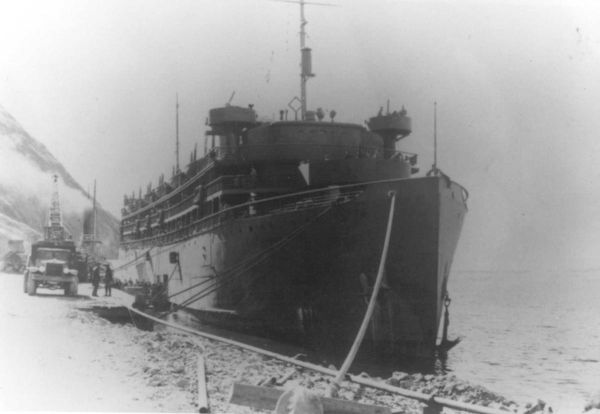
Father Washington moved along the port rail, steadying men who could not find their footing. He spoke in the same low voice he used at services. Lieutenant Fox worked the starboard side, guiding the wounded toward the remaining boats. Poling knelt beside a sailor whose leg was bleeding and tied a tourniquet with his own belt. None of them wore life jackets.
The storage locker was open. The four chaplains passed out what remained inside. When the last jacket was gone, they stepped back as one. Each reached for the straps across his own chest. Fox handed his to a soldier still in underwear. Goode gave his to a merchant seaman who could not swim. Washington placed his over the shoulders of a boy no older than eighteen. Poling did the same for the next man in line. They did not call names or look for faces that matched their own faiths. They simply gave what they had.
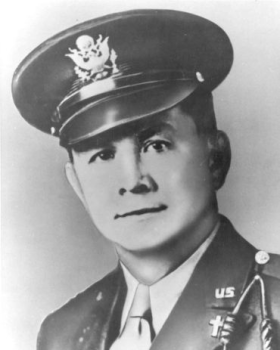
I slid down the cargo net into the water. The shock took my breath. Oil coated my face and stung my eyes. I kicked away from the hull and found a piece of broken hatch. Around me the sea was full of red pinpoints where life jackets blinked. Some of those lights already floated without men attached. I heard voices calling for mothers and for God. Then I heard the chaplains.
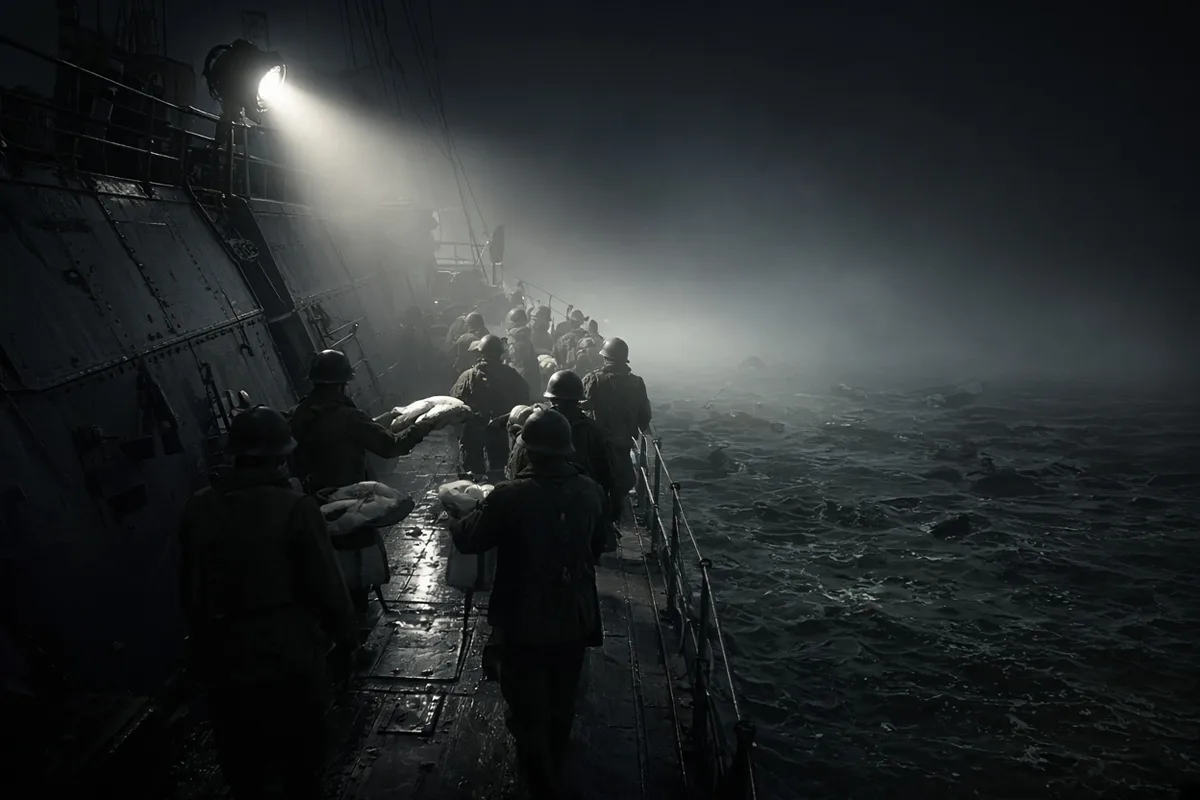
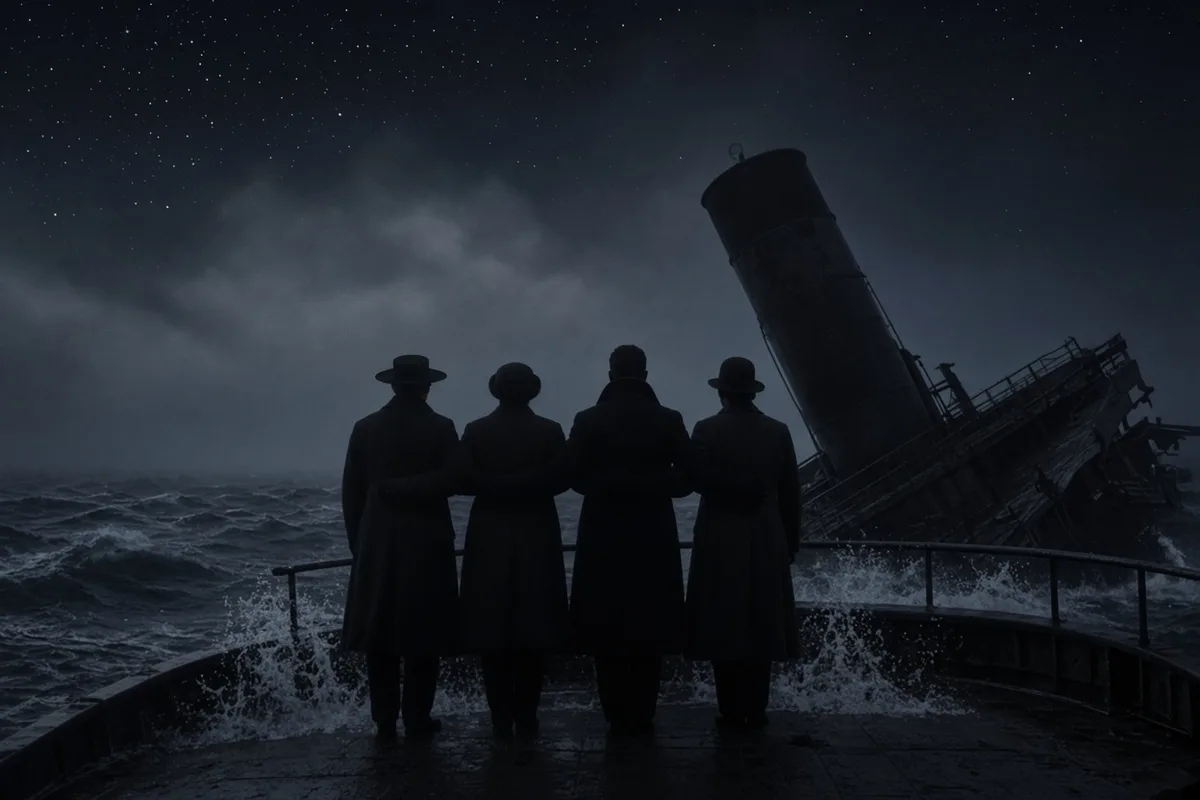
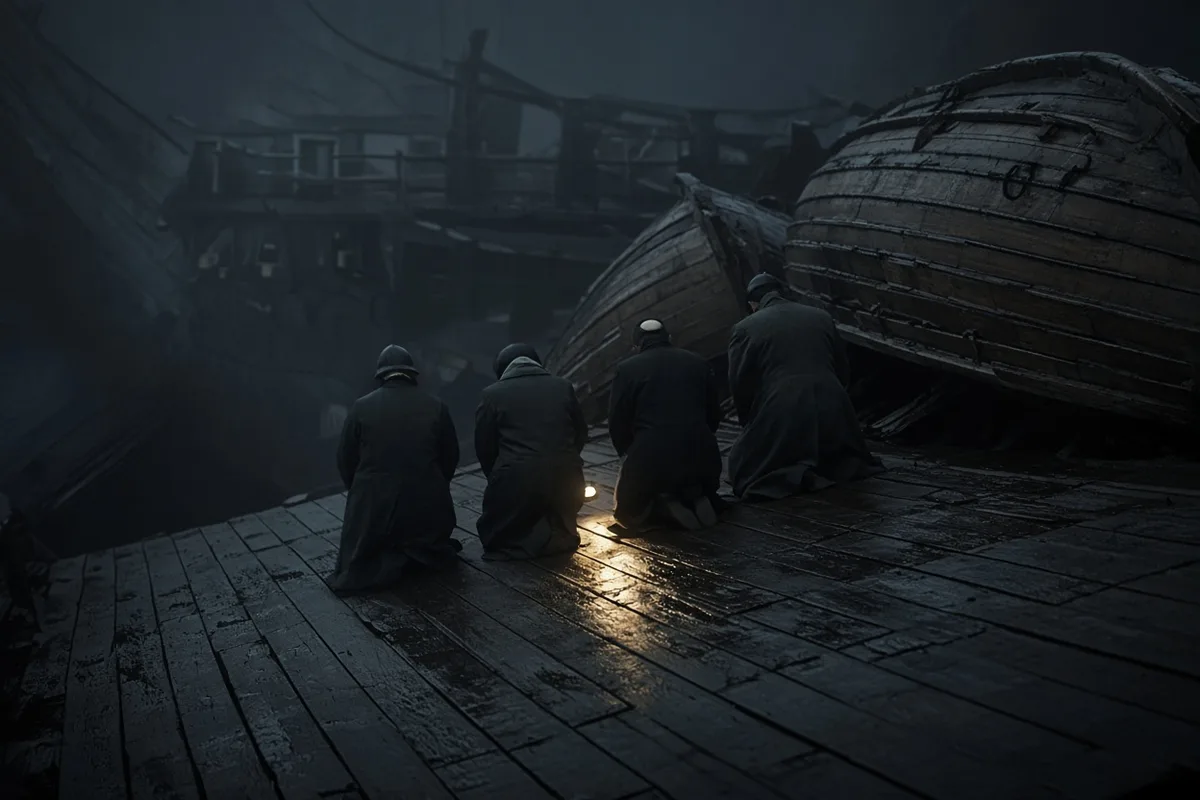
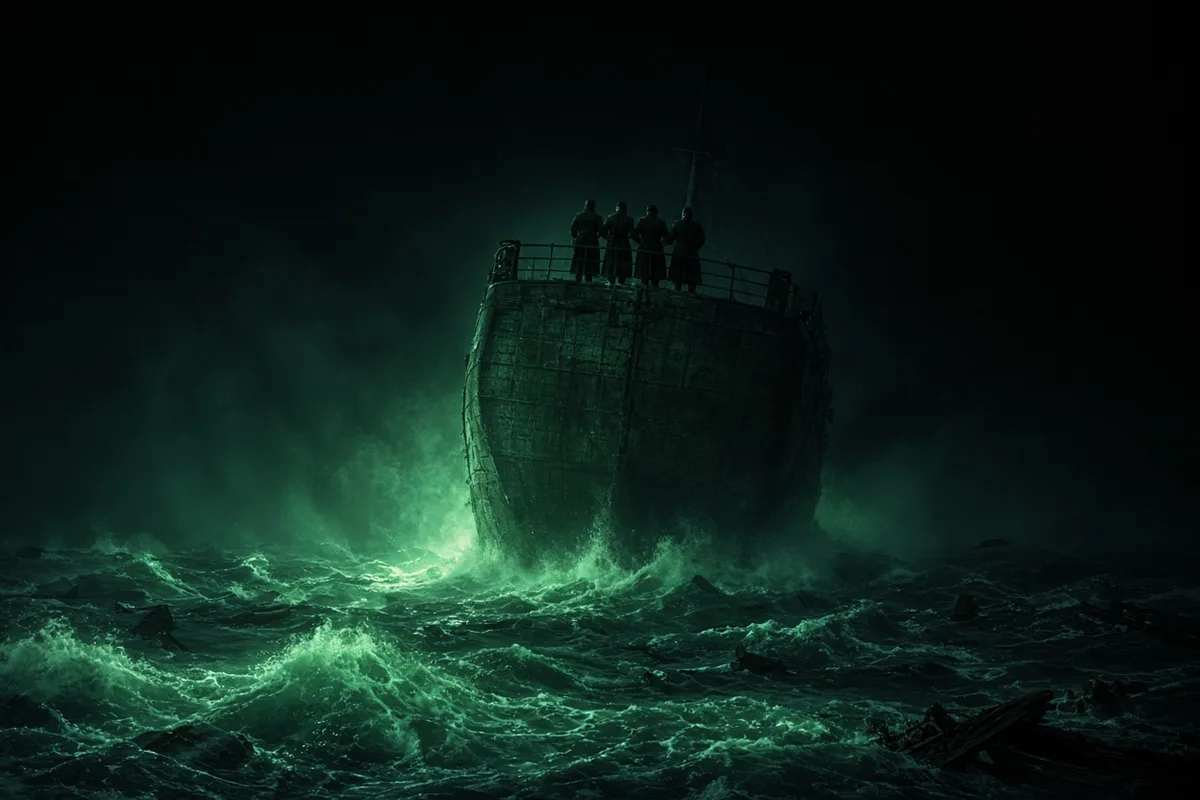
They had climbed onto the high side of the deck as it tilted. Their arms were linked. Fox’s voice carried first, then Washington’s, then Goode’s, then Poling’s. The words blurred across the water. I could not make out the prayers, only the rise and fall of four voices together. A hymn followed. The notes traveled farther than the screams. The ship went under stern first. The four figures stayed upright until the water reached their waists, then their chests, then their shoulders. One light on the deck stayed burning for a few seconds after they disappeared.
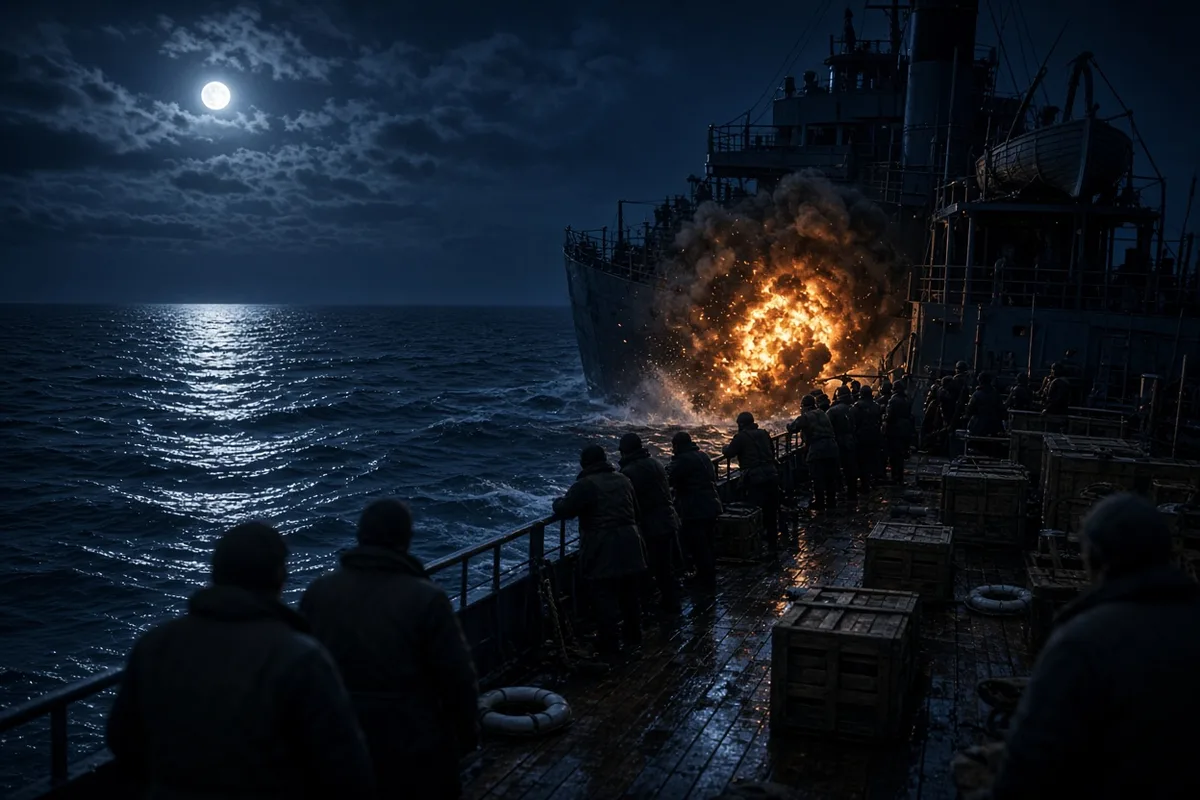
I lost track of time after that. The cold moved inward from my hands and feet. I kept the hatch under my chest and counted the red lights that still moved. Some went out one by one. Others stayed steady until rescue boats reached them. The Comanche came first. Men in the water tried to swim toward her searchlight. The Escanaba circled later and pulled more aboard. I was one of those pulled up on a cargo net. My hands would not close on the ropes, so two sailors lifted me under the arms.
On the cutter the survivors lay in rows. Some had oil in their lungs and coughed until they could not breathe. Others stared at nothing. No one spoke the names of the chaplains at first. Later, when the count was taken, we learned that 672 men had gone down with the Dorchester. The cutters brought 229 of us to shore. One more was found days afterward.
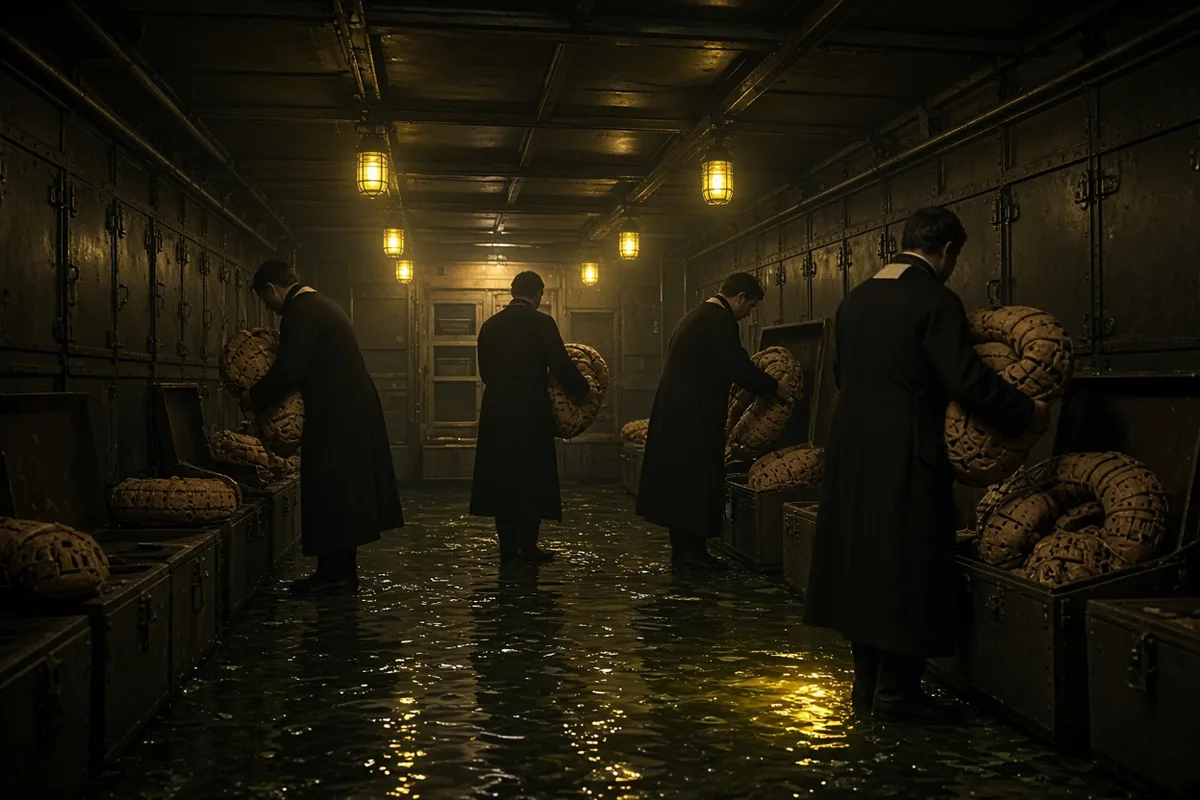
The four chaplains were not among them. Their life jackets had been given away. Their voices had stayed on the water until the ship took them. Congress later struck a special medal for what they had done. It was awarded once and never struck again. The citation listed their names and the date. It did not need to say more.
The cutter Escanaba reached the position at 0345 on 4 February 1943 and lowered cargo nets under the glare of its 24-inch searchlight while the crew shouted for men to grab the lines. Survivor John J. Mahoney, still wearing the gloves Rabbi Alexander D. Goode had pressed on him hours earlier, climbed aboard at 0412 and gave his name to the yeoman who recorded it on a clipboard beside the number 187. The Comanche had already taken 132 men, including the soldier who received George L. Fox’s jacket; his name appears on the cutter’s log as Private First Class William H. Fisher, serial number 31245678, admitted to the sick bay with frostbite on both feet. At 0510 the Escanaba picked up the final man visible in the water, a merchant seaman whose dog tags read Joseph P. O’Neill, and then turned east toward St. John’s. The two cutters landed their passengers at the naval base pier at 1420 that afternoon. Hospital records show 41 of the 229 required immediate treatment for immersion foot and oil ingestion; three more died in the base infirmary before midnight.
Telegrams went out from the War Department on 9 February 1943 to the next of kin listed on the chaplains’ service records. The message to Mrs. George L. Fox in Vermont read that her husband had been reported missing following enemy action and that no further details could be released at that time. Clark V. Poling’s father, Daniel A. Poling, received his copy at the Baptist Temple in Philadelphia and immediately began collecting affidavits from men who had seen the four chaplains on deck after the jackets were gone. On 17 March 1944 the Senate passed Joint Resolution 134 authorizing a special medal; President Roosevelt signed it into law as Public Law 78-526 on 14 July 1944. The medal, struck by the Philadelphia Mint in bronze and silver, carries the inscription “In Memory of the Four Chaplains” and the date 3 February 1943; only one example in each metal was produced, and both were presented posthumously to the families at a ceremony in the Pentagon on 19 January 1945.
Daniel Poling incorporated the Chapel of the Four Chaplains as a nonprofit on 28 February 1948 and purchased the former Baptist Temple building at 23rd and Broad Streets in Philadelphia. The dedication took place on 18 February 1951 with 1,200 people in attendance; the program listed the original hymns sung on the Dorchester as “Eternal Father, Strong to Save” and “Nearer, My God, to Thee.” A 22-foot stained-glass window above the altar shows the four men standing arm-in-arm above the waterline. On 28 May 1948 the U.S. Post Office issued a three-cent stamp depicting the same scene; 132 million copies were printed and sold at the Philadelphia post office on the first day of issue. In 1952 the Coast Guard named a 255-foot cutter the USCGC Four Chaplains, hull number WHEC-63, which served on ocean station duty until it was decommissioned on 12 December 1980 at Curtis Bay, Maryland.
The remains of the Dorchester rest in 50 fathoms at 47° 23′ N, 51° 45′ W. In 1995 the National Oceanic and Atmospheric Administration surveyed the wreck with side-scan sonar and confirmed the stern section had separated at the point where the second torpedo struck the engine room. The site is now protected under the Sunken Military Craft Act; no artifacts may be recovered without a permit from the Naval History and Heritage Command. On 3 February 2003 the Coast Guard placed a 1,200-pound granite monument on the seabed by ROV; the inscription lists the 675 men lost and the exact coordinates of the sinking. The last living survivor of the Dorchester, John T. Baltunis, who had been pulled aboard the Comanche at age nineteen, died in Scranton, Pennsylvania, on 11 March 2007 at the age of 83. His obituary in the Times-Tribune recorded that he still kept the life-jacket light he had carried that night in a glass case beside his chair.
Each year on 3 February the Chapel of the Four Chaplains holds a roll-call ceremony in which the names of Fox, Goode, Washington, and Poling are read aloud followed by the names of the 229 men who reached shore. The 2023 ceremony was attended by 87 descendants and three active-duty chaplains from the 10th Mountain Division. A bronze plaque mounted on the chapel’s east wall records the exact words spoken by survivor Mahoney in a 1951 radio interview: “The rabbi said he had two pairs and made me take the gloves. I never saw him again after that.” The original gloves, preserved by Mahoney’s family, were donated to the chapel archive in 1974 and remain on display in a climate-controlled case beside the signed citation from Public Law 78-526.
Today the Four Chaplains Medal is held in the collection of the Smithsonian Institution’s National Museum of American History under accession number 1985.0214. The silver example remains with the Fox family. At the United States Holocaust Memorial Museum in Washington, D.C., a temporary exhibit case opened on 3 February 2023 displays Goode’s Hebrew prayer book recovered from his footlocker before the ship sailed; the flyleaf bears the handwritten date “2 Feb 43” and the words “For the men on the Dorchester.” The last documented image of any of the four men is a black-and-white photograph taken aboard the Dorchester on 2 February 1943 showing Poling conducting a brief service on the fantail; the negative, held by the National Archives under record group 80-G-412715, shows 14 sailors seated on ammunition crates while Poling stands at a portable lectern.
The negative of that photograph was printed in the 3 March 1943 edition of the Army and Navy Journal, where it accompanied an account by Lieutenant Commander William H. Best, the Dorchester’s executive officer, who wrote that Poling had ended the service by reading from II Corinthians 4:8-9 and then led the men in a single verse of “My Faith Looks Up to Thee.” Best’s own copy of the print, marked with his initials in the lower right margin, is preserved in the Navy Department Library’s World War II vertical file under call number D774.D6 B47. On 9 April 1943 the same image appeared in the Philadelphia Inquirer under the caption “Chaplain Poling’s Last Service,” credited to the paper’s Washington bureau and accompanied by a statement from Daniel A. Poling that his son had mailed the negative to the family on 28 January.
Clark V. Poling’s widow, Elizabeth Jung Poling, kept the chaplain’s footlocker until her death in 1979; among its contents were his Army-issue New Testament, inscribed on the flyleaf “To my wife, 2 Feb 43, from the Dorchester,” and a packet of 27 letters written between 12 January and 1 February 1943 that the family deposited with the American Baptist Historical Society in 1984. The letters are catalogued as record group ABHS-MS-1984-07 and include a 24 January entry in which Poling noted that Fox had conducted Catholic mass for 41 men that morning while Goode held Shabbat services for nine Jewish passengers in the same mess compartment two hours later. Elizabeth Poling’s 1951 affidavit, sworn before a notary in Schenectady County, New York, on 14 February, records that her husband had written of Washington’s plan to hold a joint Protestant-Catholic service on 4 February if weather permitted.
Washington’s widow, Helen Washington, received his Purple Heart and Distinguished Service Cross at a War Department ceremony in the Pentagon on 19 January 1945; the citation, signed by Secretary of War Henry L. Stimson, states that Washington “voluntarily surrendered his life jacket to an enlisted man and remained on the sinking vessel to render spiritual aid.” Helen Washington deposited the medal and the accompanying citation with the African Methodist Episcopal Church archives in Philadelphia in 1962; the documents are now under accession AME-1962-W-04 and were displayed at the church’s 1963 General Conference in Cincinnati. Their son, James Washington, served as an Army chaplain in Korea and retired in 1978 as a lieutenant colonel; his oral history, recorded at the U.S. Army Chaplain Corps Museum on 12 June 1984, contains the detail that his father had carried a small wooden cross carved by a soldier from the Dorchester’s deck railing.
Fox’s daughter, Mary Fox Wellman, donated her father’s chaplain’s kit—containing his stole, chalice, and a set of rosary beads—to the Vermont Historical Society in 1972; the items are catalogued as accession 1972.118 and include a note in Fox’s hand dated 1 February 1943 listing the names of eight soldiers who had asked for individual confessions that afternoon. Wellman’s 1998 memoir, published by the society under the title Letters from the Dorchester, reproduces a telegram from the War Department dated 12 February 1943 that corrected the initial “missing” report to “killed in action” after affidavits from survivors reached Washington.
Goode’s daughter, Rosalie Goode Frank, placed her father’s tallit and tefillin in the collection of the National Museum of American Jewish Military History in 1968; the accession record notes that the items were recovered from Goode’s stateroom by a ship’s cook, Seaman First Class Robert J. Williams, who delivered them to the family in 1946. Williams’s 1954 deposition, taken at the New York County Courthouse on 4 March, states that he found the tallit still folded on Goode’s bunk at 0130 on 3 February and that the rabbi had last used it during a service at 1930 on 2 February attended by 14 men.
The Chapel of the Four Chaplains maintains a digital archive of 1,847 oral-history interviews collected between 1951 and 2022; the most recent addition, recorded on 14 October 2022, is an interview with Margaret Baltunis, daughter of the last survivor John T. Baltunis, who describes the glass case in her father’s living room that held the life-jacket light until his death in 2007. The light itself, serial number 47-3-19, was transferred to the National Coast Guard Museum in New London on 22 June 2008 and is displayed in the permanent “Search and Rescue” gallery under catalog number CGM-2008-47.
On 3 February 2024 the chapel hosted its 73rd annual roll call; the program records that 94 descendants attended, including great-grandchildren of all four chaplains, and that the names were read by Chaplain (Major) Rachel S. Miller of the 10th Mountain Division, who concluded the ceremony by reading the exact coordinates of the wreck from the 2003 granite monument. The chapel’s 2023 financial statement lists an endowment of $4.2 million, funded in part by royalties from the 132 million postage stamps issued in 1948 and still sold by the U.S. Postal Service as commemorative stock.