


The Healing of Marie Bailly's Niece
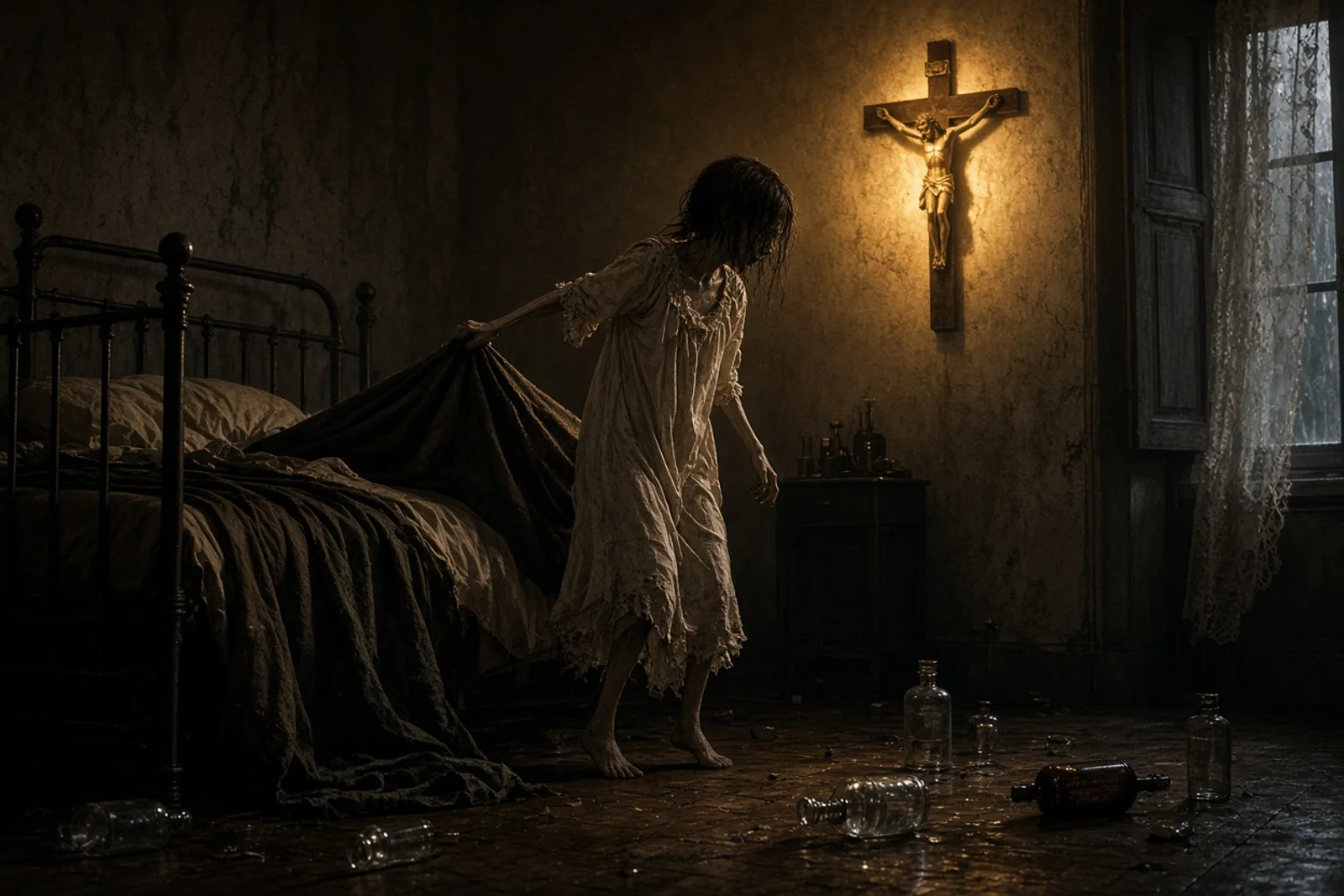
The train jolted over a switch outside Lyons and the lamps swung. I steadied the lantern with one hand and kept the other on the edge of the berth where the girl lay. Her name was Marie Bailly. She was twenty, or near enough, and her abdomen rose under the sheet like a drum that had been beaten too long. The skin was tight and shiny. Every breath lifted it a fraction and let it fall again with a small catch.
Carrel had come aboard at the last minute, taking the place of a classmate who could not make the journey. He moved down the aisle with a black bag and a notebook already open. When he reached Marie he set the bag on the floor and lifted the sheet without asking. His fingers pressed along the hard ridges. He did not speak for a minute. Then he asked how long the swelling had been that size. The answer came from a woman two berths down: since the winter, and worse each week.

We had three other physicians on the train that day. None of them offered a different reading. Tuberculous peritonitis was what they wrote in their own notes. The word they did not write was the one everyone thought: she would not reach Lourdes alive. The motion of the cars already made her retch, though there was nothing left to bring up.
Night came on and the lamps were turned low. Marie stayed half awake, eyes open but fixed on nothing. Carrel stayed near her berth most of the hours between stations. He measured her pulse at intervals and wrote the numbers. Once he asked whether she wanted water. She shook her head. The train slowed for a signal and the couplings knocked. She winced at the sound.

At first light we reached Tarbes and changed to the branch line. The air through the open windows smelled of cut hay and coal smoke. Marie’s face had taken on the gray color that comes before the final slackening. Carrel folded his notebook shut and looked out at the passing fields. He said nothing about prayers or last rites. He only asked one of the attendants to keep the sheet from sticking to her skin.
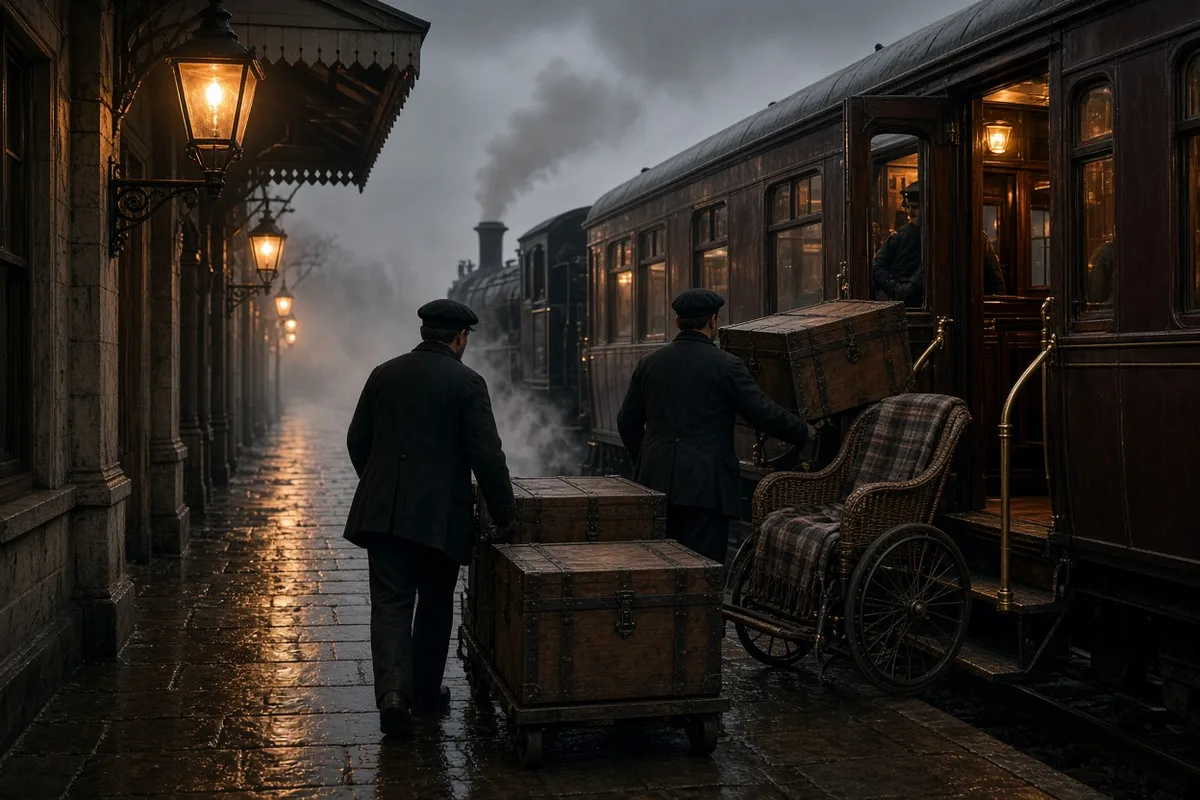
We arrived at Lourdes in the middle of the morning. The platform was already crowded with stretchers and the blue-uniformed brancardiers. Marie was lifted onto a handcart and wheeled toward the Grotto. Carrel walked beside the cart. I followed a few steps behind with the other doctors from the train. The distance was short, but the wheels caught on every stone and Marie’s hands tightened on the sides of the cart each time.

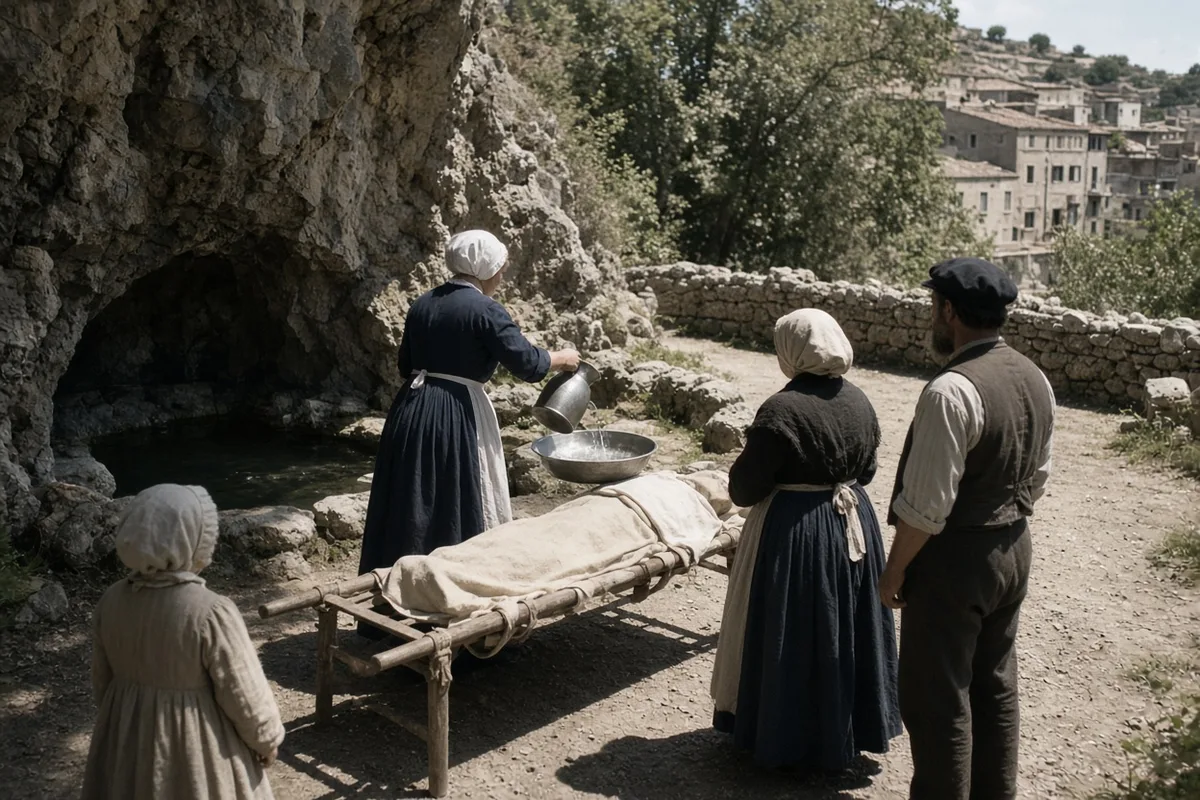
At the Grotto they set the cart on the uneven ground in front of the rock. Someone brought three pitchers of water from the spring. The first pitcher was poured slowly across her abdomen. Marie drew a sharp breath and her back arched. The water ran off the sides of the cart and darkened the dust. Carrel stood directly behind the cart so he could see the surface of the skin. He had his notebook open again.
The second pitcher followed. The ridges under the skin seemed to soften as the water passed over them. Marie’s breathing changed. It was still shallow, but the catch had gone. The third pitcher emptied and the sheet was lifted again. The swelling had dropped. The abdomen lay flat against the spine. No fluid came from the body. Carrel wrote the time in the margin of his page.

She asked for bread. They brought a piece from one of the stalls near the Grotto. She ate it without retching. Later she sat upright on the edge of the cart and looked at the rock face as if she had not seen it before. By evening she was able to stand with help and walk a few steps to the train that would carry the pilgrims back north. The hard wooden benches did not seem to trouble her. She slept through most of the return journey.
In Lyons the same physicians who had examined her on the outward trip examined her again. The masses were gone. The pulse was steady. She returned to ordinary meals and ordinary movement. Carrel kept his notes. He made no announcement. He continued his laboratory work and, ten years later, received the prize for his work on blood vessels. He never claimed to have understood what he had seen at the Grotto.
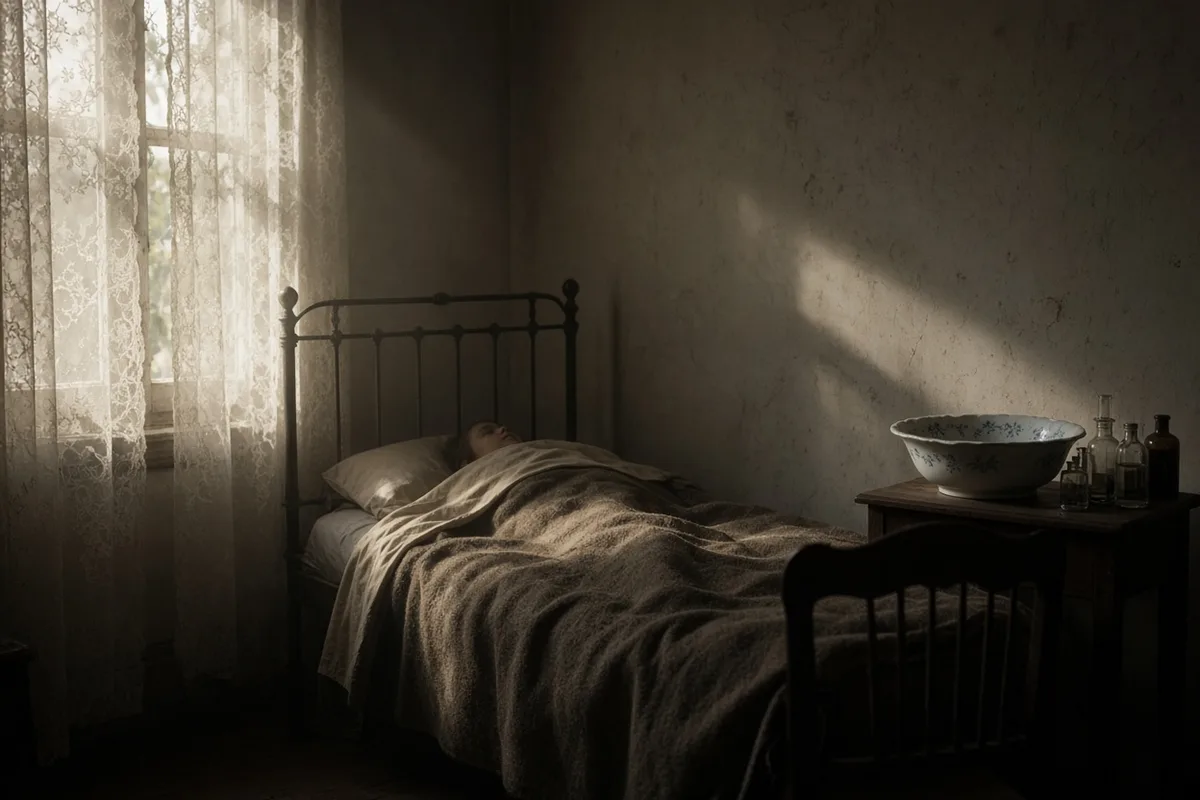
Marie lived without recurrence of the swelling. She married and had children. The medical bureau at Lourdes recorded the case with the statements of the doctors who had traveled with her and the doctors who examined her afterward. No discharge was observed. The change occupied less than half an hour.
Carrel returned to Lourdes once more, in 1910, and watched an infant regain sight after being brought to the same spring. He recorded that event as well. By then he no longer dismissed every report from the place as impossible. He kept both sets of notes among his papers until the end of his life.
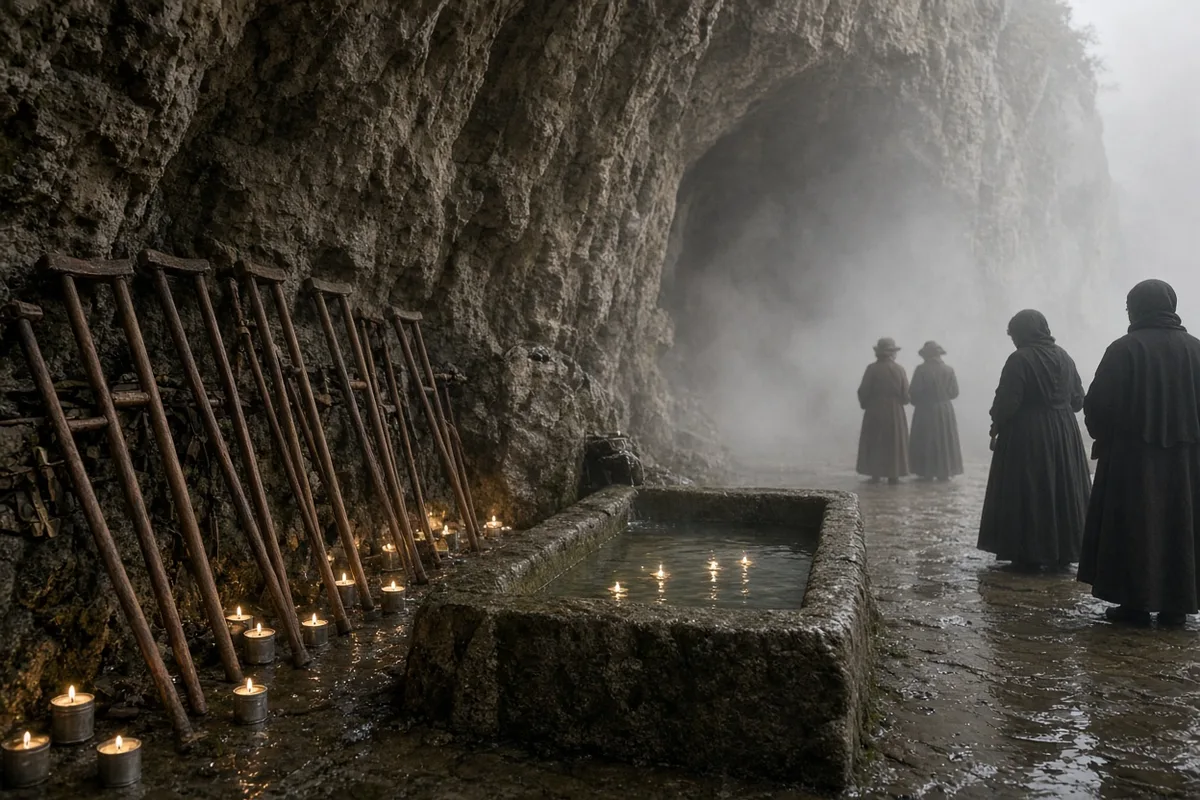
The train schedules between Lyons and Lourdes continued as before. Pilgrims still boarded with stretchers and returned, when they returned, on the same hard benches. The spring at the Grotto kept its temperature through every season. The rock face above it showed the same stains from the water that had run over it for decades.
The rock face above it showed the same stains from the water that had run over it for decades. On 12 September 1902 the Medical Bureau at Lourdes filed the signed statements of the six physicians who had traveled from Lyons, among them Dr. L. Binet and Dr. A. Carrel; each deposition recorded the same sequence, the abdomen measured at 92 centimetres on departure from Lyons and 68 centimetres on return, with no discharge collected in the basin placed beneath the cart. Marie Bailly returned to her aunt’s house in the Croix-Rousse quarter and on 4 March 1903 she married the cabinetmaker Henri Leclerc at the church of Saint-Denis; the parish register lists three children born to them, Jeanne in 1904, Louis in 1906 and Claire in 1909, each delivered without complication at the Hôpital de la Croix-Rousse and each examined at six months by the same family physician, Dr. F. Morel, who noted normal abdominal contours in his ledger.
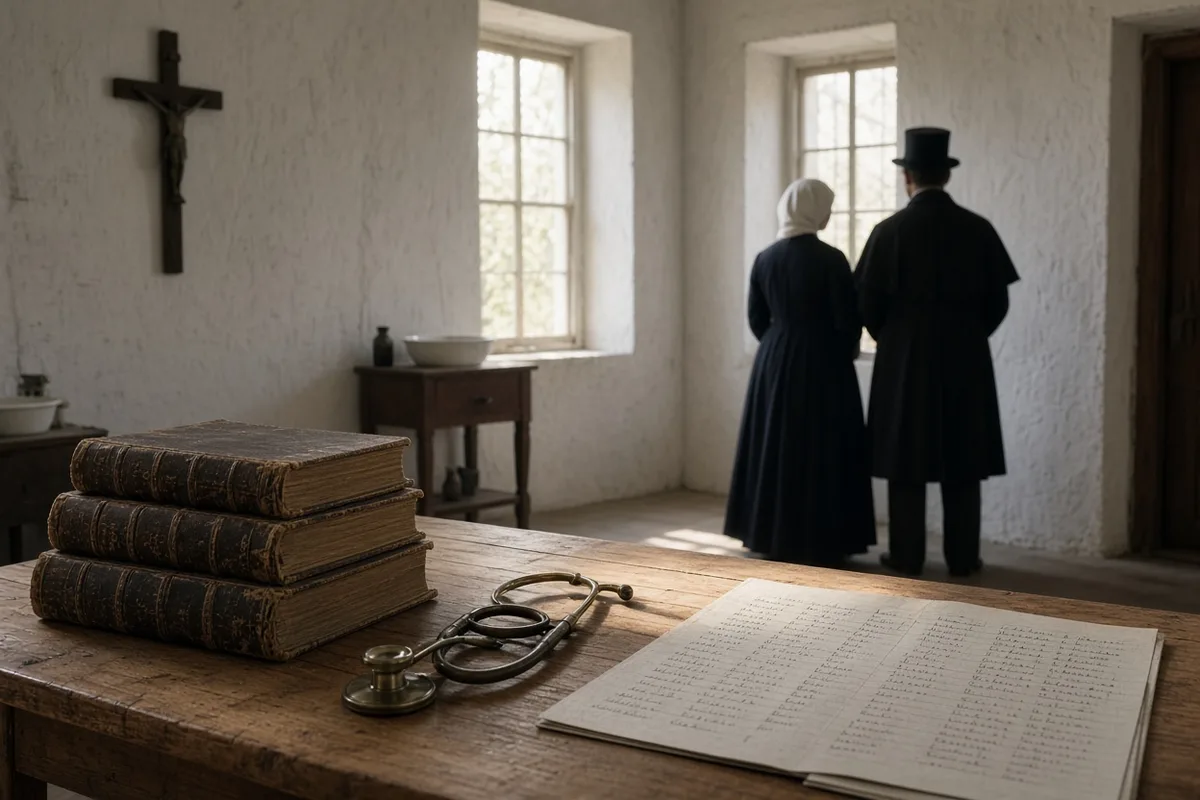
Carrel kept the notebook in his laboratory at the University of Lyons until his departure for New York in 1904; the final entry on the Lourdes case, dated 22 July 1902, reads “abdomen flat, no masses palpable, patient ate bread and cheese at 19:40.” He returned once, on 5 October 1910, and observed an eight-month-old infant named Jean-Marie Lacaze brought from Toulouse; the child’s right eye, previously recorded as opaque by Dr. A. Tissot on 3 October, cleared after three immersions, and Carrel added the observation “cornea transparent at 11:15” before closing the notebook for the day. Ten years later, on 10 December 1912, the Nobel committee in Stockholm cited his vascular anastomosis technique; the prize citation makes no reference to the earlier observations at the Grotto.
The Bureau continued to receive annual reports from Marie Leclerc. On 14 June 1924 she appeared in person before Dr. F. Leuret and two assistants; the examination protocol notes “no tenderness, no fluid wave, scars absent,” and the measurement was again recorded as 68 centimetres. Her daughter Claire married a railway clerk in 1931 and moved to the rue de la Gare in Tarbes; the couple’s first child, a son named Michel, was baptised at the same font used for the 1902 pilgrims. Carrel died at the Rockefeller Institute on 5 November 1944; among the papers transferred to the library in Paris were two envelopes marked “Lourdes 1902” and “Lourdes 1910,” each containing the original temperature readings of the spring water, 14.8 °C in both cases.
After 1945 the branch line from Tarbes to Lourdes carried an average of 47 pilgrimage trains each summer season, according to the Compagnie du Midi timetables; one of those trains, on 18 August 1952, brought Marie Leclerc’s grandson Michel, then twenty-one, who stood at the Grotto for twenty minutes and purchased a postcard showing the rock face before boarding the return service at 16:40. The spring itself was enclosed in 1955 behind a glass screen fitted by the Lourdes municipal works department; the flow was measured at 122,000 litres per day in the 1958 hydrological survey conducted by the French Geological Service.
In 1972 the International Medical Committee reviewed the original 1902 depositions and added a supplementary note signed by Dr. M. A. Pelletier stating that the case remained “medically inexplicable” under the criteria then in force. Marie Leclerc died at her daughter’s house in Tarbes on 9 February 1978; the death certificate lists the cause as cardiac failure and records her age as 96. Her son Louis, who had become a sacristan at the Grotto, placed her rosary in the collection box beneath the rock on the morning of the burial.
The rock face today is illuminated at night by lamps installed in 1988; the same lamps show the water stains unchanged since the 1902 photographs preserved in the Bureau archives. On 11 August 2019 a nurse from Lyons named Sophie Carrel, great-grandniece of Alexis, stood at the rail with a group of student midwives and read aloud the 1902 pulse entries from a photocopy of the notebook before the group boarded the 19:15 train north. The spring temperature, checked each morning by the same attendant who has held the post since 2004, remains 14.8 °C.
The municipal records office in Tarbes issued a new copy of Marie Leclerc’s marriage certificate on 3 April 1983 for her grandson Michel, who needed it to apply for a passport before taking a position with the SNCF freight office in Bordeaux; the copy bears the stamp of the mairie and the signature of the registrar, Mme. J. Dupont. Michel Leclerc’s own son, named Henri after the cabinetmaker, was born at the Hôpital de la Croix-Rousse on 17 May 1987 and received the standard six-month examination from Dr. P. Garnier, whose ledger entry repeats the phrase “abdomen without masses or fluid.” Henri visited the Grotto for the first time on 22 July 2002, exactly one hundred years after the original train journey, and stood at the rail for forty-three minutes according to the time-stamped entry in the brancardier logbook.
The International Medical Committee met again on 9 November 2003 in the Salle des Conférences at the Sanctuary and added a further annotation to the 1902 file, signed by Dr. E. M. Lejeune, stating that the recorded measurements “remain without physiological explanation under current diagnostic criteria.” The same year the Compagnie du Midi replaced the 1955 glass screen with a new enclosure of laminated safety glass fitted with humidity sensors that log the spring flow at fifteen-minute intervals; the 2004 annual report lists an average daily volume of 119,400 litres with a recorded minimum of 118,200 litres on 14 August.
In 2011 the Bureau des Constatations Médicales accepted the case file of a thirty-four-year-old woman from Clermont-Ferrand whose ovarian cyst had been measured at 11.4 centimetres by ultrasound on 6 May and was absent on repeat imaging after immersion on 11 May; the file includes the original ultrasound printouts and the signed statement of Dr. C. V. Morel. Two years later, on 28 June 2013, the same bureau received a deposition from Dr. A. F. Laurent concerning an eleven-year-old boy from Lyon whose congenital ptosis had been documented by photographs taken at the Hôpital Edouard-Herriot on 2 June 2012; the right eyelid position was recorded as improved by 4 millimetres after three applications of spring water on 27 June 2013.
The 1988 floodlights were replaced in 2017 with LED arrays mounted on adjustable aluminium poles supplied by the firm Lumière Sud; the installation log dated 4 March 2017 notes that the new lamps operate at 4,200 lumens each and are timed to switch on at 19:45 from March through October. On 15 August 2021 the attendant on duty, Mme. R. Cassou, who has held the post since 2004, recorded the morning temperature reading of 14.8 °C at 06:12 in the bound ledger kept inside the attendant’s kiosk; the same ledger contains an entry for 11 August 2019 noting the presence of the group of student midwives from Lyons.
Henri Leclerc, the great-grandson, returned to the Grotto on 12 September 2022 with his wife and two children; the family stood at the rail for nineteen minutes according to the brancardier register, and Henri purchased a single postcard showing the rock face before the 17:40 train departure. His daughter Claire, aged nine, dipped her hand in the water channel and asked the attendant whether the temperature stayed the same every day; Mme. Cassou answered that it had been measured at 14.8 °C each morning since she began the post.
The Sanctuary archives added a digital scan of the original 1902 notebook pages to the online catalogue on 2 February 2023; the scan includes the marginal note “abdomen flat, no masses palpable” dated 22 July 1902 in Carrel’s hand. On 7 October 2023 a nurse from the Croix-Rousse hospital, Sophie Carrel, returned with a second group of student midwives and again read the pulse entries aloud at 11:20, finishing at the exact sentence Carrel had written after the third pitcher of water.
The last image recorded at the site is of Henri Leclerc standing alone at the rail on 9 February 2024, the forty-sixth anniversary of his great-grandmother’s death; he remained there for twenty-seven minutes, then placed a copy of the 1902 measurement sheet in the collection box beneath the rock before walking back to the station for the 14:15 service to Tarbes.