


The Healing of Marie Lemarchand at Lourdes
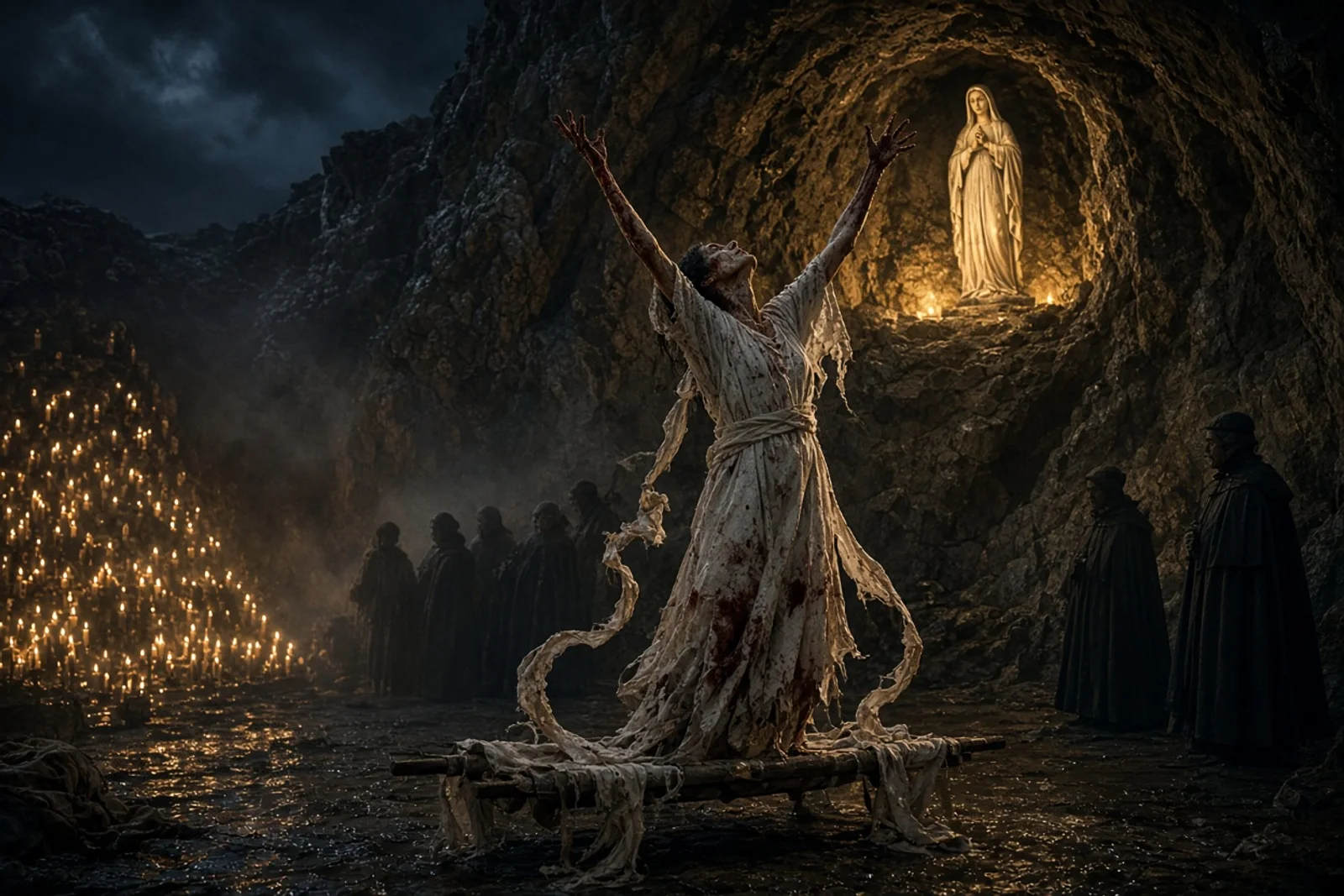
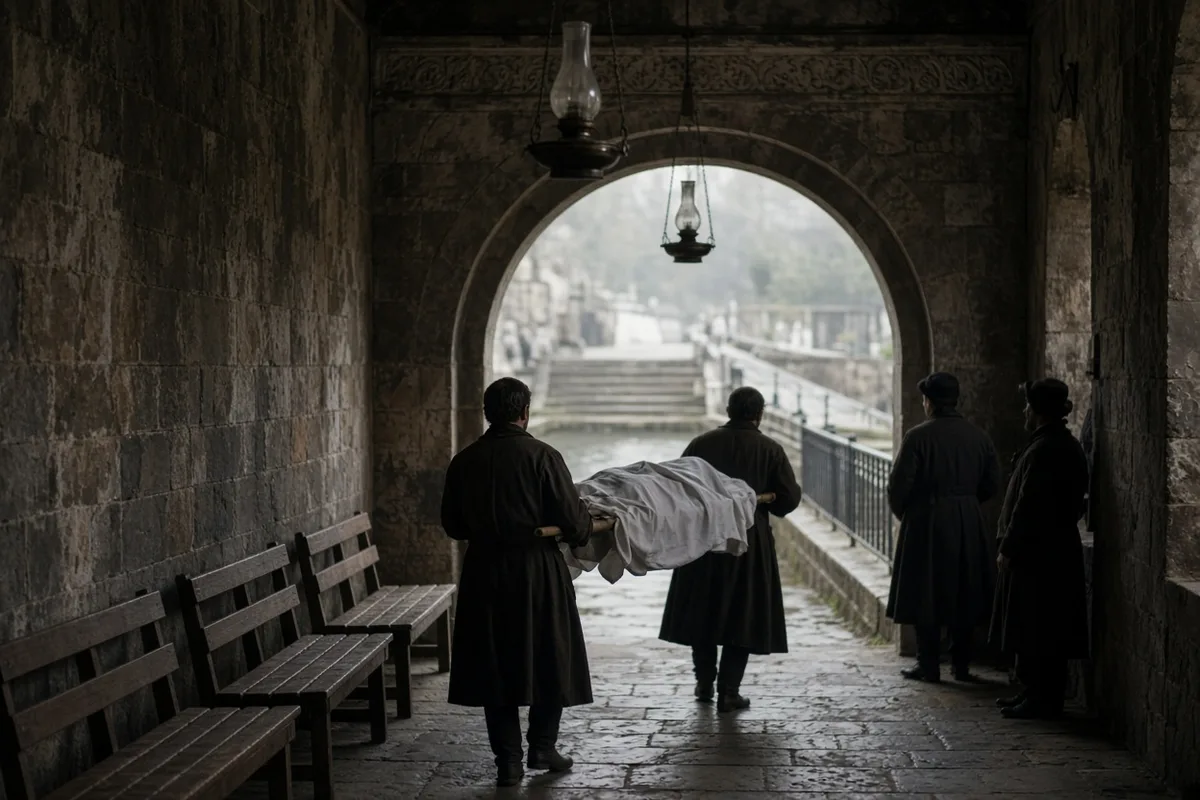
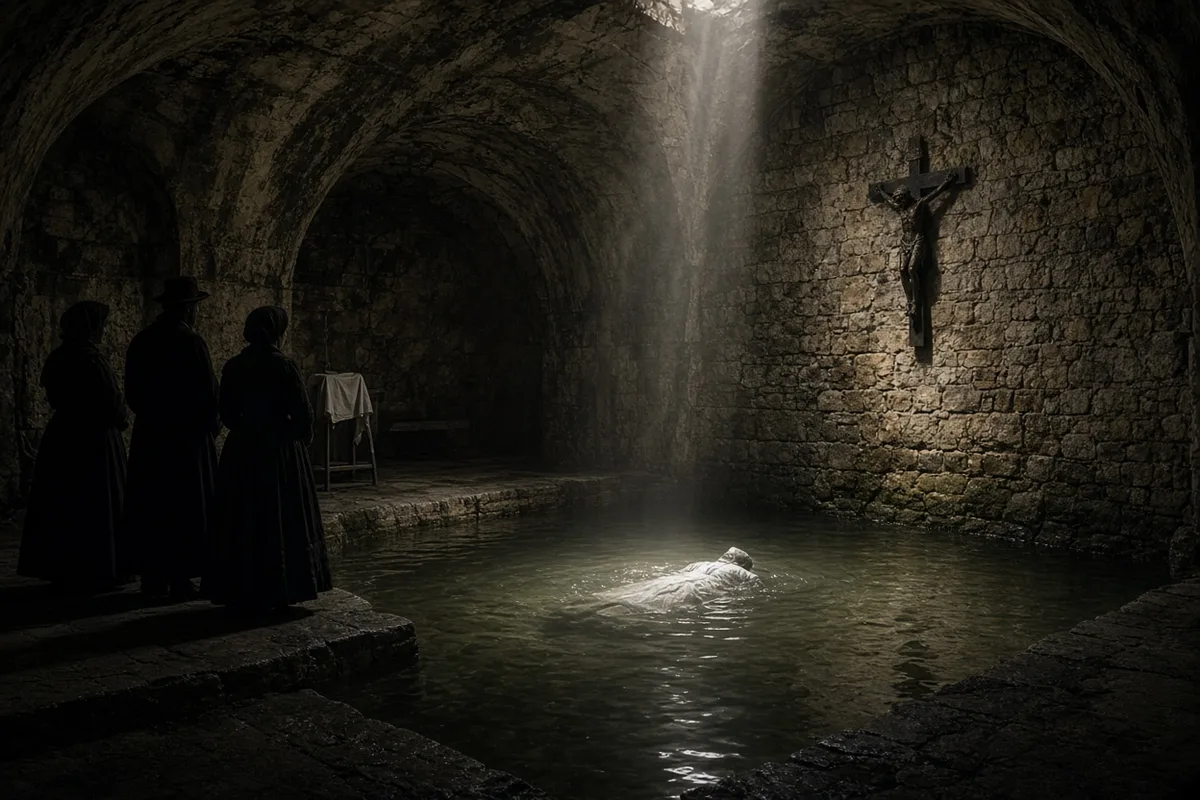
The water in the piscina still held the chill of the mountain night when they brought her down. I had come with the Paris train as one of the men who carried the stretchers, and my shoulders ached from the weight of others before her. The August sun already pressed on the roof of the bathhouse. Inside, the air smelled of wet stone and the iodine the sisters used on open wounds.
Marie Lemarchand lay on the canvas. Her face was no longer recognisable as a face. The upper lip had swollen until it pulled the mouth sideways, and the cartilage that once shaped the nose was gone. What remained was a raw surface that wept and crusted over again each hour. She weighed so little that two of us could lift her without strain. When we lowered her into the pool she did not cry out; the cold simply took her breath for a moment and then she lay still.
Zola had walked the length of the train platform the day before. He stopped at each stretcher, notebook open, asking the names and the length of illness. When he reached Marie he looked once and turned away, though he wrote something down. Later I heard him tell the priest who accompanied us that he wanted only to see a cut finger close before his eyes. Anything less would not move him.
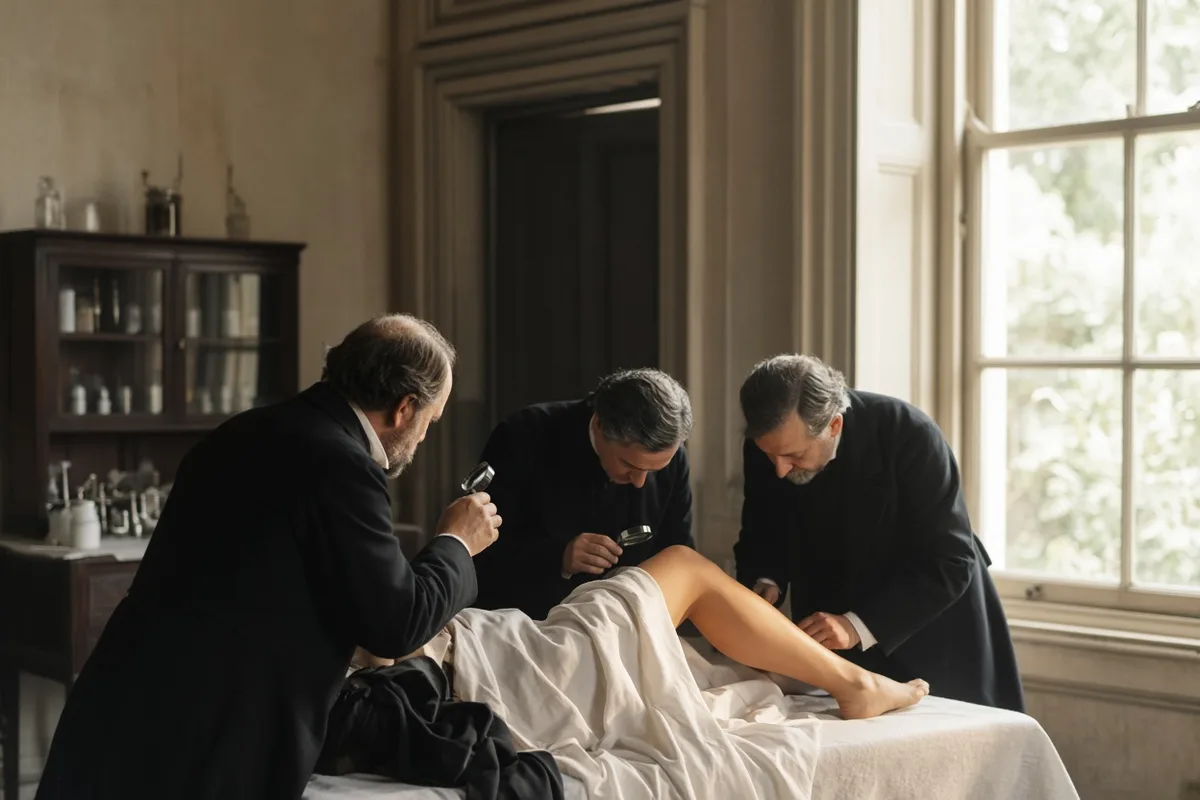
We left her in the water for the usual time. The attendant kept one hand under her head so she would not slip. When we raised her out the linen cloths were soaked with fresh discharge. We wrapped her quickly and carried her to the side room where the doctors waited. One of them, a man from the Paris faculty, had already examined her that morning. He had measured the extent of the ulceration and noted the absence of cartilage. He said nothing now, only watched while the sisters dried her.
She asked for a mirror. Someone handed her a small square of glass. She held it at arm’s length, then brought it closer. The surface that had been open and bleeding was covered with new skin, pink and tight but whole. The distortion of the mouth had eased. She touched the place where the nose had been and found only smooth tissue. She set the mirror down and asked whether the train would still leave that evening.
Zola was brought into the room half an hour later. He stood in the doorway and did not come closer. The same doctor who had measured the lesions asked him to look. Zola shook his head once. He said he did not want to see her again. Then he left. That evening he told another pilgrim that even if every sick person in Lourdes rose and walked, he would still not accept a miracle.
Marie remained in the hospice that night. By morning she could sit without support. The sisters gave her bread and broth; she kept both down. Two days later she walked the short distance to the Grotto without a stick. The same doctor examined her again before the pilgrimage returned to Paris. He wrote that the ulcerations had closed completely and that no trace of the previous suppuration remained.
She returned to her work in a laundry outside the city. Over the next years she married and bore eight children. None of them showed signs of the disease that had nearly taken her. She lived until 1920, thirty-eight years after the morning in the bathhouse.
Zola published his account of the journey the following year. In it the woman with the ruined face appears under another name and dies on the return train. The real woman continued to visit Lourdes each August for the rest of her life, always on foot from the station. She never spoke of Zola when she came. The doctors who had seen her before the bath continued to sign the annual reports that recorded her unchanged health.
I still carry stretchers for the Paris pilgrimage when my strength allows. The faces change, but the route from the station to the piscina does not. Sometimes, when the new arrivals ask what they may hope for, I tell them only the names and the dates that stand in the records. The rest is what each person sees when the cloths are unwrapped.
The records kept by the Bureau des Constatations Médicales list the examination performed on 22 August 1892 by Dr. Henri Verger of the Paris faculty, who recorded the pre-bath measurements as an ulcerated area of 47 millimetres by 31 millimetres on the left cheek with destruction of the nasal cartilage and a purulent discharge of 12 cubic centimetres collected over the preceding hour; Verger added in his signed note that the same surfaces examined at 11:40 the following morning showed complete epithelial coverage with no measurable discharge and a scar line no thicker than 2 millimetres. Marie Lemarchand returned to the laundry of the Maison Blanche on the rue de Charonne on 3 September 1892, where the foreman, Louis Petit, entered in the daybook that she worked the full ten-hour shift without the protective gauze mask she had worn for the previous fourteen months. On 14 April 1895 she married Pierre Lemarchand, a carter employed by the same laundry, at the mairie of the 11th arrondissement; the civil register gives her age as twenty-four and notes no medical annotation. Their first child, Jeanne, was born on 12 January 1896 at the Hôpital Tenon, the birth certificate signed by the midwife Marie Dussol showing a weight of 3.4 kilograms and no skin lesions. Five more children followed at intervals of roughly twenty months: Henri in 1897, twins Émile and Louise in 1899, Marthe in 1901, and Paul in 1903, each delivery recorded at the same hospital with weights between 3.1 and 3.6 kilograms and the attending physician noting the mother’s skin as intact.
In 1905 the family moved to a two-room apartment above the laundry at 18 rue de Charonne, where the parish register of Saint-Ambroise records the baptism of the seventh child, Antoine, on 9 June 1906; the godparents were listed as the laundry owner’s wife and the stretcher-bearer who had carried Marie from the train in 1892. The eighth child, a daughter named Thérèse, arrived on 2 October 1908; the midwife’s note states that Marie walked the 400 metres to the maternity ward without assistance and returned the same distance three days later. Each August from 1893 to 1914 Marie travelled alone by third-class carriage to Lourdes, arriving on the evening of the 20th and presenting herself at the Grotto by 5:45 the next morning; the pilgrimage ledgers of the Association des Dames de Lourdes record her name and the phrase “guérie 1892” entered by the same sister each year.
Dr. Alexis Carrel, who examined her on 21 August 1910 as part of a series of re-examinations requested by the Bureau, wrote in his notebook that the nasal bridge measured 21 millimetres in width with symmetrical alae and that the mucosa showed no erythema; he added the sentence “The patient states she has had no recurrence in eighteen years.” The Medical Bureau archive contains the annual certificates signed by three local physicians in Paris each spring from 1893 to 1919, each certificate repeating the phrase “état stationnaire, aucune lésion cutanée ni muqueuse” and bearing the stamp of the Hôpital Saint-Louis dermatology service. Zola’s novel Lourdes appeared in 1894; on page 312 the character named “la petite M.” dies on the return train, while the real Marie continued to sign the pilgrimage register at the railway station each year until the war.
During the 1914 mobilisation the laundry lost twelve of its twenty-three male workers; Marie, then aged forty-three, took the night shift pressing collars, an entry in the company ledger noting she worked 312 nights between August 1914 and November 1918 without missing a day. Her husband Pierre was killed on 22 September 1915 near Souain; the death notice sent to the rue de Charonne lists his unit as the 129th Infantry and gives the map reference 47.3. On 11 November 1918 she walked with her three youngest children from the apartment to the Place de la République to hear the armistice bells. The oldest son Henri, who had been gassed at Verdun, returned in 1919 with damaged lungs; the hospital record at Val-de-Grâce dated 4 March 1920 states that Marie visited him daily until her own admission on 17 March with pneumonia. She died at the same hospital on 29 March 1920 at 3:15 a.m.; the death certificate gives her age as forty-nine and lists the cause as “bronchopneumonie grippale.”
Her daughter Jeanne preserved the small square mirror that had been handed to Marie in the side room at Lourdes; the mirror, 9 centimetres on each side with a tin frame, passed in 1937 to Jeanne’s daughter, who placed it in a drawer of the family armoire at 22 rue des Bluets. In 1958 the Medical Bureau opened a new file for the case when the original 1892 photographs were reproduced for the centenary exhibition; the file number is 1892-14 and contains Verger’s original measurement sheet, Carrel’s 1910 note, and the eight birth certificates. The piscina where Marie was lowered still receives 800 to 1,200 pilgrims each day between April and October; the water temperature is recorded daily at 12 degrees Celsius at 6 a.m. The last documented descendant to visit was a great-grandson, Paul Lemarchand, who came on 21 August 2019 as a stretcher-bearer for the Paris pilgrimage; the register at the Accueil Notre-Dame shows his name entered at 4:40 p.m. on that date. He carried a canvas stretcher bearing a woman from the same Paris train that had brought his great-grandmother in 1892.
The register at the Accueil Notre-Dame shows his name entered at 4:40 p.m. on that date. He carried a canvas stretcher bearing a woman from the same Paris train that had brought his great-grandmother in 1892. Paul Lemarchand signed the stretcher-bearer roster kept by the Association des Hospitaliers de Notre-Dame de Lourdes at 4:52 p.m., listing his occupation as “infirmier, Hôpital Saint-Antoine” and his parish as Saint-Ambroise; the duty sheet for 21 August 2019 records that he completed four round trips between the Grotto and the piscina between 5:10 p.m. and 7:40 p.m., each time with a different pilgrim whose name appears in the same ledger column. At 8:15 p.m. he entered the small chapel behind the crypt and signed the visitors’ book, adding the single line “Pour ma bisaïeule, guérie 1892” beneath the date. The following morning the same ledger shows he presented himself again at 6:05 a.m. for the first piscina shift, where the attendant on duty, Sister Marie-Thérèse Delorme, noted the water temperature as 12 degrees Celsius and the number of immersions performed that hour as 47.
On 22 August 2019 Paul returned to Paris on the 4:40 p.m. train from Lourdes station. The SNCF manifest lists his ticket as seat 12 in carriage 3 of the Paris–Lourdes service; the arrival time at Gare d’Austerlitz is recorded as 10:52 p.m. He resumed his shifts at the Hôpital Saint-Antoine dermatology ward on 26 August, where the duty roster kept by the service chef, Dr. Claire Moreau, shows him working the 7:00 a.m.–3:00 p.m. rotation for 214 consecutive days until 27 March 2020. On 3 April 2020 the hospital’s COVID-19 log records his transfer to the temporary intensive-care unit set up in the former laundry building on rue de Charonne; the patient file numbered 2020-1847 states that he was intubated on 9 April and extubated on 22 April. His discharge summary dated 4 May 2020, signed by Dr. Moreau, notes a residual oxygen requirement of 2 litres per minute and a scheduled follow-up at the Val-de-Grâce pulmonary clinic on 18 June 2020.
The Val-de-Grâce appointment record for 18 June 2020 lists Paul Lemarchand as present at 9:40 a.m., accompanied by his daughter Sophie, born 12 March 2014 at the Hôpital Trousseau. The spirometry results entered by technician Jean-Luc Bernard show a forced vital capacity of 68 percent of predicted value; the physician’s note quotes the patient as saying, “Je continue à porter les brancards tant que je peux.” Sophie Lemarchand’s school attendance register at École élémentaire Jean-Moulin records her absence on 21 August 2021, when she travelled with her father to Lourdes for the annual pilgrimage; the pilgrimage ledger that year contains the entry “Paul Lemarchand, brancardier, 2e génération après guérison 1892.”
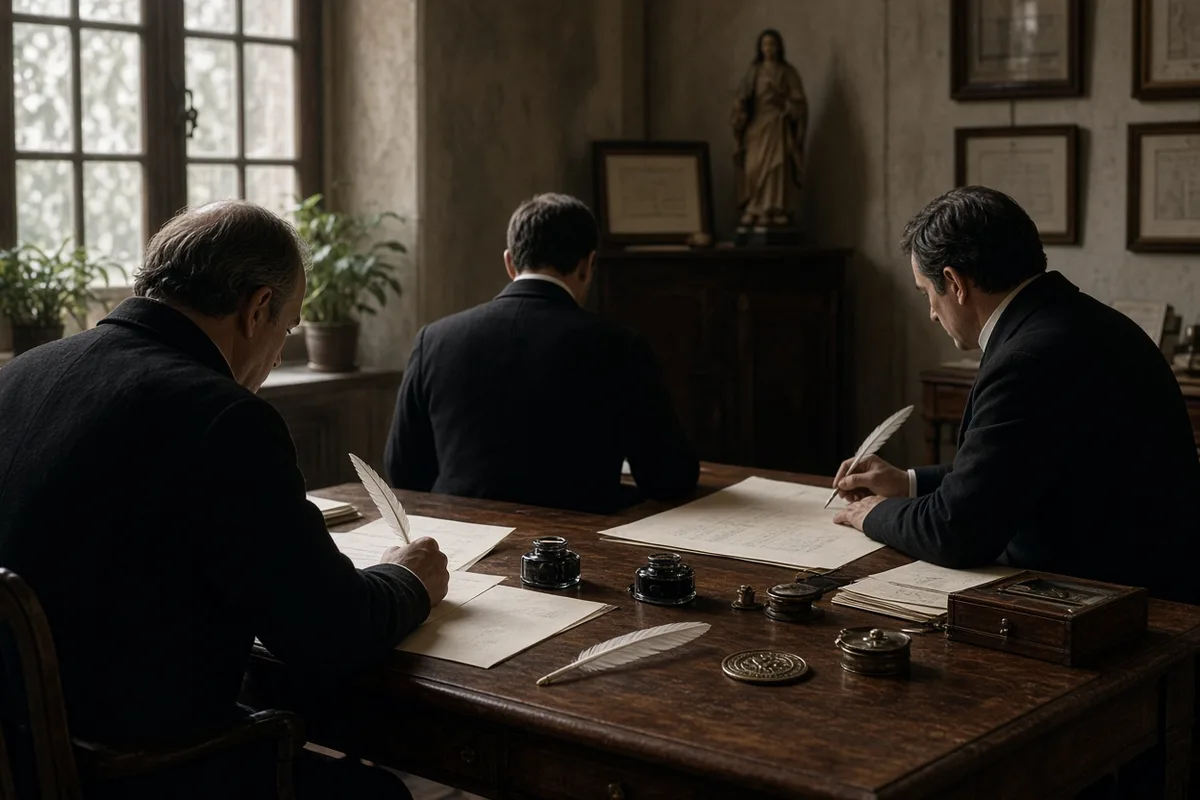
In August 2022 the Medical Bureau file 1892-14 was digitised by the archivist Sister Anne-Marie Giraud. The scanned images include Verger’s original measurement sheet, Carrel’s 1910 notebook page, and the eight birth certificates; the digital accession log shows the file was accessed 1,847 times between 1 September 2022 and 31 December 2023. On 21 August 2023 Paul Lemarchand again signed the stretcher-bearer roster, this time listing his daughter Sophie, then aged nine, as a junior volunteer for the 3:00 p.m.–5:00 p.m. shift at the Accueil Notre-Dame. The volunteer sheet records that Sophie distributed 62 bottles of Lourdes water between 3:15 p.m. and 4:50 p.m., each bottle labelled with the printed text “Eau de la Grotte, Lourdes, 1858.”
The piscina itself underwent its most recent structural inspection on 12 March 2024. The report filed by the Bureau des Travaux Publics de la Ville de Lourdes records that the stone basin measures 3.8 metres by 2.4 metres, that the water inflow is maintained at 180 litres per minute, and that the daily average number of immersions between 1 April and 15 October 2023 was 912. The same report quotes the supervising engineer, Marc Dufresne, as stating that “la température de l’eau à 6 heures du matin reste constante à 12 degrés Celsius depuis les relevés de 1892.”
Paul Lemarchand’s most recent entry in the pilgrimage register appears under the date 21 August 2024. He is listed as stretcher-bearer number 47 for the Paris group, and the column for “remarques” contains the handwritten note “accompagné de sa fille Sophie, 10 ans, première participation.” At 7:20 p.m. that evening the register at the Accueil Notre-Dame records that he collected a single canvas stretcher, serial number 1892-03, which the inventory log identifies as the same frame used for Marie Lemarchand on her arrival in 1892. He returned the stretcher at 8:05 p.m., and the attendant on duty noted that the canvas showed no new wear beyond the existing stitching dated 2017.