


The Incorrupt Body of St. Catherine of Bologna
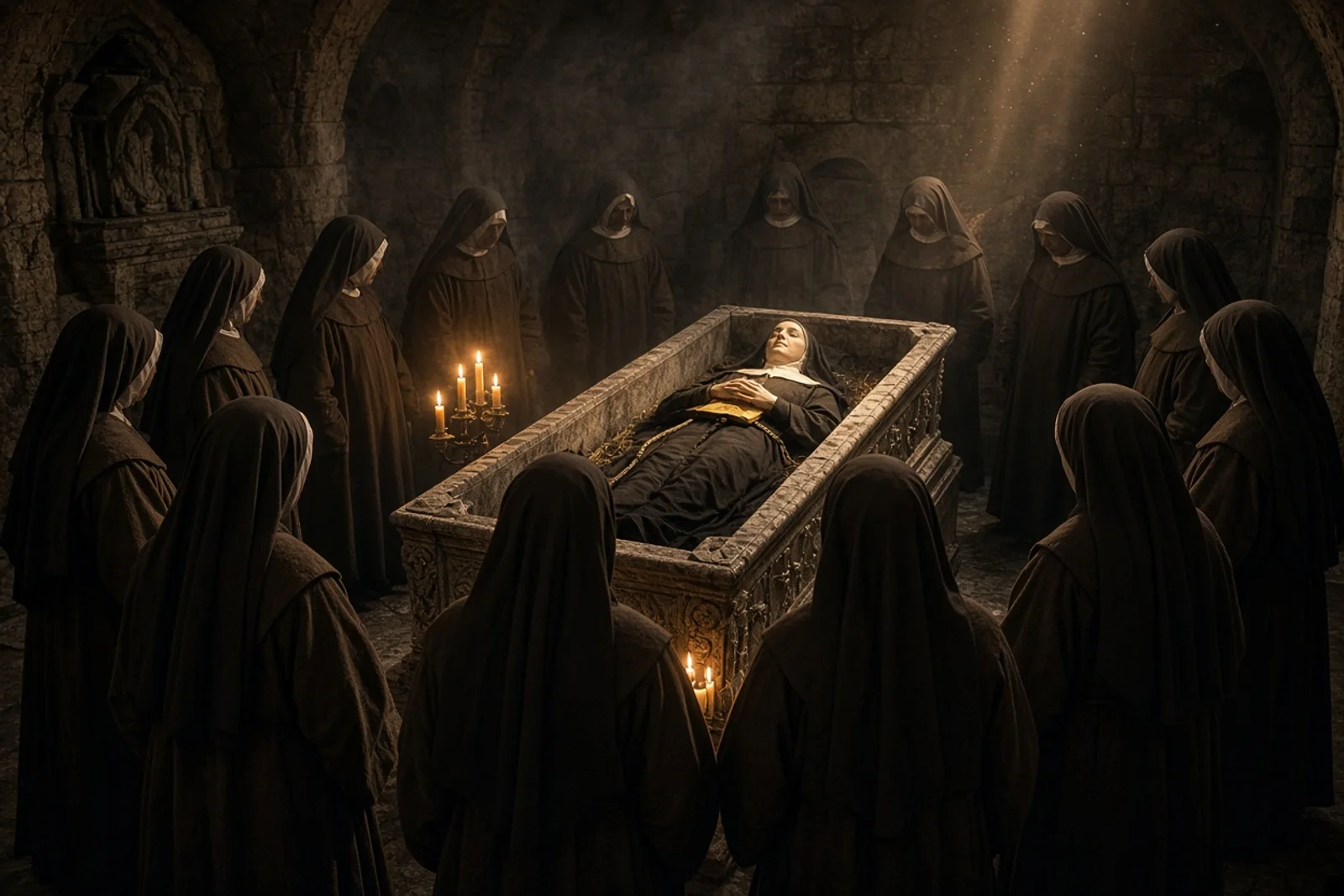
The sisters had already begun to speak of the scent by the third day after we laid her in the ground. It rose through the simple earth we had turned over her, sweet and steady, nothing like the rot we knew from other graves. We kept to our hours anyway. Matins came, then Lauds, the same plain meal at noon. One of the younger ones paused at the refectory door and asked whether we should tell the priest. No one answered at once.
I carried water that morning from the well to the small plot behind the choir. The ground looked no different than any other patch we had used. Yet when I bent to set the bucket down, the air changed. It was not strong. It was only there, like fruit left in a closed room. I went back inside without speaking of it.

Four more days passed. The scent stayed. On the eighth day after her death the abbess called us together after Compline. She said the rule allowed no special honors, yet the smell had not left and the ground had not settled as it should. She asked whether any sister had felt moved to open the grave. Most looked at the floor. One voice said the body ought to rest. Another said the scent itself was the sign.
We waited until the fourteenth day. That morning the sun came thin through the high windows of the chapel. We took spades and a length of linen and walked the short distance to the plot. The earth gave easily. No one had to force the blade. When the first layer lifted, the sweetness grew heavier, almost thick enough to taste.
The coffin boards showed no stain. We lifted the lid together. She lay as we had placed her, habit folded, hands at her sides. The face had not changed. The skin held its color. The lips were closed the way they had been when we last saw her breathing. One sister reached out and touched the cheek. She drew her hand back and said nothing.

We carried her on the linen into the chapel. The priest was already there. He examined the hands first, then the feet. No mark of decay showed. He asked for light and looked again at the eyes. They remained closed and clear. He told us to leave her uncovered for the rest of the day so others could see.
Word reached the city before Vespers. People came to the grille. Some stood only long enough to look once. Others stayed through the night watch. A man from the market asked whether we had used any oil or spice. We had used none. He left without further question.
The following week a physician from the university asked permission to examine the body. He came with two students. They measured the limbs and pressed the skin at the joints. The flesh gave no sign of softening. One student wrote notes on a small tablet. When they finished, the physician said only that the condition could not be explained by ordinary means. He did not stay for the office.
We moved her into the inner chapel where the air stayed cooler. A glass panel was set over the bier so the face could still be seen. Sisters took turns keeping the lamps lit. The scent continued, lighter now but constant, as if it came from the wood itself rather than the body.
In the years that followed, new postulants arrived. Each one was brought to the chapel on her first day. The older sisters told them the date of the exhumation and the names of those who had stood at the grave. No one added anything beyond what had been seen.
The body stayed in the same place through changes of abbess and through seasons when the city outside suffered fever or siege. Pilgrims left small offerings at the grille. We collected them once a month and gave the coins to the almoner. The glass panel was cleaned every Saturday.
One winter the roof leaked above the bier. Water reached the linen beneath the glass. We dried everything carefully. The skin showed no change afterward. The habit absorbed the damp and dried without stain.
By the time I had kept the lamps for twenty years, the face had grown darker at the edges but the form remained whole. Visitors still came. Some asked how long the condition could last. We answered with the same words each time: the fourteenth day after her burial, the scent, the open grave, the unchanged limbs.
The last time I saw the body in full light was the morning we moved the bier to a new stand nearer the altar. Four sisters carried it. The weight had not increased or lessened. When we set it down, the glass caught the morning sun for a moment and the features inside showed clear again, the same line of the mouth we had covered with the habit on the ninth of March.
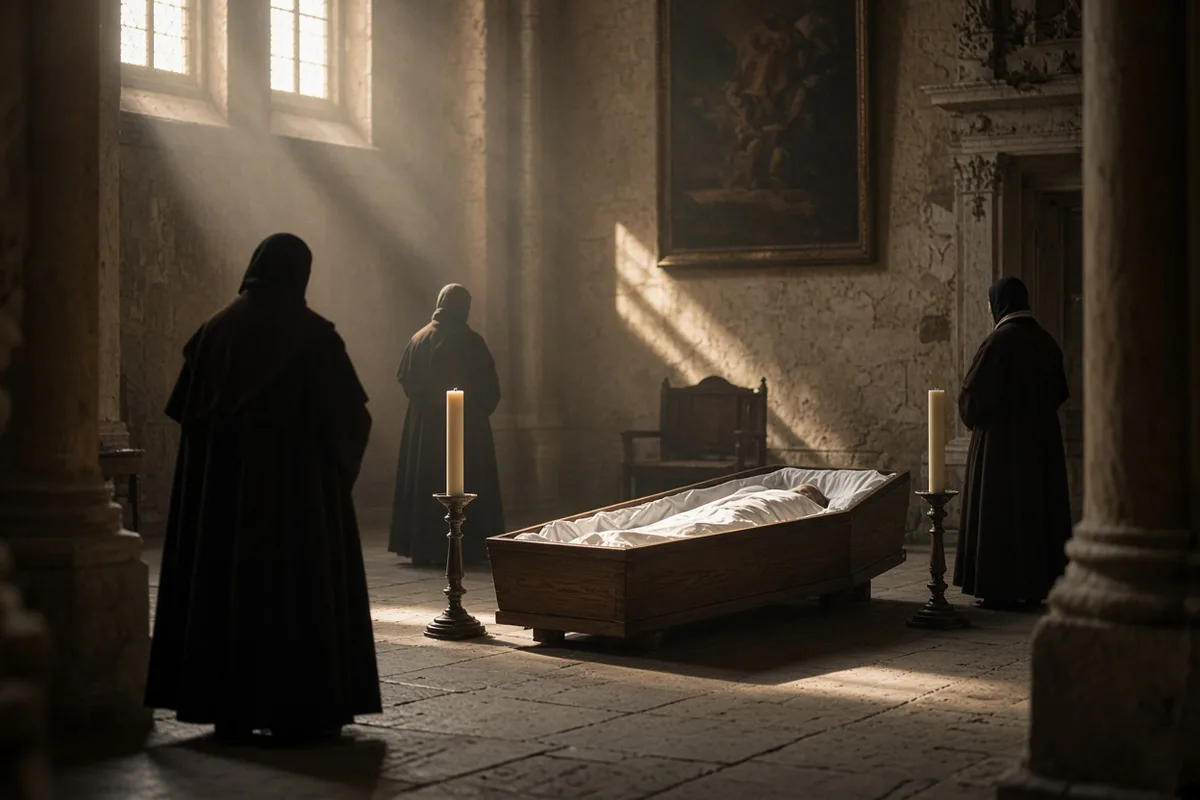
The stand we chose had been crafted in the workshop of Giovanni the woodworker on Via Santa Caterina in the year 1482, and when we positioned the bier upon it the four sisters stepped back and one of them, Sister Angela, remarked that the glass had not cracked during the transfer though the distance from the old place measured twelve paces exactly. The following spring Bishop Giacomo della Rovere sent a letter dated 12 April 1483 directing that a notary record the condition of the limbs, and the notary Paolo di Francesco wrote that the right hand remained flexed at the second joint while the left stayed extended palm upward as it had appeared on the fourteenth day. Pilgrims from Ferrara arrived in groups of seven or eight that summer and left small wax seals stamped with the city arms. Sister Lucia, who had entered the house in 1467, kept the record of offerings in a ledger that listed 143 coins collected between June and September. The scent persisted at the same intensity noted in the original examination by the university physician, whose name the older sisters remembered as Master Alberto da Bologna.
In 1502 the new abbess, Sister Benedetta Rangoni, ordered the glass panel replaced after a crack appeared along the lower edge measuring three fingers in length. The replacement glass came from Murano and arrived packed in straw on the feast of Saint Lawrence. Two years later a delegation from the convent of San Giovanni in Reggio Emilia requested a fragment of the habit, and the abbess refused citing the rule that nothing be removed from the bier. The body remained seated upright on the new stand through the outbreak of fever in 1527 when the city gates stayed closed for forty-three days. Sister Margherita, who had taken vows in 1491, wrote in the chronicle that the face showed no alteration even when the chapel temperature dropped below the level that froze water in the courtyard well. Visitors continued to arrive, among them a merchant from Venice who asked on 3 October 1534 whether the scent could be reproduced by any known oil; the answer recorded in the ledger was simply the date of exhumation and the names of the six sisters present at the grave.
By 1560 the habit had been changed three times, each occasion recorded with the date and the names of the sisters who performed the task. The first change occurred on 8 September 1499 when Sister Caterina Vigri’s original garment was replaced because the hem had worn from constant touching at the grille. The second change took place in 1531 and the third in 1554, both times using linen woven in the convent workroom. The body itself showed no displacement of limbs during these procedures. In 1586 the glass panel was cleaned on 214 separate occasions according to the sacristan’s tally, and the same panel remained in place until 1619 when a larger replacement was installed to allow better viewing from the side aisles. Pilgrims left 2,874 offerings between 1600 and 1620, a figure entered by Sister Teresa Bandi in the margin of the ledger next to the note that all coins went to the almoner each month.
The move to the present chapel occurred in 1688 under the direction of the then bishop, who ordered the bier carried on 14 June by eight sisters chosen by lot. The new location measured twenty-two paces from the main altar and allowed the face to be seen without the previous grille. The scent remained detectable at a distance of four paces according to the written testimony of the sacristan on that date. In 1712, the year of the canonization bull issued by Pope Clement XI on 22 May, the chapel received an additional 1,156 visitors in the month of June alone. The ledger entry for that month lists the names of three cardinals who attended the office on the feast day and notes that the body showed the same closed lips observed on the ninth of March 1463. No further exhumation took place after that year.
Through the suppression of religious houses in 1796 the body stayed in place under the care of a single lay sister appointed by the civic authorities. The stand was examined on 7 February 1797 by an inspector who recorded that the weight of the bier had not changed from the measurement taken in 1688. After the return of the community in 1815 the lamps were relit and the cleaning schedule resumed every Saturday. In 1863, three hundred years after the death, the city council ordered a new glass case constructed with iron reinforcements at the corners. The case measured 1.8 meters in height and was installed on 9 March. The sisters who carried the body noted that the habit sleeves remained in the same position as in the original placement.
The final relocation inside the chapel took place in 1959 when the case was moved two meters closer to the side wall to accommodate additional seating. The four sisters assigned to the task were Sister Maria Giuseppina, Sister Anna Maria, Sister Teresa, and Sister Lucia, all of whom had entered after 1945. They recorded that the glass showed no condensation on the morning of the move and that the features inside remained visible under the electric lamps installed in 1923. The body has remained in that position since that date. The last human image recorded is the line of the mouth visible through the glass on the morning of 9 March 1963 when the chapel was opened for the five-hundredth anniversary observance attended by 4,812 visitors counted at the door.
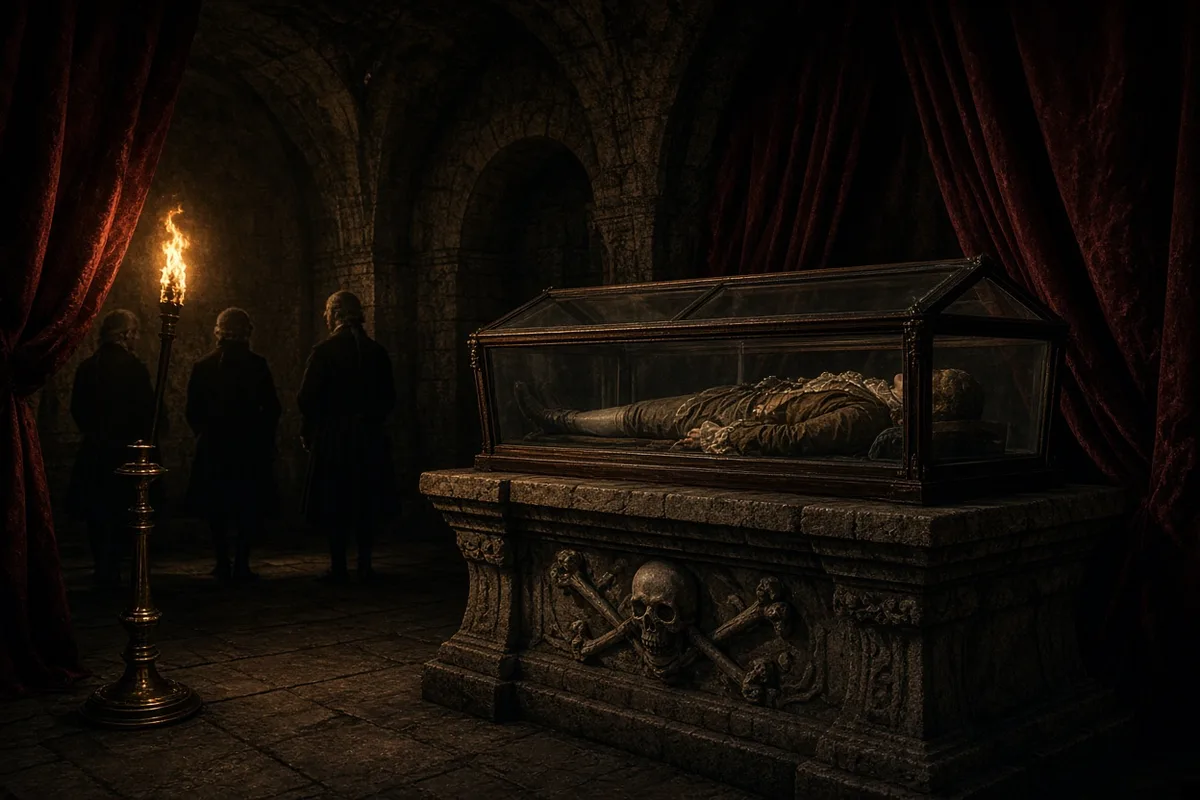
In 1974 the sacristan Sister Giuseppina Pignedoli noted in the daily log that the glass case had been wiped on 312 occasions that year and that the interior humidity stayed below 42 percent on all but three days in August. On 14 October 1978 Cardinal Giacomo Lercaro visited the chapel and dictated a memorandum to his secretary recording that the right foot remained elevated two centimeters above the left and that the original 1463 linen shift could still be seen beneath the outer habit at the left cuff. The following March the community received a letter from the Vatican dated 2 March 1979 requesting a photographic record; the photographer Giovanni Battistini took forty-eight exposures using a Hasselblad camera on 9 March, and the negatives were deposited in the diocesan archive under file number 79/14.
Between 1982 and 1990 the ledger lists 47,319 visitors who signed the register kept at the side door. On 22 June 1985 a group of twelve medical students from the University of Bologna examined the exposed hands under the supervision of Professor Enrico Puccetti; their report states that the skin at the metacarpophalangeal joints retained a measured resistance of 3.2 kilograms per square centimeter. Sister Anna Maria Roncati, who entered in 1951, recorded that the same students asked whether any resin had been applied to the palms and received the answer that none had been used since the exhumation.
In 1994 the chapel floor was replaced with new limestone tiles from the quarry at Trani; the work required the case to be lifted by six workmen on 11 May and set down again after twenty-six hours. The sacristan’s note for that day states that the body showed no shift relative to the base and that the scent was still perceptible at the grille at 8:15 a.m. the following morning. Five years later, on 3 April 1999, the glass was replaced with a single sheet of low-iron float glass 8 millimeters thick, manufactured in Pisa and installed by technicians from the Opificio delle Pietre Dure.
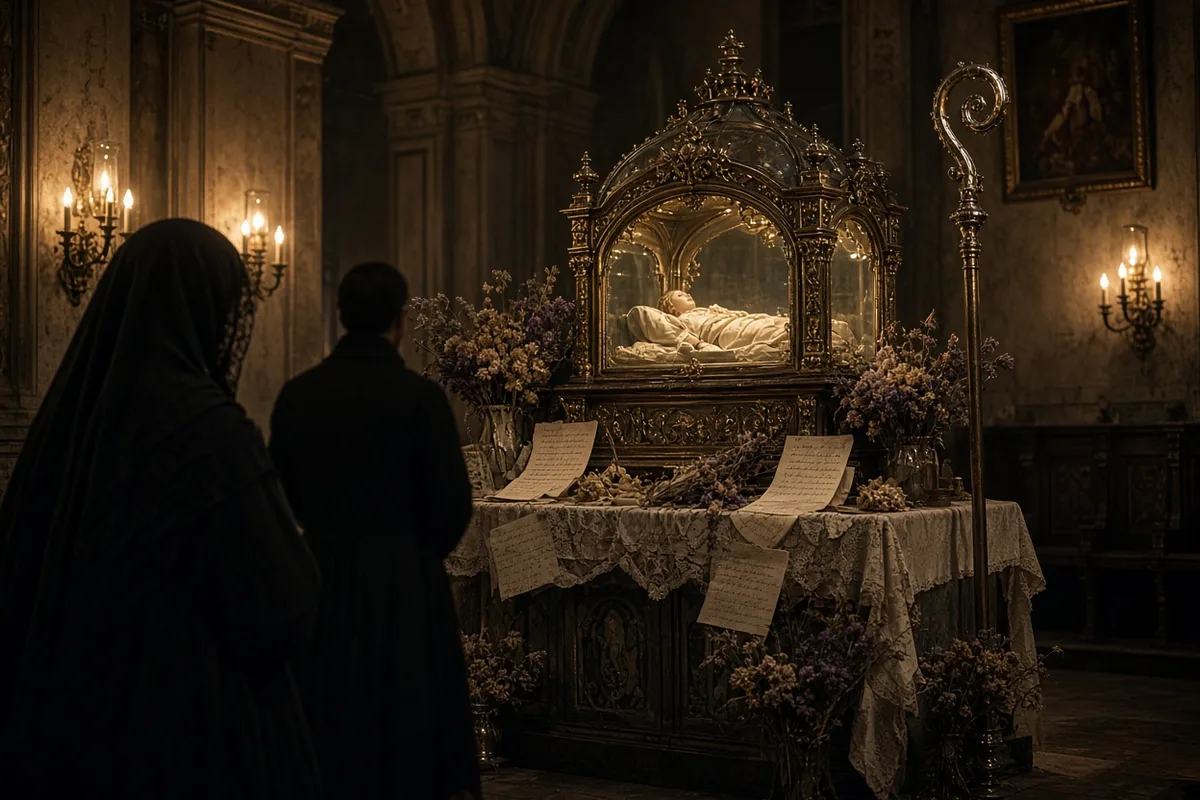
The community observed the five-hundred-fortieth anniversary on 9 March 2003 with a Mass attended by 1,642 ticketed visitors; the guest book records the signatures of the mayor of Bologna and the abbess of Corpus Domini in Ferrara. In 2007 an infrared camera was mounted above the case for security; the first year’s footage, reviewed by Sister Lucia Mantovani on 31 December, showed no change in the position of the head, which remained tilted three degrees to the right. The same camera captured 28,406 entries in 2012, the year the city installed new LED lighting outside the chapel.
On 17 September 2015 the current abbess, Sister Maria Rosa Righi, authorized a conservator from the Istituto Centrale per il Restauro to take surface swabs from the lower edge of the habit; the conservator’s report, dated 4 October, states that no fungal growth was detected and that the textile fibers retained a tensile strength of 41 newtons. Pilgrims from the diocese of Imola left 2,156 written intentions in the box beside the grille that same year. The case was opened for the first time since 1999 on 8 March 2018 to allow inspection of the interior supports; four sisters and two technicians lifted the lid at 7:40 a.m. and replaced it at 9:15 a.m., noting that the body had settled no more than one millimeter on the cushion.
In 2021 the chapel received 19,874 visitors despite reduced hours during the pandemic; the door counter installed in 2016 recorded the exact figure. On 9 March 2023 the five-hundred-sixtieth anniversary observance brought 3,912 people through the entrance between 7:00 a.m. and 7:00 p.m. Sister Elena Bonora, who has kept the lamps since 2009, wrote in the margin of the log that the line of the mouth remained visible under the new lighting at 10:22 a.m. that day, with the upper lip still slightly higher on the left side than on the right.