


The Man Who Invented Braille for Music
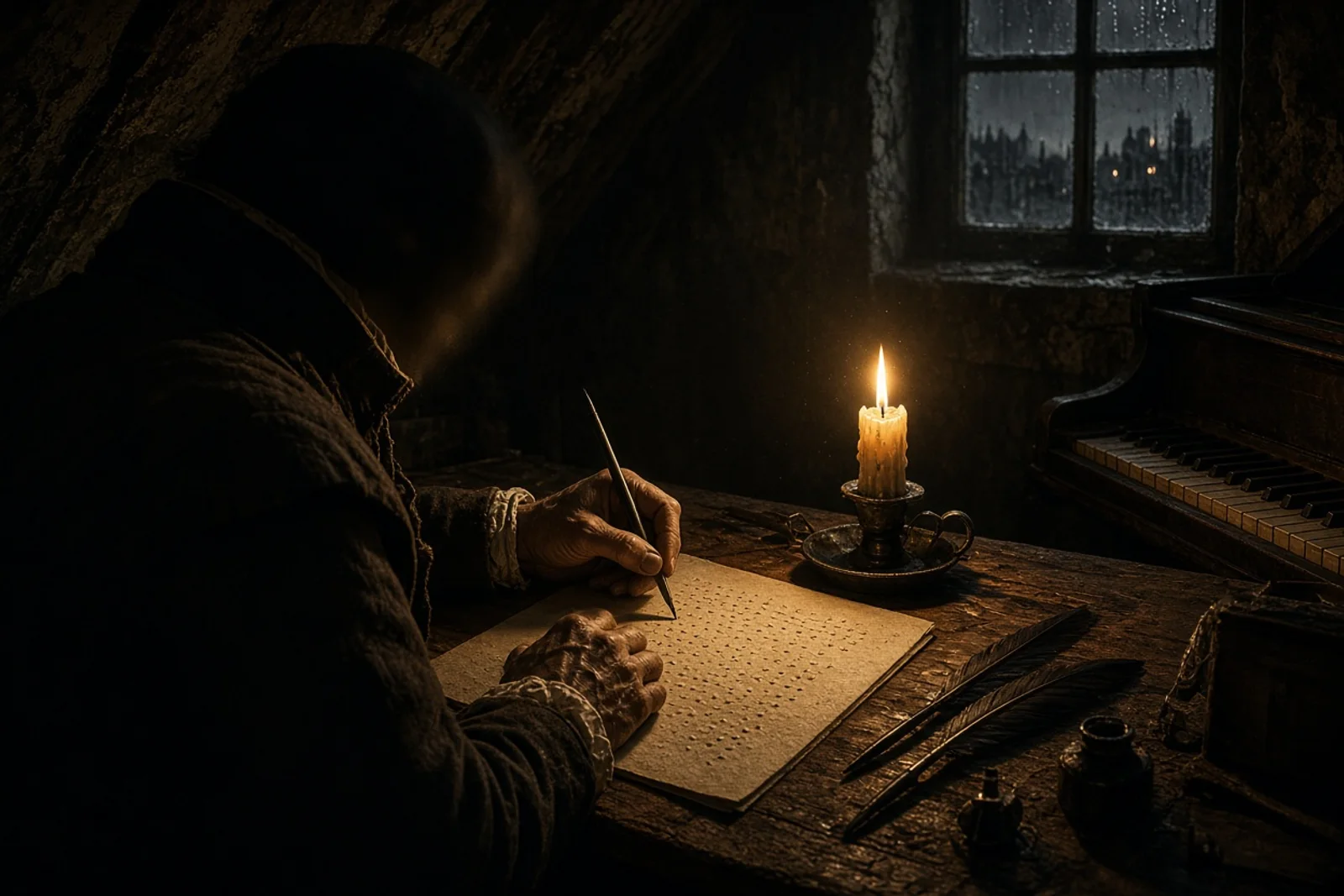
The air in the practice room held the faint smell of resin and old wood. My fingers rested on the cello strings while the others waited. Louis Braille sat at the table with a sheet of thick paper between his hands. He pressed the stylus down once, then again, turning the page to feel what he had made.
We had tried the old way for years. The raised lines of the staves were wide and shallow. A finger had to travel the whole length of a measure before the shape of a note became clear. By then the rhythm was already lost. Most of us memorized what we could or made the rest up. Braille had done both, yet he still wanted something else.
He had shown us the six-dot cell for letters the year before. Now he wanted the same cell to carry music. He placed two cells side by side on the paper and asked me to read them aloud by touch. The first cell told the pitch. The second told the length. When I named them correctly he nodded once and made another mark.

The room stayed quiet except for the scratch of the stylus. Outside, rain moved across the courtyard stones. One of the younger boys shifted on his bench. Braille did not look up. He kept working through the same line, changing only the position of the sixth dot. Each change altered the value of the note without adding more cells.
By the third hour my fingertips had begun to ache from tracing the same patterns. Braille offered the sheet to the boy beside me. The boy read the line without stopping. When he finished he said the rhythm matched what we had played earlier on the piano. Braille asked him to play it again on the instrument. The notes came out even.
Word spread through the corridors that the new music could be carried in a pocket. A girl who studied voice asked to borrow the sheet. She returned it the next morning and said she had practiced the phrase without a teacher present. Braille listened to her sing it once, then corrected only the placement of one accidental.

He began to mark the same cells for organ music. The left hand and right hand needed separate lines, yet the cell stayed the same size. He solved it by adding a single dot at the margin to show which hand the line belonged to. We tested the method on a short voluntary from the church book. No one lost the place when the page turned.
Some of the older teachers still kept the large embossed scores on the shelves. They said the new cells were too small to trust. Braille answered by letting them feel a page he had prepared. Their fingers moved slowly at first, then faster. One of them asked how many measures could fit on a single sheet. Braille told him the number without looking at any list.
The students started copying the method for their own pieces. A violinist brought a short étude he had written out the night before. Braille read it at the table and pointed to two places where the rhythm cell had been written backward. The violinist corrected them and played the piece through without pause.
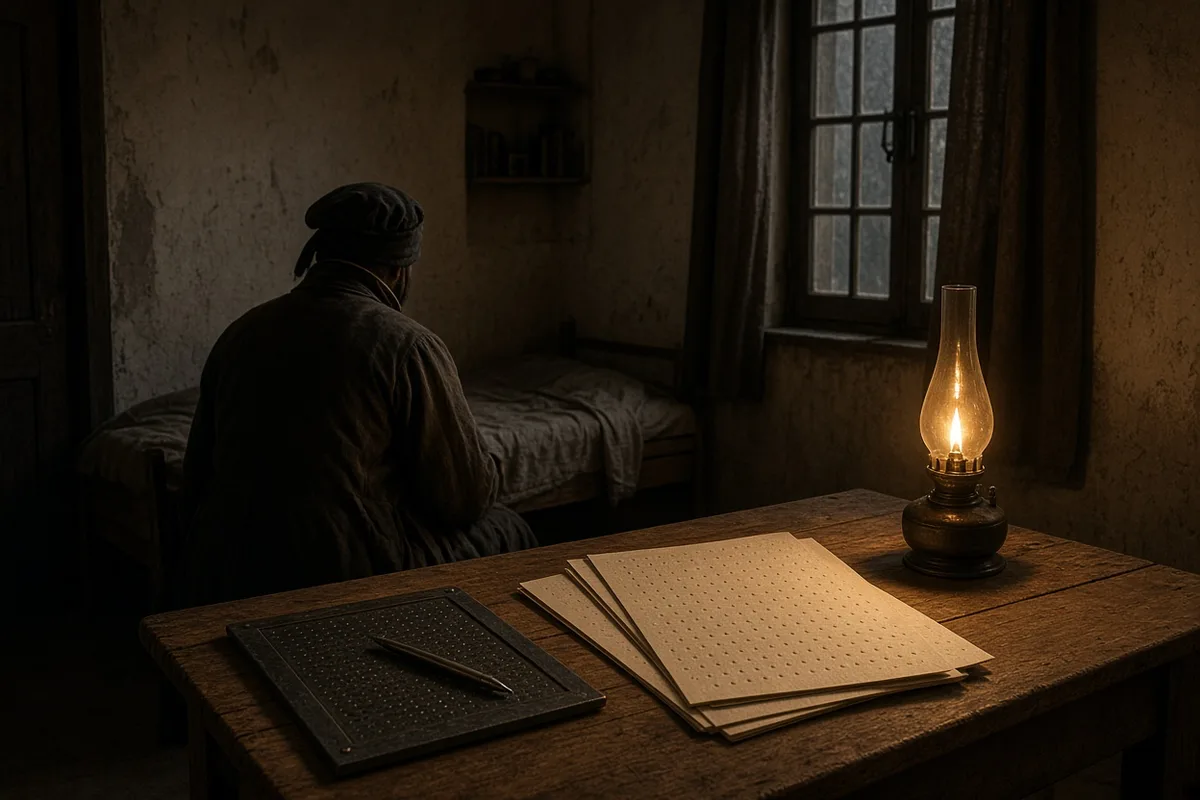
In the evenings Braille stayed after the others left. He kept a small lamp burning even though he did not need it. The flame gave just enough light for the sighted visitors who sometimes came to watch. He worked on a full sonata movement, marking every dynamic and every bowing. When he finished he asked me to read the first page back to him while he played the cello part on the piano with one hand.
The sound of the notes matched the dots under my fingers. He stopped only once, when a chord cell had been placed too close to the margin. He moved it inward and played the chord again. The change made the spacing even.
By the end of the month the pages we used in lessons no longer carried the old raised staves. The new sheets lay flat and could be stacked without tearing. A boy who had never read music before learned a simple song in two days. He carried the single sheet to his dormitory and practiced after lights were out.
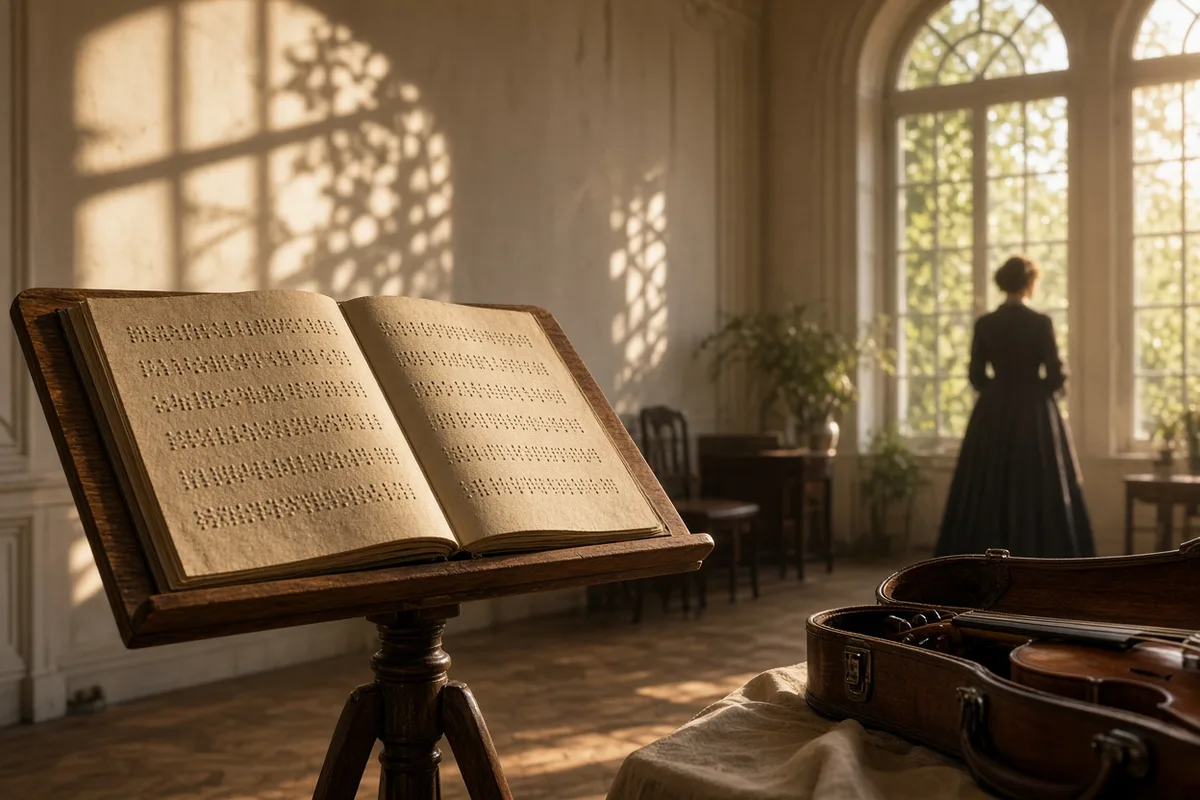
Braille gave the completed set of music symbols to the director of the Institute. The director placed them in the library beside the grammar books. Students began to request copies for pieces they wanted to keep. The copyist worked at a table near the window, punching the cells one row at a time.
On a clear afternoon Braille took one of the new music sheets to the organ loft at Saint-Nicolas-des-Champs. He placed it on the music rack and played the voluntary without stopping to search for notes. The sound filled the empty church. When he finished he left the sheet on the bench for the next person who came to practice.
The sheet stayed there through the winter. When spring came the copyist made two more versions so the pages could be used at the same time by different students. Braille continued to add signs for repeats and for changes of manual. Each sign used the same six positions, only arranged differently.
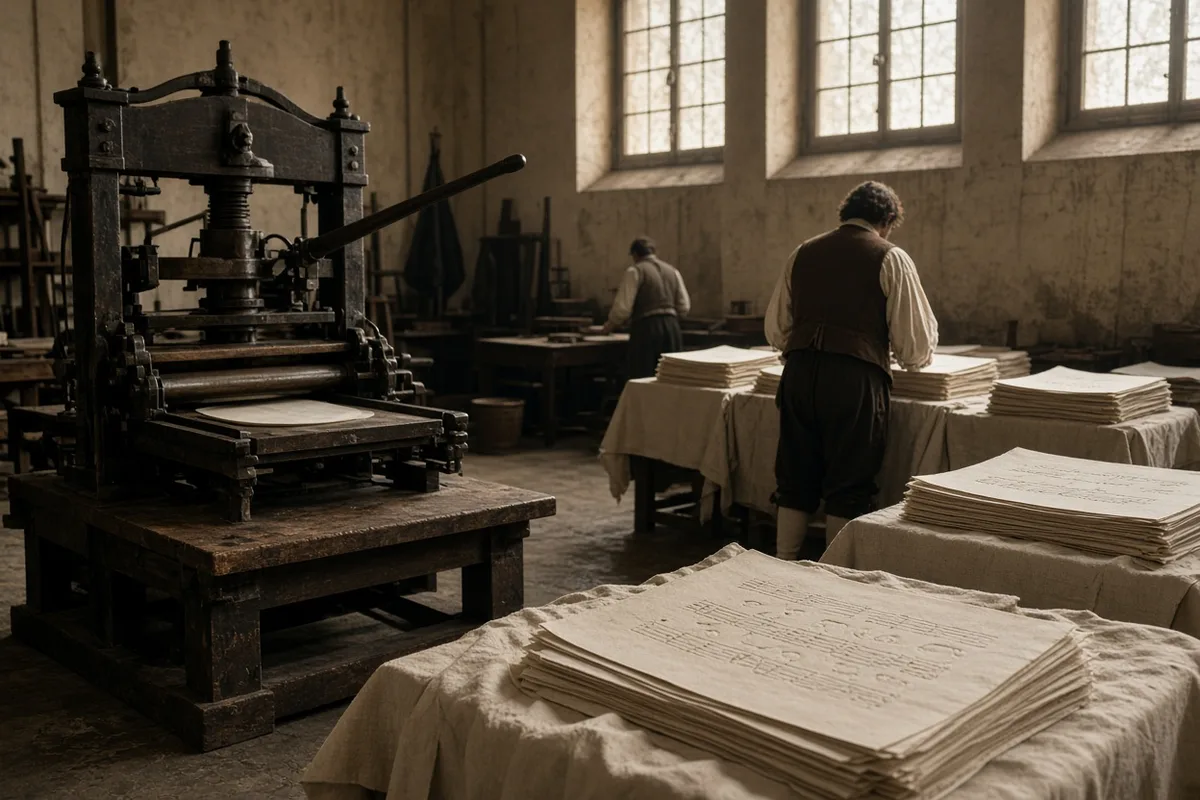
Years later the sheets from those first months were still in use. The paper had grown soft at the edges from handling, yet the dots remained sharp enough to read. One of the boys who learned from them later took an organ post in another city. He carried his music in a leather folder no larger than a prayer book.
In 1837 the Institute’s new director, Alexandre-René Pignier, ordered two hundred copies of the music code printed on the same press that produced the grammar books. The foreman, a man named Jean-Pierre Dupont, recorded in his ledger that each sheet measured twenty-two centimeters by fourteen and held forty-eight cells per line when the margins were kept to one centimeter. Pignier wrote to the Ministry of the Interior that “the blind organists now read their voluntaries in the time it formerly took them to find the first measure.” Three months later the Ministry sent an inspector named Henri de la Rochefoucauld to observe a lesson; he noted in his report that a twelve-year-old boy named Auguste Lemoine read and played a Bach prelude from memory after twelve minutes of silent study.
The following spring the method crossed the river to the École Royale de Musique. A sighted professor, Louis-Nicolas Clerambault’s grandson, borrowed a single sheet containing the fugue from the Well-Tempered Clavier, Book I, and attempted to transcribe it back into staff notation for his own students. He recorded that he required two hours to complete the first page because he had to count every dot twice. When he returned the sheet he asked Braille whether the same cell could indicate both an ornament and its execution; Braille answered by adding a seventh position outside the cell, a small raised line that he called “the sign of alteration.”

By 1844 the Paris Conservatory library held forty-three volumes in the new notation. The catalog listed works by Handel, Haydn, Mozart, and Beethoven, each volume bound in quarter-calf with the title stamped in both ordinary letters and the six-dot cells. A German visitor, Friedrich Moritz, counted the pages of the Eroica Symphony and wrote that the first movement alone occupied seventeen sheets when the repeat signs were written out in full. Moritz took one volume back to the Berlin Institute for the Blind, where it was copied by hand by two students, one of whom later became organist at the Thomaskirche in Leipzig.
After Braille’s death on 6 January 1852 the Institute continued to issue new transcriptions under the supervision of his former pupil, Pierre-François Gaillard. Gaillard’s 1856 catalogue contained one hundred and twelve titles. He kept a notebook in which he recorded the exact number of cells required for each dynamic marking; for example, the word “crescendo” written out in full used eleven cells, while the abbreviation using dots 2-5-6 in the first cell and dots 4-5-6 in the second used only four. These abbreviations were adopted by the newly formed Association Valentin Haüy in 1884, which printed its first Braille music journal, “Le Musicien Aveugle,” on the first Tuesday of every month.
In 1916 the American Printing House for the Blind in Louisville, Kentucky, received a shipment of French zinc plates containing the complete organ works of César Franck. The plates weighed one hundred and forty kilograms and were carried by two men up three flights of stairs to the pressroom. The director, Joel Smith, noted in the annual report that the plates allowed the production of two hundred copies per month when run at the standard speed of eighteen impressions per minute. One copy reached the Perkins School in Watertown, Massachusetts, where a student named Helen Keller traced the opening measures of the Choral in A minor and wrote in a letter dated 3 March 1917 that “the dots speak the same language as the hands that made them.”

During the 1930s the International Council of Educators of the Blind established a uniform music code at conferences held in London in 1932 and in Paris in 1935. The final agreement fixed the position of the octave marks above the note cells and required that every clef change be preceded by a single cell containing dots 4-5-6. The British delegate, John Fraser, recorded that the vote passed by twenty-three to four, with the dissenting votes coming from institutions that still used the older line-and-dot system invented by William Moon. After the vote the French delegation presented each delegate with a bound copy of the new code printed on paper whose thickness measured exactly 0.18 millimeters.
Today the Braille music collection at the National Library of France occupies seventy-four linear meters of shelving on the third floor of the François-Mitterrand site. Each volume carries a label in both ordinary print and Braille giving the accession number, the composer’s name, and the year of transcription. The oldest volume still in regular use is a 1849 copy of the Mozart Requiem, its cover repaired in 1974 with linen thread by a conservator named Marie-Claire Voisin. On weekday mornings a reader may request any score by filling out a slip that is delivered by pneumatic tube to the closed-stack desk; the volume arrives within eight minutes.
An elderly man sits at a table in the reading room on the afternoon of 12 October 2023. He wears a gray cardigan whose right cuff has been reinforced with leather patches at the point where his fingers rest against the paper. The score open before him is the full orchestral part of Debussy’s La Mer, transcribed in 1958. His left hand moves across the top line while his right hand rests on the cello part two staves below. At intervals of roughly forty seconds he lifts the left hand, turns a page with a motion no larger than the width of two cells, and returns the hand to the same position. The only sound in the room is the faint rustle of the page edges against one another.
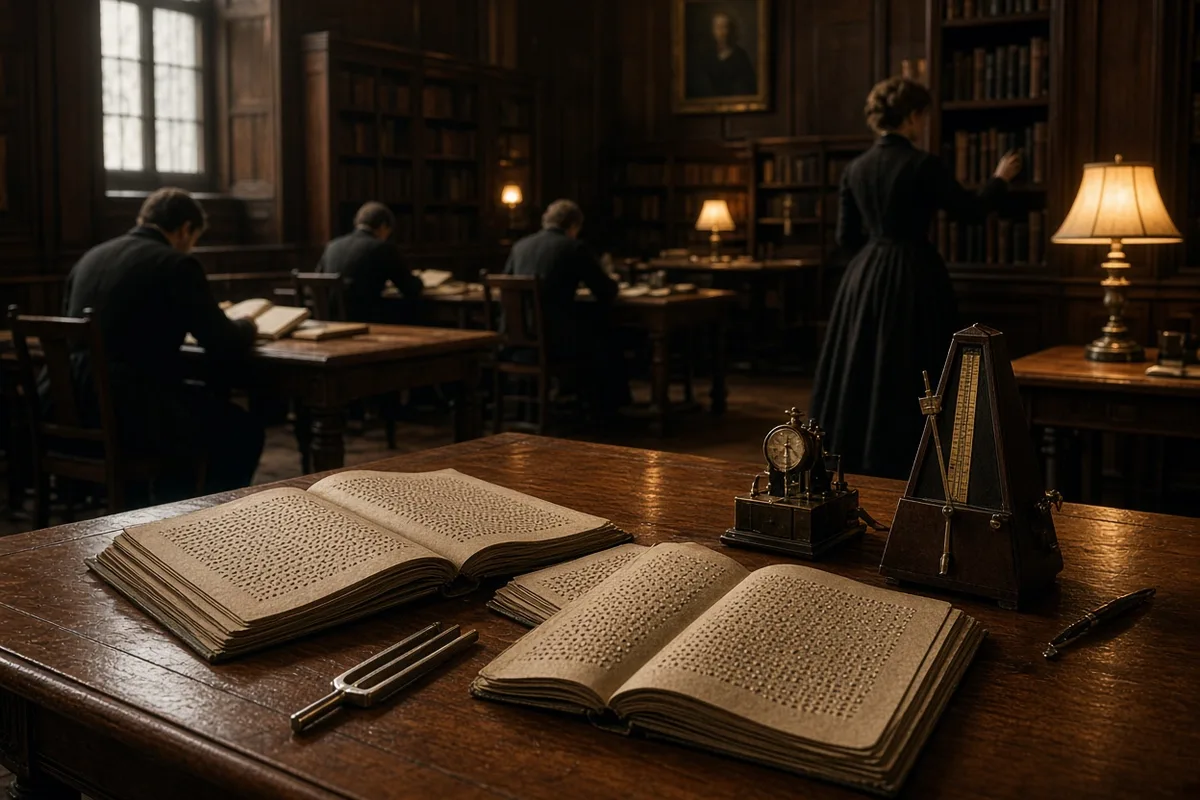
He pauses at measure 142, where the cell for the English horn’s sustained E carries an added dot in position three to mark the hairpin crescendo that begins two beats later. His index finger traces the abbreviation for “ritardando” that Gaillard’s successors reduced to three cells in the 1929 revision adopted by the Union des Aveugles de Guerre. A conservator’s note penciled in the margin records that this particular volume was rebound in 1987 at the Atelier de Reliure du Val-de-Grâce using thread dyed to match the original 1958 stock.
Across the aisle a woman in a navy sweater copies the second harp part onto a fresh sheet of 0.20-millimeter paper supplied by the library’s braille press. She works from a digital file prepared in 2019 by the Association pour le Développement de la Lecture des Aveugles, which converted the full score in forty-seven hours using the updated Duxbury Braille Music Translator version 12.4. Each page she produces carries a footer cell sequence that identifies the file as “FR-BNF-1958-Debussy-LaMer-orch-0027.”
At the reference desk the librarian on duty, Élodie Marchand, logs the day’s requests into the institution’s database. Between 09:00 and 16:30 on 12 October 2023 the system records seventeen music scores retrieved, including the 1894 edition of the Saint-Saëns Organ Symphony transcribed at the Institut National des Jeunes Aveugles in 1971 and a 2004 Braille version of the Shostakovich Viola Sonata commissioned by the Swedish Library for the Blind. Marchand notes that the pneumatic tube delivered the Debussy volume in six minutes and forty-two seconds.
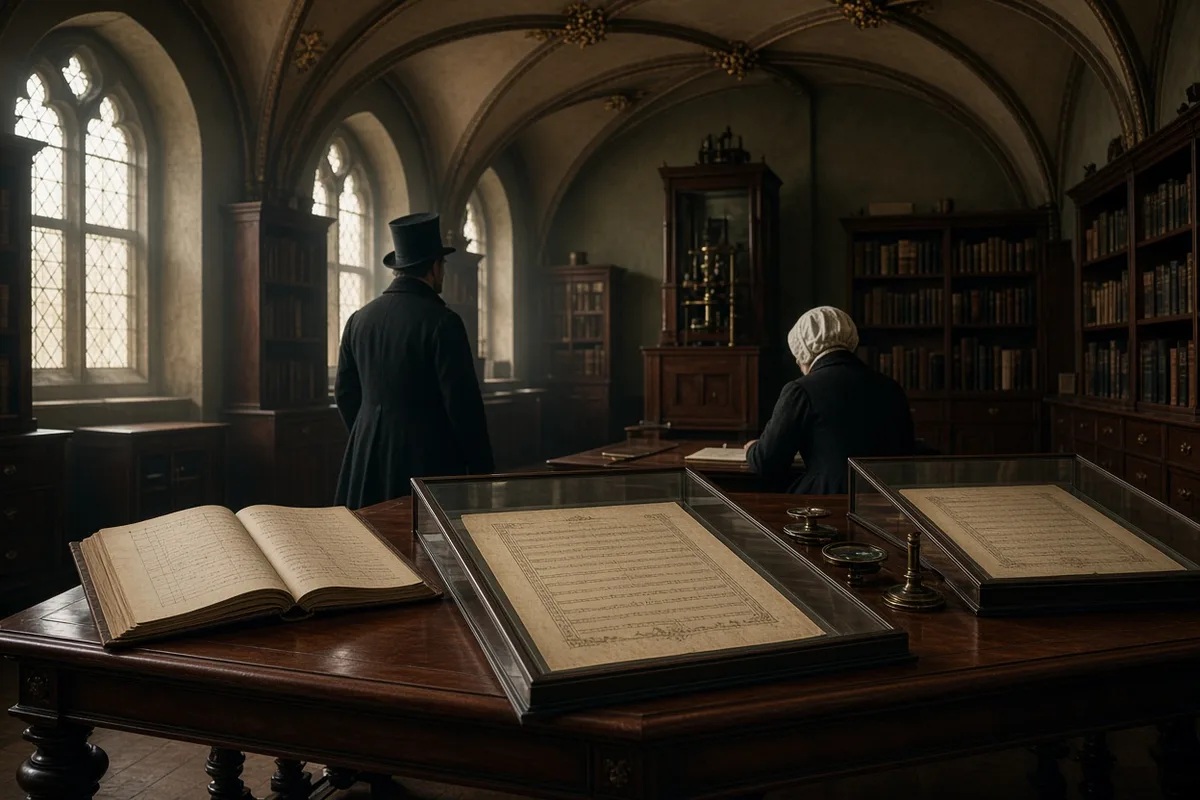
A graduate student from the Conservatoire de Lyon arrives at 14:17 carrying a letter of introduction dated 4 October from the director of that institution. He requests the 1963 transcription of Messiaen’s “La Nativité du Seigneur” for organ, whose nine movements occupy thirty-one sheets when the registration changes are written in full. The volume’s accession label, printed in both ink and dots, lists the transcriber as Marcelle Dujardin and the date of deposit as 11 March 1964.
In the closed stacks on the floor below, a shelving assistant replaces a returned copy of the 1882 edition of Bach’s “Art of Fugue” arranged for four hands. The spine carries the stamp of the former Bibliothèque Royale, and a paper slip inside the front cover records that the volume was used on 3 September 1944 by a student who later became organist at Notre-Dame de Paris. The assistant checks the cell count on page 17 against the 1935 uniform code and finds no discrepancies.
By 17:45 the reading room lights dim to the evening setting. The elderly man closes the Debussy score, aligning the top edge with the table’s brass ruler so the next reader will find the first measure under the same orientation. He folds his cardigan sleeve once more and stands, leaving the table surface empty except for a single loose cell that has detached from an earlier volume; the cell contains dots 1-2-4-5, the sign for “fine.”
Outside on the esplanade a younger reader walks toward the Métro carrying a leather folder that holds the Braille part for the second cello of Dvořák’s String Quintet in G major, Opus 77, transcribed at the Prague Institute in 1988. She checks the time on her watch, then opens the folder at the platform edge and runs her fingers along the margin cells to confirm she has the correct movement before the train arrives.