


The Miracle of the Sun at Naju

The apartment door stood open to the night air. I had come up the narrow stairs behind two sisters from the parish, their habits brushing the rail, and stepped into the small room where the statue rested in its niche. The figure was ordinary porcelain, blue mantle, white gown, hands joined. Someone had placed a single candle on the table below it. The flame threw a steady light across the face.
A woman knelt on the floor near the wall. She wore a simple dress, dark hair pulled back. Julia. She did not look up when we entered. Her eyes stayed on the statue. The room smelled of wax and the faint trace of roses that sometimes clung to her clothes after she returned from church. I had heard the stories about her recovery, the cancer the doctors had called hopeless, yet here she was, breathing evenly, no longer confined to a bed.
Fr. Lazarus Chun-Soo Lee arrived a short time later. He carried a small flashlight and a notebook. He asked no questions at first. He walked to the statue, lifted the candle higher, and leaned close. A line of moisture had formed beneath one eye. It gathered, then slipped down the cheek in a slow track. Another drop followed from the other eye. The priest touched the track with a fingertip and brought it to his lips. He said nothing for a long moment. Then he turned to the sisters and told them the Mother was weeping for the abortions and for the priests who had grown careless with their vows.
Word spread before morning. By the next evening the stairwell held a line of people. Some carried rosaries, others simply stood with their hands at their sides. Julia remained in the room most of the day. She answered the door when visitors knocked, showed them the damp face of the statue, and let them stay as long as they wished. The tears continued at intervals, sometimes stopping for hours, then starting again without warning. A few visitors brought cameras. The photographs showed the same streaks on the cheeks.
I returned several times over the following weeks. The fragrance in the room grew stronger on certain afternoons. It was not perfume from any bottle I recognized. Julia herself began to speak of messages she said she heard while kneeling there. She wrote them in a notebook she kept on the table. The words concerned conversion and reparation. She did not read them aloud unless someone asked.
Bishop Daniel Hak-Soon Chi arrived one morning in 1990. He stayed several days, praying the novena in the chapel that had been set up nearby. On the final afternoon he stood before the statue and watched fresh blood-red tears fall. He wrote a single sentence in the guest book before he left: he had seen it and he believed. Archbishop Victorinus Youn Kong-hi received the bishop’s account but declined to open a formal inquiry at that time. He told those who asked that private visits could continue.
The crowds grew. Some came from other provinces, a few from abroad. They left flowers and handwritten notes at the base of the statue. Julia reported that the statue had moved slightly within the niche on more than one occasion. The movement was never sudden. It happened while the room was quiet, the figure shifting perhaps half an inch backward or forward. Witnesses described the same thing.
In 1991 the Korean bishops traveled to Rome. Archbishop Youn mentioned the tears to Pope John Paul II. The reply was brief: observe the fruit. No further instruction followed at that meeting.
The archdiocese formed an investigation committee late in 1994 after the papal nuncio visited the chapel, placed a crown on the statue, and later reported a Eucharistic host appearing in the air above it. The committee met fifteen times. Members examined Julia’s handwritten diaries against the printed booklets that circulated among pilgrims. Discrepancies appeared in dates and in certain phrases that matched passages from other published messages. The committee also noted that some sentences echoed earlier writings by Father Gobbi. Julia answered their questions directly but offered no new documents.
Archbishop Youn issued his judgment in 1998. He stated that the events had produced no evidence they were supernatural. He warned that treating them as such would break the unity of the faith. The decree carried automatic penalties for anyone who celebrated sacraments at the site without permission.
Julia continued to live in the same apartment. The statue remained in its niche. Visitors still came, though the numbers thinned after the public statement from the archdiocese. In 2008 a new decree from Archbishop Andrew Choi Chang-moo renewed the prohibition on sacramental ceremonies there. Anyone who took part would incur excommunication.
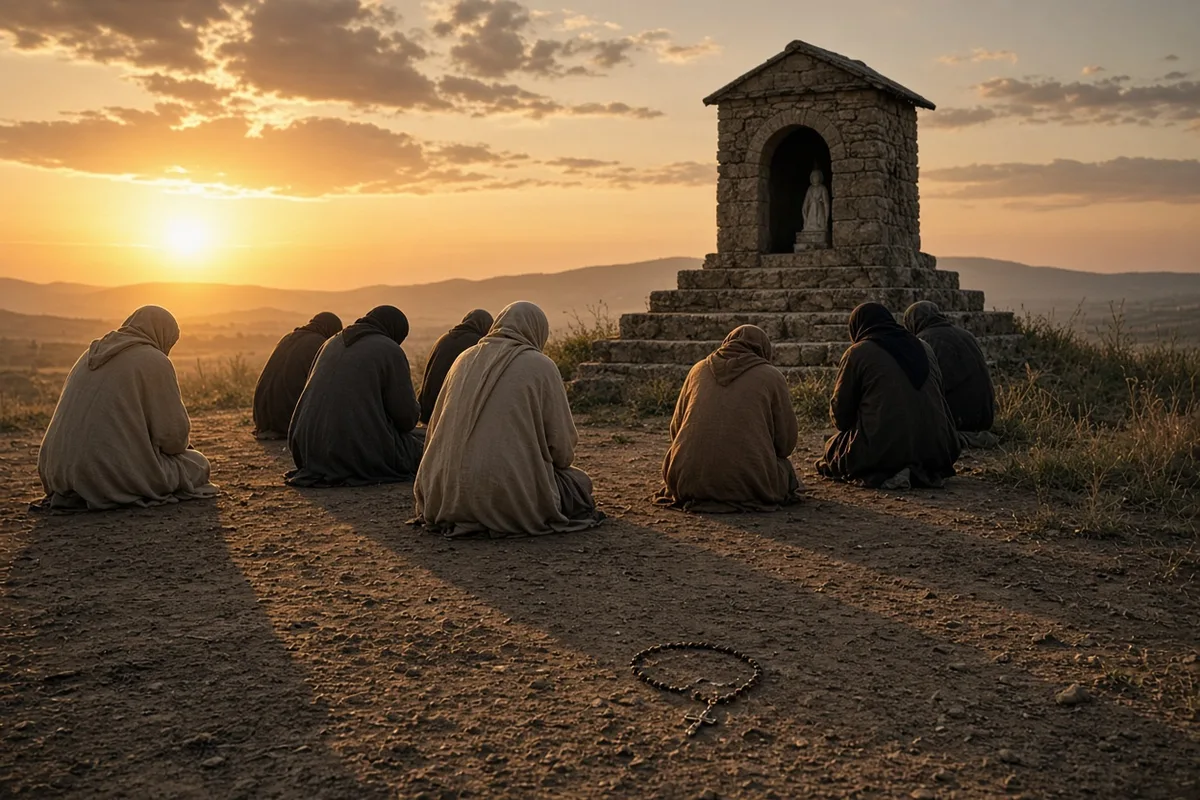
Years later the garden on the hill above the city held the statue under a simple shelter. The path leading to it stayed open. People walked it in silence, some stopping to touch the railing. The official position of the Church did not change. The tears had stopped long before. What remained was the record of what had been seen and what had been decided.
The shelter in the garden above Naju was erected in March 2003 by a group of lay volunteers who had purchased the half-hectare plot from a local rice farmer named Park Sung-ho. They used cedar posts cut from trees felled on Mount Chiri and covered the structure with corrugated polycarbonate panels purchased in Gwangju. The statue stood on a concrete pedestal 1.2 meters high, its original porcelain surface now protected by a glass case installed after a hailstorm in June 2007 cracked the right shoulder. On 14 October 2009, a retired catechist from Seoul named Lee Mi-kyung recorded in her journal that she counted 47 visitors between 9 a.m. and noon, most of them elderly women who left handwritten petitions folded into envelopes addressed to “Our Lady of Naju.” One envelope, left on the railing, contained a photograph of a child born in 2004 with a congenital heart defect; the mother had written the date of the child’s open-heart surgery at Seoul National University Hospital on the back.
In 2012 the local police recorded three separate complaints from residents on the road below the hill concerning traffic congestion on feast days. Officers issued citations on 15 August and again on 8 December when buses from Busan and Daegu blocked the single-lane access road. The archdiocese repeated its 1998 and 2008 declarations in a letter dated 22 February 2013, signed by Archbishop Thaddeus Cho Hwan-kil, stating that “no one may celebrate Mass or administer any sacrament at the Naju site under pain of automatic excommunication.” The letter was posted on the archdiocesan website and referenced Canon 1372. Pilgrims who continued to arrive read the notice at the foot of the path but proceeded anyway, leaving small plastic bottles of water they had carried from the public fountain in the city square.
Julia Kim, then 66 years old, granted a brief interview on 4 May 2015 to a reporter from the Catholic Times of Korea. She stated that the last visible moisture on the statue had appeared on 25 June 2001 and that she had not received any new written messages since 1997. She described her daily routine as rising at 4:30 a.m. to pray the rosary before the statue, then tending a small vegetable garden behind the apartment building where she still lived. The reporter noted that she walked with a cane following hip surgery performed at Naju Christian Hospital in 2010. When asked about the bishops’ decrees, she answered that she accepted the authority of the Church and continued to attend Sunday Mass at the parish church two kilometers away.
On 12 September 2017 a delegation of seven priests from the Diocese of Ulsan visited the site without prior notice. They remained for two hours, took photographs of the shelter and the surrounding camellia trees, and left without speaking to any visitors. One of the priests, Fr. Kim Jong-hyun, later wrote in a private letter preserved in the diocesan archives that the statue appeared “unchanged from photographs taken in 1995.” The following year, on 6 January 2018, Archbishop Cho issued a further clarification reminding clergy that participation in any public prayer service at the location remained forbidden. The document listed the names of four priests who had been suspended for celebrating Mass there in 2009 and 2014.
By 2020 the path had been widened to two meters by the city public-works department after repeated complaints about erosion during monsoon season. Concrete steps were added at the steepest section, numbered 1 through 87. A small wooden donation box attached to the shelter railing collected an average of 12,000 won per week, according to a ledger kept by a volunteer named Han Soo-jin, who emptied the box every Saturday afternoon and deposited the funds into an account at the Naju Agricultural Cooperative Bank. The money was used to replace weathered prayer cards and to pay for electricity that lit the shelter from dusk until 10 p.m.
Julia Kim died on 3 February 2022 at the age of 74 in Naju Christian Hospital. Her funeral was held at the parish church rather than at the hill site. The statue remained in the shelter under the same glass case. On 11 March 2022 a group of twelve women from the original prayer group placed a fresh bouquet of white roses at the base and removed the old ones. One of them, Sister Theresa Park, age 81, was photographed by a passerby standing with her hand on the railing, her head bowed. The photograph, taken at 4:17 p.m., shows the concrete pedestal, the cedar posts, and the empty path leading back down the hill. No further official statement has been issued by the archdiocese since that date.
The concrete steps installed in 2020 now show wear along their edges from daily foot traffic, with the 47th step chipped at the corner where a delivery truck backed too close on 19 July 2022. That same month the Naju city records office issued permit 2022-8847 allowing replacement of the polycarbonate roof panels after typhoon winds tore three sections loose on 6 September 2021. Volunteer Han Soo-jin, now 58, logged in her ledger that the new panels cost 1.4 million won and were delivered from the Gwangju factory on 3 August 2022. She noted the serial numbers of each panel and the date she tightened the last bolt at 2:15 p.m.
On 22 April 2023 the archdiocesan website reposted the 2013 letter under a new heading that listed the current Archbishop of Gwangju as Thaddeus Cho Hwan-kil, still in office. The post carried no additional text beyond the original reference to Canon 1372 and the names of the four suspended priests. A printed copy of that page was found folded inside a plastic sleeve attached to the donation box on 9 May 2023 by a maintenance worker from the city public-works department named Kim Young-soo. He recorded the discovery in his work log at 11:40 a.m. and left the copy in place.
The glass case around the statue was cleaned on 14 October 2023 by two women from the original prayer group, one of them Sister Theresa Park, then 82. They used a solution of distilled water and mild detergent purchased at the Naju Agricultural Cooperative store, applied with cloths they had brought from the parish sacristy. Sister Park noted in a notebook she kept in her handbag that the right shoulder of the figure still showed the 2007 hail crack, now covered by a thin line of clear epoxy applied in 2015. They finished the cleaning at 3:25 p.m. and placed a single white rose at the base before descending the 87 steps.
In January 2024 the city installed a motion-activated security camera above the shelter after two incidents of graffiti on the cedar posts. The camera model was Hikvision DS-2CD2143G0-I, serial number 789456123, mounted at a height of 2.8 meters and connected to the municipal network on 18 January. Footage from the first week showed 31 separate visits between 7 a.m. and 6 p.m., with the longest stay recorded at 47 minutes by an unidentified man in a dark coat who left a handwritten note on 21 January. The note, later collected by Han Soo-jin, contained only the date and the words “for my daughter” written in blue ink.
Julia Kim’s apartment building underwent roof repairs in March 2024 after leaks appeared above unit 3B, the unit she had occupied until her death. The contractor, Park Construction of Naju, replaced 18 square meters of tiles and charged 2.8 million won, paid from the building maintenance fund on 12 March. A new tenant moved into the unit on 1 April 2024, a retired teacher named Choi Eun-mi who told neighbors she was unaware of the statue’s history until a visitor asked to see the niche on 4 May. Choi Eun-mi declined the request and closed the door at 4:50 p.m.
The path above the city was widened again in June 2024 to accommodate an erosion-control project funded by the provincial government. Workers from the Naju public-works department poured 42 cubic meters of reinforced concrete along the lower section and planted 28 camellia saplings purchased from a nursery in Suncheon. The project log listed completion on 27 June 2024, with the final inspection signed by engineer Lee Dong-wook at 5:10 p.m. The donation box collected 14,500 won that week, the highest total recorded since Han Soo-jin began keeping weekly tallies in 2020.
On 11 September 2024 a single visitor remained at the shelter after dark. The security camera captured an elderly woman in a dark coat standing at the railing for 19 minutes, her hand resting on the metal bar. She left at 8:47 p.m. without placing anything in the box or on the pedestal. The camera timestamp shows the empty path and the shelter lights still on, switched off automatically at 10 p.m. as scheduled.