



The people who saw covid first had no power to stop it
In 60 seconds
- A 2005 White House prompt produced a federal distancing plan that was adopted, then left unfunded, unrehearsed, and forgotten for over a decade.
- Local health officers hold sweeping legal power that almost never gets used because lawsuits and career damage land on whoever pulls the trigger.
- The CDC lost weeks of testing by blocking ready outside labs and shipping contaminated kits that failed in three of its own labs.
- A teenager's 2004 contact-network science project became the intellectual core of targeted layered containment.
- By late January 2020, Mecher and Dean already flagged silent spread; hierarchy diluted their warnings and sidelined the messengers.
- Where early response worked, university labs and personal trust networks filled gaps official agencies left open.
The big idea
Lewis argues America already had the science and even a written plan to blunt covid's early spread, yet agencies built to study outbreaks carefully could not act when speed beat certainty. What worked depended on stubborn individuals willing to risk their careers—which he frames as both a tribute to them and proof the system stays dangerously unfixed.
The book in brief
In 2005 President Bush read a history of the 1918 flu and asked why America had no real pandemic plan. An informal circle of doctors and scientists—half-joking, the Wolverines—answered with a 2006–2007 federal strategy of targeted layered containment: close schools, cancel large gatherings, and create distance long before a vaccine can exist. They treated 1918 Philadelphia and St. Louis as proof that early distancing saved lives. The plan was adopted on paper, never funded, never rehearsed, and largely forgotten.
When covid arrived, that same loose network was scattered outside official power and began reassembling over email and text. Charity Dean, climbing from county health officer to California's public-health second-in-command, embodied the book's local pattern: vast legal authority on paper, almost never used in practice because the political and career costs fall on the person who pulls the trigger.
The CDC enters as the institutional opposite of that nerve. Decades of academic caution and political sensitivity had trained it to wait for peer-ready certainty and to protect its reputation for rigor. In the first weeks of 2020 those habits became liabilities—on diagnostic tests, on silent spread, on masks—while the virus moved faster than the agency's comfort with incomplete data.
Alongside an old distancing model that a teenager's science project had helped underwrite, figures like Carter Mecher argued from thin January data that community spread was already underway. Their warnings met hierarchical filters designed to stop any single voice from forcing large-scale action without consensus. Officials more comfortable with caution diluted the message or kept the messengers out of the room.
Private capacity filled some of the vacuum. University labs built their own tests and shared results through trust networks while FDA emergency pathways still ran on peacetime clocks. At the federal level, multiplying task forces never produced one accountable decider; states ran separate experiments. Lewis closes without a neat fix: where the early response worked, it worked because stubborn individuals burned career capital, which is both impressive and evidence that the next emergency will again depend on luck of who is standing where.
Context
Michael Lewis published the book in 2021 as narrative journalism that follows a small set of doctors, scientists, and officials the way his earlier work tracked individuals who spotted systemic failure ahead of the official map.
The key ideas
1
The plan left on the shelf
The only serious American pandemic strategy of the mid-2000s was adopted, then left unfunded and unrehearsed for more than a decade.
- 2005Bush reads 1918 history and asks for a real plan
- 2006–2007Wolverines' targeted layered containment adopted on paper
- Next decadePlan goes unfunded, unrehearsed, forgotten
- 2020Scattered authors try to revive it over email and text
Bush's 2005 question after reading John Barry's 1918 flu history pulled doctors and scientists from across agencies into an informal working group. They nicknamed themselves the Wolverines after the resistance fighters in Red Dawn. Richard Hatchett, a cancer physician turned strategist, and Carter Mecher, a VA doctor who modeled outbreaks from first principles, sat near the center.
Their answer was targeted layered containment. Close schools. Cancel big gatherings. Keep people apart before any vaccine exists, because vaccines arrive too late for the first wave. The proof they trusted was a 1918 comparison: Philadelphia threw a huge war-bond parade while flu was spreading; St. Louis closed schools and churches and banned public gatherings within days of its first cases.
Philadelphia's death rate ran several times higher. The federal government formally adopted the strategy in 2006–2007, then put no real money behind it, ran no drills, and largely forgot it. When covid hit, the same people—now out of power—tried to revive the old playbook by email and text. The episode sets the book's core tension: the people with the right answers rarely held the authority to act.
In practice: St. Louis moved within days of its first 1918 cases; Philadelphia held its parade and paid with a death rate several times higher.
2
Authority no one dares use
A California local health officer can quarantine people and close businesses without a court order, yet the job punishes anyone who actually does it.
Charity Dean is the book's center of gravity. Lewis follows her from a young doctor fixed on infectious disease to a Santa Barbara County health officer who treated urgent diagnosis as something she might have to finish herself when the system stalled.
On paper the legal power is extraordinary—quarantine, business closures, school shutdowns, no judge required. In practice the power sits mostly unused. Pulling the trigger invites lawsuits, political revenge, and a ruined career. Dean learned the gap early and kept acting anyway.
Her tuberculosis work among homeless residents rested on a credible threat to jail patients who refused treatment. She seldom had to follow through, because people believed she would. That personal reputation, not institutional backing, made the authority real. The same dynamic followed her into the state deputy role: optics-minded operatives undercut her, and the system still asked for courage it would not protect.
In practice: Suspecting flesh-eating bacteria, Dean cut into a corpse in a funeral home herself because no one else would confirm the diagnosis in time to protect the living.
3
An agency that watches
The CDC's habits of peer-ready caution and reputation protection, useful after outbreaks end, left it unable to lead when speed beat certainty.
Lewis treats the CDC less as a cast of villains than as a culture shaped by the wrong incentives for early 2020. Scientists there were trained not to overstate uncertain data, to wait for peer review, and to avoid claims that might later stain the agency's reputation for rigor.
That training works when you are writing the history of an outbreak already over. It fails when a novel virus is moving in real time. In January and February 2020 the agency blocked academic and commercial labs from using tests already available and insisted on building its own.
The kits it shipped were contaminated. Three of its own labs got false results before wider use exposed the problem. Weeks of testing capacity vanished while infections went undetected. The same instinct delayed clear public acknowledgment of silent spread and mask guidance, even as outside scientists reading the same thin data had already moved. The CDC could recommend; it rarely could compel, depending on voluntary state and local reporting with little operational control.
In practice: Contaminated CDC test kits produced false results in three of the agency's own labs before the failure became obvious more widely.
4
Evidence from a science fair
A 2004 student simulation of how kids mix at school gave pandemic planners their clearest showing that distancing cuts infections without medicine.
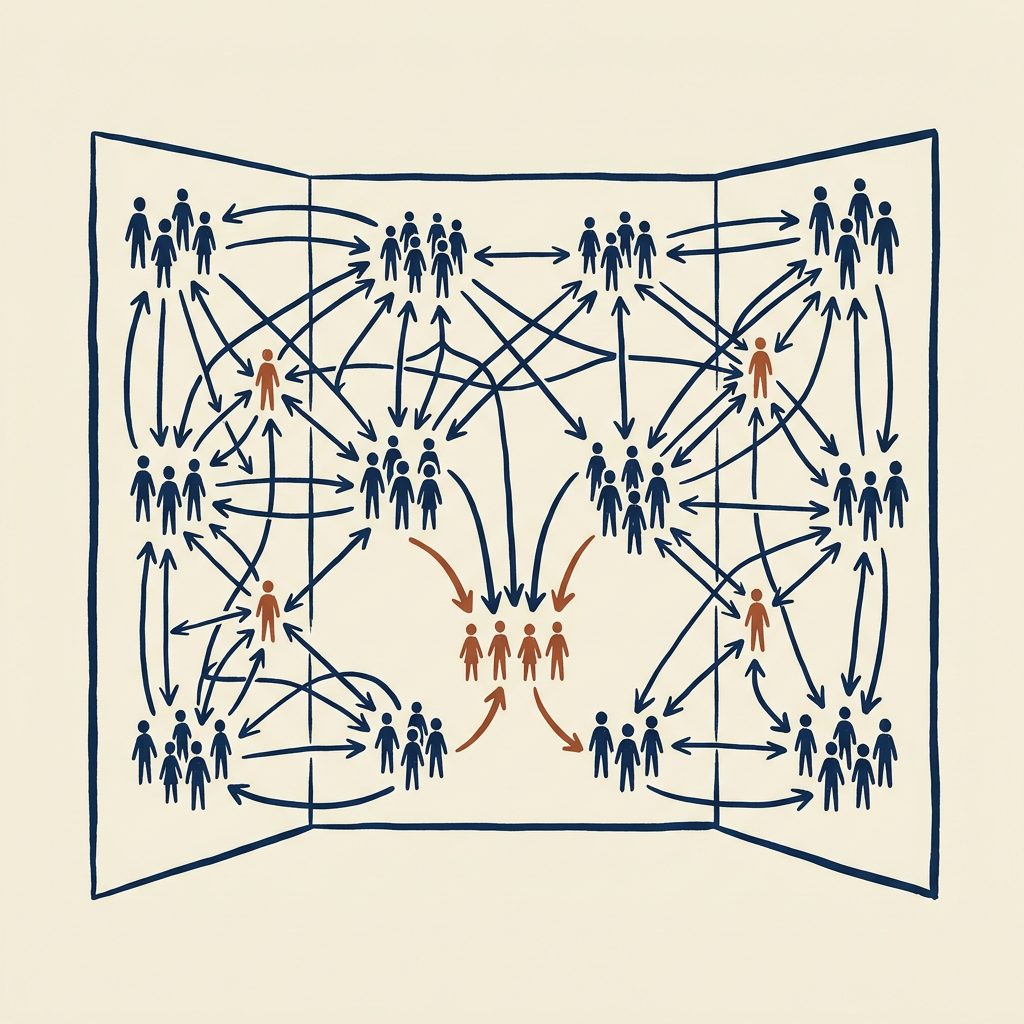
Laura Glass built a school project that tracked disease through the daily contact patterns of students. Closing schools and limiting mixing across social groups, the model said, sharply reduced total infections even with zero medical treatment.
Her father, Robert Glass at Sandia National Laboratories, saw the result was sturdier than gut feel and expanded it into a full computational model. He carried it to the federal planners, including Carter Mecher. The finding became a load-bearing piece of the 2006 targeted layered containment doctrine.
Lewis's larger point is about where useful expertise came from. Robert Glass was an outsider to public health. Formal epidemiologists had not yet claimed what a careful simple simulation made visible. Professional caution left a gap; an adjacent-field amateur walked through it. In February and March 2020 Mecher and the old network pulled the model back out to argue for early aggressive closures, weeks before the CDC or most states moved.
In practice: Laura's contact-network project, expanded by her father, fed straight into the federal distancing strategy the Wolverines later tried to revive by text.
5
Warnings that could not travel up
Officials who read late-January 2020 data as silent community spread were blocked by designs that demand consensus before any disruptive action.
By late January several of the book's central figures had separately decided the new coronavirus was far worse than official statements allowed. Carter Mecher, writing in the Wolverines' private chain, argued the virus was already spreading quietly and that the country had days, not weeks, to move. His read of incomplete Chinese numbers and prior outbreaks stayed ahead of CDC public statements for roughly another month.
Charity Dean, by then deputy director at the California Department of Public Health, tracked flights and case reports and pushed for early action. Political leadership feared public panic and economic damage. Her memos were softened or deleted on the way upward. Once she pushed hard, she was shut out of key decisions and replaced in practice by people more at ease with waiting.
Lewis frames this as structure, not cartoon villainy. Health bureaucracies are built to stop any single voice from triggering huge costly moves without broad agreement, because false alarms also carry real penalties. That design blocked panic—and also blocked timely truth. The Wolverines' workaround was to ignore the org chart, talk straight to each other, and reach sympathetic officials sideways.
In practice: Dean's sharpest warnings were edited or dropped before they reached Governor Newsom's office, and she lost her seat in the rooms that mattered.
6
The parallel testing system
After federal testing collapsed, university and private scientists with lab access built the diagnostics and data-sharing the government could not deliver on time.
Federal path
Contaminated CDC kits and slow emergency authorization
Parallel path
University and commercial labs validating tests through trust networks
Joe DeRisi, a UCSF biochemist, had spent years on a chip that could spot any known virus in a sample—work that began in biodefense and rare disease. When CDC kits failed and outside labs stayed blocked, his group and a handful of academic and commercial labs simply built and validated their own tests.
They still had to fight the FDA emergency-authorization maze, a process sized for years-long drug approvals and now dropped onto a sprint. Lewis presents DeRisi's lab as one node in an unofficial parallel public-health system that ran on relationships formed over prior decades.
The country's real early capacity, in this account, lived mostly outside government: universities, private labs, trust networks. It was substantial and mostly invisible to the agencies nominally in charge. Effectiveness hinged on who knew whom and who had a reputation worth betting on, not on institutional design. Specific places got help because scientists happened to already be in contact.
In practice: DeRisi's lab turned its virus-detection chip into working covid tests while navigating an FDA emergency path built for peacetime drug timelines.
7
Decisions without a decider
Without one accountable federal decision-maker, sound advice lost repeatedly to whichever political pressure dominated the week, and states became fifty separate experiments.
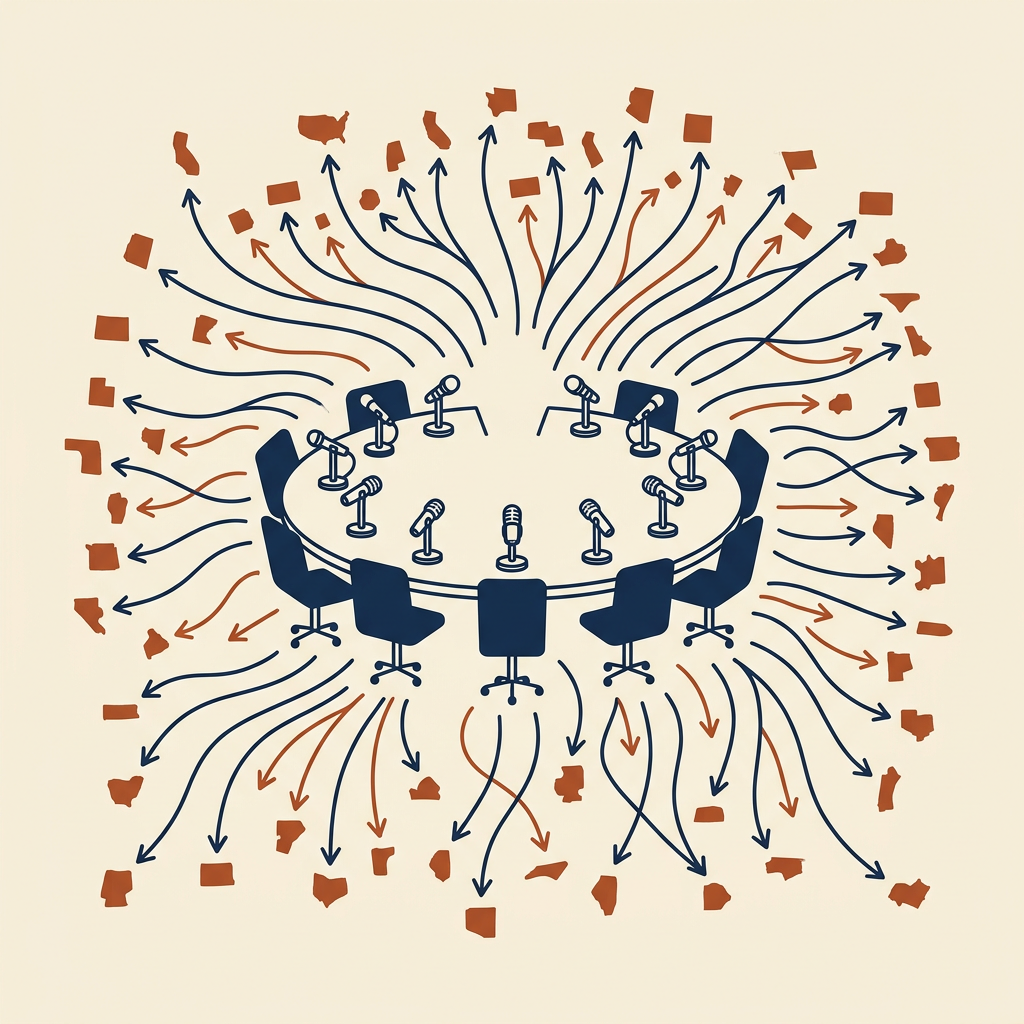
Lewis describes the Trump administration's early response as shaped less by a clear philosophy than by the vacuum where binding authority should have been. Task forces proliferated. Figures such as Mecher and Hatchett were pulled back informally, then watched their counsel get filtered, ignored, or reversed depending on the day's optics.
Travel restrictions, the Grand Princess docking, the tug-of-war between reopening pressure and health advice—each became a skirmish between people holding direct evidence and people managing political weather. Good analysis lost to bad incentives not because the science was mushy but because no one with power was on the hook for getting it right.
States were left to invent policy alone, producing wildly different rules and outcomes against the same virus. Lewis notes the pattern was not only partisan: California's Democratic leadership showed the same caution overriding expert warning traced through Dean's marginalization. Federalism plus an executive unwilling to seize the center turned a moment that needed speed and coordination into fragmented improvisation.
In practice: The Grand Princess docking and early travel-restriction fights became contests between evidence-holders and officials reading political risk, with no single person empowered to end the argument.
8
Stubbornness in place of design
Depending on rare individuals who will risk their careers is itself the institutional failure, and it will not reliably repeat.
What united Dean, Mecher, DeRisi, and the others was not title or credential. It was a disposition: act under uncertainty, accept being wrong in public, shrug at career damage. Dean's willingness to threaten jail in a tuberculosis outbreak, Mecher's blunt memos without formal epidemiology credentials, DeRisi's readiness to step around slow federal gates—all share that trait.
The book treats this dependence on character as the real indictment. A public-health system that works should not need mid-level heroics. Competent judgment should reach decision-makers because the pipes are built that way, not because someone brave happens to sit in the right chair.
Instead, early 2020 worked, where it worked, because specific people had enough access and enough indifference to institutional manners to force moves. That combination—correct placement, correct information, willingness to burn capital at the exact moment—will not show up on schedule next time. Many of the protagonists were sidelined, ignored, or worn down before vaccines arrived. The underlying weaknesses stayed largely unaddressed.
In practice: Mecher kept writing plain-language warnings into official channels despite lacking epidemiology credentials; the system had no routine path for that judgment to matter.
Key terms
- Wolverines The informal cross-agency circle of doctors and scientists who built the mid-2000s federal pandemic plan and later tried to revive it by email
- Targeted layered containment Closing schools, canceling large gatherings, and pushing distance early—before any vaccine exists
- Local health officer authority On-paper power in places like California to quarantine, close businesses, and shut schools without a court order
- Parallel public health system University, private-lab, and trust-network capacity that delivered tests and coordination when federal channels failed
- Shadow decision network Sideways communication among the Wolverines and sympathetic officials that bypassed slow official hierarchy
What to do
- Map who in your organization sees risk clearly but lacks the title to halt a process, and give their warnings an unfiltered path to decision-makers.
- Write down now how your team will act on incomplete information when waiting for certainty costs more than a wrong call.
- Pull every contingency plan you own and check the last date it was funded, staffed, or actually rehearsed—not merely filed.
- Run one short drill this week on a high-cost plausible risk so the plan has to survive contact with real people.
- When a fast-moving threat appears, clock how many approval layers sit between the first clear warning and a binding decision—and cut one.
Questions to think with
- Where in your workplace does caution that protects reputation quietly outrank speed when the cost of delay is high?
- If the person with the best early read has no formal authority, how does their warning reach someone who can act?
- Which of your ready plans have never been funded or rehearsed, and what would it take to make one real?
- When have you personally softened a true alarm to avoid political or career blowback—and what happened next?
- Does your organization reward people who were correctly worried early, or only people who waited for consensus?
The other side
The book leans hard on Dean, Mecher, and their allies' memories, casting their calls as right in hindsight while giving CDC scientists little room to explain fears about bad tests, legal limits, and past overreactions such as H1N1. Critics noted the 1918 Philadelphia–St. Louis comparison is messier than a clean proof of distancing—density, immunity, timing, and reporting all differed—and that Lewis stops in the early months, saying little about vaccines, Operation Warp Speed, later waves, or how other countries' systems fared. Following vivid individuals yields sharp scenes but weak counterfactuals: it remains unclear how much any single earlier official move would have changed a virus already spreading silently by January 2020.
Who it's for
Readers who want a character-driven explanation of why U.S. institutions froze despite talent and prior plans, and anyone who likes Lewis's style of tracking people who spot systemic failure before the official map catches up.