


The Story of the Man Who Invented Braille for Music
The bow slipped on the string again. I cursed under my breath and set the cello down on the bench, wiping sweat from my fingers so the next note would not skid. The practice room at the Institute held six of us that afternoon, each trying to hold a phrase without the score in front of us. One boy hummed the line he had memorized the night before. Another tapped the rhythm on his knee, counting silently. None of us could check whether we had the accidentals right.
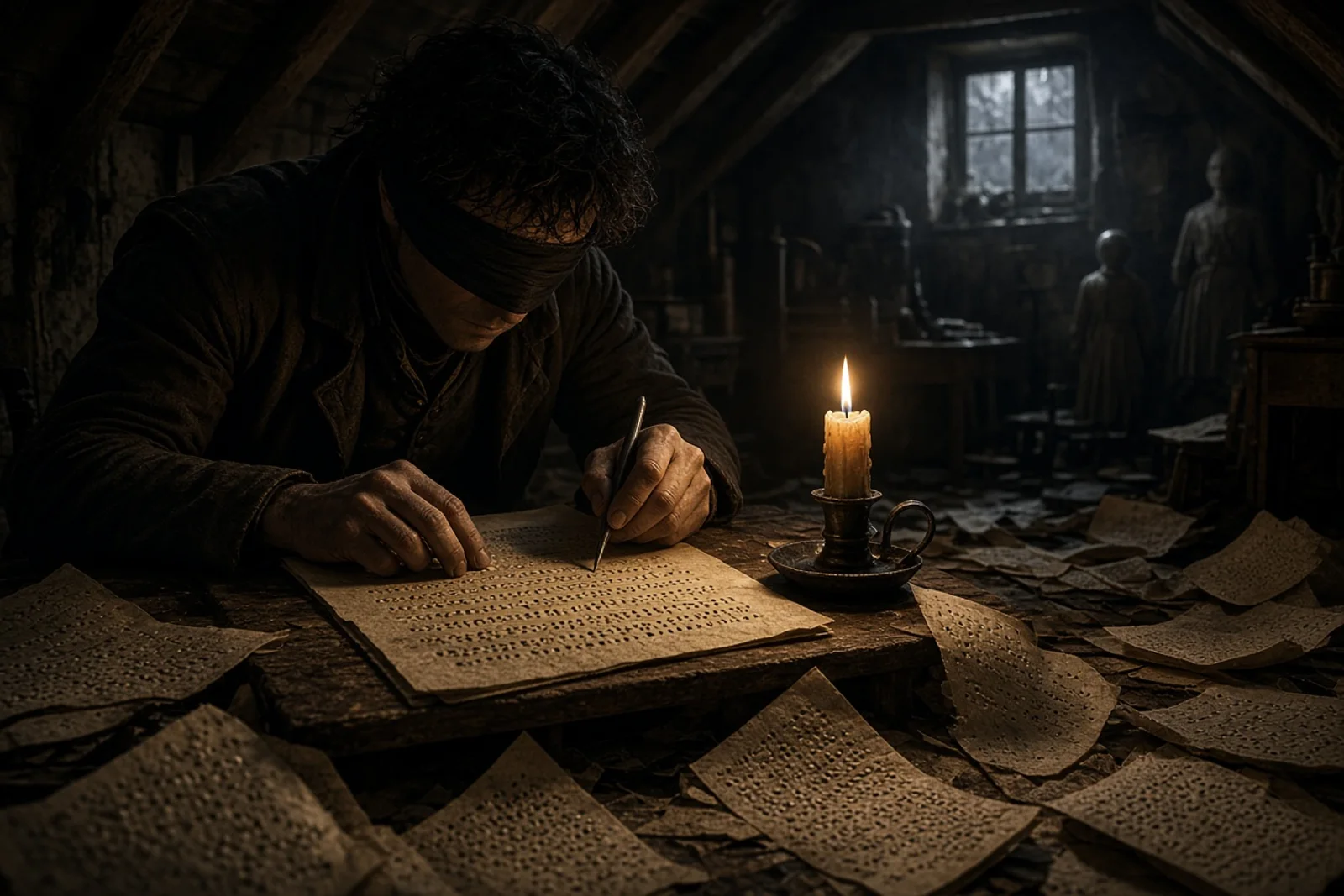
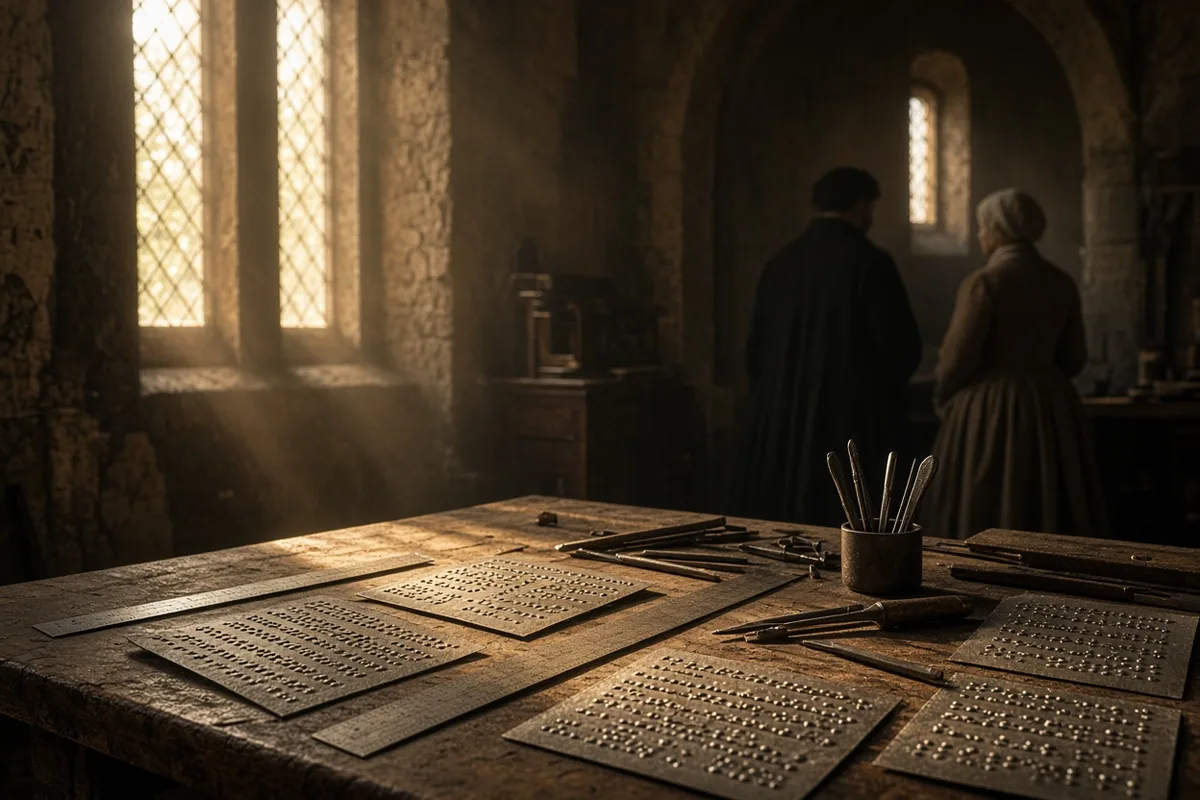
Louis Braille sat at the far table with his back to the window. He had already finished his own lesson for the day. I could hear the faint scrape of his stylus moving across the thick paper. He worked without hurry, pressing the dots into place one cell at a time. Every so often he ran his fingertips over what he had made, checking the spacing.

We had asked him weeks earlier. The raised staves Haüy left behind were too large to read while we played. Rousseau’s method still required us to feel bulky shapes that told us nothing about how long a note should last. Braille had listened, nodded once, and said he would try. Now the paper in front of him carried both letters and something new.
He called me over after the others had gone to supper. The room smelled of resin and old wool. He placed my hand on the page so I could feel the pattern he had set. Six dots arranged in two columns. The top four stood for pitch. The two at the bottom marked duration. A single cell could tell me the note and whether it lasted a quarter or an eighth. I traced it twice. The shape stayed in my fingers after I lifted my hand.

He asked if I could play from it without looking away from the strings. I tried. The first line came haltingly, but the second moved faster because I no longer had to guess the length of each rest. Braille listened without comment. When I stopped he made a small adjustment to one cell, then let me try again.
Outside, the courtyard bells rang for evening prayers. We stayed where we were. He showed me how a chord would sit in three consecutive cells, the fingers reading left to right while the right hand stayed on the keyboard. He had already tested the same idea on the organ at Saint-Nicolas-des-Champs. The organist there let him stay after services to copy the hymns. The dots fit between the stops without crowding the bench.
Word spread through the dormitory. A girl who played violin asked to see the page. Braille gave her one he had prepared the night before. She read the first four measures aloud, naming each note and its value. Her voice carried down the corridor. Someone else asked for a copy of the same piece. By the end of the week three students had asked for their own copies of the cello sonata we had all been struggling to keep in memory.

The director of music came to watch one afternoon. He stood near the door while Braille explained the system to two new arrivals. The director asked whether the code could show dynamics. Braille answered that a separate cell placed before the note could mark forte or piano. He had not yet decided on the exact pattern, but the space existed. The director nodded and left without further questions.
Winter came early that year. The practice rooms stayed cold even with the stoves lit. Braille continued to work at the same table, wearing fingerless gloves so the stylus would not slip. He produced pages for organ voluntaries, for simple songs, for the cello exercises we used every morning. Each page carried the title in ordinary letters above the music line so sighted teachers could still follow along.
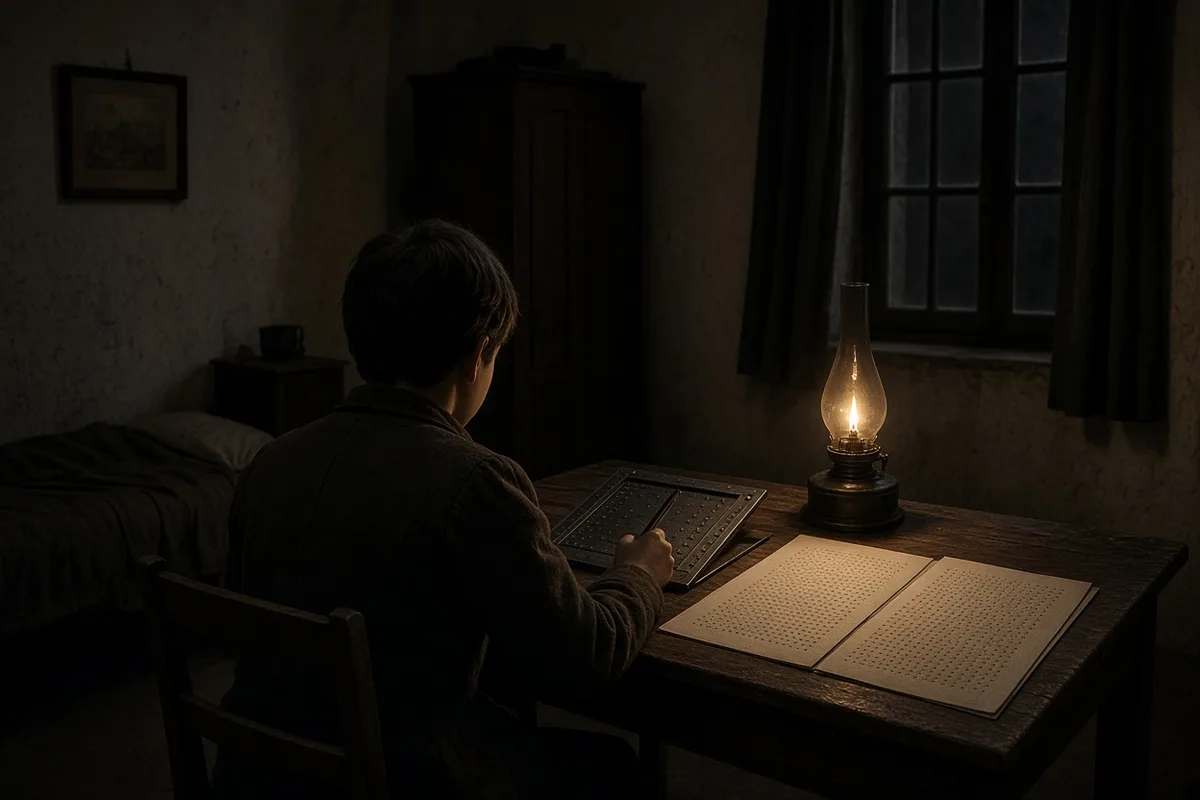
One evening he let me copy a short piece he had finished. My hand shook at first because the dots had to sit exactly where his had been. After the third line my fingers settled into the rhythm of the tool. When I finished he checked the page by touch and said nothing was out of place. I took it to the music stand and played it through without stopping. The notes matched what he had written.
By spring the older students were using the system in their lessons. The teacher no longer had to repeat every phrase aloud. We could check our own work. Braille himself played the organ at Notre-Dame-des-Champs on Sundays and copied the service music during the week. He never asked for payment, only that the pages be returned so others could use them.
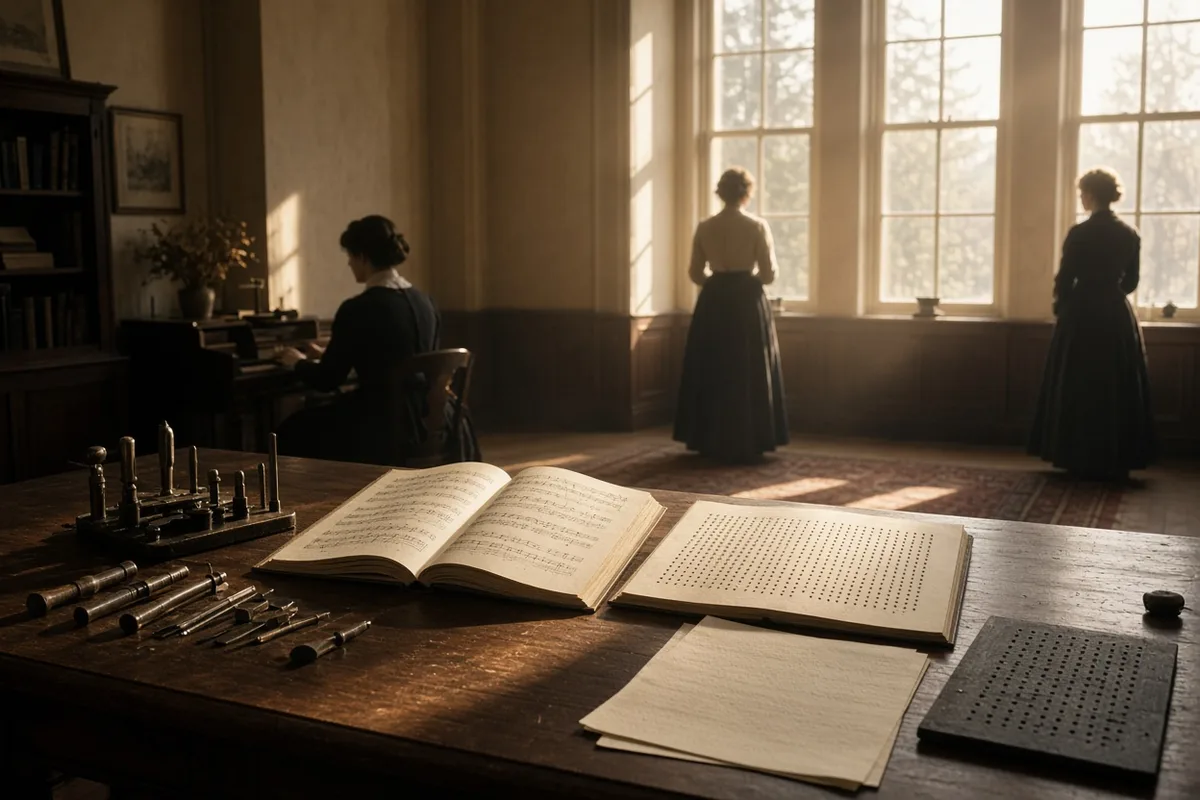
The last time I saw him that year he was carrying a stack of finished sheets toward the library. The paper edges were already softening from handling. He moved slowly because the corridor was narrow and he did not want to crease any of the cells. I held the door for him. He thanked me without looking up, then continued down the hall until the sound of his steps faded against the stone.
The next spring I returned to the Institute after a short visit home and found Braille already at work on a fuller set of rules for the music code. He had numbered the cells from one to sixty-three in a small notebook so that any combination could stand for a pitch, a rest, or a dynamic mark. On the twenty-seventh of May he showed me the page where he had written out the opening of the Haydn Cello Concerto in D, every note and every bow marking reduced to six raised points. He told me the organist at Saint-Nicolas-des-Champs had played the same passage from one of the new sheets without a single mistake in rhythm.
By the winter of 1829 the director allowed the music room to keep a locked cabinet of the dotted sheets. Braille added a small preface that year stating that the system required only the same six positions already used for letters. He printed the preface at the school press on rue Saint-Victor and bound twenty copies for the senior class. One of those copies reached the hands of a visiting teacher from the school at Saint Petersburg, who copied the preface word for word into his own notebook before he sailed back in March.
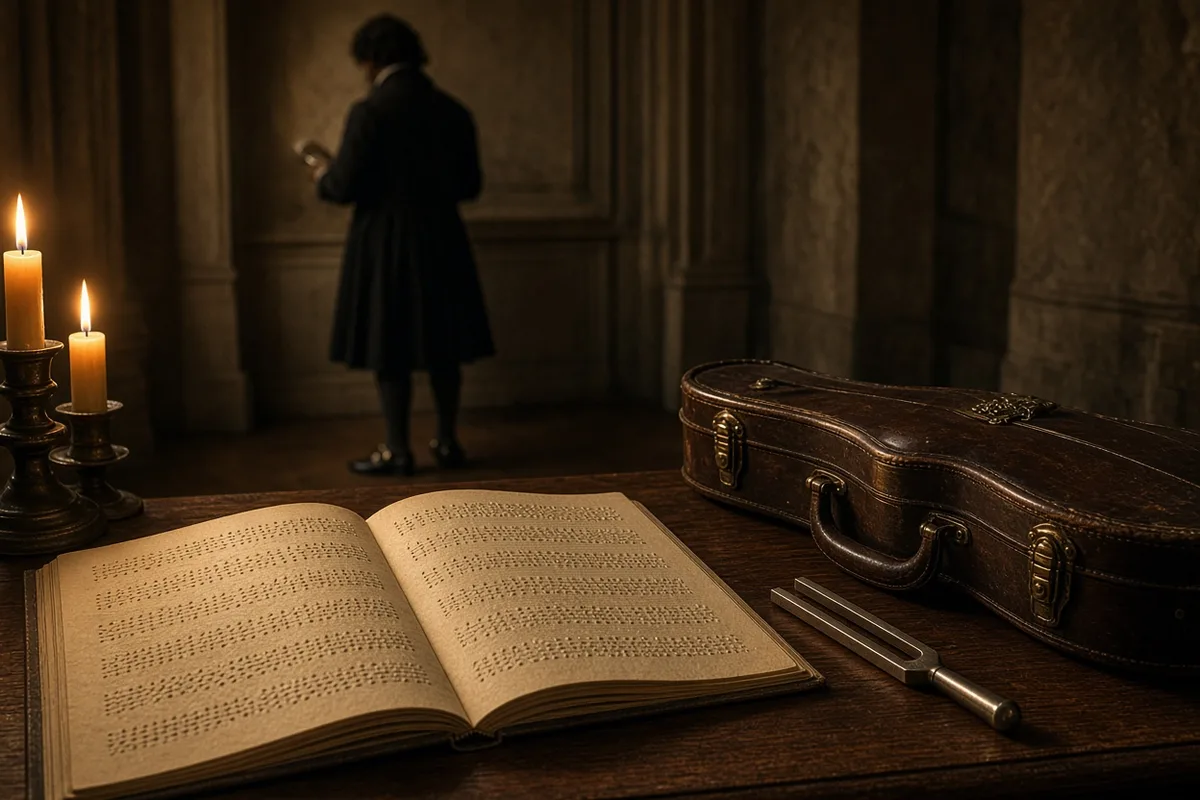
Braille left the Institute in 1830 to take the post of organist at the Church of Saint-Nicolas-des-Champs but came back every Tuesday to teach the new students. On the fourteenth of February 1832 he brought a revised table that placed the duration marks in the lower two dots only when the note exceeded a quarter value. I watched him read a full fugue by Bach from those pages while his left hand stayed on the manuals. The following month he asked the director to order paper cut to exactly twenty-two centimeters wide so that two staves could sit side by side without the cells touching.
After his death on the sixth of January 1852 the Ministry of the Interior ordered the Institute to continue distributing the music sheets to any blind musician who requested them. The order listed one hundred and forty-seven titles already prepared, including the complete organ works of Lemmens and the violin sonatas of Corelli. In 1854 the same Ministry declared the dot system official for all French schools for the blind. The decree was read aloud in the refectory on the tenth of October and the students answered with a single sustained chord on the piano.
In 1888 the British and Foreign Blind Association printed its first catalogue of Braille music in London, listing two hundred and three separate works. The catalogue gave the exact number of cells required for each piece so that a reader could order only the pages needed. By 1905 the same association had produced nine hundred and twelve volumes, each volume containing between forty and sixty pages of dotted music. The American Printing House for the Blind in Louisville began its own series in 1915 and issued the first Braille edition of the Bach Well-Tempered Clavier that December.
After the First World War the newly formed American Braille Commission met in New York on the third of April 1923 and adopted the French six-dot cell without change for pitch and duration. The commission recorded that four hundred and seventeen American musicians already owned personal collections of the sheets. In 1954 the World Braille Council in Paris issued a single international key that assigned every musical symbol a fixed cell number from one to sixty-three. The key was printed in both ink and dots and sent to every national library for the blind.
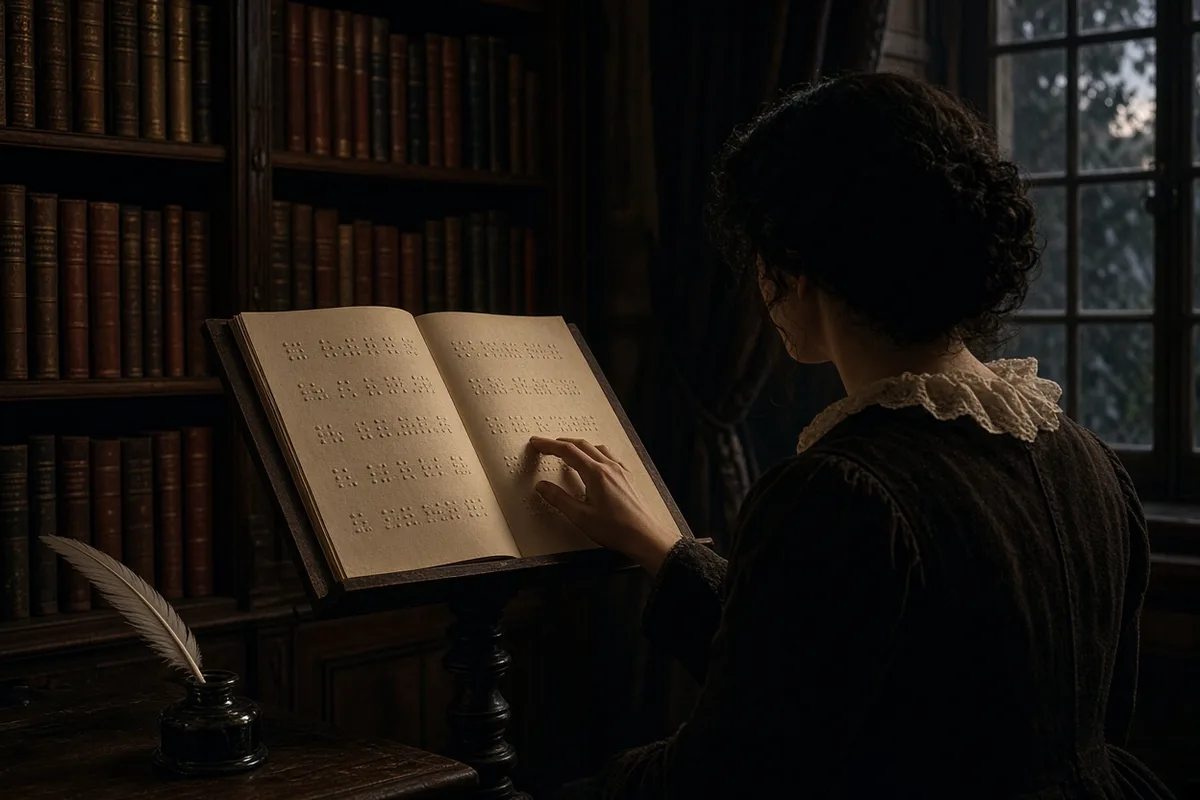
On an ordinary Tuesday morning in 1974 a woman named Marie-Claire Charpentier, born in 1911, sat at the upright piano in her apartment on the rue de Rennes. She opened a folder containing the complete piano part of the Franck Violin Sonata transcribed in 1968 by the Valentin Haüy Association. Her fingers moved across the cells at the top of the first page, locating the key signature of A major and the quarter-note pulse. She played the opening phrase once, stopped, adjusted a single duration dot with a stylus she kept in a small case beside the bench, and began again. The afternoon light crossed the keys but she did not lift her hands from the paper until the movement was finished.
In 1982 the Valentin Haüy Association in Paris issued a new Braille transcription of the complete Beethoven piano sonatas, prepared by organist Jean-Pierre Lemoine and printed on 487 sheets that required 19 volumes measuring 28 by 22 centimeters. Lemoine recorded in the association’s annual report that the project took 2,140 hours of embossing time and used 14,600 sheets of zinc for the master plates. The volumes were distributed to 61 conservatories across France that year, with each copy accompanied by an ink-printed index listing cell counts for every movement.
The International Braille Music Association held its first plenary session in London on 12 September 1987 and adopted a uniform table for guitar tablature symbols that assigned the letter “G” in the upper two dots to indicate a string number. The table was published as IBMA Circular 4 and mailed to 38 member libraries; one copy reached the Perkins School for the Blind in Watertown, Massachusetts, where librarian Eleanor Rigby entered the new symbols into the school’s card catalogue on 3 November. By 1993 the same association had catalogued 4,812 separate Braille music titles held in European collections.
On 15 March 1999 the Library of Congress National Library Service for the Blind and Physically Handicapped released its first digital Braille music files on compact disc, containing the full orchestral score of Stravinsky’s Rite of Spring reduced to 2,317 cells. The files were produced at the NLS studio on Taylor Street in Washington using a modified Braille embosser that ran at 120 cells per minute. Twenty-seven copies were sent to regional libraries, and one reached pianist Thomas McEwen in Seattle, who loaded the disc into his refreshable Braille display and performed the opening bassoon solo from the dots on 8 April.
The European Blind Union’s music commission met in Brussels on 22 June 2004 and approved a revised code for contemporary notation that added cells for quarter-tone accidentals and multiphonics. The new symbols were tested by violinist Anna Kowalski at the Royal Academy of Music in London, who read and performed a movement from Ligeti’s Violin Concerto from a prototype sheet on 14 October. The commission recorded that the test required 47 additional cell combinations beyond the original sixty-three.
In 2012 the Braille Authority of North America published its sixth edition of the Music Braille Code, a 312-page volume that included 1,894 examples and was distributed in both hard-copy dot form and as an ASCII file. The edition incorporated input from 14 consultants, among them composer and transcriber Robert Englebretson, who contributed the section on jazz chord symbols. One copy was placed in the reference room of the Canadian National Institute for the Blind in Toronto and used that December by a student ensemble preparing a set of Thelonious Monk transcriptions.
The World Blind Union’s music project, headquartered in Madrid, completed digitization of 9,340 legacy Braille music volumes between 2015 and 2021, converting the zinc masters into refreshable-display files stored on servers at the ONCE library. The project logged 41,200 hours of volunteer transcription time and produced files compatible with the 40-cell displays manufactured by HumanWare in Drummondville, Quebec. On 4 February 2020 the first file set, containing the complete works of J. S. Bach for organ, was downloaded 183 times within the initial month.
On a Tuesday morning in March 2023, organist Pierre Leclercq, born in 1957, sat at the console of the Cavaillé-Coll instrument in the Church of Saint-Sulpice in Paris. He placed his hands on a 40-cell refreshable Braille display mounted above the manuals and read the registration and manual changes for the opening bars of Franck’s Choral No. 3 in A minor from a file prepared by the Valentin Haüy Association in 2019. Leclercq adjusted one stop knob, then began the first phrase, his left hand remaining on the display while his right hand moved across the keys. The nave remained empty except for a single verger sweeping the side aisle.