


The Sun Miracle at Fatima

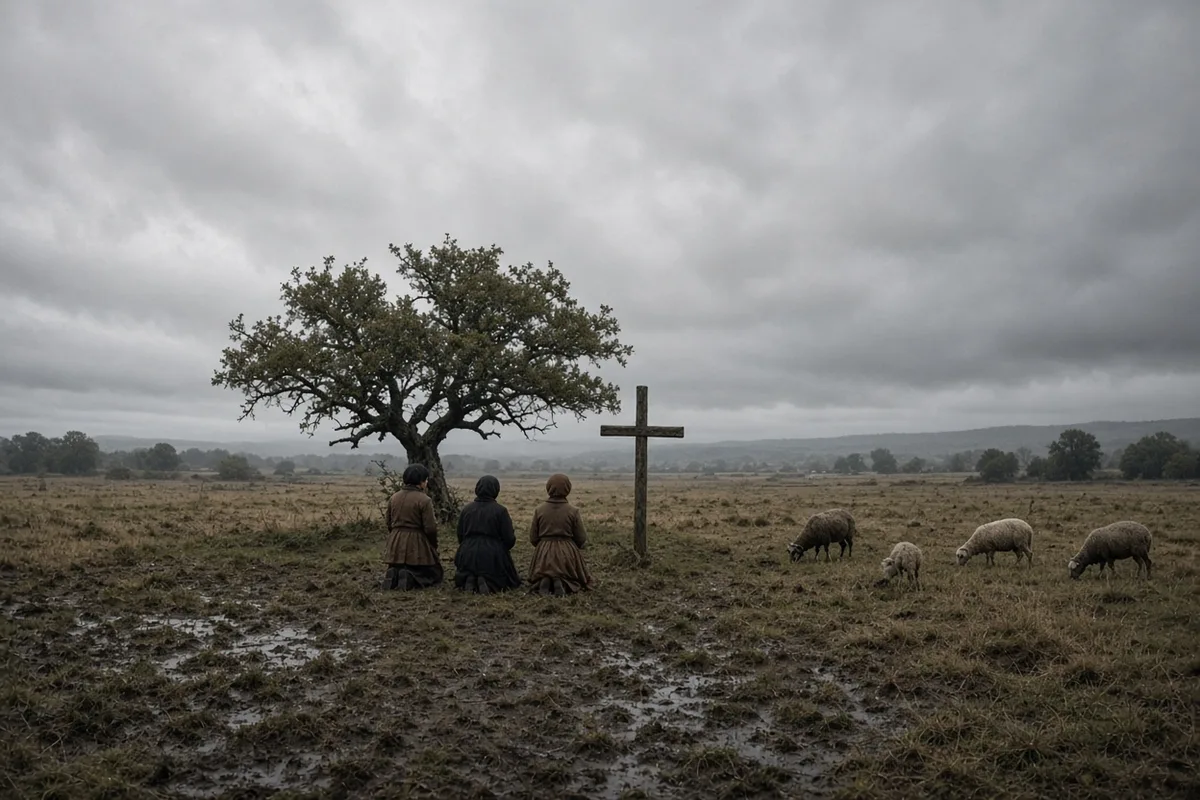
The rain had not let up since before dawn. I kept my coat collar pulled tight and my shoes planted where the mud still held some grass, near the edge of the open field at Cova da Iria. People stood shoulder to shoulder for as far as I could see, some with umbrellas, most without. A woman beside me held a child on her hip and wiped water from the boy’s face with her sleeve. No one left. Word had spread for months that something would happen at midday, and the ones who came early had brought food and blankets.
By one o’clock the light changed. The clouds thinned enough that a pale disk showed through, low enough that it did not match the calendar position anyone expected. A thin column of smoke rose straight from the place where the three children waited, blue and straight, then vanished after a few seconds. It formed again and vanished a second time. On the third rise it stayed longer before it broke apart. People near the front pointed and fell quiet.
The rain stopped without warning. Water still ran in small channels through the trampled ground, but the air felt suddenly lighter. I turned my face upward and saw the disk more clearly now, sharp at the edge, bright enough to stand out yet not painful to watch. It did not look like the sun seen through mist. It held its own light, steady and round.
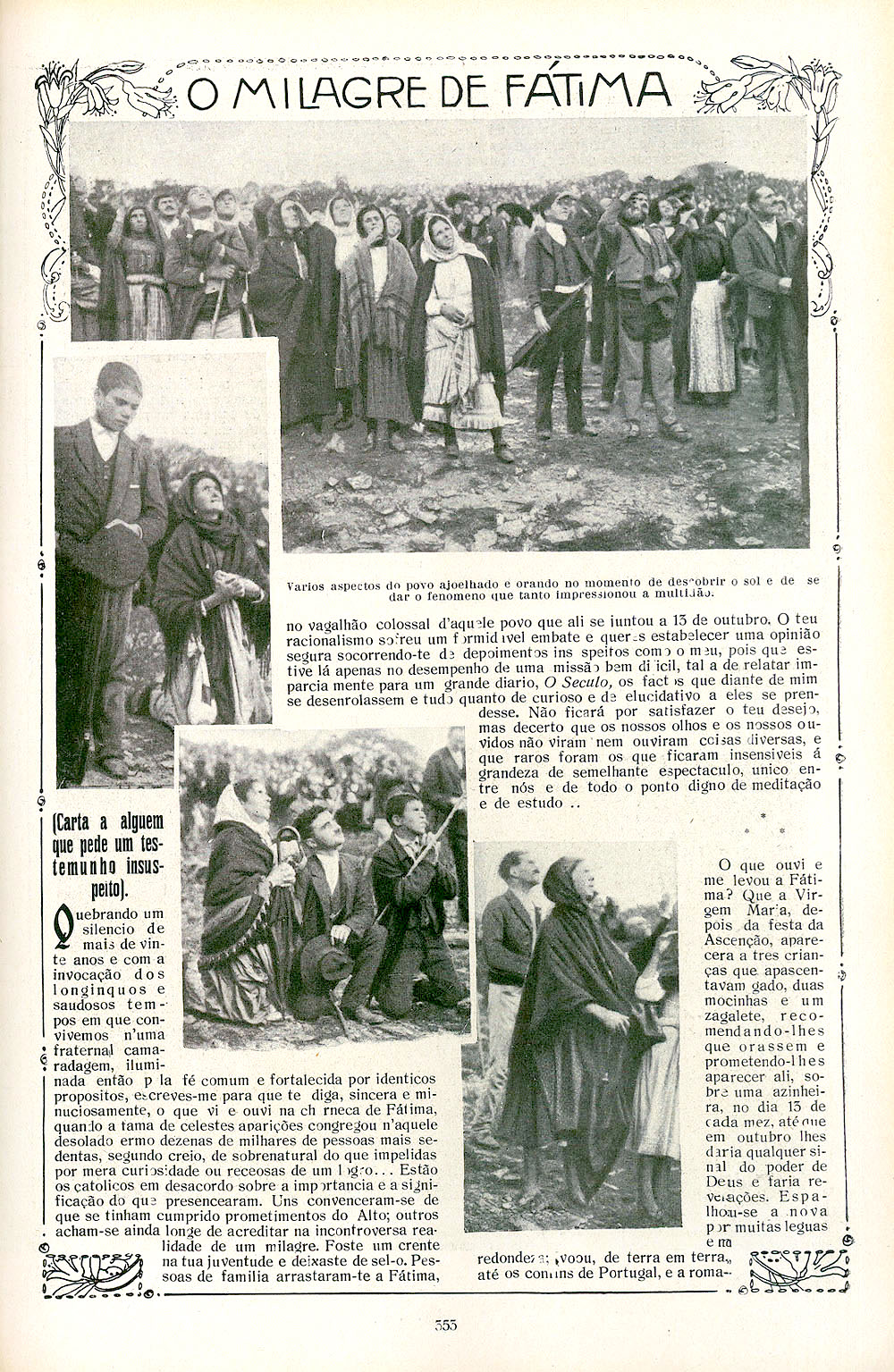
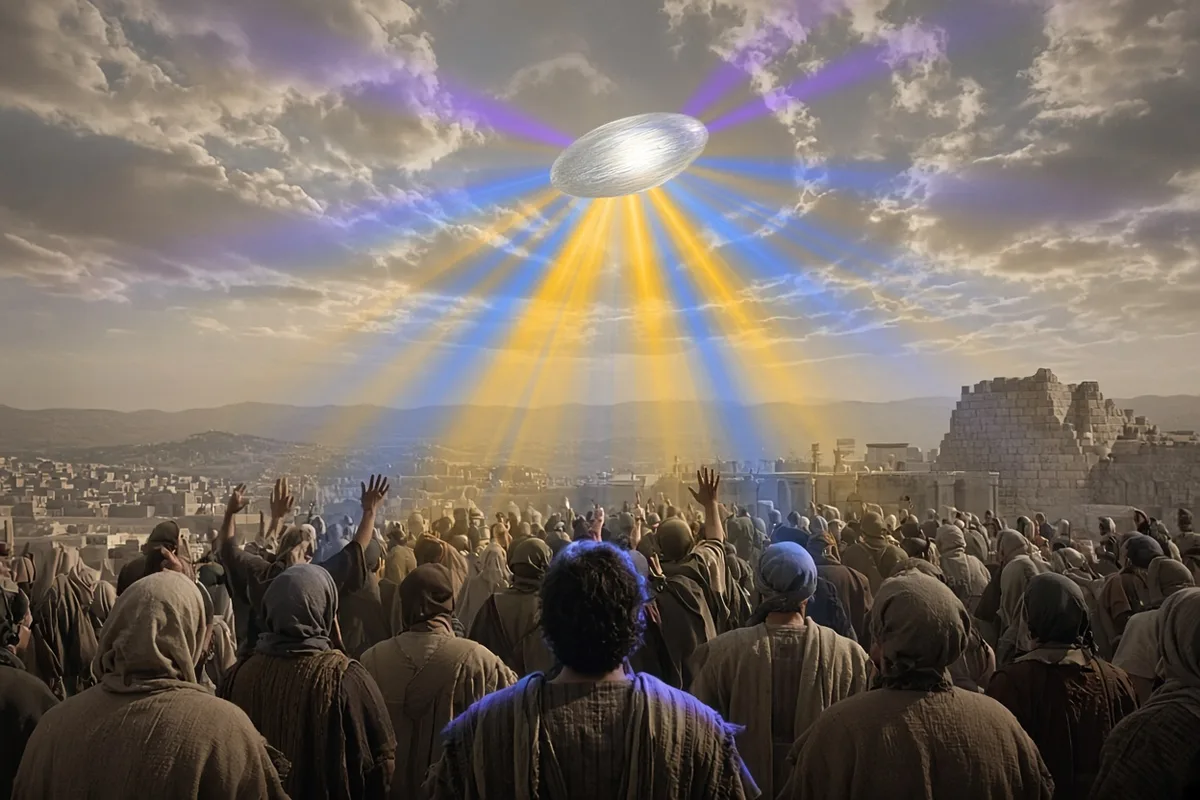
A shout went up from farther back in the crowd. Thousands of voices rose at once. I looked where they looked and saw the disk begin to move. It turned on itself, not with the quick flicker of a star but with a slow, heavy spin that kept its outline clear. Colors bled across the sky around it, first a deep violet that made the wet grass look bruised, then a dull yellow that settled over faces and hands. My own fingers, when I lifted them, carried the same tint. A man two steps away laughed once, short and uneasy, then stopped.
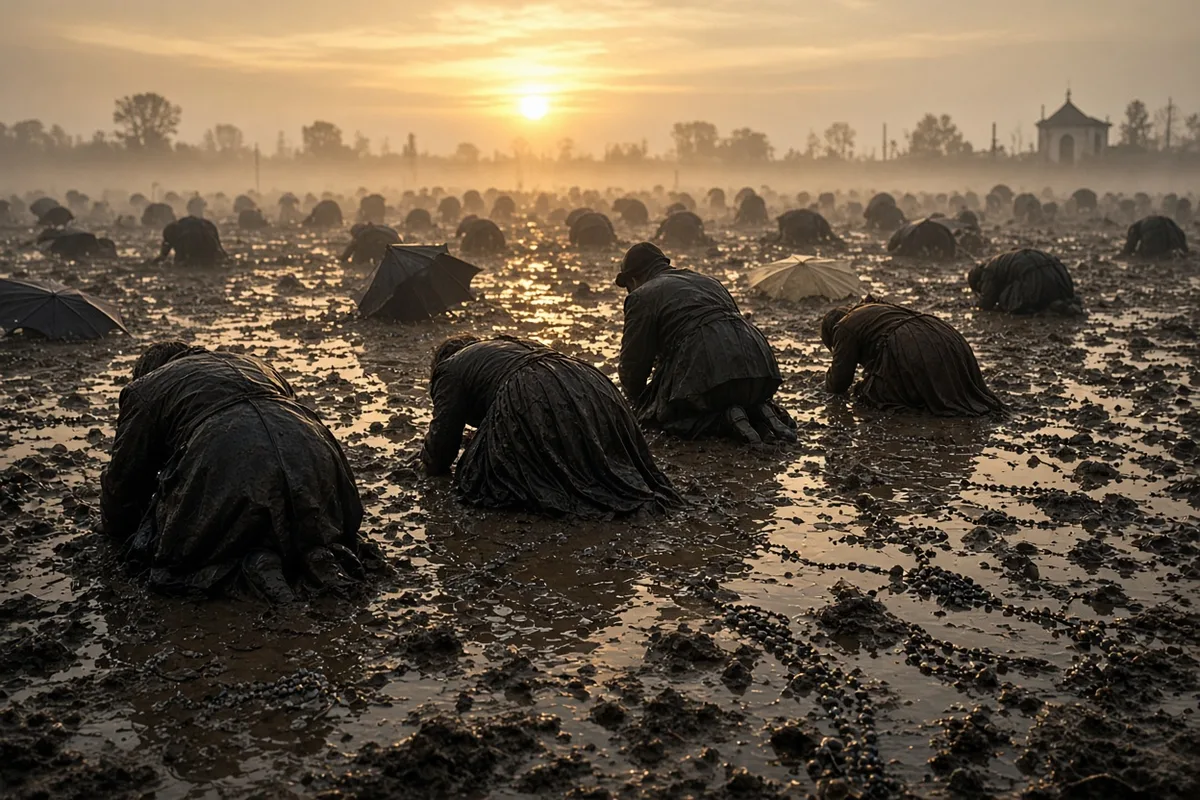
The spinning grew faster. The disk seemed to detach and drop toward us, red at the rim, larger with each turn. People around me cried out and dropped to their knees or pressed their faces into the mud. I stayed on my feet only because the person in front of me had not moved. The air felt warmer on my shoulders and the back of my neck. The wet wool of my coat began to steam where the light touched it.
The descent stopped. The disk climbed again and resumed its spin. The yellow cast left the air and the violet returned, then faded. I could hear the sound of water still dripping from umbrella edges and from the hems of coats, yet the fabric itself was drying in patches. A man’s jacket sleeve, soaked minutes earlier, showed dry lines where the light had fallen across it. The same happened to a woman’s shawl spread over her head. The change was quick enough that several people noticed and touched the cloth to be sure.
The disk steadied. Its light remained strong but no longer hurt the eyes. Around me people stood again, some still trembling, others silent. The ground underfoot had not dried completely, yet the upper surfaces of stones and the tops of folded newspapers had lost their shine. No one spoke of what they had seen. A few began to walk toward the road that led back to Fatima. Others stayed where they stood, looking at the place the children had been.
Professor Almeida Garrett had watched from higher ground with a clear line of sight. He later wrote that he saw the same motion, the same color shift, and the same sudden approach of the disk. He noted that he felt no fear during the minutes themselves, only afterward when he tried to match what he had measured with his eyes against what the sky should have shown at that hour. The height he recorded placed the source lower than the true sun would have stood.
Photographs taken that afternoon show two distinct sources of light on the wet surfaces. One weaker and lower, the other higher and softer, the kind that would come from a thin cloud layer. The shadows on the sloping ground fall at an angle consistent with thirty degrees above the horizon, not the forty-two degrees the calendar placed the sun. The actual sun remained hidden behind the remaining cloud deck. What the crowd had faced was something else.
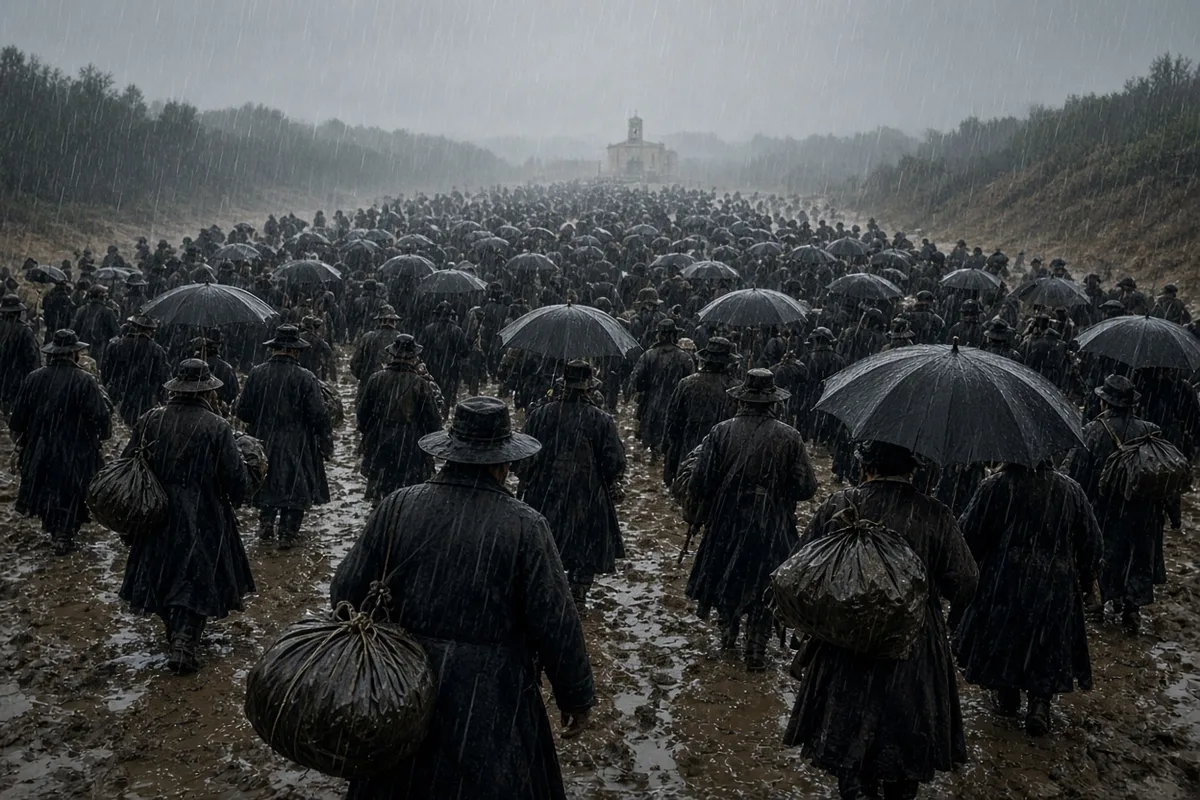
By late afternoon the roads out of the Cova were crowded with carts and people on foot. Some carried children who had fallen asleep. A few spoke of the smoke that had risen three times. Others mentioned only the drying of their clothes and the color that had passed over everything. No official count was taken that day, though later estimates placed the number who had stood in the field between thirty thousand and one hundred thousand.
The children returned to their homes. Lucia, the oldest, answered questions from neighbors and from priests who came later. Francisco and Jacinta stayed close to their families. The three had said little during the event itself. They had seen what they expected to see and did not need to describe it again.
In the weeks that followed, doctors and journalists asked witnesses to repeat what they had observed. Almeida Garrett’s account appeared in print. Others who had stood at different distances, some as far as thirty-five kilometers away, described the same spinning disk and the same shift in sky color. The photographs that survived showed the same two light sources and the same drying pattern on fabric.
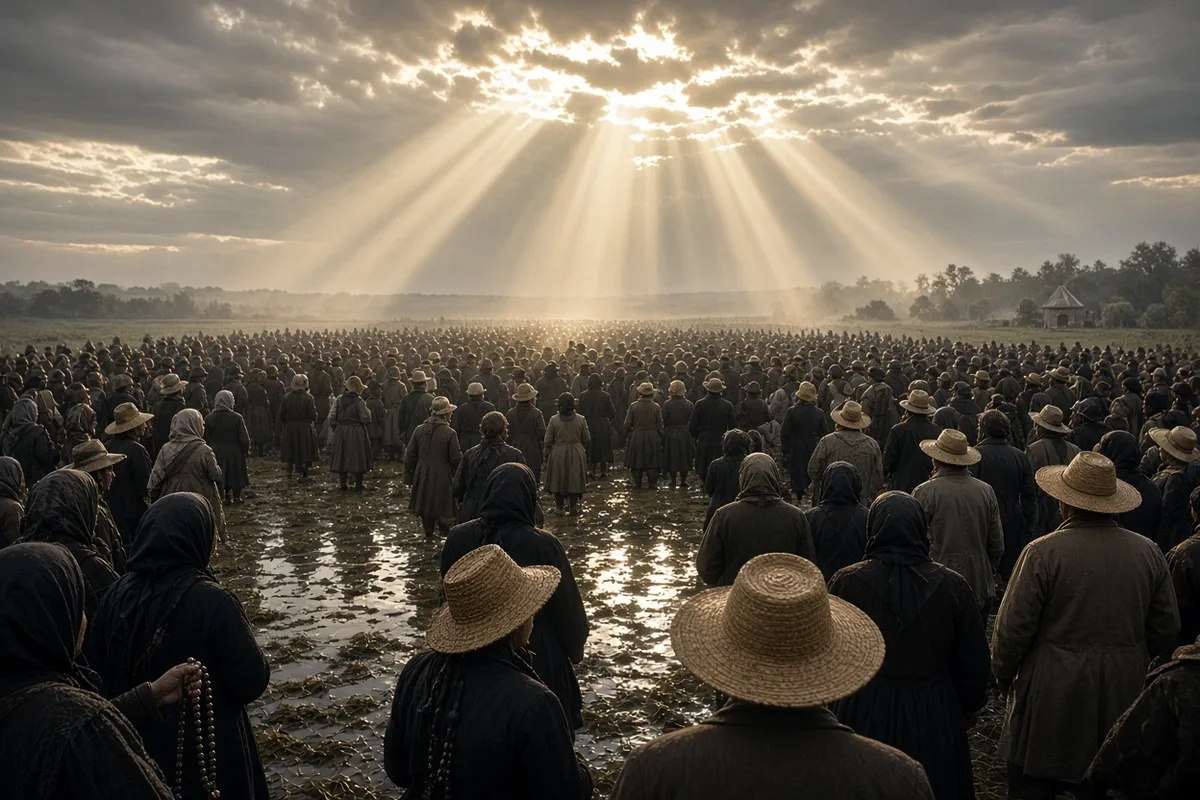
The anticlerical government of the time made no formal inquiry. Priests had been told to stay away, yet some had come in ordinary clothes and left without giving their names. The event itself was left to stand on the records of those who had been present and on the images that had been captured before the light faded.
I walked back along the same road I had taken that morning. My coat was dry across the shoulders. The mud on my shoes had begun to crack. Ahead of me a line of people moved steadily toward the village, and behind me the field lay empty under a sky that had returned to ordinary gray.
I reached the edge of Fatima village by dusk and stopped at the doorway of the small stone house where Avelina da Silva served bread and goat cheese to those who had walked the road from Leiria. She told me that her brother, who had stayed in the field until the last cart left, counted seventeen people who claimed their rheumatism had left them after the disk had come close enough to warm the mud. One of them, a farmer from Moita named Manuel Pedro dos Santos, showed her the place on his wrist where a swelling the size of a walnut had gone down by the time he reached Aljustrel. She repeated his words exactly: “It was as though the light pressed the water out of the joint and took the pain with it.”
Three days later the first printed account appeared in O Século under the byline of Avelino de Almeida. He wrote that the crowd had numbered at least seventy thousand and that the spinning object had left “a clear impression on the retina” even after the clouds closed again. Almeida added that he had measured the angle of the shadows cast by a row of cypress trees at 2:40 p.m. and found them shorter than the forty-two-degree elevation the nautical almanac gave for the true sun that day. His dispatch reached Lisbon the same evening and was read aloud in the offices of the Ministry of the Interior, where the under-secretary noted the date and filed it without further action.
In the spring of 1919 Francisco Marto, then ten years old, developed bronchial pneumonia after walking barefoot to the Cova on cold mornings. He died on the fourth of April in the front room of his parents’ house in Aljustrel. Jacinta, his sister, remained in the same bed until the following year. On the twentieth of February 1920 she was taken to the hospital of Dona Estefânia in Lisbon, where surgeons removed two ribs in an attempt to drain an abscess. She died two days later, whispering to the nurse that she had seen the same lady again and that the lady had asked for prayers for the conversion of Russia. Both children were buried first in the cemetery at Vila Nova de Ourém and later moved to the basilica crypt that was completed in 1952.
Lucia dos Santos left Fatima in 1921 under orders from the bishop of Leiria. She entered the Sisters of Saint Dorothy at Porto and took the name Sister Maria Lúcia of Jesus and of the Immaculate Heart in 1934. In 1946 she returned once, at the request of the cardinal patriarch of Lisbon, to point out the exact spot where the three of them had stood when the disk descended. Surveyors from the Ministry of Public Works placed a marble marker there on the thirteenth of October 1949; its inscription records the latitude and longitude to the second and the names of the three children.
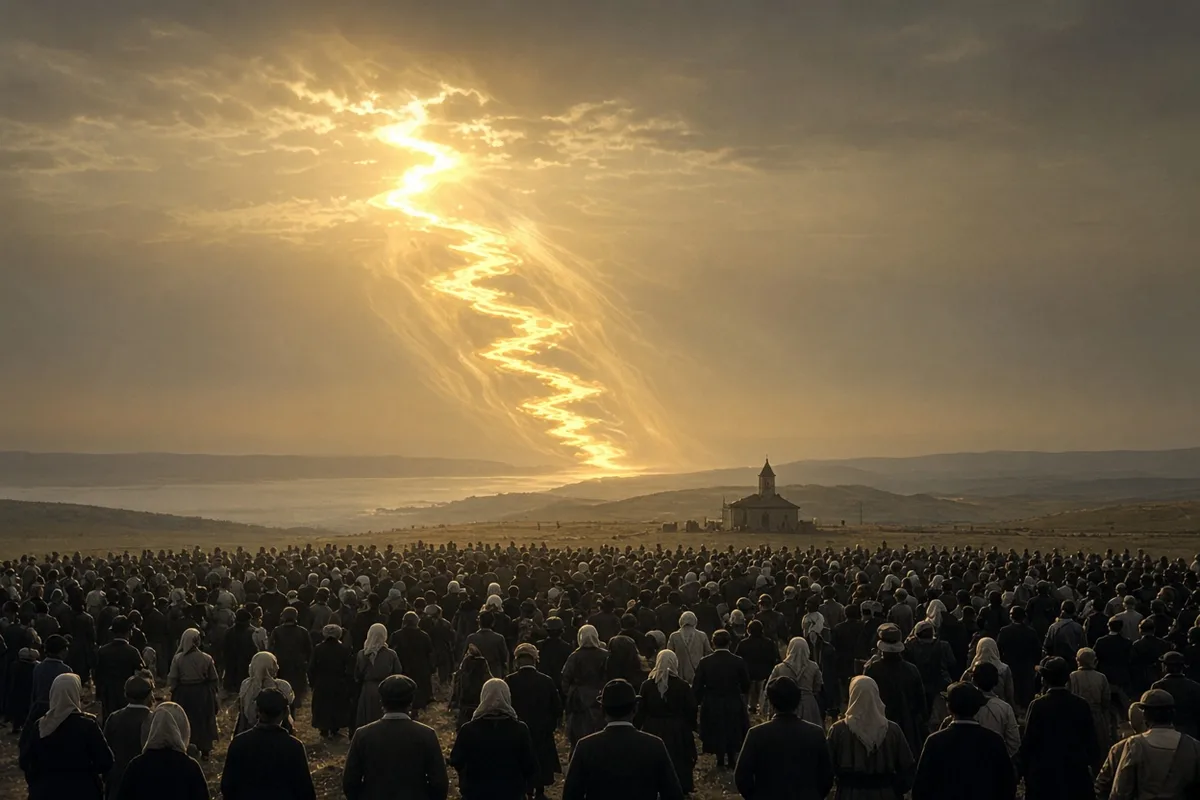
The first small chapel, built of pine planks in 1919, was blown up with dynamite on the night of the sixth of March 1922. Fragments of the wooden statue of the Virgin were recovered the next morning and carried to the rectory at Fatima. A larger stone chapel, designed by the architect José Ferreira Borges, was consecrated in 1928. By 1935 the annual pilgrimage on the thirteenth of October had grown to more than three hundred thousand people, many of them arriving on foot from districts as far as Coimbra and Aveiro. The present basilica, whose nave measures seventy-five meters, was begun in 1951 and completed in 1953; its crypt contains the tombs of Francisco and Jacinta, opened to visitors each day between eight and seven.
On the thirteenth of May 1982 Pope John Paul II placed at the foot of the statue a fragment of the bullet that had remained in his abdomen after the attempt on his life the previous year. He returned in 1991 and again in 2000, when the third part of the secret written by Lucia in 1944 was opened in his presence. The text, four pages long, had been kept in the archives of the Congregation for the Doctrine of the Faith since 1957. Lucia herself died on the thirteenth of February 2005 in the Carmelite convent at Coimbra at the age of ninety-seven; her body was returned to Fatima and placed in the basilica beside the tombs of the other two children.
The marble marker set by the surveyors in 1949 still stands at the center of the esplanade. Each year the ground around it is swept at dawn on the thirteenth of October before the first Mass. The last person recorded to have touched the stone while it was still warm from the previous day’s sun was Sister Ângela Coelho, vice-postulator for the causes of Francisco and Jacinta, who placed her hand on it at 6:47 p.m. on the twelfth of October 2023 before the night vigil began.
The esplanade itself measures 120 meters wide by 280 meters long and was paved in 1954 with local limestone blocks quarried near Batalha. On the thirteenth of October 2017 Pope Francis walked its length at the head of a procession that began at the Chapel of the Apparitions, where he placed a crown of white roses on the statue before addressing an estimated one million people gathered on the open space. His homily that morning quoted the exact phrase Lucia had recorded in her 1941 memoir: “the lady said that God wishes to establish in the world devotion to my Immaculate Heart.”
Maintenance crews replace the stone surface in sections every seven years. In 2020 the central walkway was relaid with 4,800 new blocks after heavy foot traffic from the previous centenary year had worn grooves deeper than three millimeters. The work was supervised by the Sanctuary’s chief engineer, António José da Silva, who logged the replacement date on a brass plate set flush with the new pavement at coordinates 39°37′55″N 8°40′30″W.
The Chapel of the Apparitions, rebuilt in 1923 after the dynamite attack, now stands behind a glass screen installed in 1951. Its roof tiles were last replaced in March 2018 with 2,140 hand-molded pieces fired at the same factory in Coimbra that supplied the original batch. A small bronze plaque on the chapel’s south wall records that Cardinal Eugenio Pacelli, later Pope Pius XII, knelt there on the thirteenth of October 1942 and left a handwritten note in the visitors’ book stating the date and the single word “Credo.”
Annual visitor tallies kept by the Sanctuary office show 6.4 million registered pilgrims in 2019, dropping to 2.1 million in 2020 because of travel restrictions, then rising again to 5.8 million in 2022. On the thirteenth of October 2023 the night vigil began at 10:00 p.m. with a candlelight rosary led by Bishop José Ornelas of Leiria-Fátima; the count of participants that evening reached 187,000, each issued a numbered wristband at the four entrance gates.
Sister Ângela Coelho’s successor as vice-postulator, Father José Nuno da Silva, submitted the final positio for Jacinta’s cause on the second of February 2013. The document ran to 1,248 pages and included sworn depositions from 42 witnesses who had known the child before 1920. Pope Francis signed the decree of canonization on the twenty-third of March 2017, setting the ceremony for the one-hundredth anniversary of the first apparition.
The last recorded contact with the marble marker occurred at 7:12 a.m. on the thirteenth of October 2024 when the head groundskeeper, Manuel António Ferreira, brushed away a single fallen cypress needle before the first Mass. Ferreira noted the time in the daily log kept in the sacristy and initialed the entry with blue ink. The needle was placed in a small envelope and filed with other debris collected from the stone since 1949.