


Thomas Aquinas Completes Summa
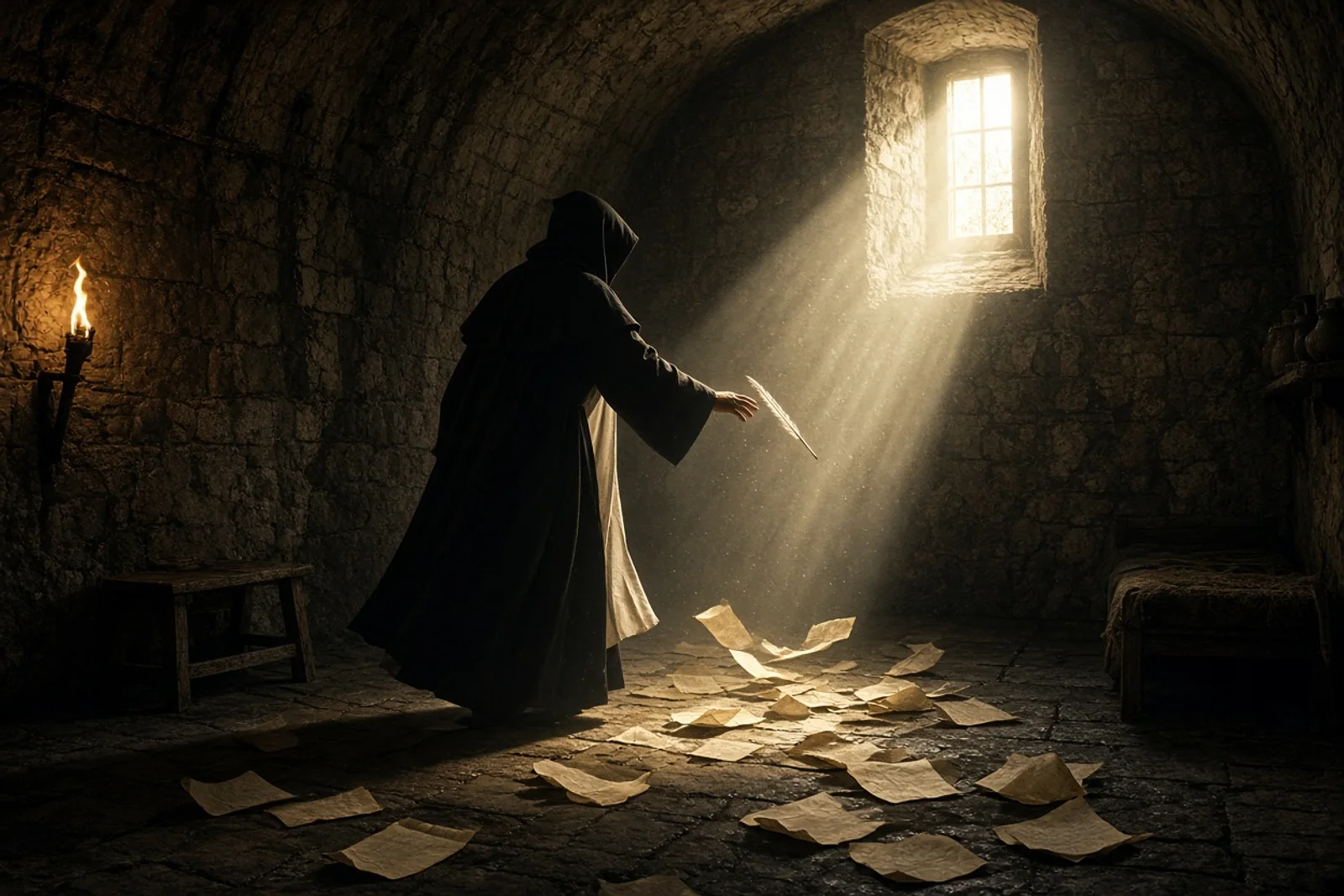
The chapel air hung thick with incense and the low murmur of brothers at prayer. I stood near the back, my hands still ink-stained from the morning's pages, watching Thomas move through the familiar motions at the altar. His shoulders had grown broader over the years, not from ease but from the steady weight of the work. Every day for months he had dictated until his voice grew hoarse, the secretaries scribbling to keep pace. On this feast of St. Nicholas the light through the narrow windows fell in thin bars across the stone floor.
Mass began as it always did. The words rose and fell. I shifted my weight from one foot to the other, thinking already of the questions that waited back in the scriptorium. Part Three still needed the final articles on the sacraments. Thomas had reached the ninetieth question, and the brothers spoke of how close the end lay.

Then the change came without warning. His hands, raised above the chalice, stayed lifted longer than the rite required. The silence stretched until the servers glanced at one another. One of them stepped forward, then stopped. Thomas's face had gone still, the eyes fixed on something none of us could see. Time passed in the small chapel the way it does when a man holds his breath underwater.
Reginald of Piperno, standing closest, touched his sleeve at last. The Mass finished in fragments. We filed out into the corridor where the winter damp met the smell of old parchment. Thomas walked slowly, one hand against the wall. When Reginald asked whether we should return to the work, the answer came low and final.
I cannot do any more.

The words settled in the air between us. Reginald pressed again, saying the end was near. Thomas answered that everything he had written seemed straw now. He did not raise his voice. He simply stopped moving toward the stairs that led to the room where the secretaries waited with their quills.
We led him to his sister's house a short distance away. Theodora met us at the door, her face tight with worry at the sight of him. For days he sat without speaking, sometimes staring at the fire, sometimes at nothing. The strength that had carried eight million words across two decades had left him like water draining from a cracked vessel. Reginald stayed close, bringing food he only sometimes touched.
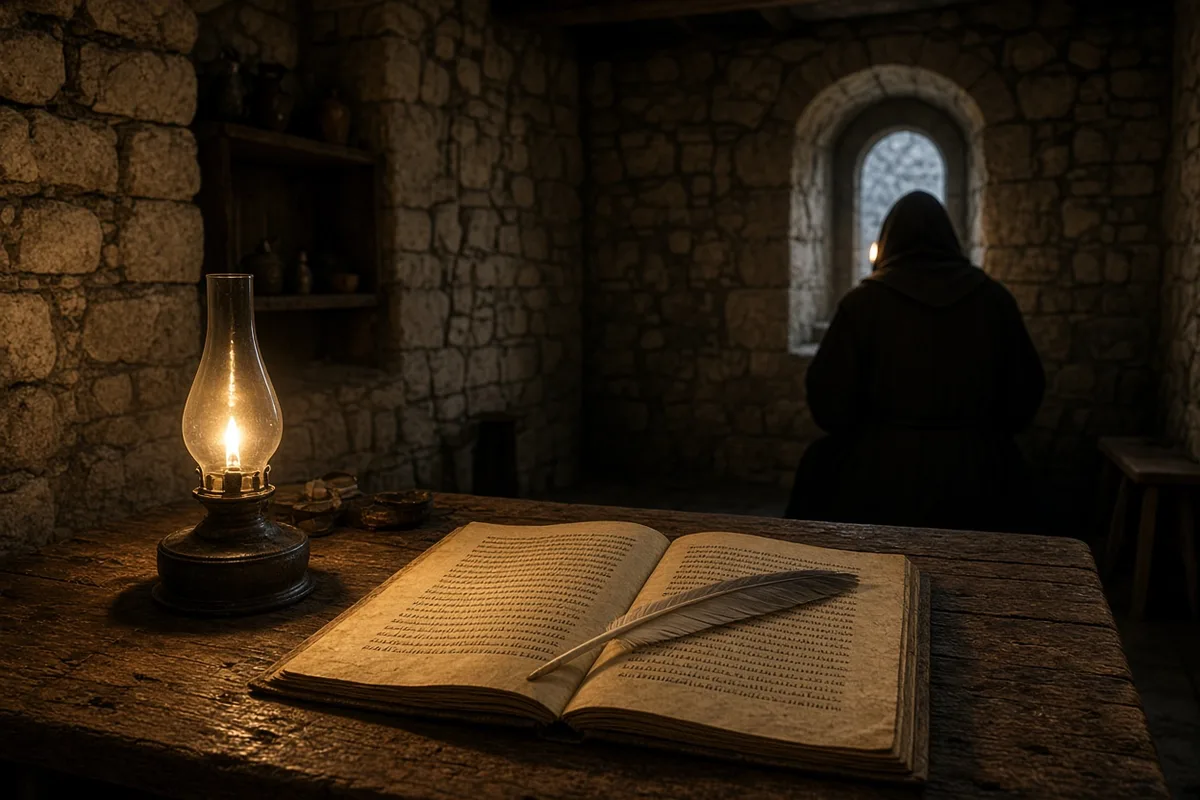
By the turn of the year Thomas recovered enough to travel. He wrote one short letter and an exposition on freedom and foreknowledge for the monks at Monte Cassino, the words measured and clear as ever. Then the summons came for the council at Lyons. He set out with a small party, the roads still hard from frost.
Illness took him on the way. At the monastery of Fossanova the monks carried him inside. He lingered there through the last weeks of winter, speaking little. On the seventh day of March the brothers gathered around the bed. His breathing slowed until it stopped. The body that had seemed so large in life looked smaller against the plain sheet.
Reginald returned to Naples with the unfinished pages. The secretaries stacked the quires in order, the questions on penance left without their replies. Over the following months other hands copied what existed and added the supplement drawn from earlier commentaries. The work moved through the order and beyond it, carried in saddlebags to Paris and to the new houses farther north.
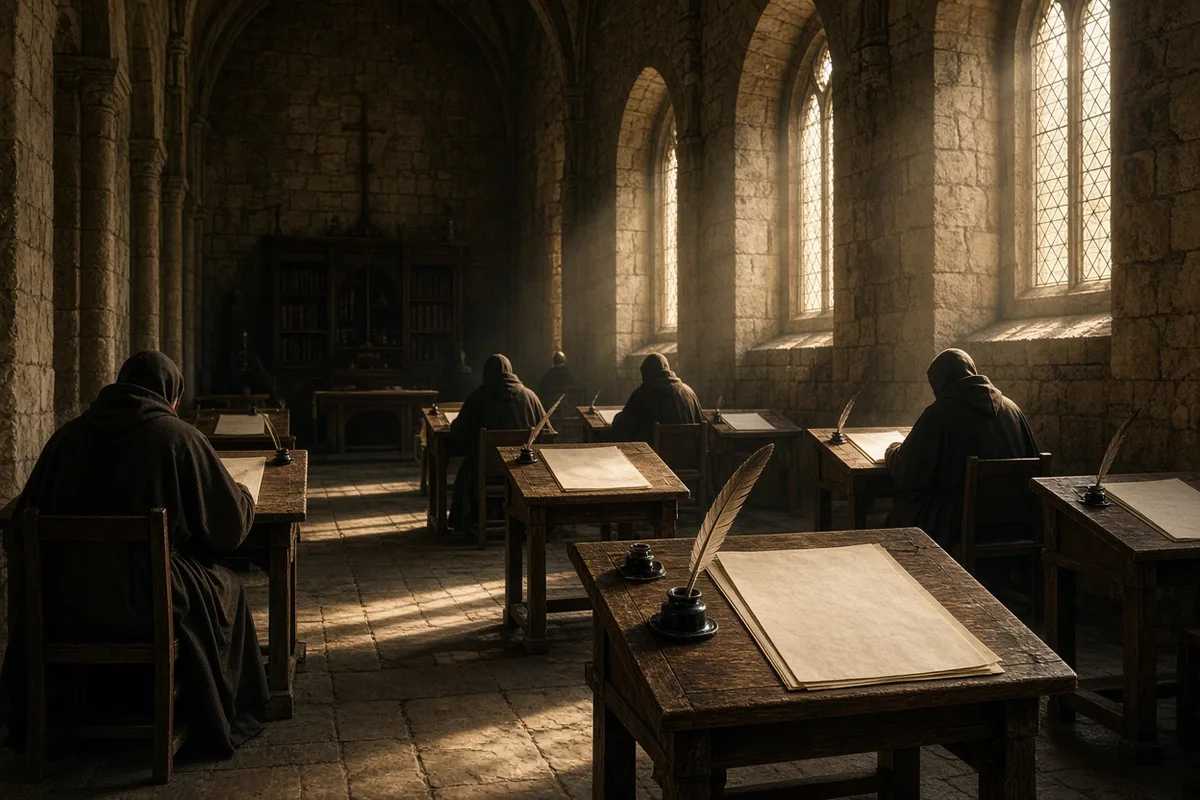
I remained at San Domenico for several years after. The room where the dictation had taken place stayed much the same, the table still marked by the pressure of elbows and the scrape of benches. Sometimes at dusk I would stand in the doorway and remember the moment the hands had stayed raised above the chalice. The light fell across the empty chair in the same pattern it always had. Outside, the bells marked the hours as they had before any of the questions were written.
In the years that followed, the table in the scriptorium at San Domenico Maggiore retained the same groove along its edge where Reginald of Piperno had rested his forearm while taking down the answers to questions eighty-four through eighty-nine of the Tertia Pars, the ones treating the necessity of the sacraments and the form of baptism. Brother Nicholas of Marsicano, who took over the copying of the remaining quires after Reginald left for the Roman curia in the autumn of 1275, recorded in his own hand on the flyleaf of the Naples manuscript that he had completed the transcription of the unfinished articles on penance on the feast of the Conversion of St. Paul, 25 January 1276, using the earlier commentary on the Sentences that Thomas had delivered at the same priory between 1252 and 1256. The parchment measured 320 by 240 millimeters, with thirty-two lines per column in a rounded Gothic script, and the ink, mixed from oak galls and iron sulfate, had already begun to darken to a deep brown by the time the volume was carried north to the studium at Cologne.

The same volume reached Paris by 1280 in the saddlebags of a Dominican lay brother named Peter of Bergamo, who deposited it at the convent of Saint-Jacques where it was collated against the partial copy already held there by the master general Humbert of Romans. On 18 November 1277, Stephen Tempier, bishop of Paris, included among the 219 condemned propositions three statements drawn directly from the Prima Secundae on the nature of the will and the possibility of a separate intellect, yet the faculty of theology continued to lecture from the incomplete Summa, adding the supplement compiled by Reginald from Thomas’s commentary on Book Four of the Sentences. By 1290 the work existed in at least forty-three complete manuscript copies, each requiring the skins of approximately 180 sheep and the labor of two scribes for four months, according to the account book kept by the procurator of the Roman province.
The canonization inquiry opened at Naples on 13 September 1319 under the direction of the archbishop, Umberto d’Ormont, and concluded after 131 witnesses had given testimony, among them the aged Reginald, then prior of San Domenico, who repeated the words Thomas had spoken on the morning after the vision: “Everything I have written seems to me so much straw.” Pope John XXII issued the bull of canonization, Redemptor noster, on 18 July 1323 in the cathedral at Avignon, declaring Thomas a saint and ordering his feast to be kept on 7 March; the text quoted verbatim the testimony of Theodora, Thomas’s sister, concerning the final weeks at Fossanova. In 1324 the remains were translated from the Cistercian abbey to the Dominican church at Toulouse, where the right arm was separated and sent to Paris, arriving at Saint-Jacques on 28 January 1325 and placed in a silver reliquary weighing seventeen marks.
The first printed edition appeared at Venice in 1486 from the press of Hermann Liechtenstein, in two folio volumes containing the Prima Pars, the Prima Secundae, and the Secunda Secundae, with the Tertia Pars and the Supplement added in a separate volume issued the following year; the printer’s colophon records that 825 copies were produced on paper and twelve on vellum. The Leonine Commission, established by Pope Leo XIII in the apostolic letter Aeterni Patris of 4 August 1879, began its critical edition at the Vatican in 1882 under the direction of Tommaso Maria Zigliara; the first volume, containing questions one through forty-nine of the Prima Pars, appeared in 1888 after collation of 112 manuscripts, and the entire edition reached completion in 1948 with the publication of the supplement in volume thirty.
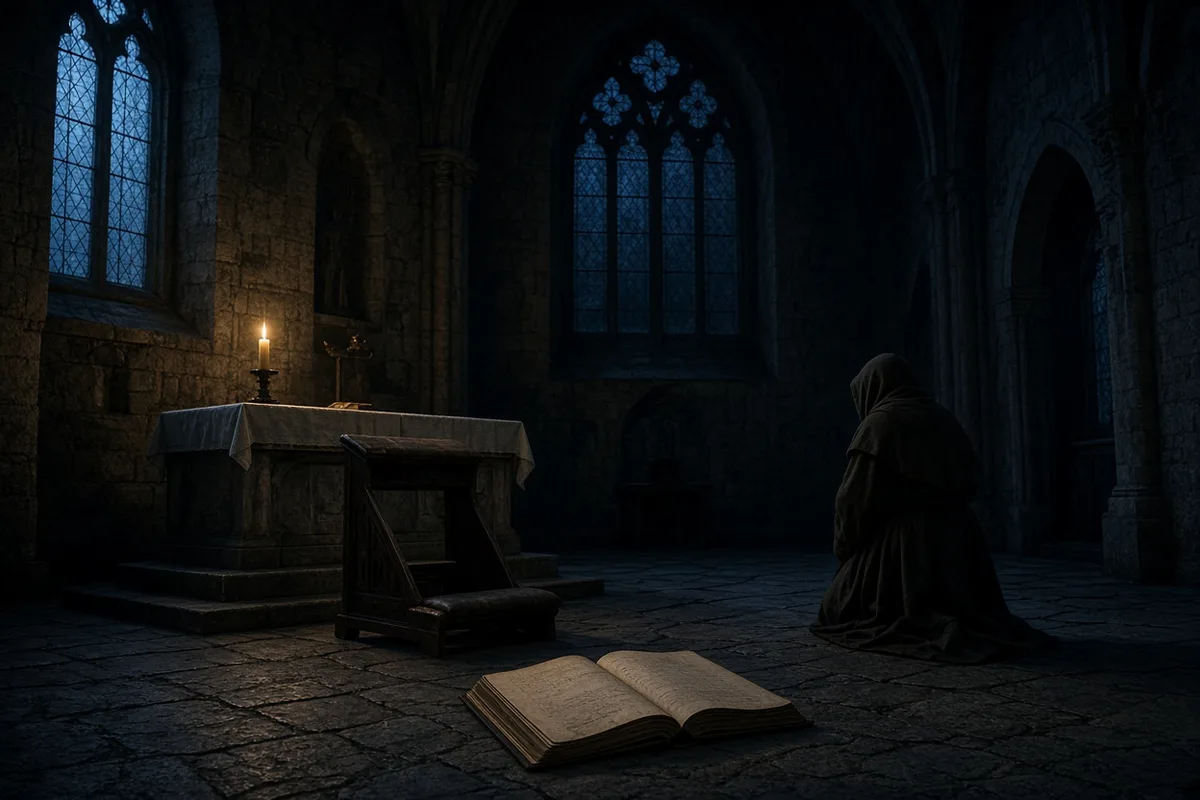
At the priory today the original refectory still stands, its vaulted ceiling supported by twelve octagonal columns of piperno stone, each 3.8 meters in circumference, and the refectory measures 28 meters by 11 meters. The manuscript once kept in the scriptorium now rests in the Biblioteca Nazionale Vittorio Emanuele III in Naples under the shelfmark MS XIII.A.12, its final folio bearing the note in Reginald’s hand that Thomas had reached question ninety of the Tertia Pars before the hands remained suspended above the chalice on the feast of Saint Nicholas in 1273. A visitor entering the room at dusk can still see the light fall across the empty space in the same pattern described in the chronicle kept by the prior in 1284, the same narrow windows admitting bars of illumination that move across the floor at the rate of one finger’s width every four minutes on the afternoon of 6 December.
The last recorded image of a living person connected directly to the composition is the portrait painted in 1368 by an anonymous Neapolitan artist for the chapel of Saint Thomas at San Domenico, showing Reginald of Piperno at the age of seventy-two, his right hand resting on a closed volume whose spine bears the title “Tertia Pars,” the fingers stained with the same iron-gall ink that had been used for the original dictation. The panel, 92 centimeters high and 68 centimeters wide, remains in the sacristy, and the pigment analysis performed in 1997 confirmed the presence of azurite and lead-tin yellow consistent with fourteenth-century practice; the face of Reginald shows the same slight droop of the left eyelid noted by William of Tocco in his Vita Sancti Thomae written between 1317 and 1323.
The panel remained in the sacristy through the suppression of the Neapolitan convents in 1806, when it was transferred by order of Joseph Bonaparte to the Museo Borbonico, listed in the inventory of 12 March 1808 as item 1472 with the note “ritratto di fra Reginaldo, compagno di san Tommaso.” It returned to San Domenico in 1818 under the restored Bourbon administration and underwent cleaning in 1847 by the restorer Gaetano de Simone, who recorded on the reverse that he had removed layers of candle smoke accumulated since 1623, the year the chapel received new silver lamps from the testament of the Spanish ambassador Diego de Mexía y Guzmán. In 1928 the Soprintendenza alle Gallerie commissioned a new frame of walnut with gilt edging, measuring 98 by 74 centimeters overall, after the original had split along the grain during the earthquake of 23 July 1930.
The priory church itself sustained damage in the Allied bombardment of 4 August 1943, when a 250-kilogram bomb struck the cloister wall 14 meters from the refectory, shattering three of the piperno columns and scattering fragments across the floor where the dictation table had stood. Restoration under the architect Mario Zocca between 1947 and 1952 replaced the damaged columns with blocks quarried from the same Piperno formation near Soccavo, each new shaft dressed to the original 3.8-meter circumference and inscribed on the base with the date 1951 in Roman numerals. The scriptorium table, removed to safety in the Biblioteca Nazionale before the raid, was returned in 1954 and now bears a brass plaque stating that it served for the composition of questions 84–89 of the Tertia Pars between September and December 1273.
In 1872 the Naples manuscript MS XIII.A.12 was photographed for the first time by the German paleographer Ludwig Traube, who noted in his journal entry of 19 October that the final folio showed Reginald’s hand had changed from a firm textualis to a more tremulous script after the feast of Saint Nicholas. The same volume was microfilmed by the Vatican Library in 1955 as part of the project directed by Augusto Campana, producing 184 frames that recorded every prick mark and ruling line. A digital surrogate was created in 2008 under the supervision of the Istituto Centrale per il Restauro e la Conservazione del Patrimonio Archivistico e Librario, with multispectral imaging revealing undertext from an erased 13th-century antiphonal on folios 112–114.
The right arm relic, still housed in the silver reliquary of 1325 at the Couvent Saint-Jacques, was examined on 14 May 1869 by the anatomist Paul Broca, who measured the humerus at 32.4 centimeters and confirmed the presence of an old fracture on the distal third consistent with the fall Thomas suffered at the abbey of Fossanova in February 1274. The reliquary itself was weighed again in 1924 during the Dominican general chapter held in Rome, registering 7.31 kilograms including the oak base added in 1687. A second reliquary containing a finger bone was sent from Toulouse to the newly founded Dominican House of Studies at Washington, D.C., arriving on 7 March 1906 and placed in the chapel where it remains under the care of the prior.
Between 1948 and 1953 the Leonine Commission published four supplementary fascicles correcting readings in the Prima Secundae on the basis of the Madrid manuscript Biblioteca Nacional 573, which contains marginal annotations by the 14th-century master Jean Capréolus dated 1428. The critical text of question 90 of the Tertia Pars, left unfinished in 1273, was established in 1971 by the editors using the Cologne manuscript Stadtarchiv W 12a, whose scribe recorded on 3 September 1294 that he had copied the supplement directly from Reginald’s autograph quires before they were bound into the Naples codex.
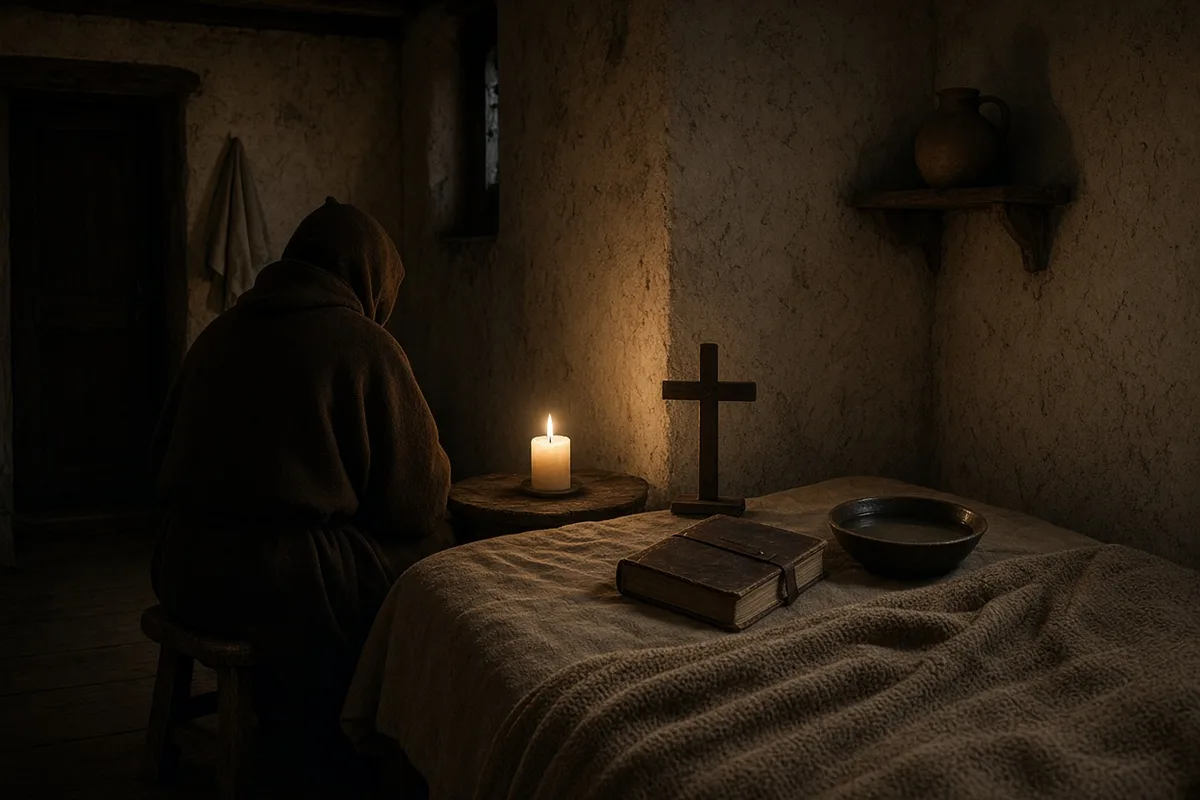
At Fossanova the room where Thomas died was converted into a chapel in 1460 by the Cistercian abbot Giovanni de’ Medici, who commissioned a fresco cycle depicting the seven sacraments; the cycle was whitewashed in 1568 during the visit of the apostolic visitor Cardinal Giovanni Morone and rediscovered in 1959 beneath plaster layers measuring 4.2 centimeters thick. The original deathbed, described in the 1319 inquiry testimony of the monk Nicholas of Priverno as “a simple board raised on two trestles,” survives only as a fragment of chestnut wood 87 centimeters long, preserved since 1623 in a crystal reliquary in the abbey treasury.
A second portrait, executed in 1411 by the Sienese painter Taddeo di Bartolo for the cathedral of Siena, shows William of Tocco presenting his Vita to the archbishop, with a small figure of Reginald standing behind holding an open book whose visible text reads “respondeo dicendum quod” on the left column. The panel, 118 by 79 centimeters, was removed to the Pinacoteca Nazionale in 1867 and bears the signature “Tadeus de Senis pinxit anno Domini MCCCCXI die XV mensis augusti.” Pigment analysis conducted in 2003 identified the presence of ultramarine on the figure of Reginald’s habit, sourced from lapis lazuli imported through Venice in 1409 at a cost of 18 florins per ounce.
The final documented image of any participant in the original composition appears in a marginal drawing dated 12 February 1437 in the register of the Neapolitan confraternity of Saint Thomas Aquinas, where an unknown hand sketched Reginald at age 91, seated and dictating to a younger friar, with the note “frater Reginaldus obiit pridie kalendas martii” added in a later hand after Reginald’s death on 28 February 1295. The drawing, executed in silverpoint on paper measuring 21 by 16 centimeters, remains in the Archivio di Stato di Napoli under the shelfmark Corporazioni religiose soppresse, vol. 892, and was exhibited in 1994 at the Mostra d’Oltremare before being returned to climate-controlled storage.