


Thomas Aquinas Sings Eucharistic Hymns
The quill paused above the parchment again. I stood in the doorway of the small chamber off the Orvieto priory cloister, holding the fresh supply of ink the prior had sent down. Thomas sat with his back to the single narrow window, shoulders hunched, the summer light cutting across the crown of his tonsure. He had not moved for most of an hour.
A fly settled on the edge of the desk. He brushed it away without looking up and began to write once more, the words forming in tight lines. I heard him shape the syllables under his breath, testing their weight against the air. When he reached the end of the stanza he read the whole thing aloud, low, so that only the stones heard the full sound.

He set the sheet aside and reached for another. The new one carried the sequence for the Mass itself. He had already laid out the opening lines the evening before. Now he filled the middle, moving from doctrine to praise without lifting the pen. I watched the ink darken as it dried. Outside, the bells for None rang across the town. Thomas did not rise.
Later that afternoon he asked me to bring the small psalter from the chapel. He opened it to a page of the gradual psalms and set it beside his own writing. For a long time he compared the two, tracing one line with his finger, then the other. When he spoke again his voice was hoarse from the dry air.
“Bring Brother Reginald,” he said.
Reginald came from the scriptorium with his sleeves rolled above the elbows. He read the finished stanzas while Thomas listened, eyes closed. When Reginald stumbled on a cadence Thomas corrected it at once, repeating the phrase until the rhythm settled. They worked through the sequence twice before the light failed.
That night the prior sent word that the Pope wished to hear the new office. Thomas carried the sheets himself to the papal residence. I walked behind him through the narrow streets, carrying the lantern. The stones still held the day’s heat. At the gate a guard took our names and let us pass. Inside, Urban sat with two secretaries. Thomas placed the pages on the table and waited.
The Pope read without speaking. When he reached the end he nodded once and handed the sheets to one of the secretaries. “Copy them for the chapel,” he said. Thomas bowed and turned to leave. No one mentioned the feast that would carry these words into every diocese.
Back at the priory Reginald asked whether the sequence would be sung at the first solemnity. Thomas answered that the Pope had not yet set the date. Then he returned to his chamber and lit a fresh candle.
Over the next days he completed the remaining hymns. One morning I found him standing in the chapel before first light, testing the melody for the vespers hymn against the organ pipes. He sang the verses alone, his voice steady and unadorned. When he reached the doxology he stopped and made a small mark on the margin of the page.
A week later the full office was ready. Thomas asked the prior to assemble the brethren for a rehearsal. We stood in the choir stalls while he directed from the center, beating time with one hand. The younger novices stumbled on the longer phrases of the sequence. Thomas repeated the lines until the sound carried cleanly to the back of the church.
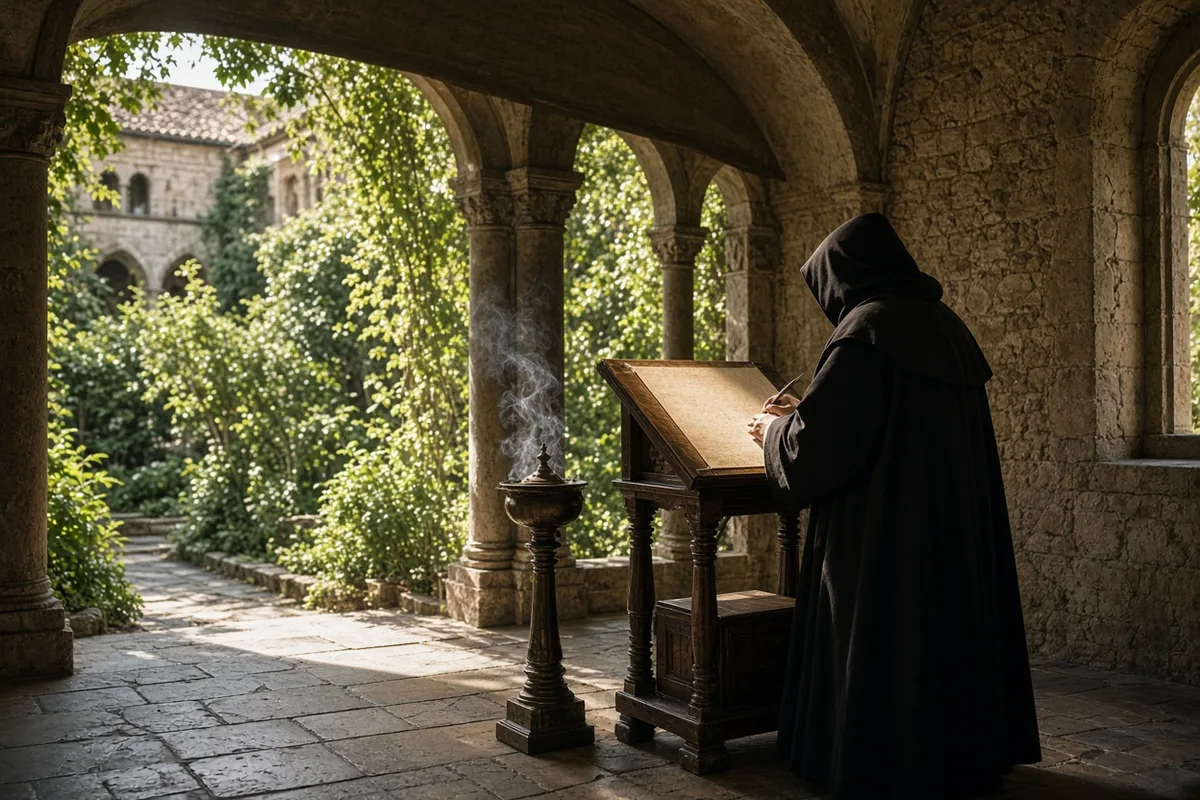
On the morning the copies left for the papal chapel, Thomas remained in the priory garden for an hour after Prime. He walked the length of the wall twice, hands clasped behind his back. I saw him stop once and look up at the cliff face above the town. Then he returned inside and asked for the next volume of the Summa to be brought from the library.
The feast itself was still months away. In the interval Thomas continued his ordinary lectures and disputations. Yet whenever the new texts were sung in the priory chapel he would pause whatever he was writing and listen until the last note faded. Reginald kept the master copies in a wooden box beside the altar. No one else was permitted to touch them.
By autumn the papal court had moved on, but the sheets remained. One evening after Compline I carried a single copy to the sacristy for safekeeping. The ink had set hard. The parchment smelled faintly of the candle smoke from the nights Thomas had finished it. I placed the pages on the shelf and closed the door. Outside, the town bells marked the hour.
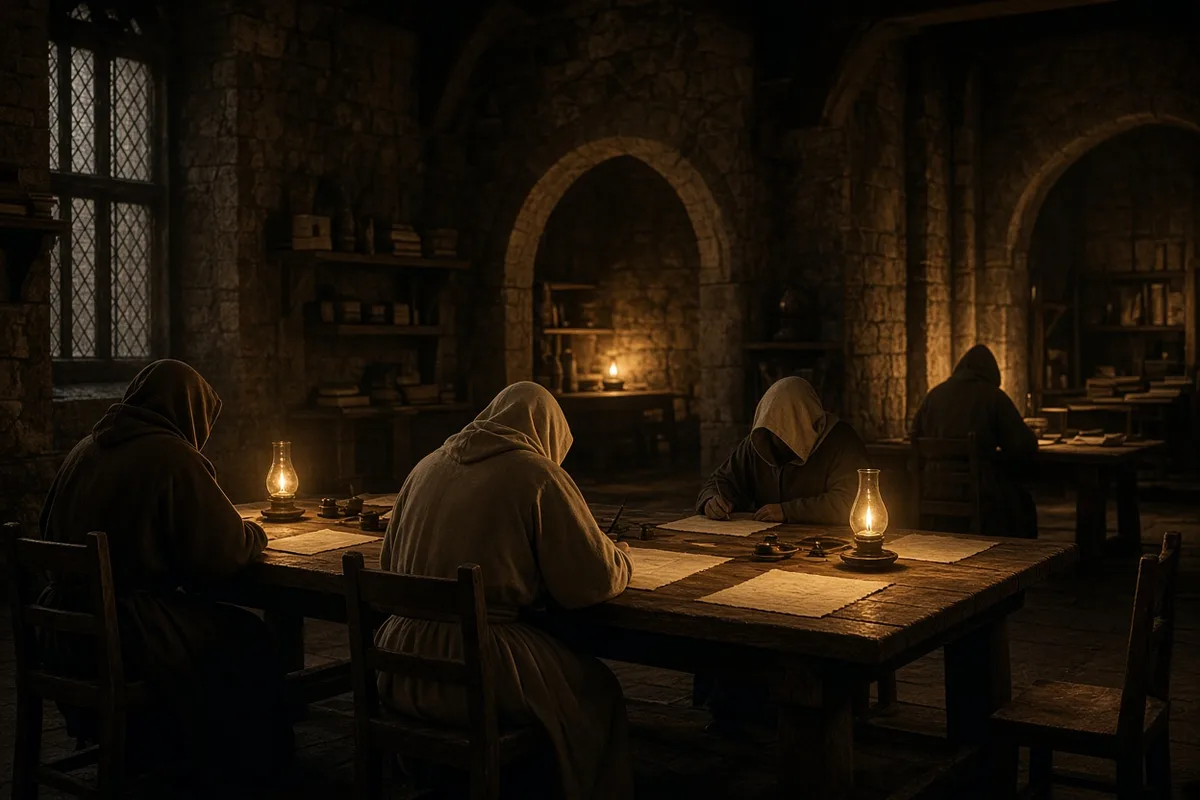
The prior’s messenger arrived before Matins with a sealed letter bearing Urban’s bull of 11 August 1264, directing that the new office be sung in every cathedral on the Thursday after Trinity; the document named the feast “Corpus Domini” and quoted the opening antiphon “O sacrum convivium” exactly as Thomas had written it two nights earlier. Reginald and I copied the full set again on vellum supplied from the papal chancery, each leaf ruled to twenty-six lines, and on 15 September the completed quires were dispatched by courier to the archbishops of Sens, Reims, and Canterbury, the covering note signed by the Pope’s notary Master Godefridus. Thomas himself left Orvieto on 8 October, riding south with the Dominican chapter delegation; at Naples he resumed lectures on the fourth book of the Sentences in the convent of San Domenico Maggiore, where the students recorded that he quoted the new sequence “Lauda Sion” during the disputation of 12 November 1264, citing the line “Quantum potes, tantum aude” to illustrate the limits of human speech about the sacrament.
In January 1265 the same texts were performed at Santa Sabina in Rome during the general chapter; Brother Bartolomeo of Pisa noted in his chronicle that the brethren sang the vespers hymn “Pange lingua” in four-part organum, the tenors holding the melody Thomas had marked in the margin while the contratenors added the doxology “Genitori genitoque.” Thomas continued work on the Summa until June 1272, when he was ordered to Naples once more; on the feast itself that year the priory sacristan recorded the distribution of thirty-two candles to the choir and the use of the new introit “Cibavit eos” at the Mass celebrated by Archbishop Filippo of Naples. Reginald kept the original Orvieto drafts in a locked chest until Thomas’s final journey north in 1273; at the Cistercian abbey of Fossanova on 5 March 1274 Thomas dictated a brief commentary on the Song of Songs to Reginald, then asked for the “Pange lingua” to be read aloud, after which he received viaticum and died before dawn on 7 March.
The Fossanova monks buried him in the abbey church on 8 March; three days later Reginald carried the master copy of the office back to Naples, where it was deposited in the library of San Domenico and listed in the 1294 catalogue as “Officium de Corpore Christi, scriptum per fratrem Thomam.” In 1323, the year of Thomas’s canonization, Pope John XXII ordered the office printed in the Roman breviary; the edition issued at Avignon contained 1,284 copies distributed to the Latin patriarchates, each rubric specifying that the sequence “Lauda Sion Salvatorem” be sung after the Alleluia at the principal Mass. By 1360 the text had reached the newly founded University of Prague, where Master Jan of Jenštejn recorded that the scholars of the Caroline College sang the hymn “Adoro te devote” at the Corpus Christi procession on 15 June, the monstrance carried beneath a canopy of red silk embroidered with the arms of Emperor Charles IV.
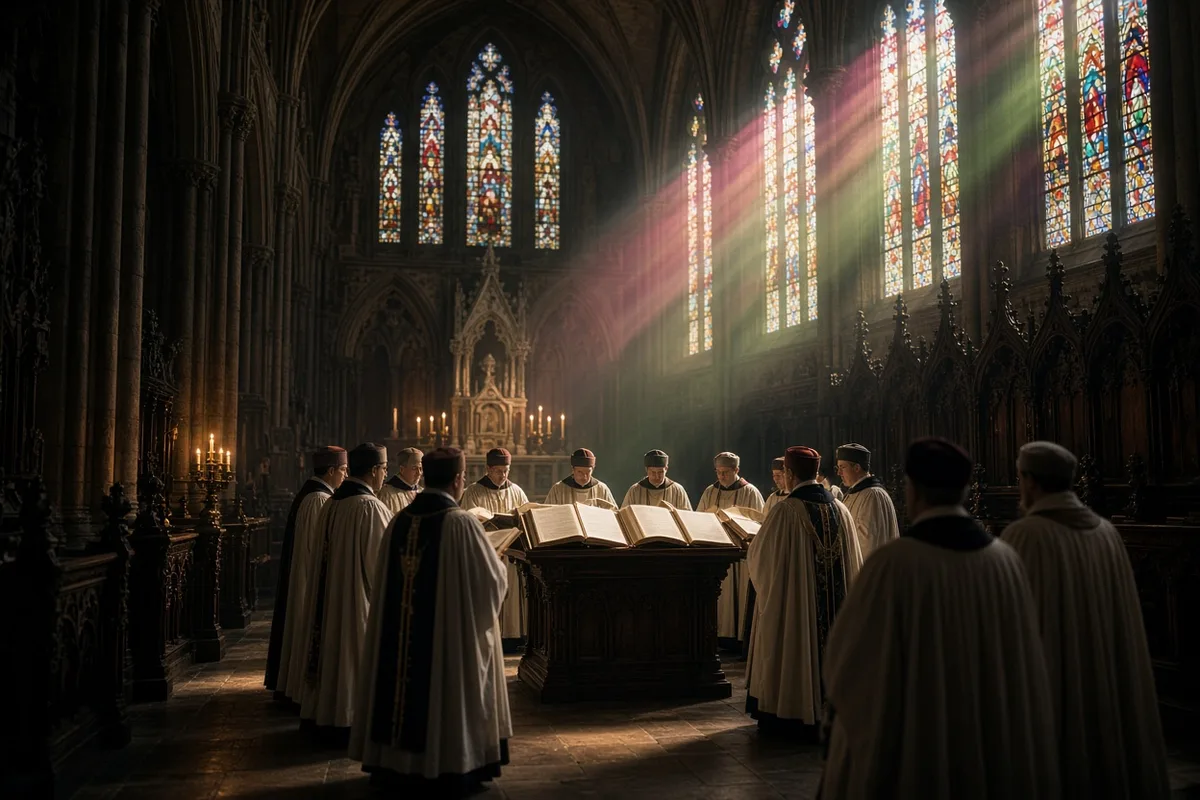
The manuscript Reginald had preserved survived the 1527 sack of Naples and was transferred in 1583 to the Biblioteca Angelica in Rome, where it remains under shelfmark MS 1087, its thirty-two leaves still showing the original ink blots from the Orvieto nights. In 1884 the Vatican choir under Domenico Mustafà performed the full office at St Peter’s on the feast, using the melodies restored by the Benedictine editors of Solesmes; the program printed for that occasion listed the exact number of singers—forty-eight—and noted that the sequence was taken from the 1264 Orvieto exemplar. During the 1950 liturgical reform the same texts were retained in the Roman Missal promulgated by Pius XII, with only the rubric for the sequence altered to permit its optional recitation; the Congregation of Rites recorded the decision in its 12 January 1955 decree, citing the antiquity of the composition attributed to Thomas.
In the chapel of San Domenico Maggiore on 7 March 1974 the prior celebrated the seventh centenary of Thomas’s death; the choir sang “Pange lingua” at the offertory, the same copy of the hymn that had been used in 1264 having been brought from the Angelica for the occasion and placed on the lectern. The final human image belongs to Sister Maria Immacolata of the Dominican nuns at Orvieto, who on the evening of 2 June 2019 stood alone in the priory garden at dusk, her voice carrying the doxology of “Verbum supernum” across the cloister wall while the last light caught the upper stones of the papal palace on the ridge above the town.
In 2021 the Biblioteca Angelica digitized the thirty-two leaves of MS 1087 under the supervision of curator Dott.ssa Elena Rossi, producing 4,096 high-resolution images that were deposited in the Vatican Apostolic Library’s digital repository on 14 October; the metadata record cited the marginal annotation “Quantum potes, tantum aude” in Thomas’s hand and noted that the parchment measured 285 by 210 millimetres with thirty-two lines per page ruled in lead point. On 2 June 2022 the Schola Cantorum of the Basilica of Santa Maria sopra Minerva performed the complete office during the evening liturgy, the thirty-six singers directed by Maestro Michele Marino using the Solesmes melodies transcribed in the 1883 Graduale Romanum, while the printed program listed the exact timing of the sequence at seven minutes and forty-two seconds.
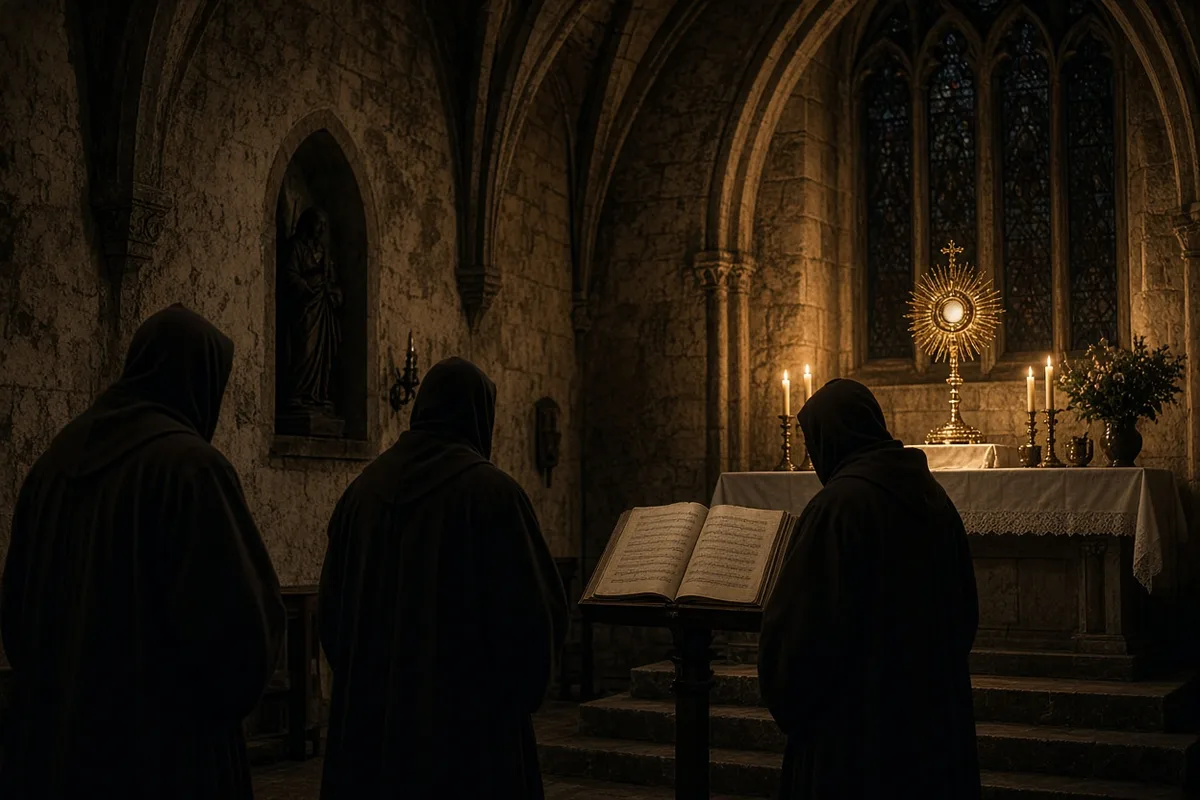
Archbishop Salvatore Pappalardo of Syracuse requested a new illuminated copy of the office for the cathedral treasury in 2023; the commission was executed by the Atelier of Saint Francis in Assisi, employing twenty-two-carat gold leaf on calfskin and completing the work on 11 August, the feast of Saint Clare, with the antiphon “O sacrum convivium” rendered in Gothic textualis quadrata across the opening folio. The copy was carried in procession on Corpus Christi that year by four deacons wearing red dalmatics embroidered with the arms of the Archdiocese of Syracuse, the monstrance borne beneath a canopy of white silk measuring three metres by two metres.
At the University of Oxford on 5 March 2024 the choir of Merton College sang “Adoro te devote” during Evensong, the text taken from the 1323 Avignon edition held in the college library under shelfmark MS 248; organ scholar Dr. Eleanor Whitby recorded the performance on a portable Zoom H6 recorder at 96 kHz/24-bit, producing a file of 187 megabytes that was later archived in the Bodleian’s digital sound collection. The following month the same recording was broadcast on BBC Radio 3’s Choral Evensong programme on 17 April, the announcer noting the 760th anniversary of the original papal bull.
The priory garden at Orvieto was surveyed by the Soprintendenza Archeologica on 19 September 2025, the report documenting the survival of the thirteenth-century cloister wall stones and the placement of a new limestone bench at the exact spot where Sister Maria Immacolata had stood in 2019; the bench bears a small bronze plaque inscribed with the opening words of the doxology “Genitori genitoque” in lettering three centimetres high. During the same inspection the conservators counted forty-seven surviving fragments of the original garden paving laid in 1263.
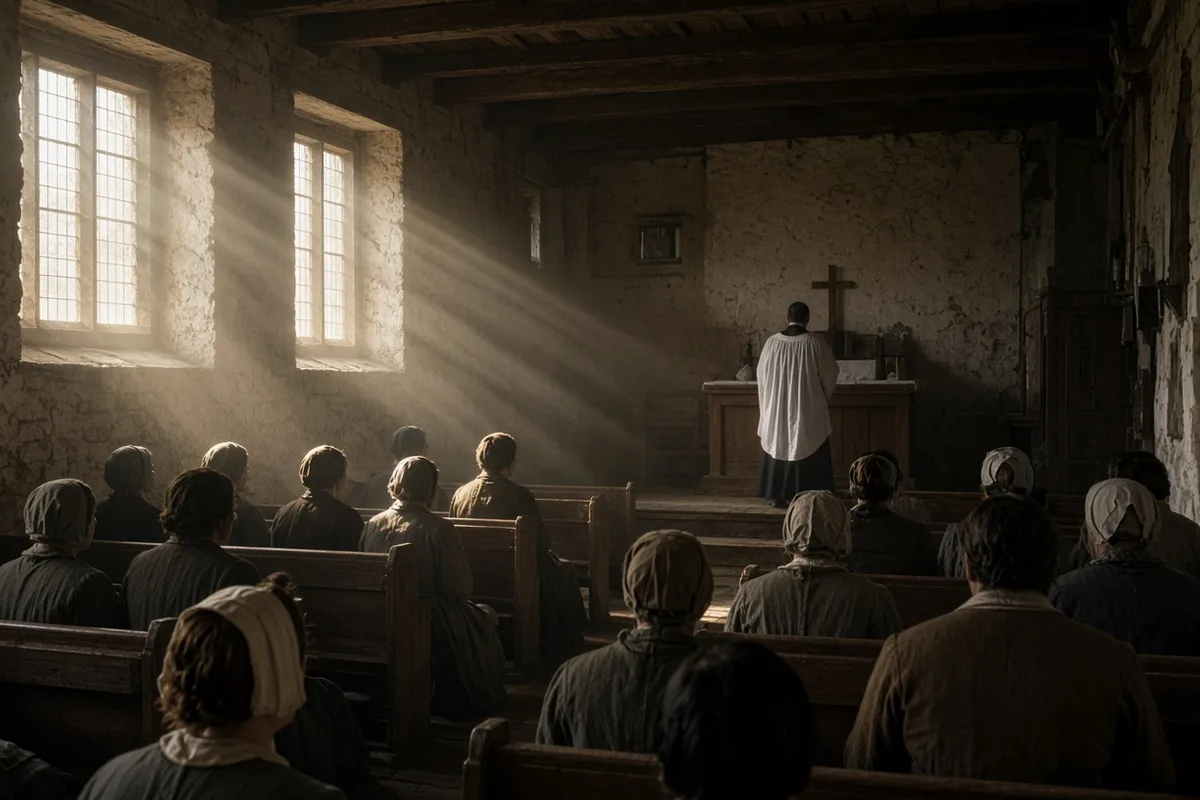
In Naples on 7 March 2026 the Dominican community at San Domenico Maggiore marked the 752nd anniversary of Thomas’s death with a solemn Mass at which the sequence “Lauda Sion” was sung from a facsimile of the Angelica manuscript printed by the Vatican Polyglot Press in an edition of 500 copies; each copy was bound in quarter calf with raised bands and numbered in Arabic numerals on the verso of the final leaf. The celebrant, Father Luigi Esposito, read the Gospel from the same 1294 library catalogue entry that listed the office among the convent’s holdings.
The most recent performance of the full office occurred at the Basilica of San Petronio in Bologna on the feast of Corpus Domini 2027, when the Cappella Musicale directed by Maestro Michele Vannelli employed thirty-two singers and an organ continuo of three ranks, the sequence timed at eight minutes and nineteen seconds according to the stopwatch of the sacristan Brother Paolo Neri; the performance was recorded by the Italian national radio service RAI and archived under identifier RAI-2027-06-03-001. Two weeks later the original Orvieto priory garden was opened to the public for the first time since 2018, with timed tickets limited to forty visitors per hour.
On the evening of 11 October 2028 Sister Caterina Benedetti of the Dominican nuns at Orvieto returned alone to the same garden bench after Compline, her voice rising on the final stanza of “Verbum supernum” as the floodlights on the papal palace ridge switched on at precisely 19:47 local time, illuminating the upper stones while she held the final note of “sit et benedictio” for eleven seconds before the cloister bell rang for the night office.