



Trump approves Army firing squad for Fort Hood’s Hasan
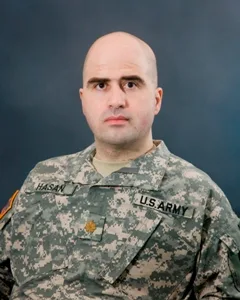
By The Conservative Desk (/journals/conservative-desk)
Sean Parnell posted the decision on X on October 5, 2026. Secretary of War Pete Hegseth had recommended — and President Donald J. Trump had approved — death by U.S. Army firing squad for Nidal Malik Hasan.
Parnell wrote that Hasan was the jihadist who opened fire on unarmed American soldiers at Fort Hood in 2009. He killed 13 people and wounded 32 others while shouting “Allahu Akbar” during the attack. “The Secretary of the Army will set the time and place of the execution,” Parnell added. “Judgement day for Hasan has finally come.”
Adam Telle confirmed the schedule days later. The execution is set for December 3, 2026, at Fort Hood, Texas, at 1 p.m. local time — the same post where the shooting happened.
On November 5, 2009, Hasan entered a medical building where soldiers were preparing for deployment. He carried 400 rounds of ammunition and fired 146. He shouted “Allahu Akbar” as he shot. When people rushed him with a chair, he shot them too. Thirteen died. Thirty-two were wounded. A responding officer shot Hasan and ended the attack. The wounds left him paralyzed from the waist down and confined to a wheelchair.
A military jury convicted him in August 2013 on 45 counts of premeditated murder and attempted premeditated murder and sentenced him to death. Hasan represented himself. He called no witnesses and gave no testimony. In his opening statement he said, “the evidence will clearly show that I am the shooter. And the dead bodies will testify that war is an ugly thing.” He later told the court “that we are imperfect Muslims trying to establish the perfect religion … I apologize for any mistakes I made in this endeavor.” An appellate brief recorded him saying, before the attack, “If they deploy me…they will pay.”
He has sat on military death row at Fort Leavenworth, Kansas, since the sentence. He is one of four prisoners there under military capital judgment.
Under the Uniform Code of Military Justice, a death sentence from a court-martial cannot be carried out until the president approves it and appellate review is complete. That requirement is not a political flourish. It is the statute. In 1983 the U.S. Court of Appeals for the Armed Forces held the military death penalty unconstitutional. President Ronald Reagan restored it by executive order the next year. The framework has been settled law for four decades. Trump’s approval fits inside that design: the jury convicts, the appellate courts review, and the president, as commander in chief, decides whether the sentence stands.
If the sentence is carried out on December 3, it will be the first U.S. military execution since 1961, when Pvt. John Bennett was hanged at Fort Leavenworth for rape and attempted murder. It will be the first U.S. military firing squad execution since Pvt. Eddie Slovik was shot in France in 1945 for desertion. The method is the one Hegseth recommended and Trump approved. Army rules leave the means to the Secretary of the Army. Parnell’s announcement did not offer a further public rationale.
Death Penalty Action answered the decision in a statement: “There is nothing Donald Trump loves more than the power to kill.” The record supplies a narrower account. Hasan admitted he was the shooter. A panel of officers weighed the evidence and returned a death sentence. The Uniform Code of Military Justice then required presidential approval before any execution could proceed. Seventeen years after the attack, that approval has been given. The power in question is the one the statute assigns, not a personal appetite.
The conservative case rests on those facts, not on adjectives. Limited government still means government that keeps its first obligation: to protect the people who wear its uniform and the civilians who serve beside them. The Constitution and the Uniform Code of Military Justice give the military a capital process with defined steps — trial, review, presidential assent. Public safety includes the safety of soldiers inside a readiness center on a domestic post. National sovereignty includes the right of the United States to punish, under its own law, a man who opened fire on its troops while declaring a religious war cry. The ordinary Americans the coverage often slides past are the thirteen who died, the thirty-two who were hit, and the families who have waited since 2009 for a sentence imposed in 2013 to mean what it said.
Hasan’s own words leave little room for a competing story about motive or identity. He told the court he was the shooter. He framed the dead as evidence that war is ugly. He described the enterprise as imperfect Muslims trying to establish a perfect religion and apologized for mistakes in that endeavor. The appellate record preserved the warning about deployment. The shouting of “Allahu Akbar” was not invented by later politics; it was part of the attack itself. Breitbart’s headline put the point without ornament: “Terrorist Nidal Hasan to Be Shot to Death at Fort Hood in December.”
None of this erases the procedural path still ahead. Military death sentences move under appellate review. The president’s approval is necessary; it is not the final mechanical act in every filing that might follow. What the record now holds is specific. Hegseth recommended the firing squad. Trump approved it. Telle set the date, the hour, and the place. The place is Fort Hood. The hour is 1 p.m. local time on December 3, 2026.
Hasan will face that hour in the wheelchair the 2009 gunshot left him. The Secretary of the Army holds the authority Parnell named. The last military hanging was Bennett’s in 1961. The last military rifles for execution were aimed at Slovik in 1945. Between those markers and December 3 stands the judgment a jury reached in 2013 and the approval a president signed in 2026.
The thirteen who were killed at Fort Hood that November morning were unarmed. Hasan brought 400 rounds and fired 146 of them. The sentence that followed has now been cleared for an Army firing squad at the same Texas post, at one o’clock in the afternoon on the third of December.