



Trump greets Xi at Andrews with military display as Taiwan arms package stays unshipped
By The Conservative Desk (/journals/conservative-desk)
Chinese President Xi Jinping’s plane touched down at Joint Base Andrews just before 6:00 pm local time on Wednesday, September 23, 2026. President Donald Trump and First Lady Melania Trump met Xi and Peng Liyuan on the tarmac, shook hands, and stood for the national anthems as a military band played.
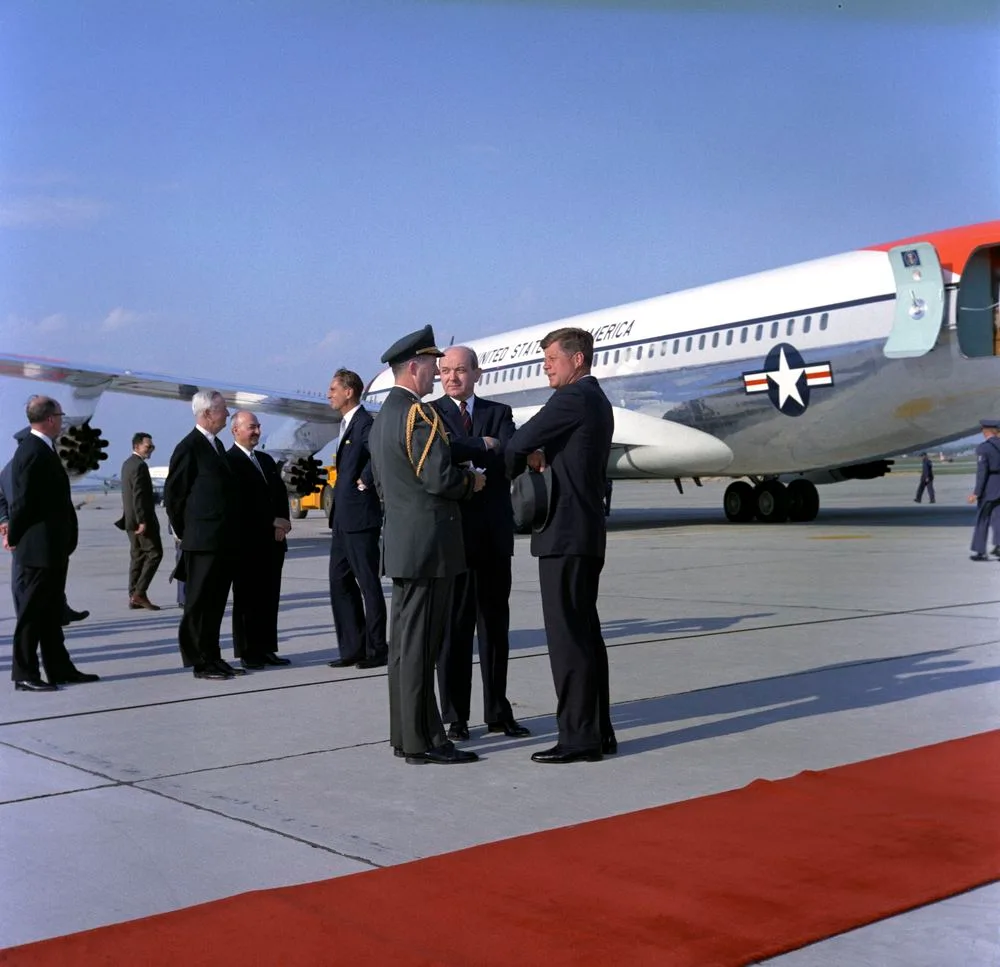
It was the first presidential airport welcome of a foreign leader since John F. Kennedy greeted Harold Macmillan in 1962, papal visits aside.
A 30-metre-long red carpet ran from the staircase. A 21-person honour guard lined it. Two American children handed bouquets to Xi and his wife. Six F-22 fighters and six F-16s sat on the apron. Two B-1 bombers then thundered overhead. Trump grimaced at the noise. Xi stayed impassive. Trump slapped Xi on the back and said something the microphones did not catch. At the end of the ceremony Xi and Peng climbed into their own car; the Trumps returned to theirs. That differed from the shared limousine ride Trump and Vladimir Putin took in Alaska.
Trump later told reporters the reception had gone well. “I thought it was a great little meeting, a great greeting, and I think they appreciate it.” The display was meant to answer the red carpet, honour guard, military band, and roughly 300 Chinese youths who chanted a welcome during Trump’s May trip to Beijing, where Xi himself did not appear at the airport.
Fox News noted the break with modern practice: Trump becomes first president since 1962 to greet a foreign leader at Joint Base Andrews. Other outlets covered the same arrival.
The pageantry opened a three-day state visit that ends Friday morning with tea and a National Archives stop to view the Declaration of Independence and the Constitution. A formal state dinner is set for Thursday evening in the White House East Room. Invited American guests include Cabinet members and chief executives such as Nvidia’s Jensen Huang and SpaceX’s Elon Musk. Two AFP sources said no Chinese CEOs traveled in Xi’s delegation.
On the same day Treasury Secretary Scott Bessent announced an economic holding pattern. “We have agreed today that we will extend what we call the Busan agreement, the economic detente between the two countries that was scheduled to end on November 10th. That is going to be extended until January 10th to give us more time to see what we can do on the economic front.” He added, “We met today to see if we could do a bigger deal as opposed to just a series of smaller things.”
That is the administration’s case stated in its own terms: keep talking, stretch the detente, test whether a larger commercial arrangement is possible, and avoid an immediate tariff snap-back. Secretary of State Marco Rubio defended high-level contact on the same practical ground. “The idea that we would not interact with them at the highest levels is irresponsible. It’s outrageous. We have to.”
Senator Roger Wicker rejected the premise of the lavish welcome. Speaking before the arrival, he said Trump should not have issued the invitation “based on all of the troubling issues we have with President Xi and the Chinese Communist Party.” He urged that every minute of dialogue keep in view “the purposes of China’s massive military buildup, or about China’s clear support for Iran.” His central warning was direct: “Our commander-in-chief should keep in mind that his guest is a brutal, unelected and oppressive dictator who seeks to dominate his neighbours and whose massive military arsenal is aimed directly at the United States of America.”
Wicker’s objection is not a quarrel with diplomacy itself. It is a demand that ceremony not outrun leverage or clarity. The tarmac already answered one half of that test. American combat aircraft were arrayed and flown for a leader whose military trajectory Wicker describes as pointed at the United States. The other half remains unsettled. A $14 billion U.S. military package for Taiwan has been approved and has not been shipped. Taiwan is the partner most exposed to the buildup Wicker named. Extending an economic pause to January 10 may buy negotiators time; it does not move the hardware that would raise the cost of coercion in the strait.
The visit’s public schedule underscores the same tension. On Friday the two couples are to stand before the Declaration of Independence and the Constitution—documents that locate sovereignty in the people and bind rulers to law—after three days of honors for an unelected head of a party-state. Free enterprise appears in the guest list as American technology executives, not as reciprocal Chinese commercial counterparts. Taxpayers underwrite the honour guard, the flyover, and the East Room dinner. Ordinary workers live with the results of any tariff truce that holds or collapses, and with the strategic risk if military aid already voted stays on the dock.
Trump said Iran would be among the subjects. “I’ll be talking about that and many other subjects -- but it’s all coming along well, including that.” The record supplies no further detail on what was said planeside or what will be said in the Oval Office. Jonathan Czin and Edgard Kagan are among the analysts named in coverage of the trip; the sources give them no verbatim lines for this account.
The Busan timeline now runs to January 10. The $14 billion Taiwan package remains approved and unshipped.