



Why Bogle says owning the market cheap beats trying to win
In 60 seconds
- Investors as a group match the market before costs and lag it afterward by exactly those costs, so every fee dollar leaves their pockets.
- Bogle’s Cost Matters Hypothesis holds that lower expense ratios, turnover, and loads predict better long-term relative fund performance more reliably than manager skill.
- Active managers collectively hold the market, so after costs roughly two-thirds to three-quarters of U.S. equity funds lag their benchmarks over 10- and 20-year periods.
- A 2 percent annual cost over a working career can hand the financial system 50 percent or more of an investor’s potential terminal wealth.
- Chasing past winners fails because performance reverts and investors’ dollar-weighted returns trail the funds’ reported figures—sometimes 6 or 7 percent versus a reported 10 percent.
- A broad, low-cost total stock market index fund held permanently is the route that guarantees a fair share of whatever the market returns.
The big idea
Bogle argues that investing is zero-sum before costs and a losing game after them, so the rational move is to own the entire market through the cheapest broad index fund and hold it. Costs—not a shortage of clever managers—are what separate the market’s return from what most investors keep.
The book in brief
In The Little Book of Common Sense Investing, Bogle starts from arithmetic, not stock tips. The Gotrocks family owns every U.S. stock and collects the full market return until waves of helpers—stock pickers, then pickers of pickers—carve fees from a pie that never grows. Before costs, all investors together earn exactly the market; after costs they trail by every dollar paid in management fees, commissions, and trading taxes.
He then states the Cost Matters Hypothesis: funds sorted by expense ratio show cheaper quartiles beating expensive ones across periods and across stocks and bonds. A skilled manager still starts each year down often 2 percent or more once expenses, loads, trading costs, and cash drag are counted; over 25 years that headwind can turn a comfortable retirement into a shortfall.
Active management loses as a group for the same reason. Managers collectively hold the market, so pre-cost returns match it and post-cost returns lag by the toll. Long-run comparisons show roughly two-thirds to three-quarters of active U.S. equity funds trail over 10- and 20-year spans, and past winners are weak guides to future ones. Investors worsen the gap by pouring money in after strong years and pulling out after weak ones, so a fund’s reported 10 percent annual return can become 6 or 7 percent for the people who actually held it.
Compounding magnifies the damage. Over 50 years, paying 0.1 percent annually versus 2 percent on identical gross returns can more than double terminal wealth for the low-cost path; the higher-cost path can surrender 50 percent or more of potential accumulation. Bogle’s answer is a total stock market index run for a few hundredths of a percent, with turnover far below the 50 to 100 percent common in active funds, which also defers capital gains. The same logic hits bonds harder: a 1 percent fee eats a much larger share of an expected 4 or 5 percent bond return than of an 8 or 9 percent stock return. A pair of low-cost total stock and total bond index funds, mixed for horizon and risk, captures nearly what markets offer.
Structure and behavior close the arc. Most fund companies maximize fees and assets; Vanguard’s mutual ownership removes that outside profit motive. Simplicity aids discipline—one or two broad index funds leave fewer panic points. The 1973-74 bear market and the 2000-2002 dot-com collapse rewarded holders and punished those who sold near the bottom. Paying less and tinkering less is how investors keep more.
Context
John C. Bogle published the book in 2007 after decades inside the fund industry. It mattered because it turned an insider’s long campaign for indexing into a plain-spoken case any saver could act on.
The key ideas

1
Helpers shrink the pie
Investors as a group cannot beat the market they own, so every fee dollar transfers return from them to the industry with mathematical certainty.
Before helpers
Family owns all stocks and keeps the full market return
After helpers
Same market return, but fees carve out a permanent slice
Bogle opens with the Gotrocks family, which owns all the stocks in America and simply collects dividends and earnings growth while paying no one. Helpers arrive to pick better stocks for different members; the market’s total return is unchanged, yet a slice now goes to fees and family returns fall. A second wave offers to pick the best helpers, and returns fall again.
The parable is pure arithmetic. Before costs, the return earned by all investors equals the market’s return because the market is the sum of their holdings. After costs, the group underperforms by exactly the amount paid in advisory fees, commissions, and trading-related taxes. He calls these the relentless rules of humble arithmetic.
Active management, fund fees, brokerage costs, and tax drag from frequent trading are all subtractions from a fixed pie. The only way to capture the market’s full return is to own the whole market and pay almost nothing. A 1 percent annual management fee that sounds trivial can consume a third or more of total accumulation once compounded over 30 years.
In practice: When the Gotrocks family starts paying layers of stock-picking helpers, collective wealth drops by exactly the fees even though the underlying market return never changed.

2
Costs predict relative results
Expense ratios, turnover, and loads—not manager talent—are the most reliable predictors of a fund’s long-term standing versus peers.
- Cheapest quartileHighest average relative returns
- Middle cost quartilesReturns decline as costs rise
- Most expensive quartileLowest average relative returns
Bogle names his central claim the Cost Matters Hypothesis, set as a practical counterweight to the Efficient Market Hypothesis. He does not need perfect efficiency; he only needs arithmetic to hold. Whatever the market returns before costs, funds with lower expense ratios, lower turnover, and lower sales loads come closer on average to matching it.
Studies he cites sort funds into quartiles by expense ratio and find a near-monotonic link: the cheapest quartile outperforms the most expensive across time periods and across stock and bond funds alike. Cost is a headwind every single year, in bull and bear markets, for skilled and unskilled managers.
A genuinely gifted manager still begins each year with a deficit equal to the expense ratio plus trading costs, often totaling 2 percent or more once loads, transaction costs, and cash drag are included. Over one year that is noise; over 25 years it can separate a comfortable retirement from a shortfall. Hunting the rare manager who clears the headwind is less reliable than removing the headwind with the lowest-cost vehicle.
In practice: Funds in the cheapest expense-ratio quartile beat those in the most expensive quartile with striking consistency across the periods and asset classes examined.

3
Active management’s group loss
Active managers as a group must lag the market by their costs because they collectively hold the same stocks the market holds.
2/3–3/4
active U.S. equity funds lagging benchmarks over 10–20 years
Before costs, active managers hold the market portfolio by definition—every share one fund owns was sold by someone else. Their collective pre-cost return equals the market’s. Add expense ratios, commissions, bid-ask spreads, and tax inefficiency from high turnover, and the group must underperform by those costs.
The average actively managed equity fund carries a higher expense ratio than an index fund, plus turnover-driven trading costs often invisible because they never appear in the stated expense ratio. Long-run comparisons, including SPIVA-style reports referenced in later editions, show roughly two-thirds to three-quarters of active U.S. equity funds lag their benchmark over 10- and 20-year periods, with the gap widening as the horizon lengthens.
Some managers beat the market in a given year or even over long stretches, yet identifying them in advance has proven nearly impossible. Past outperformance is a weak predictor of future outperformance. Individual skill may exist; a system that requires picking the right skilled manager beforehand is a weaker bet than refusing to pay the toll.
In practice: Over 10- and 20-year windows, roughly two-thirds to three-quarters of actively managed U.S. equity funds trail their index benchmarks once costs are counted.

4
Tyranny of compounding costs
Small annual fees that look harmless in any single year become the dominant drag on lifetime wealth once they compound for decades.
0.1% annual cost
Nearly the full balance keeps compounding for 50 years
2% annual cost
Terminal wealth can fall by more than half; 50%+ of potential accumulation goes to fees
Compounding builds wealth, yet it works with equal force against investors when applied to costs. Bogle calls this the tyranny of compounding costs. Two investors start with the same sum and earn the same gross market return over 50 years; one pays 0.1 percent a year all-in, the other 2 percent.
Gross returns match, but the low-cost investor’s net terminal wealth can be more than double the high-cost investor’s. The fee is taken every year from a growing base, and the investor also loses all future compounding on the dollars removed. Someone contributing steadily over a career at 2 percent total annual cost can hand 50 percent or more of potential final accumulation to the financial system even though no single year’s fee felt large.
Most people underestimate the damage because expense ratios sit in fine print, trading costs often go undisclosed in prospectuses, and tax costs from turnover rarely enter the performance numbers used to pick funds. Time turns small percentages into large absolute sums.
In practice: On identical gross returns over 50 years, paying 2 percent annually instead of 0.1 percent can more than halve terminal wealth and surrender 50 percent or more of potential accumulation.
5
Chasing stars backfires
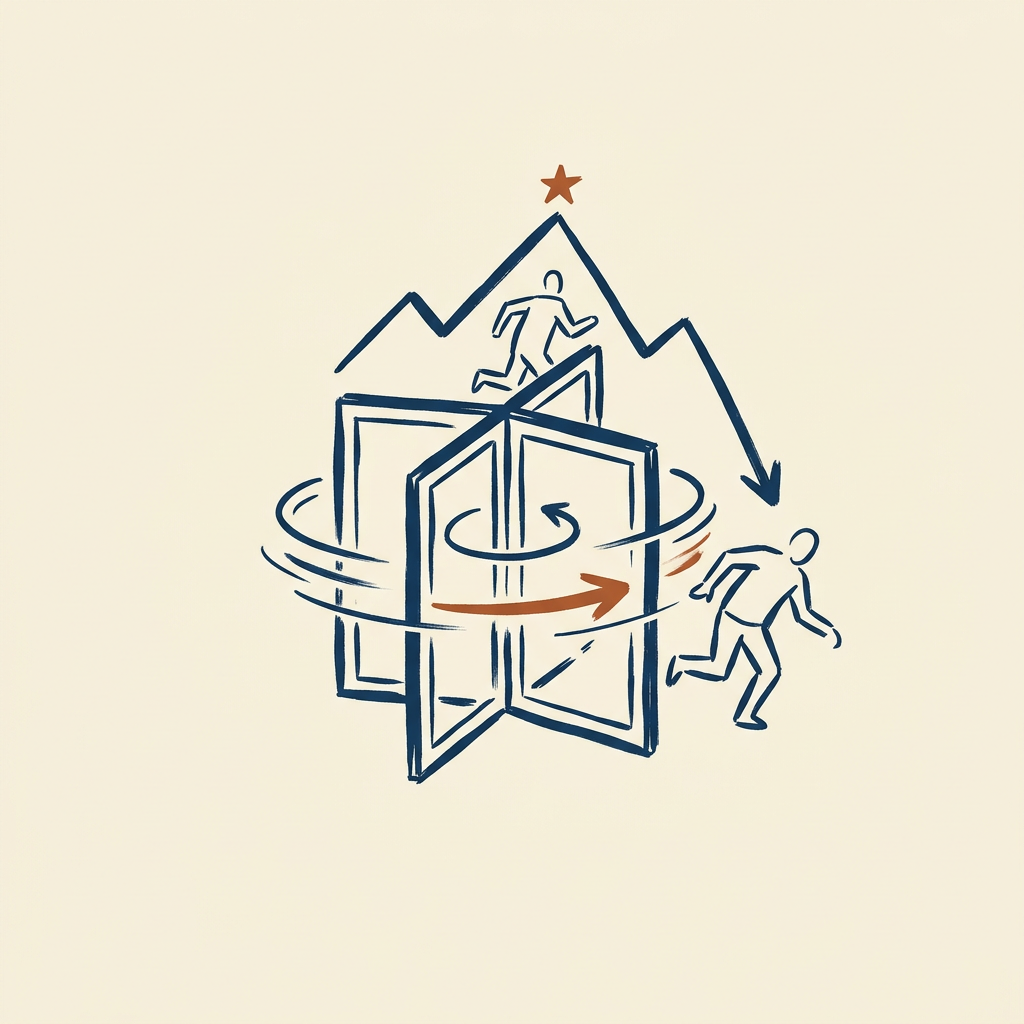
Selecting funds by recent returns fails because outperformance fades and investors systematically buy after peaks and sell after troughs.
Even funds that beat the market in the past are poor bets going forward. Evidence of reversion to the mean shows top-decile performers in one period are no more likely than chance to stay on top in the next. Spectacular gains from a concentrated bet or hot sector often reverse when conditions normalize.
Investor behavior deepens the damage. The gap between a fund’s reported total return and the dollar-weighted return its investors actually earn shows that investors as a group take home substantially less than the funds report. Money floods in after strong stretches and flees after weak ones, so the largest dollars arrive just before declines.
A fund posting 10 percent a year over a decade might have delivered only 6 or 7 percent to the people who held it. Chasing star performance is not neutral; it actively harms most who practice it. The proposed fix is a fund whose premise is not to time or select at all, which removes the urge to chase and flee.
In practice: A fund that returned 10 percent annually over a decade could leave its actual investors with only 6 or 7 percent because the biggest inflows arrived right before a drop.

6
The total-market index answer
A broad market index fund held forever is the strategy that guarantees investors their fair share of whatever the market returns.
Active equity fund
Roughly 1% expense ratio; 50–100% annual turnover; repeated capital gains
Total market index
Few hundredths of a percent; minimal turnover; deferred gains
Bogle favors an index that tracks the broadest market, such as a total stock market index, though he notes the S&P 500 has tracked the broader market closely enough for most investors. Its virtue is not topping every year’s leaderboard; it is eliminating the risk of the wrong manager, sector, or switch timing.
The fund holds every company by market value, needs no ongoing analysis, generates minimal turnover and tax bills, and can run at an expense ratio of a few hundredths of a percent versus roughly 1 percent for typical active equity funds of the period. Low turnover matters beyond the expense line: the fund rarely sells winners, deferring capital gains for years or decades—an edge active funds turning over 50 to 100 percent of holdings yearly cannot match.
Critics call indexing a guarantee of mediocrity. He replies that capturing the market minus a fraction of a percent actually places an investor in roughly the top third of all investors over extended periods, once most active funds’ cost-driven lag is counted. Indexing is not a clever tactic; it is the mathematical result of accepting the market’s return instead of failing to beat it.
In practice: An index at a few hundredths of a percent in expenses, versus roughly 1 percent for typical active equity funds and 50 to 100 percent annual turnover, defers capital gains while active peers realize them repeatedly.

7
Bonds feel the fee harder
The same cost arithmetic favors bond index funds even more, because lower expected returns leave less room to absorb fees.
Stocks
1% fee on expected 8–9% return leaves most of the return intact
Bonds
1% fee on expected 4–5% return consumes a much larger share
Bogle carries the argument into fixed income and finds the case for low-cost indexing stronger, not weaker. Bond returns are lower and more predictable; the bond universe is defined mainly by credit quality and duration rather than the wide outcome dispersion that might reward stock-picking skill.
A 1 percent expense ratio consumes a much larger share of an expected 4 or 5 percent bond return than of an expected 8 or 9 percent stock return. Data show actively managed bond funds lagging bond index funds by margins that track their expense-ratio gaps, with even less variation than in equities because duration and credit exposure are easy to replicate cheaply.
The practical portfolio is simple: a low-cost total stock market index beside a low-cost total bond market index, mixed for time horizon and risk tolerance, captures nearly all that financial markets offer at a fraction of a typical active balanced portfolio’s cost. Further slicing into sectors, factors, or specialty indexes tends to reintroduce cost, complexity, and the urge to trade on recent performance.
In practice: On bonds expecting 4 or 5 percent, a 1 percent fee takes a far larger bite than the same fee on stocks expected to return 8 or 9 percent, and active bond funds’ lag closely matches their extra expenses.

8
Incentives over competence
Fund companies are built to maximize fees and assets under management; that structural misalignment—not mere manager incompetence—drives high costs.
Writing as an insider, Bogle treats the underperformance already shown as a feature of how most management companies are owned. Publicly traded or privately held managers profit by charging the highest fees the market will bear and by growing assets even when size hurts a strategy.
Marketing pushes past performance because recent winners sell, even though that pattern harms buyers. He contrasts this with Vanguard’s mutual ownership: the management company is owned by the funds and thus by shareholders, removing the outside profit motive that pushes fees up.
The misalignment exists even when everyone acts in good faith; the business model rewards asset growth and fee collection over investor returns. Practices such as closing and merging failed funds into clean records, star ratings that chase recent results, and share classes with different loads sold through commissioned advisors all obscure true costs. Reform, on this view, requires changing incentives, not only educating investors.
In practice: Under Vanguard’s structure the funds own the management company, so profits that would otherwise go to outside owners stay with fund shareholders instead of pushing fees higher.

9
Discipline beats selection
The hardest step is not choosing the index fund but holding it through downturns without trading.
After the math and the structure, Bogle turns to psychology. Simplicity is a safeguard: one or two broad index funds create fewer decision points where fear or greed can strike than a dozen active funds.
Even index investors can wreck returns by trading on headlines. The selection decision matters less than the behavioral decision to remain invested through declines. He points to the 1973-74 bear market and the 2000-2002 dot-com collapse as episodes when investors who abandoned diversified equities near the bottom locked in losses a patient holder later recovered.
A long horizon is an investor’s greatest asset, destroyed the moment short-term volatility is treated as permanent loss. Indexing does not erase volatility; it removes manager-driven underperformance and leaves the investor responsible for behavior. Patience, not a calm market, becomes the deciding factor in outcomes.
In practice: Investors who sold diversified equity holdings near the lows of 1973-74 or 2000-2002 locked in losses that patient index holders later recouped.
Key terms
- Cost Matters Hypothesis Bogle’s claim that costs predict a fund’s long-term relative performance more reliably than manager skill
- Relentless rules of humble arithmetic The certainty that investors as a group earn the market before costs and lag by exactly those costs after
- Tyranny of compounding costs How small annual fees grow into huge lifetime drains when compounded against the investor
- Reversion to the mean The tendency for strong past fund performance to fade toward average in later periods
- Dollar-weighted return What investors actually earn after the timing of their own deposits and withdrawals, often less than the fund’s reported return
- Total stock market index fund A fund that owns essentially every stock in proportion to market value at very low cost and low turnover
- Expense ratio The annual percentage deducted from fund assets for management and operations
- Mutual ownership structure An arrangement like Vanguard’s in which fund shareholders own the management company, aligning fees with investor interests
What to do
- Compare every retirement-account fund’s expense ratio and trailing 10-year returns to a comparable low-cost index fund this Monday.
- Direct new contributions into a broad low-cost total market index fund instead of actively managed options.
- Consolidate overlapping actively managed holdings into fewer cheaper funds rather than adding more.
- Write your intended holding period and a pre-commitment rule for what you will do in the next 20 percent market decline.
Questions to think with
- If today’s expense ratios compounded unchanged for another 25 years, how much of your nest egg would go to the industry?
- Which of your holdings would you still buy if their past performance numbers were hidden?
- What exact action will you take in the next 20 percent decline, and is it written down before panic arrives?
- Does any active fund you own clear a high enough after-cost hurdle to justify not indexing that slice?
- How many separate decision points does your current mix create where fear or greed could force a trade?
The other side
The cost arithmetic is near airtight and later SPIVA-style data have backed it, yet the broader case is thinner: Bogle largely brushes past the indexing paradox—whether markets stay efficient if passive ownership crowds out the active price discovery his framework assumes—stays heavily U.S.-centric, dismisses factor and value tilts mainly on cost grounds rather than engaging whether premia exist, offers little beyond willpower to stop impulsive trading of index funds themselves, and does not grapple with concentration risks if a few giant low-cost providers dominate.
Who it's for
First-time investors weighing an advisor’s fund picks against a simple do-it-yourself account, mid-career savers who have watched active funds lag and want the structural reason, and retirement-plan participants confused by fee disclosures and marketing claims will get the most from the full book.