



Why the universe's beginning still breaks our best equations
In 60 seconds
- Hawking traces the shift from an Earth-centered static cosmos to Hubble's expanding universe, which run backward implies a dense beginning.
- He shows Einstein made simultaneity depend on motion, then reframed gravity as spacetime curvature confirmed by bent starlight.
- Quantum uncertainty, he argues, makes the smallest scales genuinely probabilistic, clashing with smooth general relativity at extremes.
- Black holes moved from Schwarzschild's math to astronomical candidates, and Hawking's 1974 work says they slowly radiate and evaporate.
- With Hartle he offers a no-boundary origin in imaginary time, finite yet edgeless like a sphere's pole.
- He closes by betting physics is near one unified theory, a confidence later results and his own revisions undercut.
The big idea
Hawking argues modern cosmology replaced a fixed, unchanging universe with an expanding one born in a hot dense state, and that physics' central unfinished task is marrying general relativity's curved spacetime to quantum mechanics' probabilities. Until that marriage, he says, the Big Bang singularity and black-hole interiors remain places where our best laws predict their own failure.
The book in brief
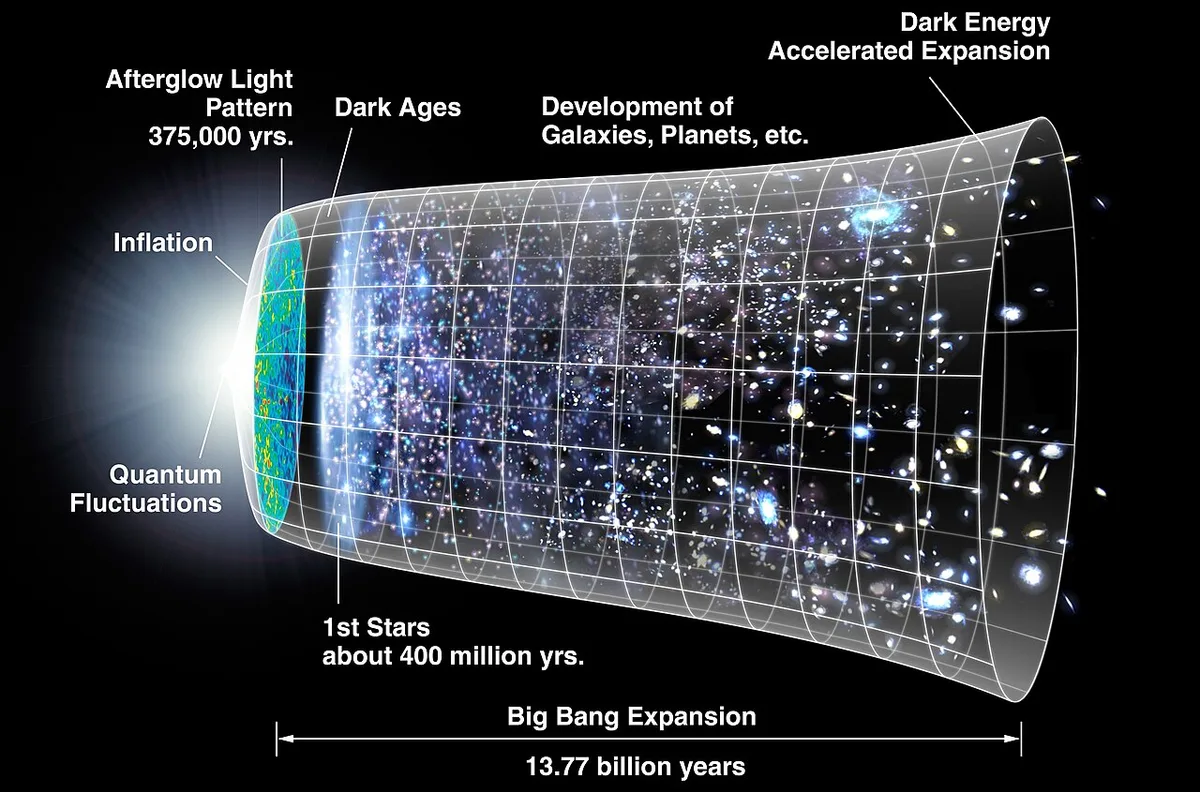
The book opens on the sky we inherited: Earth still at the center, Ptolemy's workable system, Copernicus and Galileo's challenge, Newton's universal gravity still locked to an infinite static stage he could not stop from collapsing. Hubble's redshifts then force expansion, so reverse the film and a beginning appears—an implication Hawking refuses to treat as a mere math glitch.
Special relativity next strips time of its universal tick; general relativity turns gravity into geometry and survives the 1919 eclipse test. Applied to a uniform cosmos, those equations plus the microwave afterglow and singularity theorems drive the universe to an infinite-density boundary where the theory itself breaks.
Quantum mechanics enters as the missing language of the very small: uncertainty, wave functions, interference from single particles. Ordinary matter compresses to quarks and leptons ruled by four forces; electroweak unification becomes the template and the hope for something larger. Black holes shift from wartime curiosity to objects with candidates like Cygnus X-1, then—once quantum pairs near the horizon are allowed—to slow leaks that tie them to temperature and entropy and open an information puzzle.
Hawking's own no-boundary idea tries to erase the sharp edge of the beginning. The arrow of time is relocated from fundamental law to a low-entropy start. The finale surveys supergravity and strings as routes to one theory of everything, then reaches for rhetorical closure the evidence cannot yet underwrite.
Context
Stephen Hawking published the book in 1988 to explain, without equations, how modern physics understands the universe's origin, structure, and possible end. It mattered because it turned cosmology from specialist debate into a subject of mass curiosity.
The key ideas
1
Abandon the fixed stage
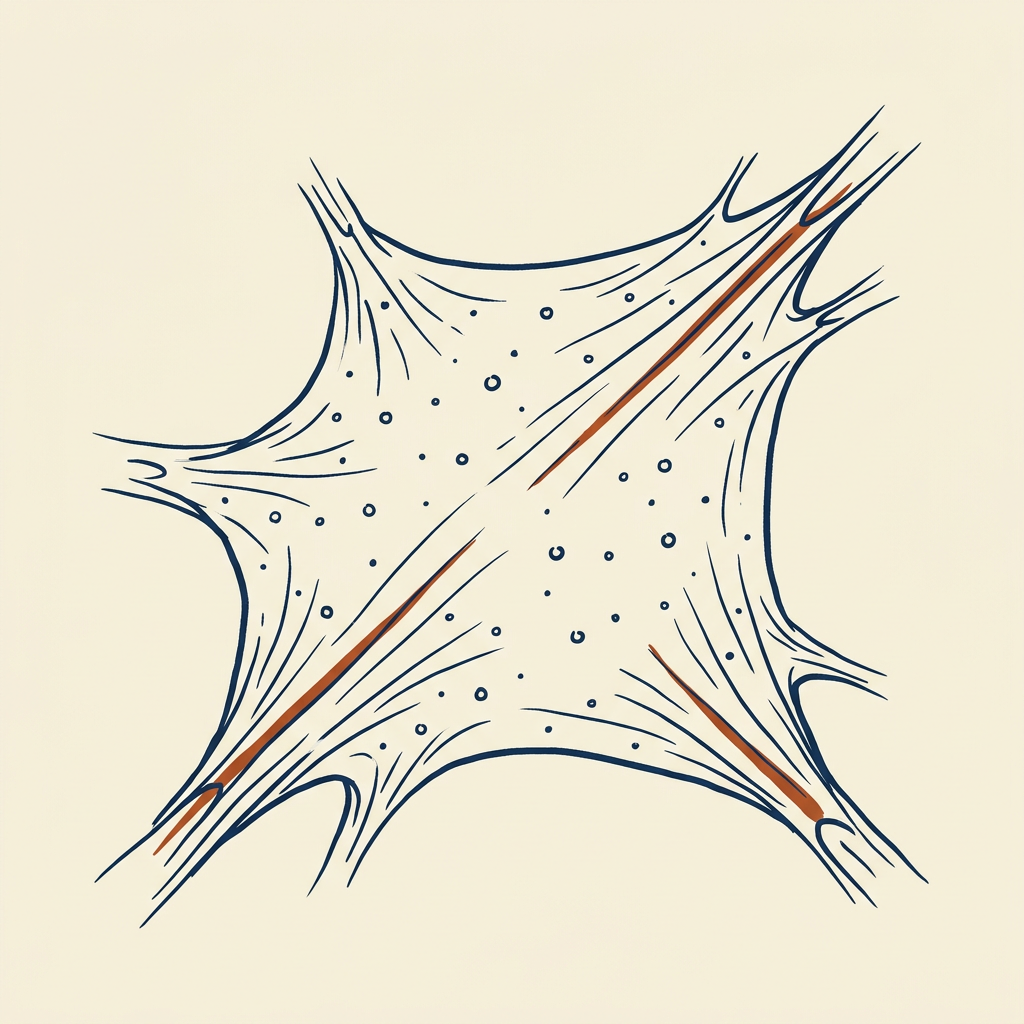
Hawking argues the true shock was not new sky facts but dropping any need for a center or permanent stillness once expansion was measured.
For most of history the Earth sat unmoved at the middle; Aristotle read straight-falling objects as proof, and Ptolemy's machinery predicted planets well enough for centuries. Copernicus shifted the center to the sun; Galileo's moons of Jupiter showed not everything circles us; Newton gave one gravity for apples and orbits yet still assumed an infinite static backdrop he feared would collapse.
Hubble's 1929 redshifts, proportional to distance, made the straightforward reading expansion of space itself. A static arrangement was not merely unproven; gravity would pull it inward or demand impossible fine-tuning to hold it still.
That discovery, Hawking treats as a twentieth-century intellectual jolt, sets the book's puzzle: expansion now means a denser past, and eventually a beginning the rest of the argument must face.
In practice: Distant galaxies show redshift that grows with distance, which Hawking reads as space stretching and galaxies riding apart.
2
No universal now
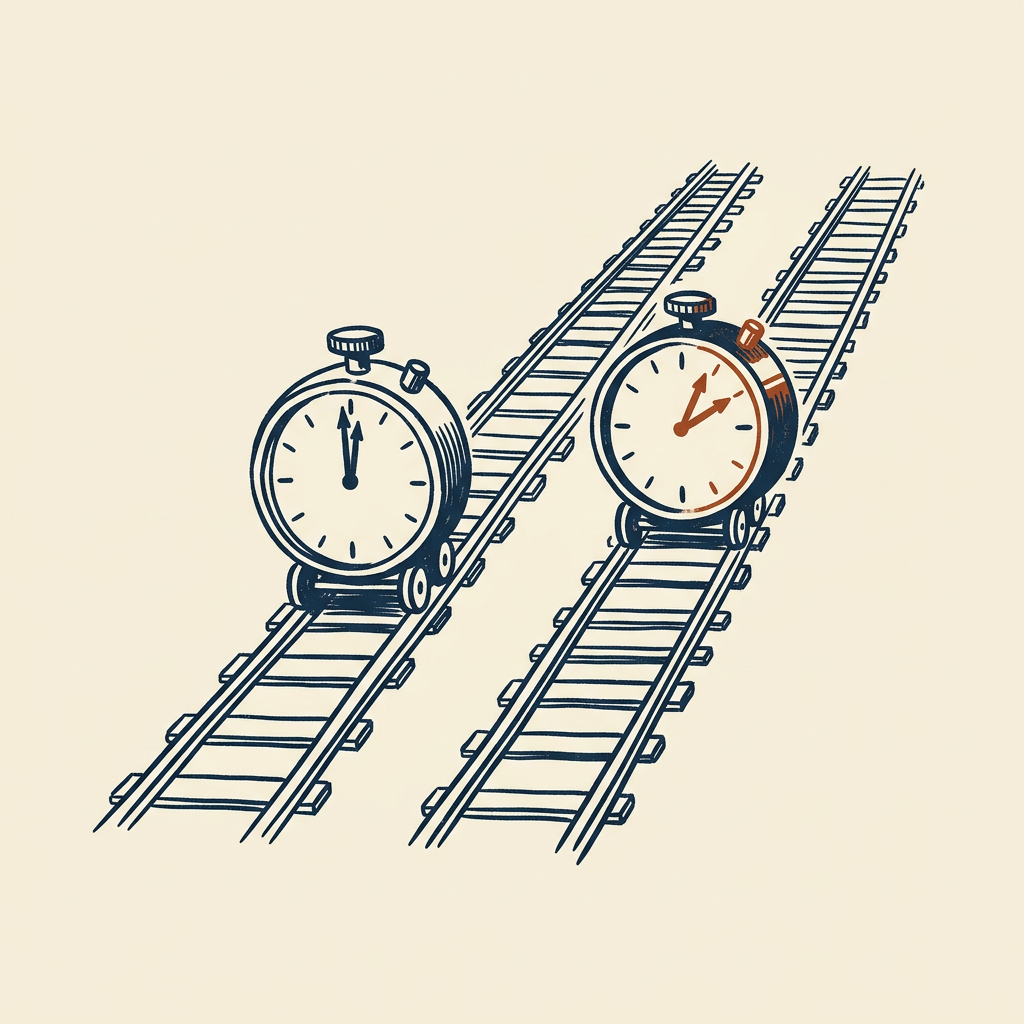
Special relativity, Hawking reports, makes simultaneity depend on the observer's motion; time is not a shared metronome.
Newton's backdrop
One absolute time and space shared by every observer
Einstein's frames
Each observer's clocks and lengths valid; simultaneity can disagree
Newton treated space and time as the same absolute stage for everyone. The Michelson-Morley result—that light's speed stays fixed for every observer—refused everyday velocity addition.
Einstein's 1905 move was to let clocks and rulers change between frames instead of forcing light to vary. A moving clock runs slow relative to you; a moving ruler shortens; neither frame is wrong. Two distant events can be simultaneous for one traveler and sequential for another—not from signal delay but from time's structure.
Mass-energy equivalence follows at once. Once time is frame-dependent, questions about what happened 'before' the universe began lose any single obvious meaning.
In practice: Muons created high in the atmosphere decay in microseconds at rest yet still reach the ground because their high speed slows their clocks relative to us.
3
Gravity as bent geometry
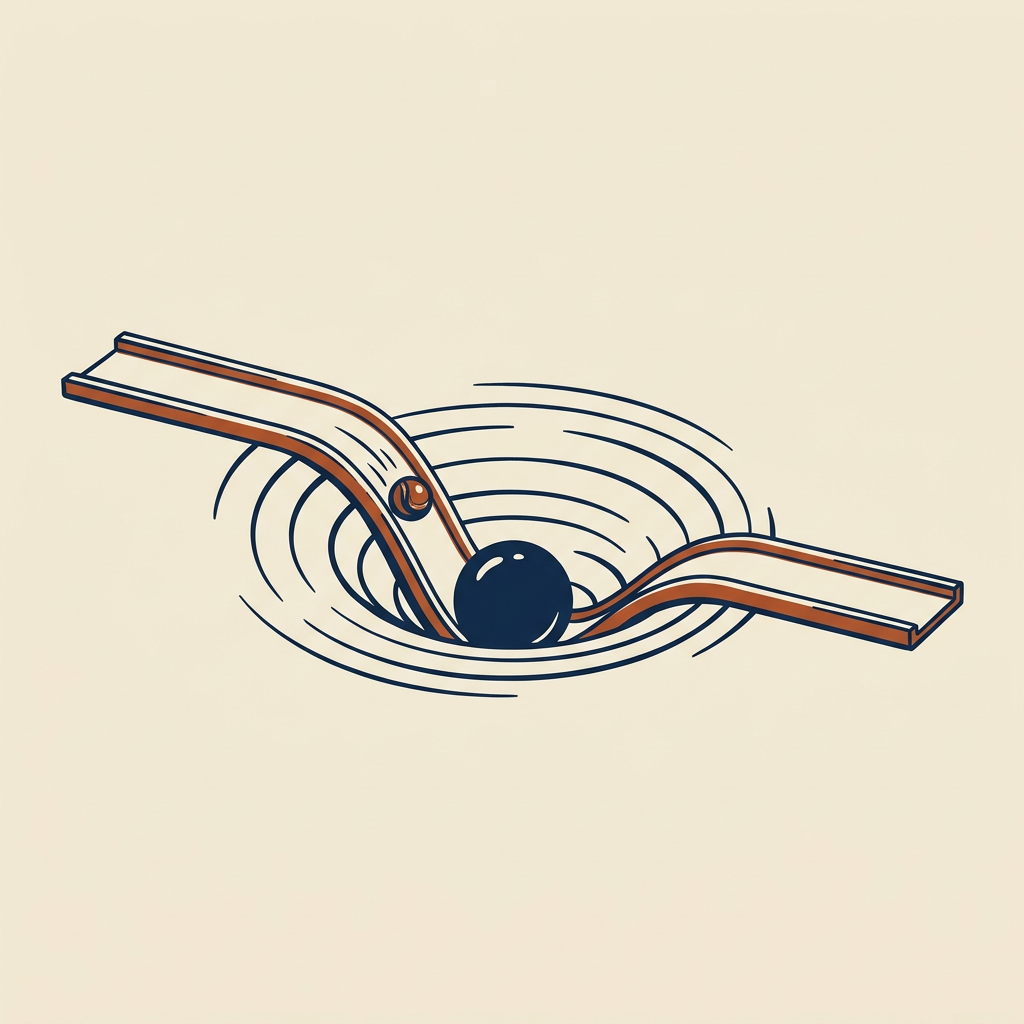
General relativity claims gravity is spacetime curvature, not a pulling force, and Hawking notes it has matched every precision test since 1919.
Force picture
Invisible pull yanks masses together across flat space
Geometry picture
Mass curves spacetime; objects follow straightest paths in the curve
Special relativity ignored gravity and acceleration. Einstein's equivalence principle—that a sealed accelerating rocket feels identical to standing in a gravitational field—became the bridge.
Massive bodies bend the geometry around them; free bodies follow the straightest paths through that curvature, which we experience as attraction. A planet is not yanked by an invisible cord; it coasts the bent landscape.
The theory predicted starlight grazing the sun should deflect by twice the Newtonian amount. Eddington's 1919 eclipse expeditions matched Einstein's figure and made him a public name. The same geometry corrects GPS satellite clocks; without it, positions would drift by several kilometers per day.
In practice: Eddington's teams measured starlight bent near the sun's edge during the 1919 eclipse and found Einstein's value, not Newton's.
4
Equations force a beginning
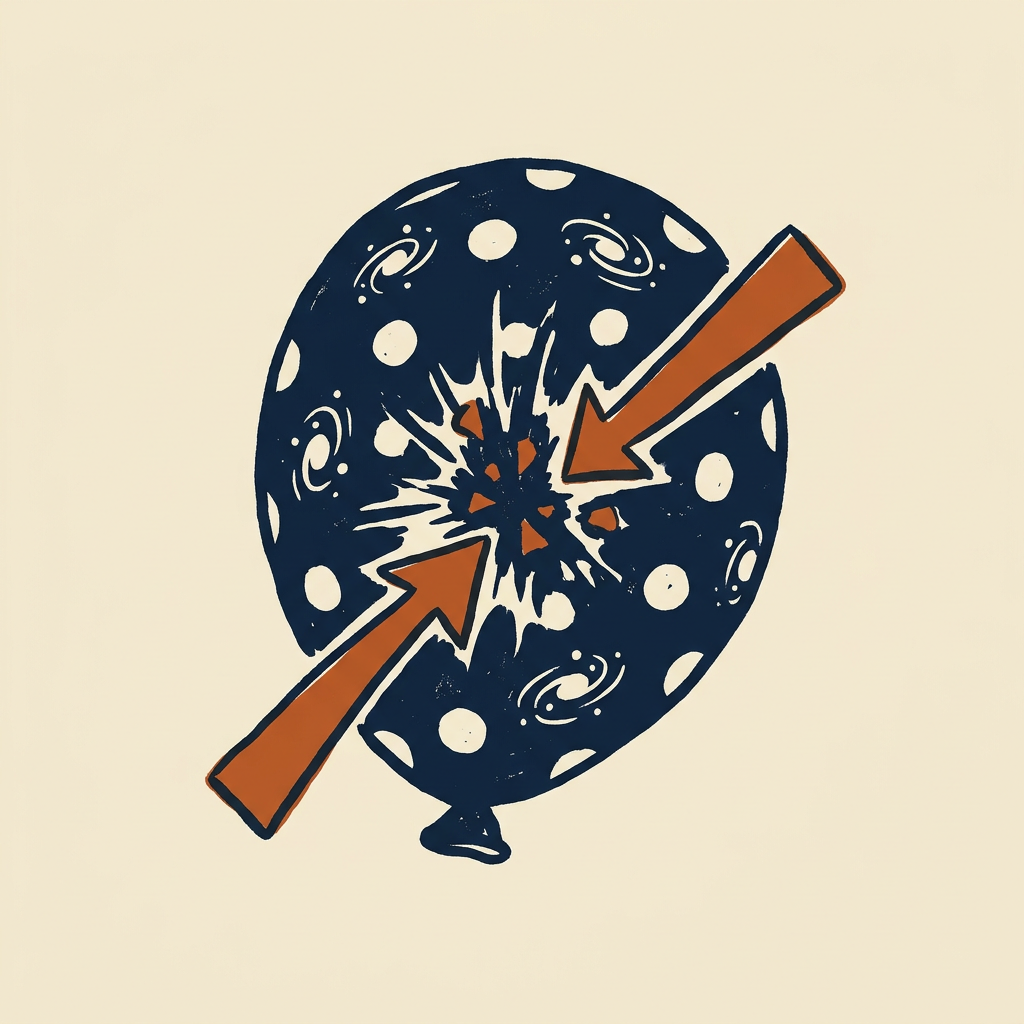
Run general relativity backward on an expanding uniform cosmos and Hawking says you reach infinite density—a real boundary where the theory fails, not a data gap.
- 1Expansion measuredGalaxies recede with distance
- 2Equations reversedFriedmann solutions run backward to higher density
- 3Afterglow foundUniform microwave background matches cooled hot birth
- 4Singularity theoremsUnder general conditions the past boundary is unavoidable
Friedmann showed in the 1920s that Einstein's equations for a large-scale uniform universe yield expansion or contraction, not stasis. Hubble's recession locked in the expanding branch and a hotter, denser past.
The 1965 Penzias-Wilson microwave hiss, uniform across the sky, matched the cooled afterglow expected from that hot youth—radiation from roughly 380,000 years after the start. Hawking and Penrose later proved that, under broad conditions with enough matter, a past singularity is unavoidable if general relativity holds: zero size, infinite density, equations broken.
That predicted self-failure is why Hawking insists general relativity cannot be the last word and must meet quantum mechanics at the extremes.
In practice: The cosmic microwave background discovered in 1965 fits the leftover glow of a hot early universe that has since expanded and cooled.
5
Probability replaces certainty
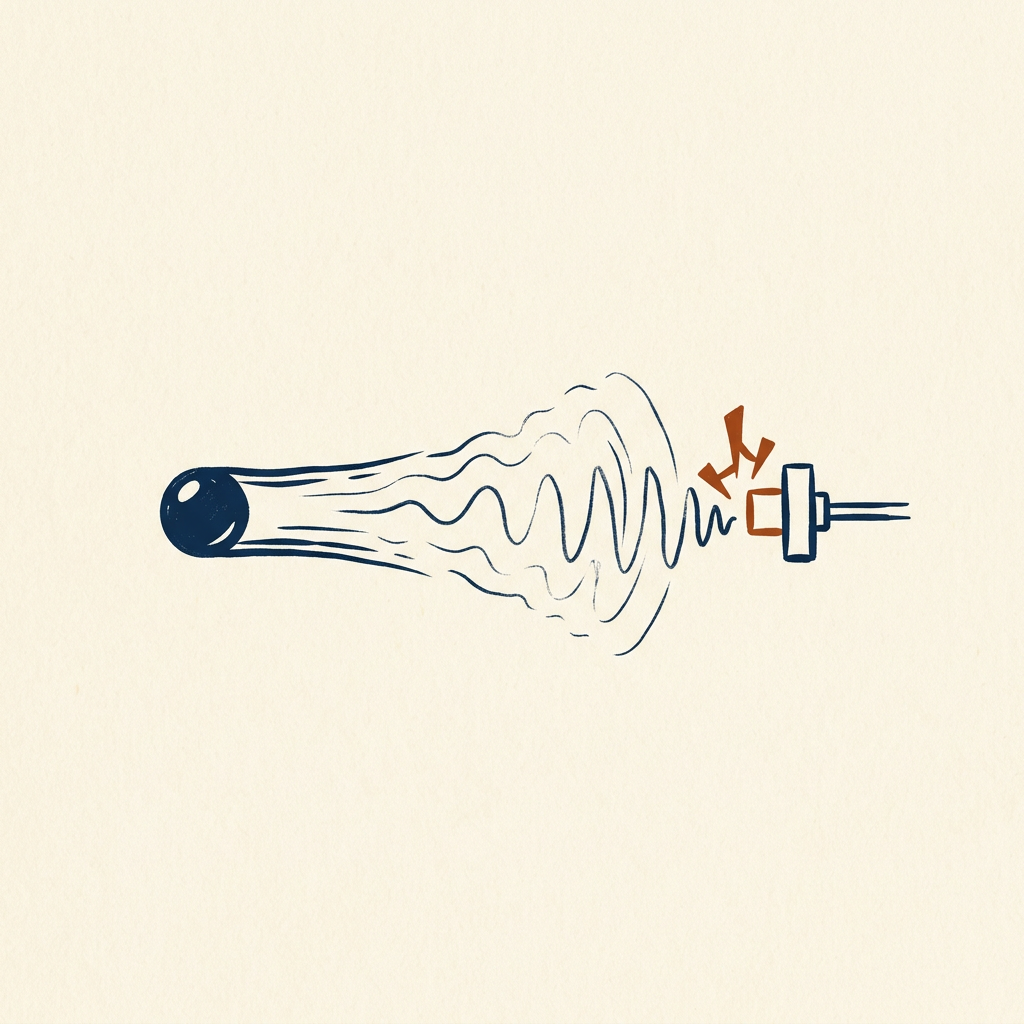
Heisenberg's limit, Hawking stresses, is structural: the small-scale universe is genuinely probabilistic, not merely hard to measure.
Classical hope
Enough data yields one exact future path for every particle
Quantum rule
Wave functions give probabilities; position and momentum trade precision
Pin a particle's position more tightly and its momentum grows less knowable, and the reverse; the trade-off is built into nature. Newtonian dream of exact future states from enough data gives way to wave functions that yield only odds.
Fire electrons one by one through two slits and an interference pattern still builds—the signature of waves—even though each electron lands as a point. Until measured, the electron behaves as a probability wave; measurement localizes it. Light likewise toggles between waves and photon packets.
At the densities inside black holes and the earliest universe, these effects cannot be ignored the way they are for planets. Smooth spacetime and discrete chance still lack one consistent frame, the obstacle behind the book's later speculation.
In practice: Single electrons through a double slit slowly paint a wave interference pattern on the screen despite arriving one particle at a time.

6
Four forces, unfinished merge
Hawking reduces matter's variety to quarks, leptons, and four forces, treating electroweak success as the template—not yet the proof—for fuller unification.
- Theory of everything (goal)Single frame including gravity; still open
- Grand unification (unconfirmed)Strong, weak, and electromagnetic forces merge at extreme energy
- Electroweak (achieved)Electromagnetism and weak force unified; W and Z found
- Four separate forcesGravity, electromagnetism, strong, weak as everyday starting list
Ordinary stuff bottoms out in quarks that bind into protons, neutrons and other hadrons, plus leptons such as electrons and neutrinos. Four interactions govern them: gravity (weakest, longest reach), electromagnetism, the strong force inside nuclei, and the weak force of radioactive decay.
Glashow, Salam and Weinberg merged electromagnetism with the weak force; their framework predicted W and Z bosons found at CERN in 1983 after the 1979 Nobel. Hawking reads that win as evidence that separate-looking forces can become one framework with testable bite.
Grand unification of all four, and a final theory that folds in gravity, remain unconfirmed; no experiment has reached the energies where full convergence is expected. The track record still licenses the ambition of later chapters.
In practice: The W and Z bosons predicted by electroweak theory were detected at CERN in 1983, confirming that merger.

7
Black holes exist—and leak
General relativity allows regions nothing can escape; Hawking's quantum add-on says those regions slowly radiate mass away until they vanish.
- 1Virtual pair formsNear the horizon a particle-antiparticle pair pops from the vacuum
- 2One falls inIts partner is lost inside the event horizon
- 3One escapesFrom afar the hole appears to emit radiation
- 4Mass dropsEnergy carried away reduces the hole until, in theory, it vanishes
↻ and round again
Schwarzschild's 1916 solution already implied that enough mass in a small enough radius creates an event horizon. For decades the idea stayed mathematical; no process seemed able to compress matter that far. Chandrasekhar's mass limit—roughly 1.4 suns—showed a spent stellar core above that threshold cannot resist collapse, and a heavy enough remnant can pass the neutron-star stage into a black hole.
They emit no light, yet companions reveal them: Cygnus X-1's invisible dense partner pulls gas that heats and screams X-rays, with mass and size matching a black hole better than a neutron star. Hawking treats that as strong circumstantial evidence for the book's era.
Classically nothing returns once past the horizon. In 1974 he showed virtual particle pairs near the horizon can split—one falls in, one escapes—so the hole radiates, loses mass, and shrinks faster as it gets smaller, ending in a final burst. Stellar-mass holes evaporate far slower than the universe's age, yet the result links them to temperature and entropy and poses the information paradox if the hole disappears completely.
In practice: Cygnus X-1 pairs a visible star with an unseen compact companion whose pull and X-ray glow fit a black hole.

8
Origin without an edge
The Hartle-Hawking no-boundary idea treats the beginning as finite spacetime with no sharp rim, a speculative candidate rather than settled fact.
If singularities mark where law fails, a description of the start must avoid them. In 1983 Hartle and Hawking used imaginary time—a coordinate that behaves like a spatial direction—to smooth the distinction between time and space near the origin.
Traveling toward the beginning becomes like moving toward a sphere's pole: the geometry simply stops offering a further 'north,' so no edge and no extra starting rule need be imposed by hand. In principle the proposal yields a wave function for the whole universe.
Hawking voices more confidence than the evidence carries. Imaginary time lacks direct physical reading, and sharp tests that would separate the idea from rivals stay scarce; it is a consistent option, not a verified one.
In practice: Hawking likens asking what came before the Big Bang to asking what lies north of the North Pole—a question the geometry does not admit.
9
Why clocks feel one way
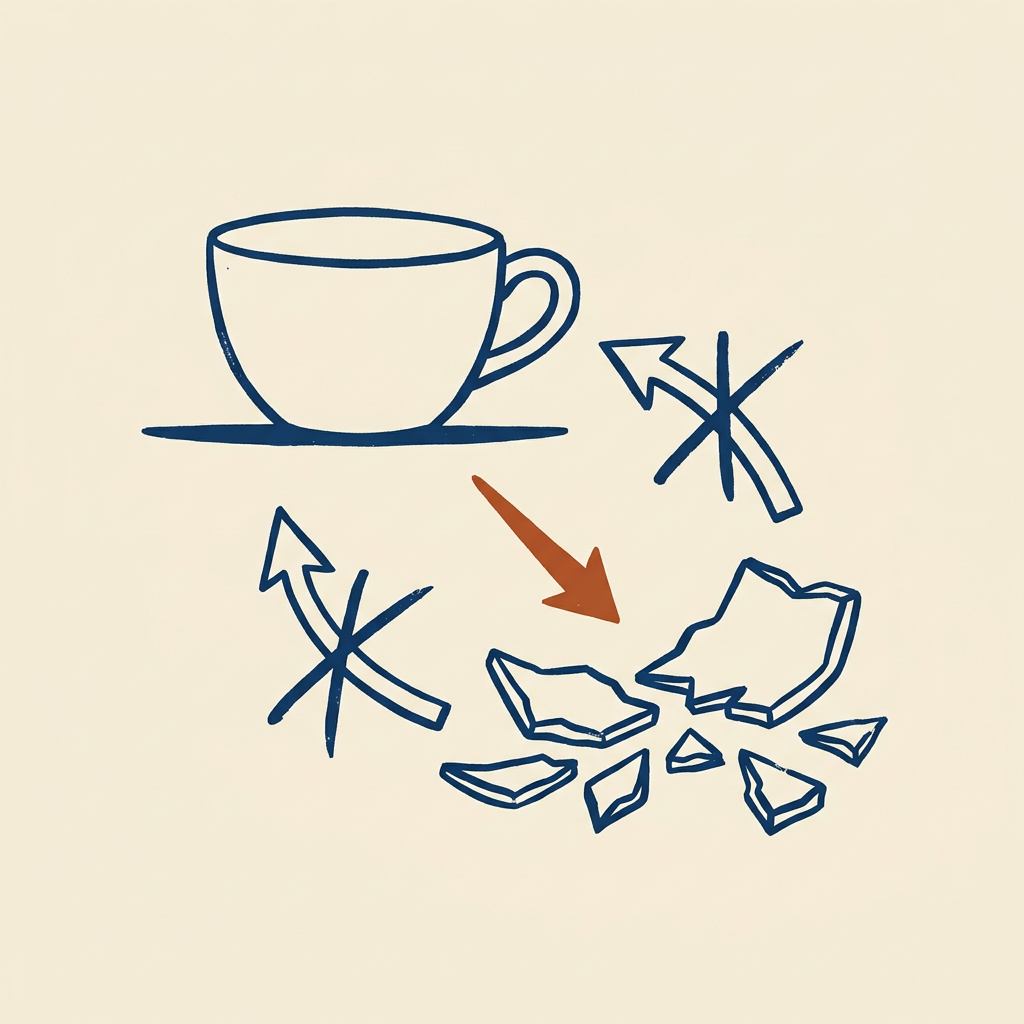
Hawking locates time's forward feel not in the fundamental laws but in a universe that began extremely ordered and low-entropy.
Fundamental laws
Equations work identically with time reversed
Lived arrows
Entropy rises, memories form, universe expands—all one way because the start was low-entropy
Microscopic laws run equally well forward or backward; nothing inside them prefers a direction. Yet glasses shatter and do not reassemble, and memories point only one way.
He separates three arrows that happen to align: thermodynamic (entropy of an isolated system tends to rise because disordered arrangements vastly outnumber ordered ones), psychological (memory formation itself increases disorder, so minds track the thermodynamic arrow), and cosmological (the direction of expansion).
If the early universe started in an extraordinarily ordered state, entropy had nowhere to go but up, fixing the thermodynamic arrow and, with it, the psychological one. The direction of time becomes a contingent fact about initial conditions, which loops back to whatever explains those conditions.
In practice: A shuffled deck is overwhelmingly more likely than a suit-sorted one simply because far more disordered arrangements exist.
Key terms
- event horizon The boundary around a black hole past which nothing, including light, can escape
- singularity A point of infinite density and zero size where the equations of general relativity break down
- redshift The stretch of light toward longer wavelengths that signals galaxies receding as space expands
- uncertainty principle The built-in limit on knowing a particle's position and momentum sharply at the same time
- Hawking radiation The slow particle emission from black holes that arises when quantum pairs straddle the horizon
- no-boundary proposal Hartle and Hawking's idea that imaginary time makes the universe finite yet without an edge at its origin
- entropy arrow The tendency of disorder to increase, which Hawking ties to why we feel time flowing forward
- electroweak unification The already-tested merger of electromagnetism and the weak force into one framework
What to do
- Pick one tested claim such as the microwave background or light bending and compare it with current observational data.
- When a 'theory of everything' appears in news, ask what new measurement it predicts rather than what it only re-describes.
- Reread the black-hole or arrow-of-time sections beside a source that shows the underlying math at your level.
- Sketch the three arrows of time on paper and note where your own daily habits only make sense in one direction.
- List which of the book's ideas rest on confirmed observation versus which remain speculative candidates.
Questions to think with
- If expansion implies a denser past, does 'before the Big Bang' name a real epoch or a malformed question?
- Why should thermodynamic, psychological, and cosmological arrows point the same way when microscopic laws do not prefer a direction?
- Does treating the origin as edgeless like a sphere's pole actually explain why the universe began, or only restate the geometry?
- When quantum mechanics and general relativity clash at a horizon, which framework should give first?
- How much confidence should a popular account carry when it must replace equations with analogy?
The other side
The confident late-book tone outran the physics; decades on, no finished theory of everything exists. String theory still lacks a confirmed testable prediction and has sprawled into a vast landscape of possible versions. Hawking later conceded information is not lost in black holes and revised the no-boundary idea itself. Avoiding equations sometimes lets speculative proposals feel as solid as measured results like the microwave background. Closing talk of knowing 'the mind of God' mixes a map of law with the deeper why-anything-exists question. The book was also bought far more often than finished, denser than its plain prose suggests.
Who it's for
Curious non-scientists who want the conceptual meaning of curved space and an expanding cosmos, plus students with a little introductory physics who need the map before the equations. Readers who already want technical finality or light skimming will be less well served.