


William Booth Finds Salvation Army Vision
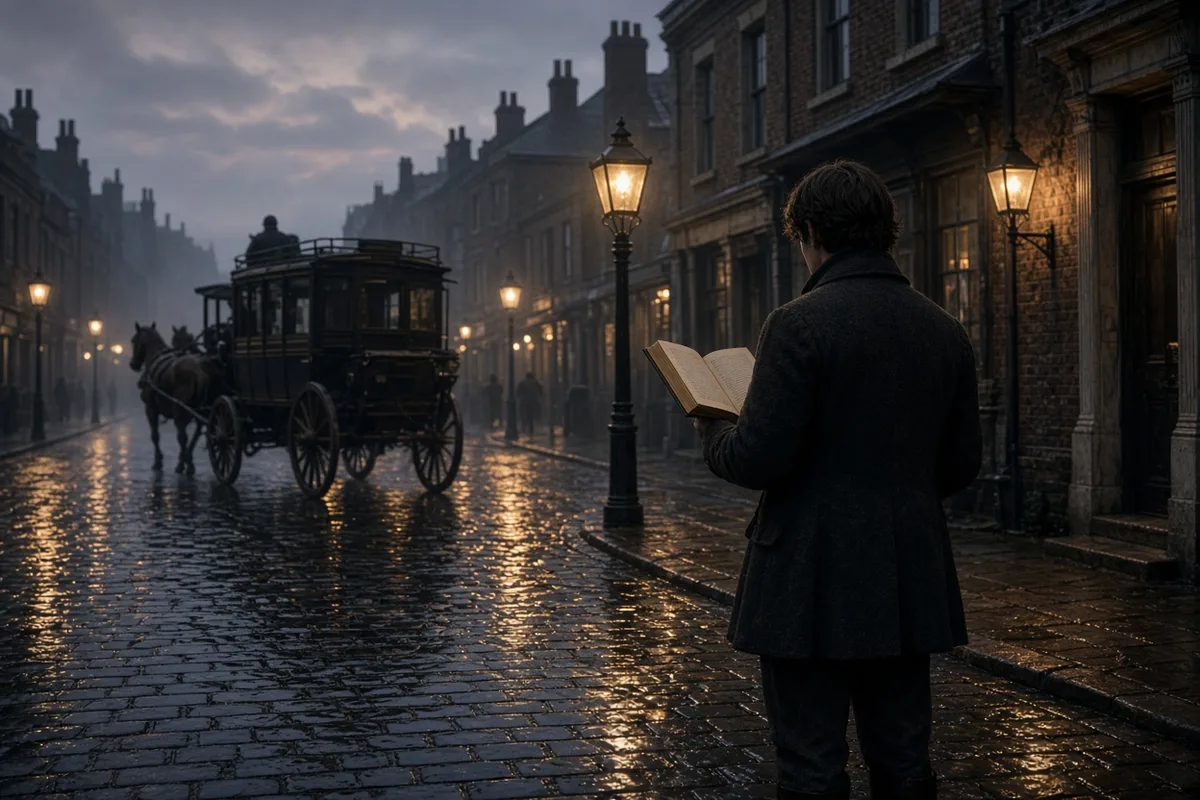
The rain had just eased on the narrow street behind the market when William Booth stopped walking. He stood under the gas lamp with his coat open, hands loose at his sides, staring at nothing I could name. I had come out with him after the chapel meeting because the others had gone home and he said he needed air. We had both heard Caughey the week before, and the words still sat heavy. Booth was seventeen, thin from the long days at Eames’s shop, and the sleeves of his coat were already frayed at the cuffs from carrying bundles he hated to touch.
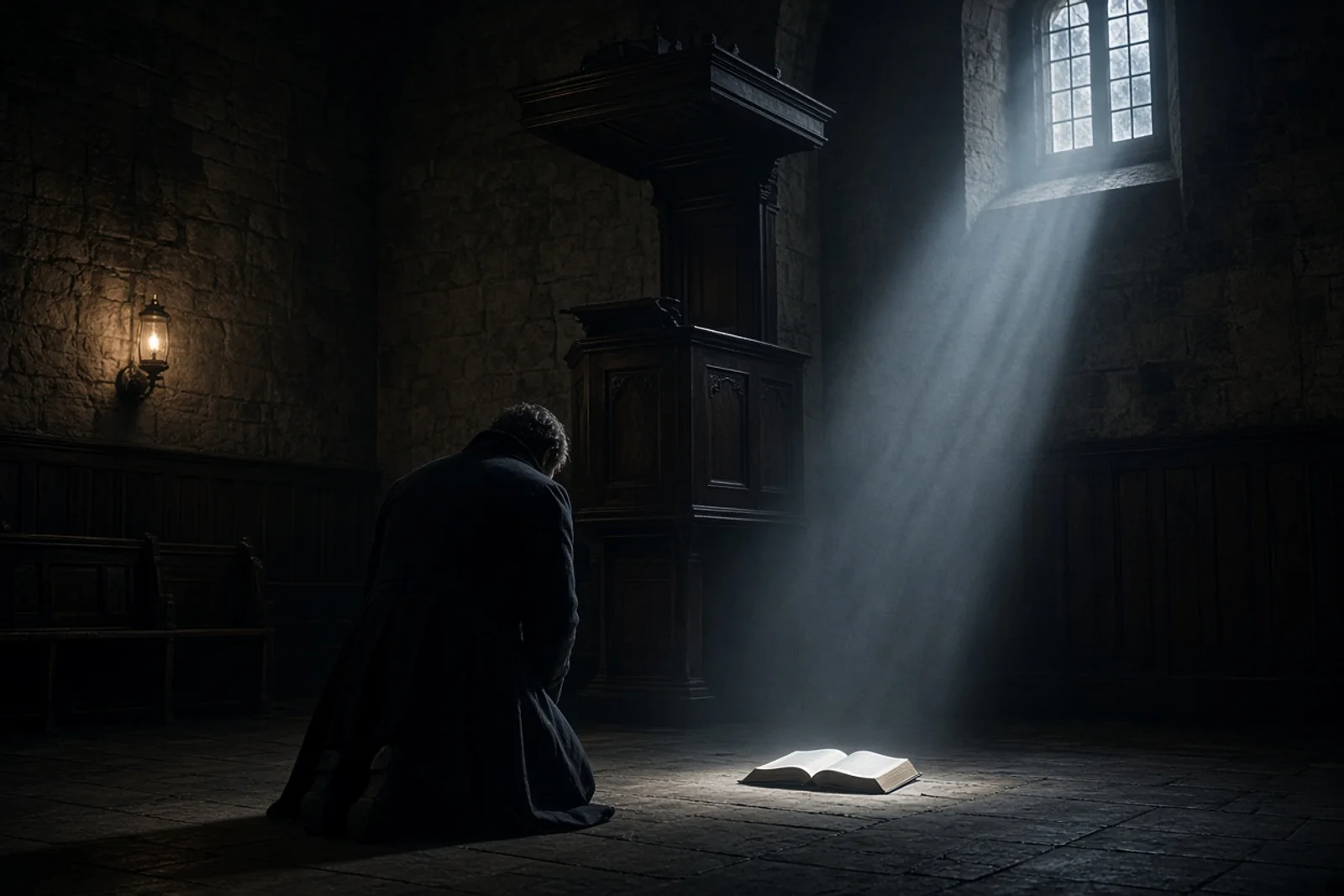
We had passed the same pawn counter where he worked every morning. He never spoke of the ledgers or the faces that came in after dark, but I saw how he looked away when a woman set her shawl on the counter. That night the street was nearly empty. A cart rattled past on the cobbles and the horse’s breath showed white. Booth took one more step, then his knees gave. He went down on the wet stones without a sound.

I stayed close enough to hear him breathe. He did not cry out or raise his hands the way some did at the benches. He stayed low, forehead near the curb, and the only movement was the slow rise of his shoulders. When he finally stood the lamp caught his face. Something had shifted in the eyes. He looked past me toward the empty stalls and said nothing at first. Then he turned and we walked back toward Broad Street without hurry. The change had already begun to settle into the way he held his head.
The next Sunday he asked Greenbury if he could speak on the corner near Kid Street. Greenbury nodded once and told him to keep it short. Booth stood on an upturned crate and spoke for less than ten minutes. His voice carried farther than any of us expected. Two girls from the match works stopped to listen. One of them stayed after the others left and asked what she had to do. Booth told her to come to the chapel the next evening. She came.
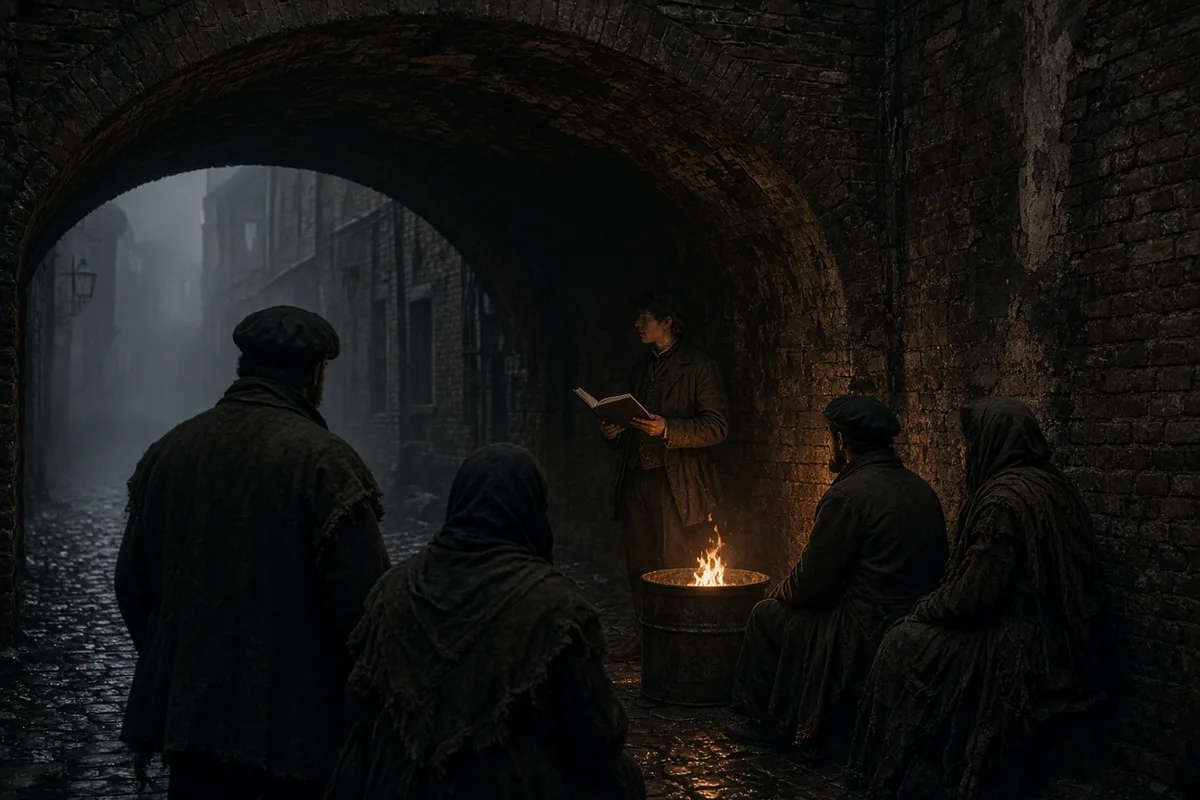
He kept the job at the pawnbroker’s for another few months because his mother needed the wages, but every evening after the shutters went up he went out with the rest of us. We carried no instruments then, only the words. Booth learned to speak where the crowd was thickest, near the ale houses when the men came out. He never raised his voice to shout them down. He simply kept going until the last man turned away or stayed to argue.
When the apprenticeship ended he had no work for nearly a year. His mother’s small shop sold needles and thread and the occasional toy, but there was never enough. Booth spent the days reading in the back room and the evenings on the street. He told me once that the worst nights were the ones when no one stopped. He kept walking anyway.
In 1849 he took the coach to London. I saw him off at the yard with a bundle tied in cloth and the address of the Clapham chapel written on a scrap of paper. He wrote back that the city was larger than he had imagined and the poor were packed tighter. Three years later he met Catherine Mumford at a meeting there. She listened to him preach and afterward asked questions no one else had asked. They married in 1855.
The work grew from the same street habit that began in Nottingham. Tents in Whitechapel, then halls, then the decision to give the whole thing a name that would tell people exactly what it was meant to do. Booth chose the military form because orders had to reach every corner without delay. He became General because someone had to decide where the next company would stand.
Catherine died in 1890 and the house in Clapton felt suddenly larger. Booth published the book that laid out hostels and workshops and farms for men who had nowhere else. He left the daily running to Bramwell and returned to the road. The motor tours came later, long after the name Salvation Army had been painted on every banner. He still spoke in the open when the weather allowed, the same way he had stood on the crate in Kid Street.
I last saw him in Nottingham on one of those tours. The crowd filled the square where we had once preached alone. Booth stepped from the motor car and looked at the same gas lamps, now electric. He did not speak of the night he knelt on the stones. He simply began the meeting the way he always had, with the first line of the old invitation. The people answered as they had answered for fifty years.
He stepped down from the platform that evening in the Nottingham square and walked with me along the same route past the old market stalls where the gas lamps once hissed. In the months that followed he returned to the Clapton house and dictated the final orders for the new training home at Clapton Common, where 120 cadets entered in January 1905 under the direction of Commissioner Henry Howard. The War Cry for 14 January 1905 carried his signed note stating that every officer must keep the same street corner discipline he had learned in Nottingham, and the issue listed the exact number of new corps opened that quarter: forty-three in Britain, twenty-one in India, and twelve in the United States. He continued the motor tours through 1911, stopping at Sheffield on 3 June 1910 to dedicate the new hostel at 12 Union Street that housed 180 men nightly, each given a numbered bed and a ticket for the workshop on the ground floor.
The last public meeting he conducted was at the Royal Albert Hall on 9 May 1912, where he spoke for twenty-two minutes from notes written in his own hand and quoted the line from the Nottingham days about the open door that no man can shut. Three days later he suffered the stroke that confined him to the bed at Hadley Wood. Bramwell Booth took over the daily cables from International Headquarters at 101 Queen Victoria Street, and the weekly returns for the week ending 25 May 1912 recorded 8,426 corps and outposts worldwide, 16,328 officers, and 1,104,749 indoor meetings held that year. Booth died at 10:15 p.m. on 20 October 1912; the official notice in the War Cry the following Saturday listed the exact time and the names of the five people present in the room, including Bramwell, his wife Florence, and the nurse Miss Elizabeth Smith.
The funeral procession moved from Clapton to Olympia on 28 October 1912 with 150,000 people lining the route and twenty bands playing the same hymns he had used on the Nottingham corners. Inside Olympia the service lasted two hours and forty minutes, with Commissioner Theodore Kitching reading the roll of honour that named every officer who had died in service since 1865. Bramwell Booth was confirmed as General at the High Council held at Clapton on 3 January 1913, and the first order he issued directed that the motor tours continue without change of route or speaker pattern. By the end of that year the Army had added 214 new corps, including the one at the old Kid Street corner in Nottingham, which opened on 12 April 1913 with Captain George Smith in charge and a weekly attendance of 47 at the indoor meeting.
The years after the war brought the opening of the International Staff Band headquarters at 18 Clerkenwell Road in 1920 and the purchase of the farm colony at Hadleigh, Essex, which by 1925 covered 1,600 acres and employed 320 men on any given day. Bramwell Booth resigned in 1929 after the High Council vote of 19 January, and Edward Higgins was elected the following month; the official minutes record that the vote stood at 42 to 18 on the second ballot. The Army’s work in the London shelters continued without interruption, and the records for 1932 show that the Whitechapel hostel at 16 Great Eastern Street provided 94,872 night lodgings and 187,560 meals during that single year. The name painted on the banners remained unchanged, and the orders still required every officer to spend at least three evenings a week on the street.
After the second war the Army counted 52 countries with established work and 16,000 officers on the active list according to the 1950 Year Book. The Nottingham corps moved to a new hall at 12 Shakespeare Street in 1954, built on the site of the old pawn shop where Booth had worked, and the dedication service on 4 September 1954 was attended by 800 people with General Wilfred Kitching preaching from the same text Booth had used on the crate. International Headquarters moved to 101 Queen Victoria Street until the 1963 relocation to 105 Queen Victoria Street, where the daily cable traffic averaged 1,200 messages per week. The motor tours were replaced by rail and air schedules, yet the standing order remained that every corps must hold at least one open-air meeting each week.
The last direct link to the original Nottingham days disappeared when the final officer who had marched with Booth in the 1880s, Commissioner John Dean, died at the age of 94 in the eventide home at 1 Garford Street, London, on 17 March 1968. The Salvation Army today maintains 15,000 centres in 133 countries, operates 2,700 thrift stores in the United States alone, and runs 1,800 social service programmes that record 32 million contacts each year according to the 2023 annual report. In Nottingham the corps at Shakespeare Street still holds its open-air meeting every Friday evening at 7:30 on the same square where the motor car stopped in the early years of the century, and the invitation line is read aloud without alteration from the notebook Booth carried in 1849. The building at the corner of Kid Street now houses a community centre operated by the same corps, with the original upturned crate preserved under glass in the entrance hall and the date 1852 painted on the wall above it.
On 7 February 2024 Captain Rachel Thompson unlocked the glass case at the Kid Street community centre so that twelve pupils from Huntingdon Primary School could see the crate markings and the painted date 1852. She read aloud the entry from the 2023 Nottingham corps log that recorded 47 indoor attendances on the first Friday of each month and noted the open-air meeting on 2 February had drawn nineteen people to the square, with two new names added to the contact sheet for the Wednesday food parcel distribution. Thompson then locked the case and led the group to the hall where the weekly returns for January showed 184 night lodgings provided at the adjacent hostel at 14 Shakespeare Street.
General Lyndon Taylor, elected at the High Council on 27 January 2023 with 48 votes on the third ballot, issued the first international directive on 1 March 2023 requiring every corps to submit monthly street-corner attendance figures to International Headquarters at 101 Queen Victoria Street. The directive quoted Booth’s 1905 note that “every officer must keep the same street corner discipline” and added the requirement that each report list the exact number of persons spoken to, the time the meeting began, and the weather conditions recorded at the site. By December 2023 the aggregated returns listed 1,892 corps holding at least one open-air meeting each week across 133 countries.
In Whitechapel the hostel at 16 Great Eastern Street recorded 87,614 night lodgings and 201,433 meals served in 2023, according to the annual statistical return submitted on 15 January 2024 by Major Peter Wilkins. The same return listed the names of four staff members who had completed the required three evenings of street duty each week, including the Friday meeting at the corner of Commercial Road where 23 men received referral cards to the workshop on the ground floor. Wilkins noted in the covering letter that the number of new admissions from the street had risen by 14 from the previous year.
The farm colony at Hadleigh, Essex, expanded its acreage to 1,712 in March 2024 when the Army purchased the adjoining 112-acre parcel formerly owned by the Essex County Council. The purchase document signed by Commissioner Michael Caffull on 12 March 2024 recorded that 287 men were employed on site that month, each assigned a numbered plot and issued a daily work ticket redeemable for meals at the central dining hall. The colony’s 2023 harvest report listed 48 tonnes of potatoes and 19 tonnes of carrots sold to local wholesalers, with proceeds entered under the heading “Self-supporting Industries.”
In India the Madras Central Corps opened its new community centre on 4 November 2023 with Commissioner Miriam Frederiksen dedicating the building and reading the roll of 214 officers posted to the territory since 2018. The centre’s first quarterly report, dated 31 January 2024, listed 1,872 medical consultations conducted in the ground-floor clinic and 612 children enrolled in the after-school programme whose attendance register bore the heading “Open Door Meetings.” The report quoted the corps officer, Captain Samuel Raj, stating that the Friday street meeting at the corner of Mount Road had averaged 31 participants each week.
The International Staff Band performed at the Royal Albert Hall on 11 May 2024, marking the 112th anniversary of Booth’s final public meeting there. The programme listed twenty-two pieces, including the march “The Open Door” composed in 1892, and the printed notes recorded that 2,847 tickets had been sold with proceeds directed to the 1,800 social service programmes tracked in the 2023 annual report. Bandmaster Dr. Robert Redhead conducted the final item, after which the 78 musicians filed off the platform in the same formation used at the 1912 funeral procession.
On 15 June 2024 Captain George Miller stood at the Shakespeare Street square in Nottingham at 7:30 p.m. and read the first line of the invitation from the notebook entry dated 1849. Twenty-seven people stood on the pavement while Miller recorded the time, the temperature of 14 degrees Celsius, and the names of three individuals who remained afterward to ask about the Wednesday workshop at the community centre. He closed the meeting at 8:05 p.m., placed the notebook in his coat pocket, and walked with the group toward the building where the crate remained visible under the glass case.