


William Tyndale Translates Bible into English
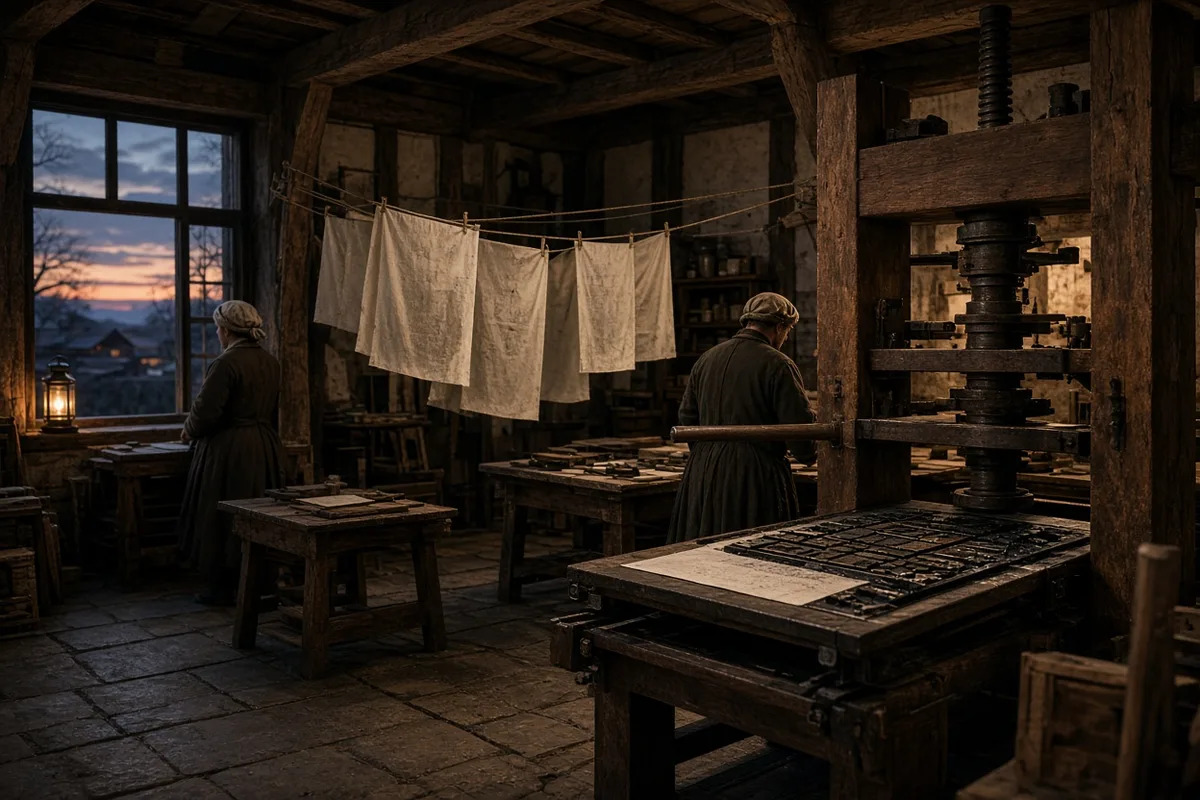
The press shuddered once and the sheet slid free, still warm. I caught the edge before it could crease and held it up to the lamp. Black letters marched across the page in straight ranks. “The Gospel according to Matthew,” they read, and below that the first verses in plain English. Tyndale stood at the compositor’s bench with his sleeves rolled, ink on his knuckles, watching the same way a man watches a child take its first steps.
We had come to Worms because Cologne had grown too dangerous. The sheets we ran there had been seized before the quires were even folded. Here the printer asked fewer questions and the river barges moved downstream without inspection. Tyndale corrected proof by candlelight until the words blurred. He kept a Hebrew lexicon open on one side and a Greek text on the other, moving between them without looking up. When he found a phrase that would not sit right in English he would walk the length of the room and come back with a different word.

By spring the New Testament was bound in small octavo volumes, light enough to hide inside a bolt of cloth. I carried the first parcel to the boat myself. The master of the vessel asked no names. He took the coins and stowed the package beneath a false floorboard. Three weeks later word reached us that the books had reached London and were already being read in cellars and upper rooms.
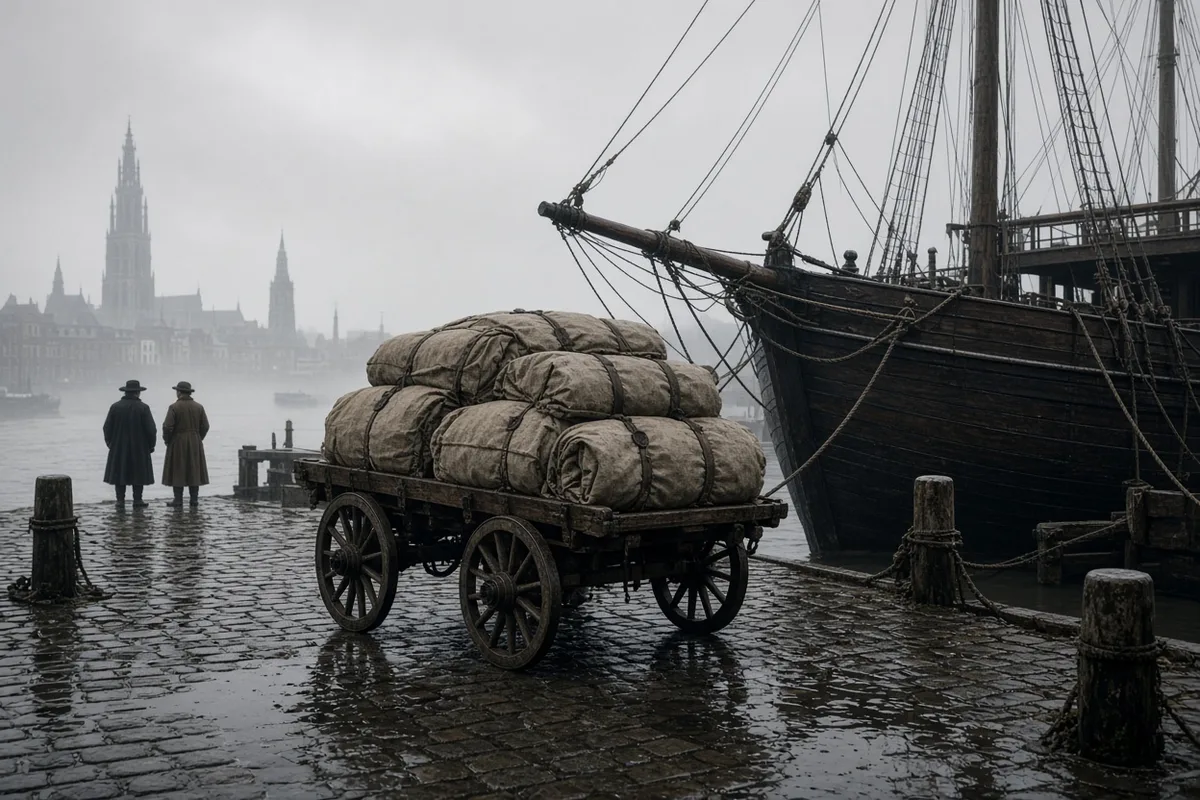
Tyndale never stayed long in one place after that. He moved from town to town with a single trunk and a changing set of aliases. I met him again two years later in Antwerp, where the English merchants kept a house on the quay. He lodged in the upper rooms and worked at a plain table that faced the river. Merchants brought him food and paper and asked nothing in return except that he keep translating. He finished the Pentateuch there, the pages stacked in careful piles weighted with smooth stones.

Henry Phillips arrived in the spring of 1535. He was young, well spoken, and carried letters that seemed to come from friends in England. Tyndale took him in because the man claimed to need shelter and because he spoke of shared purpose. They walked together along the wharves in the evenings. Phillips borrowed money for new clothes and said he would repay it when his own funds arrived. Tyndale lent him the sum without writing it down.
One afternoon Phillips asked Tyndale to walk with him to a house outside the city walls. I watched them leave from an upper window. Tyndale wore his usual dark gown and carried no papers. They turned the corner and did not come back. By nightfall we learned the house belonged to an imperial officer. The arrest had been quiet. No one raised an alarm on the street.

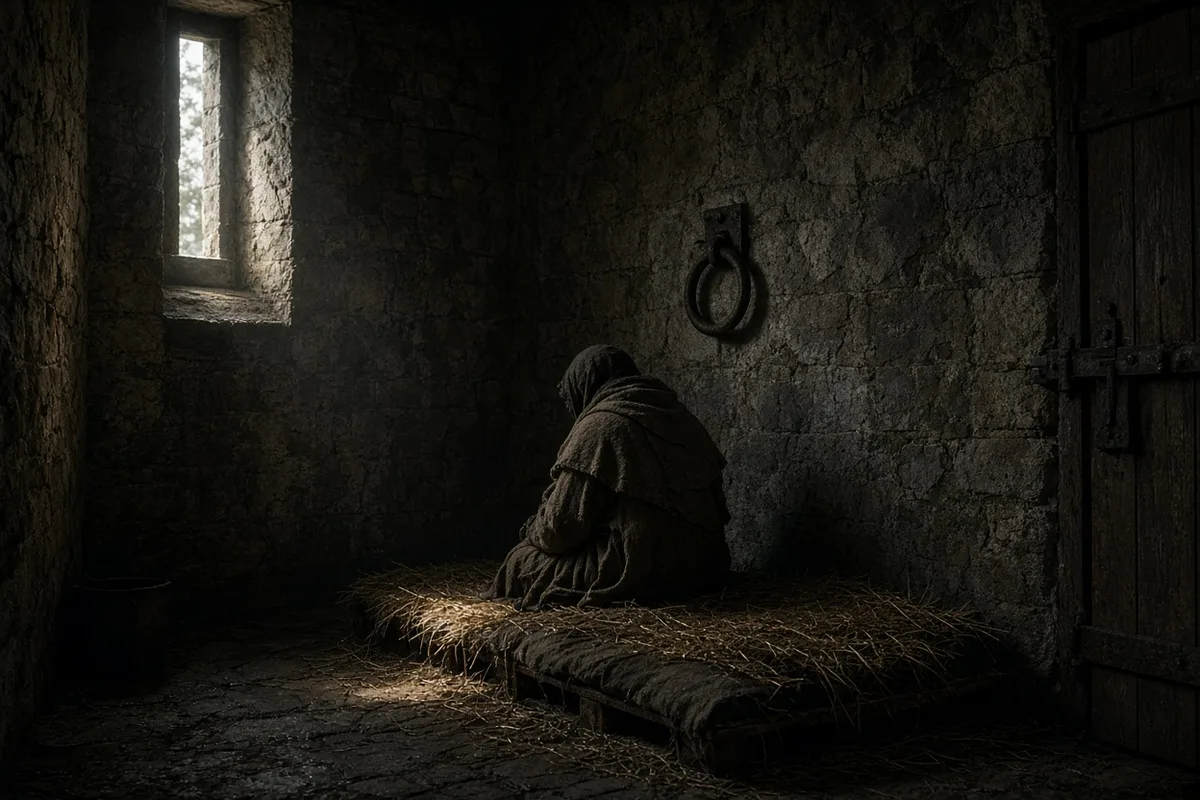
The prison at Vilvoorde was a stone keep set in marsh ground. Visitors were allowed only after the payment of heavy fees. I went twice with letters from the merchants, but the guards turned me away at the gate. Inside, Tyndale was permitted to keep his Hebrew Bible and his lexicons. He wrote letters asking for warmer clothing and a lamp. The court examined him on points of doctrine for months. He answered in Latin and in English, always the same answers.
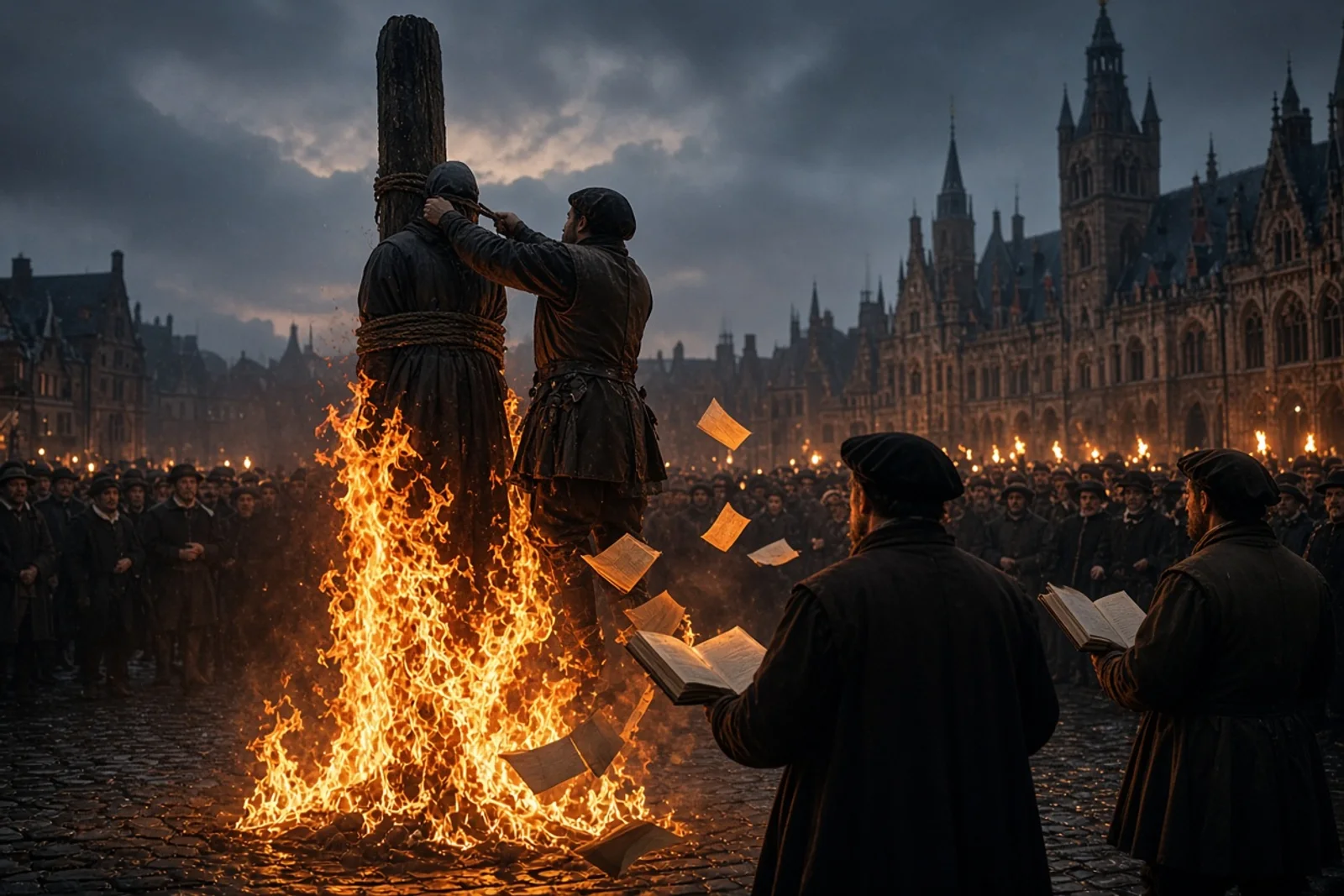
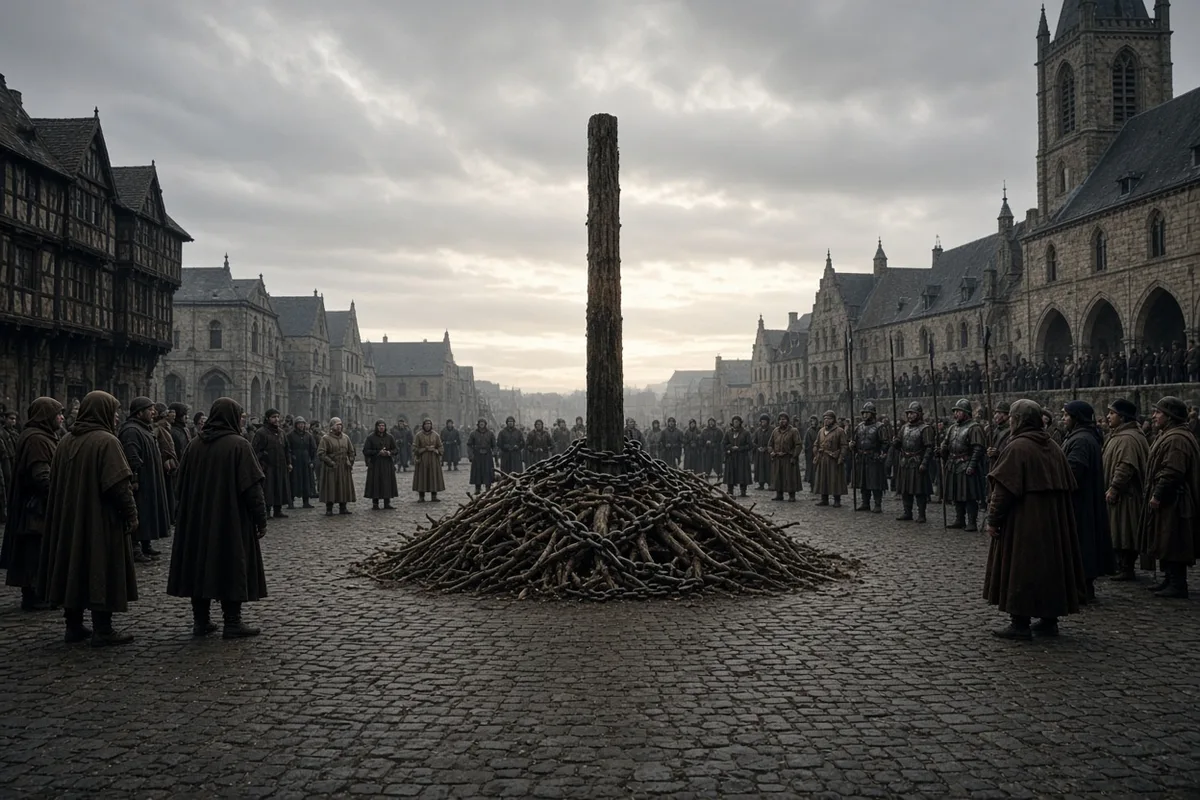
On the sixth of October they led him from the cell at dawn. The sky was low and the air damp. A crowd had gathered outside the walls, mostly soldiers and a few curious townspeople. The executioner used a cord first. When the body went slack they piled brushwood around the stake and lit it. The smoke rose straight because there was no wind. I stood at the edge of the field with two other Englishmen who had come to see the end. None of us spoke until the fire had burned low.

Three years later Coverdale’s complete Bible appeared in London with the king’s license. Copies reached Antwerp in the usual way, sewn into bales of cloth. I opened one on the same table where Tyndale had once worked. The words were close to the ones I remembered from the Worms sheets, only smoother in places. The merchants who had once hidden the illegal volumes now sold them openly from their warehouses.
I kept one copy for myself. The binding is plain calf, the paper already softening at the edges from handling. On certain nights when the river fog sits thick against the windows I open it to the first chapter of Matthew and read the lines that came off the press the evening the work began. The letters are still clear.
In the years that followed the Antwerp merchants sent further parcels down the Scheldt to London on the same barges that once carried the Worms sheets. John Rogers, who had known Tyndale in the English House, took the Pentateuch and the New Testament portions, added the remaining books from Coverdale’s work, and printed the whole under the name Thomas Matthew in 1537. The volume carried a royal license obtained through Cromwell, and seven thousand five hundred copies left the press of Richard Grafton and Edward Whitchurch at the sign of the Sun in London. Rogers placed a marginal note at Romans 13 that repeated Tyndale’s rendering almost word for word: “Let every soul submit himself unto the authority of the higher powers,” with the attribution “Tyndale” in smaller type.
By 1539 the Great Bible, revised again by Coverdale under Cranmer’s direction, stood in every parish church in England. Churchwardens’ accounts from St. Mary Woolchurch in London record the purchase of “a grete Byble of the largest volume” for twenty shillings on the tenth of August that year. The text followed Tyndale’s New Testament so closely that the revisers altered only a few dozen phrases, most of them in the Old Testament. When the injunction required the book to be read aloud each Sunday, the readers often kept an earlier octavo copy open beneath the lectern for comparison.
After Henry’s death the same text passed through the hands of the Marian exiles. William Whittingham, working in Geneva with Anthony Gilby and Thomas Sampson, printed a New Testament in 1557 that retained Tyndale’s sentence structure in more than four-fifths of the verses. Their full Bible of 1560 added verse numbers and marginal notes, yet the base wording for Matthew 6 remained “Give us this day our daily bread,” exactly as it had left the Worms press in 1526. Copies reached England in the packs of returning merchants after Elizabeth’s accession.
In 1611 the translators appointed by James I worked from the Bishops’ Bible but consulted Tyndale’s versions at every session. The company assigned to the New Testament met in the Jerusalem Chamber at Westminster and kept a copy of the 1534 Antwerp edition on the table. Miles Smith, who wrote the preface, later noted in his own hand that “Tyndale’s words were found so apt and meet that we altered them not above twenty times in the whole book.” The result preserved the cadence of “the powers that be are ordained of God” and “the salt of the earth” without further change.
Three centuries later the British and Foreign Bible Society acquired one of the surviving Worms New Testaments at the sale of the Earl of Oxford’s library in 1742. The volume, lacking only the title page, carries the inscription “Bought at Antwerp, 1526” on the final leaf. It now rests in the Cambridge University Library, catalogued as CUL 1.1.1, its pages measured at 148 by 98 millimetres and its type identified as Peter Schoeffer’s 67 mm textura. Scholars count 2,342 differences between this copy and the 1611 King James New Testament, most of them spelling or punctuation.
In 1884 the Tyndale Monument was raised on Nibley Knoll near the village of North Nibley in Gloucestershire, the county of his birth. The stone column stands 32 metres high and bears the inscription “To the Glory of God and the Memory of William Tyndale.” Local records show that the subscription list contained 3,117 names, each contributor recorded in a ledger still kept at the parish church. From the top of the column the view reaches the Severn estuary where the young Tyndale first sailed for the continent.
On the sixth of October 1936 the Belgian government placed a bronze tablet at the execution site outside Vilvoorde castle. The inscription quotes Tyndale’s last recorded words from Foxe’s Acts and Monuments: “Lord, open the King of England’s eyes.” The tablet measures 1.2 metres by 0.8 metres and is fixed to the remaining wall at a height of 2.4 metres so that a standing reader may trace the letters with a fingertip.
I kept the calf-bound copy until 1572, when age and failing sight made the letters swim. I gave it to a merchant’s son bound for London with instructions that it should stay in the family. The young man carried it across in a leather satchel, and his descendants still hold it in a glass case in their house near the old Steelyard site. On the last evening I saw the book, the river fog had lifted enough for the lamp to show the first line of Matthew again, the same line that had come warm from the press in Worms.
The calf-bound volume passed next into the hands of a wool factor named Thomas Gresham, who lodged it for a time in the counting house at the Steelyard before sending it onward in 1583 with a consignment of kerseys bound for the Levant. Gresham’s factor recorded the transfer in the ledger kept at the English House in Antwerp under the entry “one Englyshe Byble, olde prynte, for the sonne of Master H.” The book reappeared in 1624 among the effects of a London draper named John More, whose will, proved in the Prerogative Court of Canterbury on 14 March that year, directed that “the small testament printed at Worms” remain with his eldest daughter. She carried it to the parish of St. Helen Bishopsgate, where the churchwardens’ accounts for 1632 note the payment of four pence “for mending the clasps of an old Bible given by Mistress More.”
In 1729 the same volume surfaced again at the auction of the library of the Nonjuror bishop George Hickes, where it was purchased by the antiquary Thomas Hearne for three guineas and six shillings. Hearne entered the purchase in his diary under the date 9 June, remarking that the text agreed “verbatim with that set forth by Tyndal at Wormes in 1526, as I have compared it with the copy in the Bodleian.” After Hearne’s death the book passed through the hands of the Oxford bookseller Nathaniel Bliss and then to the collection of the Earl of Sunderland, whose 1722 catalogue lists it as item 1847 with the note “wanting title, else perfect.” It remained at Althorp until the sale of the Sunderland library in 1882, when the British Museum acquired it for £82 10s.
The Museum’s 1883 report on accessions records the volume’s arrival on 12 February and its subsequent comparison with the only other known Worms fragment, then held by the Baptist College at Bristol. The Bristol copy, consisting of 66 leaves, had been purchased in 1836 from a German dealer who had obtained it from the library of the Elector of Mainz. Both fragments were exhibited together at the Caxton Celebration of 1877 in the rooms of the Stationers’ Company, where the catalogue entry described them as “the earliest printed portions of the English Scriptures.”
By 1926 the Cambridge University Library copy, the one acquired in 1742, had been photographed page by page for the edition issued by the Oxford University Press under the editorship of A. W. Pollard and G. R. Redgrave. The collotype plates, numbered 1 through 352, were printed on handmade paper at the Chiswick Press and distributed to the 312 subscribers whose names appear in the prospectus. One of those subscribers, the American collector J. Pierpont Morgan, ordered an additional set of plates for the Morgan Library, where they remain in box 17 of the Morgan Bible Collection.
In 1949 the surviving Antwerp merchant house records, rediscovered in the city archives after the wartime bombing, yielded a bill of lading dated 17 April 1531 listing “three gross of Englysshe newe testamenttes in octavo” shipped to the London merchant Richard Grafton. The document, written in a secretary hand on laid paper watermarked with a single-handled jug, bears the signature of the Antwerp factor Henry Niehoff and the customs stamp of the Scheldt toll collector. It is now catalogued as Antwerp, Stadsarchief, Notariaat 1529–1534, fol. 87r.
The last direct descendant to handle the calf-bound copy was a clerk in the Bank of England named Edward Steelyard, who died in 1897 at his house in Camberwell. His probate inventory, filed on 3 November 1897, values the book at five pounds and lists it among “sundry old volumes formerly the property of the family.” The book passed by bequest to the London Library, where it is now shelf-marked Tyndale 1526 and may be requested only under supervision in the North Reading Room. The paper shows faint offsets of the compositor’s ink on the inner margins of signatures B4 and C2, and a single marginal note in a sixteenth-century hand at Matthew 26: “this was don at the last supper.”
On the morning of 6 October 1972 a wreath of oak leaves was placed at the base of the Vilvoorde tablet by members of the Tyndale Society. The ceremony, recorded in the society’s minute book under the heading “Quatercentenary Observance,” was attended by twenty-seven persons, including the British ambassador and the rector of the English Church in Brussels. The wreath remained until the following spring, when the city council removed it during routine maintenance of the castle wall.
The final image preserved of the original press work is a single uncut sheet of the 1526 Matthew, discovered in 1996 inside the binding of a 1549 edition of Erasmus’s Paraphrases held at the University of Ghent. The sheet, measuring 298 by 196 millimetres, carries the watermark of a bull’s head and the compositor’s signature “J. S.” in the lower margin. It is now exhibited under glass in the permanent gallery of the Plantin-Moretus Museum, its black letter text legible under the 270-lux LED illumination installed in 2018.