



Texas Guard F-16 Crashes Near Traverse City
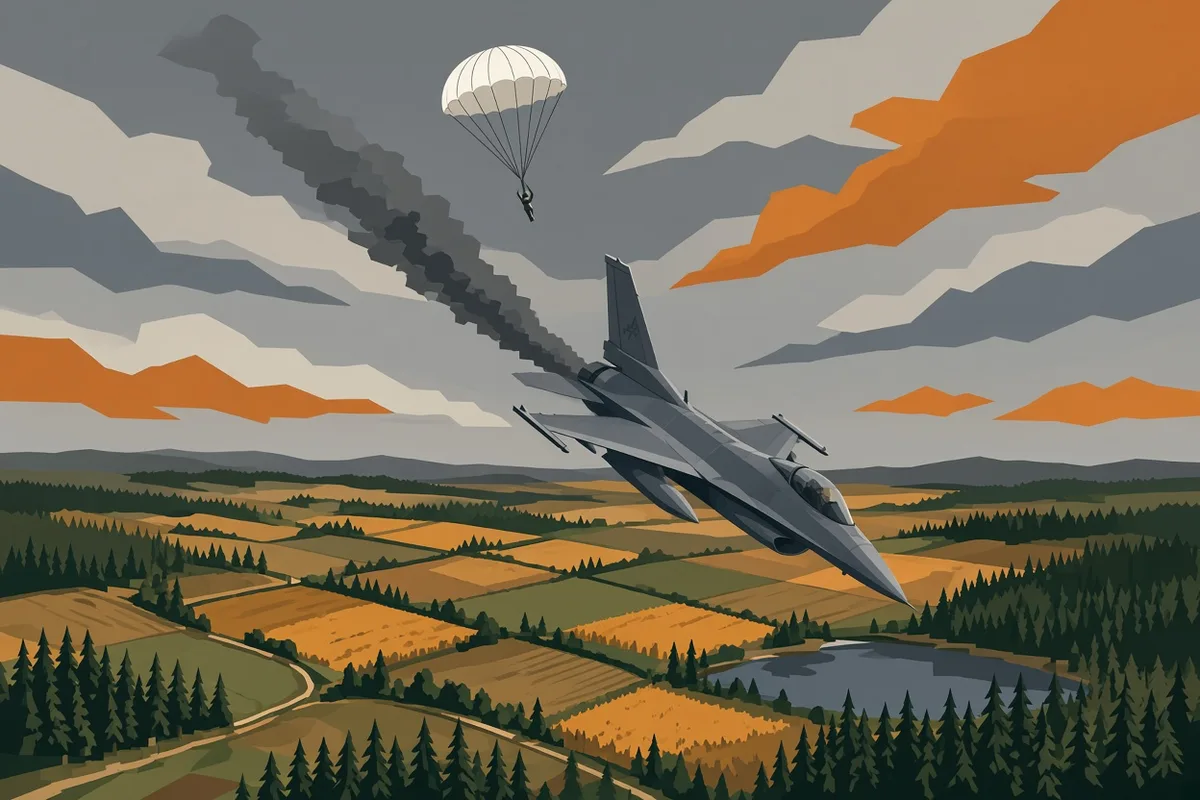
Two F-16 Fighting Falcons were flying under the callsigns Buck 11 and Buck 12 when Buck 11 radioed Minneapolis Center: “We have a possible mayday by wingman, I believe may have taken a bird.”
The jet that went down belonged to the Texas Air National Guard’s 149th Fighter Wing, based at Joint Base San Antonio-Lackland. It had launched from the Air National Guard’s Combat Readiness Training Center in Alpena, roughly 150 miles east, as part of Operation Northern Cactus, a training mission that had brought the unit into northern Michigan. The aircraft was a F-16 Fighting Falcon on a routine flight when the emergency developed. The pilot ejected before impact.
It was around 2 p.m. EDT on Thursday, Sept. 17, 2026, in Green Lake Township and Blair Township, Grand Traverse County, near County Road 633 and Jeffrey Place, roughly seven miles south of Traverse City. Nicole Blonshine heard the impact from inside her office and ran outside at once.
“It sounded like a huge explosion. I ran out and I saw a big smoke plume, and my first thought was somebody’s house blew up,” said Blonshine, the Blair Township supervisor. She had not seen the aircraft strike the ground. The smoke plume was what met her when she reached the open air.

Across the road from the crash path, Jerry Johnston’s wife was home when the impact shook the house. The jet had come down in a rural, sparsely populated stretch of Blair Township. No injuries were reported on the ground. No homes were damaged.
Thomas Fabatz was splitting firewood when he heard the bang. At first he thought little of it. Then word came that a military jet had gone down nearby. He set out along a two-track, cut through the Glacier Ponds subdivision, and reached the burning wreckage about 20 to 25 minutes after the crash. Firefighters were already on the wreckage. Police were sealing off the area. Debris lay scattered through the yards and wetland.
“You could see the plane all smashed up,” Fabatz said. He watched emergency crews bring the pilot out of the nearby woods on an off-road vehicle, strapped to a backboard. The ’chute never fully opened before he hit the ground. Fabatz relayed that from a witness who had seen the ejection. “I mean, if he would have hit a house, there would be a lot more damage,” he said.
Ed Wilson saw the plane going down, then the explosion and the black smoke. Nadiia Bayley was vacuuming inside her home along County Road 633 when the explosions started. Zachary Bayley saw the smoke plume from a distance and rushed back past police and emergency crews already swarming the road.

“I just rushed home because I didn’t know what was going on,” he said. “It was in the direction of my house — and she’s panicking, calling, saying things are exploding.”
Authorities expanded the order from shelter-in-place to a full one-mile radius evacuation centered on County Road 633 and Jefferson Place. Michigan State Police said the move was prompted partly by a hazardous chemical spill related to the plane crash. The F-16 emergency power unit uses toxic hydrazine monopropellant. A shelter opened at Kensington Church, 6880 Secor Road in Traverse City, with the American Red Cross assisting. Michigan State Police Lt. Ashley Miller advised anyone with a scratchy throat, shortness of breath, or coughing to go immediately to Munson Medical Center.
Art and Charity Eisner were away from their Jeffrey Place home when their daughter texted. Their two dogs and cat remained inside. “I’m just anxious,” Charity Eisner said. “That’s our biggest concern — our pets,” Art Eisner said. “When can we get to our pets?”
The F-16 Fighting Falcon is a single-engine multirole fourth-generation fighter, nicknamed the Viper by the people who fly it. Its frameless bubble canopy, side-stick, and ejection seat reclined thirty degrees from vertical were design choices that came out of the Lightweight Fighter program of the early 1970s, first under General Dynamics and later Lockheed Martin; the type remains among the world’s most common combat aircraft. A bird strike can mean engine ingestion and total power loss, a hazard felt most sharply in a jet that carries only one engine, and such collisions are likelier at lower altitudes.

Scott Dennis flew the F-16 for thirty years and retired an Air Force brigadier general. After an engine fails, he said, pilots keep flying and try to restart. If the restart does not take, they prepare to eject.
“We can trim the airplane such that once we eject, the airplane won't keep flying for an undetermined amount of time; it'll kind of pitch down,” Dennis said. “And, I don't know if this pilot had that opportunity or not, but we have a checklist to go through to kind of minimize both safety to the pilot and minimize impact on the ground.”
Dennis said the Air Force would set up two boards to investigate and that a cause finding could take six months to a year. All Texas Air National Guard aircraft that had come to Michigan for the training were grounded at once, likely for twenty-four hours.
By Sunday the Grand Traverse Health Department, working with local, state, and federal partners, lifted the evacuation order for the area around the crash site in Green Lake Township near County Road 633 and Jeffrey Place. Emergency response officials cleared residents to return to their homes. They could use their well water as they normally would. Health officials asked that no one touch any material from the crash, including dust, ash, debris, or other remnants. Those steps, they said, would also help people avoid accidentally ingesting dust or ash left behind.
The jet had reportedly been scheduled to perform a flyover at a high-school football game on Friday night, the Alpena News reported.