



You are a coalition of host and microbes, not one body
In 60 seconds
- Yong argues every animal and plant is a holobiont: host plus resident microbes acting as one functional unit.
- Microbes preceded complex life by billions of years and still help build organs, train immunity, and sometimes steer behavior.
- Partnerships start by active immune-mediated recruitment and pass on through eggs, birth, milk, and social contact, not DNA alone.
- Disease can mean a collapsed microbial community; fecal transplants for C. diff showed cure rates above 90 percent by restoring competition.
- Diet, antibiotics, C-sections, and formula act as unplanned ecosystem interventions with fast effects on gut communities.
- Responsible use means engineering relationships between species, not just killing germs or swallowing single probiotic strains.
The big idea
Yong’s central claim is that no animal or plant is a solitary individual; each is a negotiated coalition of host and microbes so intertwined that development, immunity, and sometimes behavior depend on the partnership. Treat the holobiont as the real unit, and biology, medicine, and even personal identity look different.
The book in brief
Yong opens by flipping the usual scale of life. Microbes had the planet for eons before animals or plants appeared, so every later body evolved inside a bacterial world, not beside one. Germ theory, essential for fighting disease, also trained people to see microbes mainly as enemies and missed the larger cast of partners.
He then shows how those partnerships get started and stay useful. Hosts do not passively tolerate residents; they recruit, filter, and police them. Many body parts and immune structures finish developing only when microbial signals arrive. Some microbes go further and steer host reproduction or, more tentatively, mood-related behavior in lab animals.
The argument next turns to inheritance and failure. Microbial communities travel across generations through channels separate from DNA, so heredity is partly ecology. When the bargain breaks, illness can be a disrupted community rather than a single invader, which changes what a cure should target.
Everyday choices about food, birth, and medicine become forms of ecosystem management whether anyone intends them that way. Practical fixes that work tend to restore or redesign relationships, not just add or erase one species. Yong closes by widening the frame: the discrete individual is a useful simplification at best, and ancient bacterial symbionts locked inside our cells are the deepest proof that cooperation between species built complex life.
Context
Ed Yong published I Contain Multitudes in 2016 as a readable synthesis of microbiome and symbiosis research up to that point. It gave evolution-minded and health-curious readers a science-first corrective to both the old microbes-as-enemies default and the marketing claims around probiotics.
The key ideas
1
Life is bacterial first
Yong argues life is better read as bacterial first because microbes preceded, outnumber, and enabled every later form of life.
- ~3.5 billion years agoBacteria and archaea appear
- Next ~2 billion yearsMicrobes have Earth alone
- After thatAnimals and plants evolve inside a bacterial world
- 1860s–20th centuryGerm theory frames microbes mainly as disease agents
Bacteria and archaea appeared roughly 3.5 billion years ago and held the planet alone for about two billion years before anything like a modern complex cell. Every animal and plant since evolved inside that world.
A human body, on Yong’s telling, carries roughly as many bacterial cells as human cells, and those microbes bring far more genes than the human genome. The exact cell ratio was already uncertain when he wrote, but the structural point stands: the body is a composite system with biochemical options it never had to evolve alone.
He offers the holobiont—the organism plus its resident microbes treated as one functional unit—as the lens for everything that follows. Germ theory from the 1860s onward was medically vital, yet it also taught generations to default to microbes as enemies and overlook builders, feeders, and protectors.
In practice: The Hawaiian bobtail squid recruits glowing Vibrio fischeri into a light organ from seawater each generation, a relationship Yong uses as the book’s recurring model of partnership.
2
Partnerships keep starting
Symbiosis, Yong argues, is a recurring near-routine outcome whenever a host offers microbes a stable niche for a metabolic service the host cannot perform.
A partnership does not have to be a one-time evolutionary miracle. The bobtail squid hatches with an empty light organ and must recruit the right Vibrio from thousands of seawater species within hours, using mucus only the partner can survive and colonize.
Work Yong highlights from Margaret McFall-Ngai shows the squid’s immune system is not mere tolerance. Vibrio signals help finish building the light organ, and the immune system then expels non-partners daily. Selection is active and continuous.
Aphids and Buchnera show the other extreme: a vertically locked partner that supplies missing amino acids and has lost the genes for free living. Natural selection, on this view, favors the bargain whenever the exchange is stable, and similar deals have arisen independently across insects, mollusks, and vertebrates.
In practice: Buchnera cannot survive outside aphids, while Vibrio is recruited fresh from the ocean each squid generation—two strategies for the same underlying logic.
3
Organs need microbial cues
Yong argues many animal structures are constructed by microbial signals during development, not merely occupied afterward.
Without microbes
Thin gut lining, weak walls, odd vessels, poorly organized lymph tissue, skewed antibodies
With ordinary gut bacteria
Structures mature, defects reverse, specific immune cell populations appear
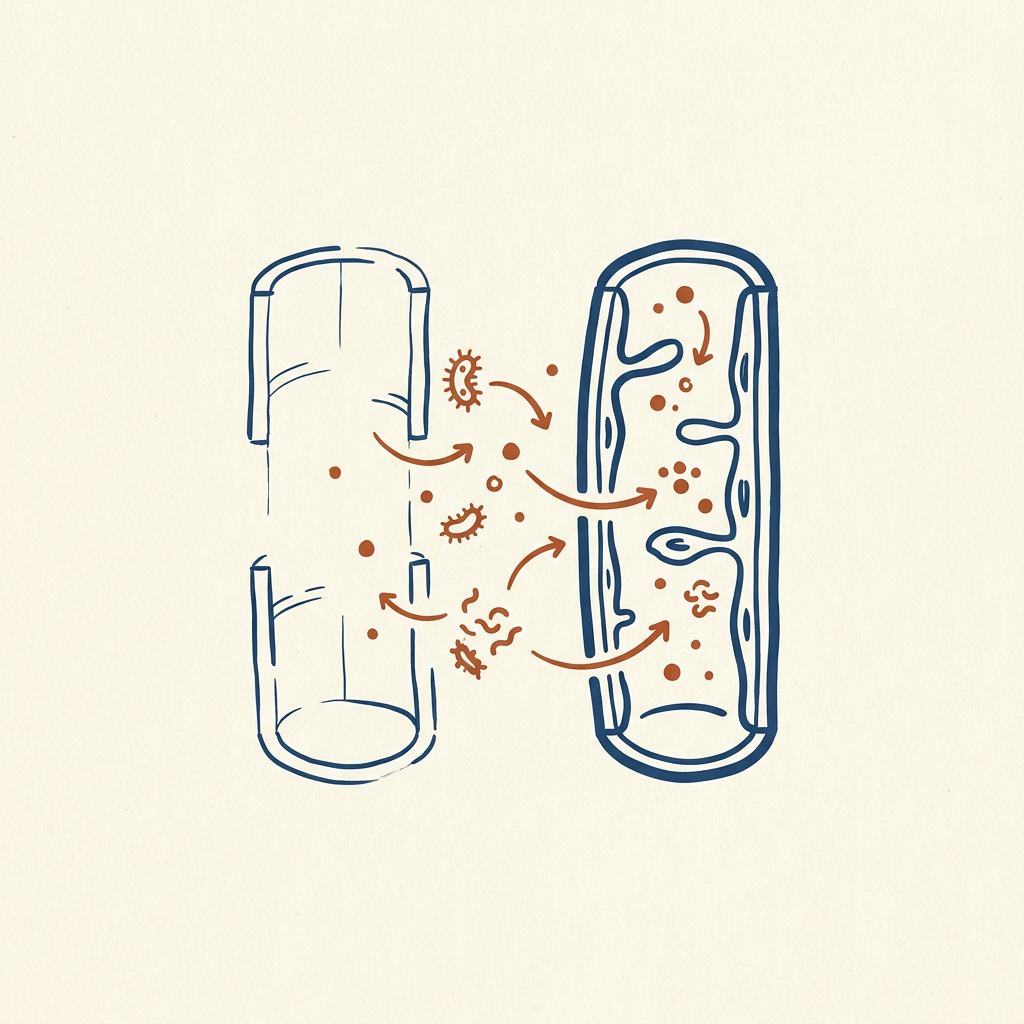
Germ-free mice raised without microbes develop thin gut linings, weaker intestinal walls, and abnormal gut blood-vessel patterns. Ordinary gut bacteria reverse those defects when introduced.
The immune system tells a parallel story. Without microbes, lymph tissue stays poorly organized and antibody production skews. Species such as segmented filamentous bacteria trigger maturation of immune cells, including Th17 populations, that do not appear properly alone.
So the immune system’s job, in Yong’s reframing, is substantially management: cultivate and negotiate with residents, tolerate most, and still answer real threats. Gnotobiotic work from Jeffrey Gordon’s lab colonized germ-free mice with defined communities to link specific microbial genes to specific host changes, moving some claims from correlation toward causation—mostly in mice, with human equivalents ethically out of reach.
In practice: Segmented filamentous bacteria in mice trigger Th17 immune cells that fail to mature correctly in germ-free animals.
4
Microbes can steer behavior
Some behaviors, Yong shows, are steered by microbial residents for microbial ends, which blurs where a host’s ‘own’ behavior begins.
Firmly shown
Wolbachia alters insect reproduction—male killing, parthenogenesis, incompatibility—to spread itself
Still thin
Mouse gut-microbe transfers change anxiety-like traits; human mood claims outran the 2016 data
The clearest cases are insects and Wolbachia. The bacterium kills male embryos, induces parthenogenesis, or causes cytoplasmic incompatibility because it passes only through eggs and spreads faster in female-heavy populations. Motive and mechanism are well documented.
Mammalian gut-brain claims are shakier. Germ-free mice show altered anxiety-like behavior and stress-hormone responses; moving gut microbes between mouse strains can move behavioral traits with them. Yong flags work in this vein, including from John Cryan’s lab, as preliminary, rodent-heavy, and unclear in human translation.
He treats the press leap to bacteria ‘controlling the mind’ as a cautionary tale. Accept the general principle that microbes can shape behavior; do not swallow every headline claim made in its name.
In practice: Wolbachia manipulates wasp and other insect reproduction to favor its own spread through eggs, a firm case unlike thinner gut-brain findings in mice.
5
Heredity outside the genome
Microbial communities travel across generations through ecological channels, so Yong treats heredity as partly ecology rather than genetics alone.
Some insects park partners like Buchnera directly in eggs, nearly as reliable as genes. Mammals pass gut microbes during vaginal birth and through milk.
Human milk contains complex sugars—human milk oligosaccharides—that infants cannot digest but that feed Bifidobacterium in the baby’s gut. Mothers, on this reading, are provisioning the infant’s bacteria, a deliberate evolutionary investment highlighted in work associated with David Mills and Bruce German.
Squid re-recruit Vibrio from seawater; termites gain gut partners from nestmates. Host traits whose whole point is to filter or feed the right microbes can be favored because selection can act on holobionts. That extends standard evolutionary theory: fitness tracking must follow ecology, not only DNA.
In practice: Human milk oligosaccharides feed infant Bifidobacterium rather than the baby directly, shaping the early microbiome on purpose.
6
Disease as collapsed community
Yong argues many illnesses reflect a stable microbial community tipping into dysfunction, which changes what a cure should target.
>90%
trial cure rates Yong cites for fecal transplant in recurrent C. diff
Dysbiosis names those unhealthy community states. Recurrent C. diff often follows antibiotics that wipe competing gut bacteria and leave a vacuum the pathogen exploits. The story is ecological collapse, not only invasion.
Fecal microbiota transplantation supplies the strongest clinical support Yong cites: stool from a healthy donor can restore competition and resolve recurrent C. diff with cure rates above 90 percent in trials around the book’s writing, beating repeated antibiotic courses.
He separates that solid case from weaker links to obesity, autism, or depression, which then rested mostly on correlations or small cohorts without matching transplant proof. Early obesity-microbiota mouse transfer findings were suggestive, not settled. Apply the ecological frame case by case, not as a blanket story for every altered microbiome.
In practice: After antibiotics clear competing gut bacteria, C. diff surges; a fecal transplant can restore a competitive community and clear recurrent infection at high trial cure rates.
7
Food as ecosystem management
Because gut bacteria respond directly to diet, Yong treats food choices as ecosystem management whether or not anyone plans them that way.
Comparative work, including from Jeffrey Gordon’s lab, found rural Malawian and Amazonian groups hosted more diverse gut bacteria than urban Americans, tracking higher dietary fiber diversity.
Controlled diet-switch studies showed gut populations shifting within days when volunteers moved between high-fiber and high-fat, low-fiber menus—faster than host genetics could explain.
Industrial low-fiber diets, heavy antibiotic use, C-sections, and formula feeding become large, mostly unplanned interventions in a coevolved system. Yong refuses neat prescriptions: the science then mapped short-term composition shifts far better than long-term health outcomes. The conceptual move is to see ordinary choices as ecological acts.
In practice: Volunteers switching briefly between high-fiber and high-fat, low-fiber diets showed measurable gut bacterial shifts within days.
8
Engineer the relationship
Responsible application, Yong argues, means engineering relationships between species rather than eliminating or adding microbes in isolation.
Isolation tactics
Broad-spectrum antibiotics or single commercial probiotic strains that often fail to colonize or backfire
Relationship tactics
Defined bacterial cocktails, Wolbachia mosquito releases, coral-algae partnership protection
Most commercial probiotics he surveyed lacked strong human trials for the claims on their labels. A strain that works in a dish or a mouse often fails to colonize a human gut already held by a settled community.
Stronger paths include designed bacterial cocktails aimed at C. diff as a controlled alternative to whole-stool transplants, and Wolbachia-infected mosquitoes from Scott O’Neill’s team, field-released in Australia with early drops in dengue transmission in trial neighborhoods.
Coral bleaching is a heat-driven breakdown between coral and its photosynthetic algae, so reef protection is protection of a partnership. Broad-spectrum killing or single-strain dumping tends to fail because it ignores community context. Deliberate engineering still carries ecological uncertainty and needs humility.
In practice: Wolbachia-infected mosquitoes released in Australian trial neighborhoods showed encouraging early reductions in dengue transmission.
9
Identity as shared address
Once organisms read as ecosystems, Yong argues biology, medicine, and individual identity are about coalitions whose interests partly align and partly conflict.
Squid, aphids, mice, corals, and humans develop, defend, and sometimes behave through microbial partners. The discrete individual remains a handy simplification and becomes misleading when taken as the whole story.
Medicine trained on sterile machines invaded by germs missed ecosystem imbalance as a driver of chronic trouble—a blind spot only partly correcting through work like fecal transplants. Evolutionary thinking that stressed competition between individuals also underweighted cooperation between species as a source of innovation.
Mitochondria and chloroplasts—ancient bacterial symbionts inside every plant and animal cell—are the oldest exhibit, predating the book’s other cases by roughly two billion years. Yong does not replace competition with cozy harmony; he says biology systematically undercounted partnership. A human is a negotiated coalition, and understanding it means knowing the full membership.
In practice: Mitochondria, once free-living bacteria, sit inside every animal cell as the deepest long-term symbiotic bargain Yong cites.
Key terms
- holobiont The host plus its resident microbes treated as one functional unit
- dysbiosis A disrupted, unhealthy state of a microbial community
- vertical transmission Passing microbes directly to offspring, as through eggs or birth
- horizontal transmission Acquiring microbes each generation from the environment or others
- gnotobiotic Animals colonized only with known, defined microbes for controlled study
- human milk oligosaccharides Milk sugars the infant cannot digest that feed preferred gut bacteria
- Vibrio fischeri The glowing bacterium the bobtail squid recruits into its light organ
- Buchnera An aphid bacterial partner that supplies amino acids and cannot live alone
- Wolbachia A bacterium that steers insect reproduction to spread itself through eggs
What to do
- Eat a varied mix of plant fibers this week—different vegetables, legumes, and whole grains—not just more of one kind.
- Question any probiotic that promises a health outcome without naming human trials of that specific strain.
- Ask, before minor antibiotic use, whether the benefit outweighs disrupting a competitive gut community that recovers slowly.
- Treat any single study tying gut bacteria to mood, weight, or disease cautiously until you know if it was mice or humans.
- Stop treating gut microbes as background noise when you weigh food, birth, and medicine choices.
Questions to think with
- If you are a holobiont, where do ‘your’ interests end and your microbes’ interests begin?
- When should medicine target a whole microbial community instead of a single pathogen?
- Which everyday habits are you willing to treat as unplanned experiments on your gut ecosystem?
- How should evolutionary stories change if cooperation between species is as generative as competition between individuals?
- What would it take for a probiotic or diet claim to move from mouse correlation to trustworthy human evidence?
The other side
The book is strongest on tightly controlled model systems and weaker on human health leaps; gut-brain and obesity threads leaned on rodent or correlational data that later work complicated, the famous cell-ratio figure was revised toward roughly 1-to-1 the same year, narrative momentum sometimes outruns Yong’s own caveats, and the 2016 snapshot cannot cover a decade of more skeptical human evidence that followed.
Who it's for
Readers who already like deep evolution writing and want the symbiosis layer beneath it, plus health-curious people who want microbiome science without probiotic marketing. Biology, medicine, and ecology students or professionals looking for a clear 2016-era synthesis will get the most from the full book.