



Your brain negotiates the finish line more than your muscles
In 60 seconds
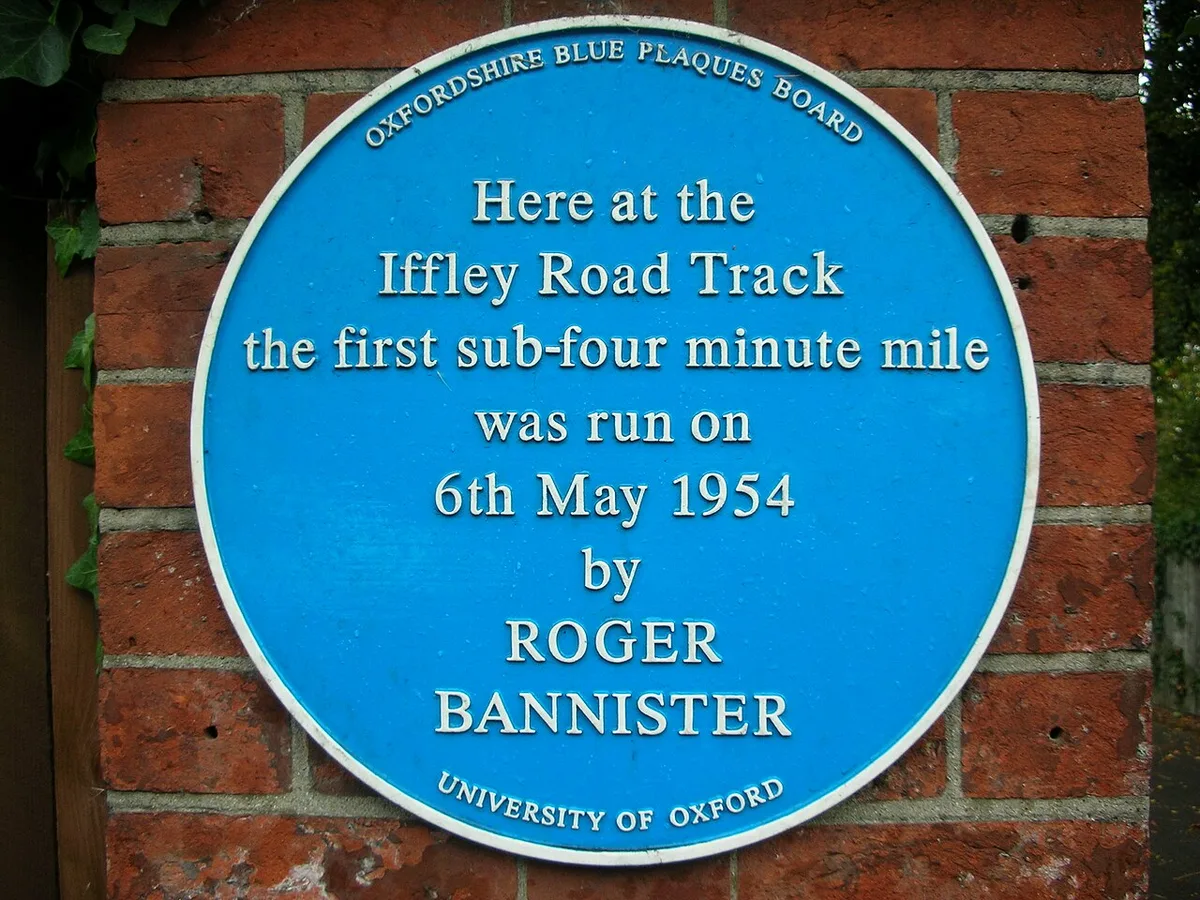
- Endurance limits act like an elastic band stretched by belief and context, not a fixed wall—Bannister’s 3:59.4 mile in May 1954 was followed within weeks and a decade by many others with no anatomical change.
- The classic VO2-max model cannot fully explain why athletes often stop with fuel and oxygen still available in muscle.
- Marcora’s psychobiological model holds that athletes quit when perceived effort rises to match the effort they are willing to give, not when muscles fail outright.
- A 90-minute mentally fatiguing Stroop task made cyclists quit earlier despite unchanged heart rate, oxygen use, or lactate.
- Deception about pace or distance, trained self-talk, repeated discomfort exposure, and carefully hedged brain-stimulation work can change performance without changing measured physiology.
- Nike’s 2017 Breaking2 attempt (Kipchoge 2:00:25) showed a near two-hour marathon needed shoes, pacing, cooling, and engineered belief together.
The big idea
Hutchinson argues the point where an athlete stops is set jointly by the body and the brain’s calculation of effort, not by muscle failure alone. The limit is real but negotiated—moved by perception, belief, anticipation, and motivation as much as by oxygen delivery or glycogen.
The book in brief
Hutchinson opens with Roger Bannister’s sub-four-minute mile in May 1954. Physiologists had treated the barrier as a biological ceiling; within weeks John Landy broke it too, and within a decade dozens had. Nothing in human anatomy changed. The case frames the book’s claim: the outer boundary of endurance behaves less like a wall and more like an elastic band that stretches under psychological and situational pressure. Hard limits still exist—fuel runs out, hearts max out, heat can kill—but between the theoretical ceiling and the moment an athlete actually stops lies a large zone governed by expectation, context, and the brain’s protective calculations.
Twentieth-century exercise science mostly treated stopping as a peripheral plumbing problem. A.V. Hill’s 1920s work made VO2 max the working ceiling: once oxygen delivery maxes out, muscles starve, lactate rises, and the body is forced to quit. Tim Noakes challenged this from the 1990s onward. He noted that VO2 max often plateaus or dips before exhaustion, and that biopsies from collapsed athletes still show fuel and oxygen left. He proposed a “central governor,” a subconscious brain mechanism that throttles muscle recruitment before catastrophe. Critics said he lacked a specific neural circuit and that local muscle failure still explains most stopping. Hutchinson does not settle the fight; he uses it to pose the book’s question: if muscles are not failing outright, what decides the stop?
Samuele Marcora’s psychobiological model supplies the pivot. Athletes stop or slow when perceived effort (Borg RPE) rises to match the maximum effort they are willing to give for the goal (“potential motivation”). Fatigue becomes a decision, even when it does not feel chosen. Marcora’s striking test had cyclists do a demanding Stroop task for 90 minutes before a ride to exhaustion; they quit earlier than controls despite identical heart rate, oxygen use, and lactate—only perceived effort was higher. Mental and physical tasks appear to draw on a shared resource, and the brain’s sense of effort, not a direct muscle-chemistry readout, is the proximate limiter.
From there the book shows how malleable that limiter is. Cold-pressor work finds endurance athletes, especially ultra runners and swimmers, tolerate ice water longer than sedentary people or power athletes; training studies suggest repeated hard effort recalibrates how the brain rates the same signal. Deception experiments speed a rider’s own avatar or falsify remaining distance and change pacing and finish times without greater reported effort. Placebo “performance enhancers” (saline) improve time trials. Heat research links the sharp drop near a roughly 40°C core temperature to reduced central drive, not muscle failure. Thirst satiety arrives within seconds of drinking, before absorption, via mouth and throat signals—the same anticipatory logic Noakes used to overturn “drink ahead of thirst” advice after hyponatremia deaths, including a well-publicized 2002 Boston Marathon case.
Direct brain interventions follow. Structured self-talk (Blanchfield/Marcora, 2014) extended cycling time to exhaustion by roughly 15 percent with lower RPE at matched points, though Hutchinson notes effect sizes vary. Small tDCS studies report similar directional gains without cardiovascular changes; Hutchinson flags small samples, imperfect blinding, and broader replication trouble since about 2015. Outliers such as ultrarunner Diane Van Deren, after temporal-lobe surgery that scrambled time sense and short-term memory, and polar explorers who endured via routine and narrow goals, suggest the felt weight of long fatigue is partly a constructed narrative. EPO-era oxygen boosting raises the physiological ceiling but does not erase the psychological layer.
The argument lands on Nike’s Breaking2 project in May 2017. Kipchoge, Tadese, and Desisa chased two hours on the Monza track with Joyner’s physiological modeling, a carbon-plate shoe later tied to roughly 4 percent better running economy, arrowhead pacers, a pace car with exact splits, cooling, hydration, and deliberate belief framing. Kipchoge ran 2:00:25, then 1:59:40 in a non-record Vienna setup in 2019. Hutchinson’s close: body and mind are one integrated system; the joint limit is what “endure” names.
Context
Alex Hutchinson is a journalist and former national-team runner with a physics PhD. Endure mattered because it turned a fractious specialist fight—central governor theory versus classic cardiovascular limits—into a readable account of why willpower is physiology, not metaphor, for athletes, coaches, and general readers.
The key ideas
1
The elastic wall
A limit that looks like a fixed physiological wall, such as the four-minute mile, is often collective belief wearing physiology’s costume.
- May 1954Bannister runs 3:59.4
- Weeks laterLandy breaks four minutes too
- Within a decadeDozens of runners follow
Hutchinson begins with Roger Bannister’s 3:59.4 mile in May 1954. Many physiologists had insisted the barrier was a biological ceiling. Within weeks John Landy beat it; within a decade dozens of runners had. No sudden change in muscle fiber or cardiac anatomy explains the cascade.
The point is not that limits are imaginary. Muscles still run out of fuel, hearts still have maximum outputs, and heat still kills. Between those theoretical hard stops and the moment an athlete actually quits, however, sits a wide zone that expectation, context, and the brain’s protective math control.
If periphery alone set the ceiling, one runner breaking a barrier should not immediately make the same barrier easier for others. Hutchinson treats the mile cluster as an anomaly the rest of the science must explain, and he returns to variations on it throughout the book rather than as standalone proof.
In practice: Bannister’s sub-four mile was followed so quickly by Landy and then a crowd of others that anatomy cannot be the full story.
2
Cracks in the oxygen model
The long-dominant claim that endurance is capped by oxygen delivery cannot fully explain why elites often stop with capacity still left in the tank.
Classic model
VO2 max ceiling forces stop via oxygen starvation and lactate
Observed cracks
VO2 often plateaus before exhaustion; biopsies still show reserves
A.V. Hill’s 1920s oxygen-consumption work made VO2 max the century’s working ceiling: reach it, starve the muscles of oxygen, accumulate lactate, and stop. Endurance became a plumbing problem of heart, lungs, and vessels.
Tim Noakes began challenging that picture in the 1990s. He observed that VO2 max frequently plateaus or even dips slightly before exhaustion, and that muscle biopsies taken right after collapse still show fuel reserves and available oxygen. Outright peripheral failure should look more like empty tanks.
Noakes proposed a subconscious “central governor” that limits muscle recruitment early, building in a safety margin. The idea remains disputed; critics wanted a specific neural circuit he did not supply, and some peripheral-fatigue researchers still hold that local muscle failure explains most stopping. Hutchinson refuses to crown a winner. He simply locks in the book’s question: if the muscles are not failing outright, what is choosing the moment to quit?
In practice: Biopsies from athletes who have just collapsed often still show leftover fuel and oxygen rather than total depletion.
3
Effort decides the stop
Performance is better predicted by how hard the work feels relative to how much effort someone is willing to give than by raw muscle capacity.
Muscle-only story
Stop when oxygen, fuel, or lactate hits a hard peripheral limit
Psychobiological story
Stop when perceived effort meets maximum acceptable effort for the goal
Marcora replaced a hidden veto circuit with a conscious motivational account. Stopping or slowing happens when rating of perceived effort climbs to the maximum effort the athlete will tolerate for that goal—what he calls potential motivation. Fatigue is reframed as a decision, even when it does not feel chosen in the moment.
Two numbers matter: the Borg-scale sense of hard-ness and the motivation ceiling for the task. That pairing predicts better than isolated muscle measures alone.
The decisive lab move was cognitive. Cyclists who spent 90 minutes on a demanding Stroop-style task before a ride to exhaustion quit significantly earlier than those given an easy control task. Heart rate, oxygen consumption, and blood lactate looked the same; only perceived effort during the ride was higher. A pure muscle model struggles with that result, and a strictly unconscious governor does too, because the manipulation hit conscious cognitive work. Hutchinson treats the finding as the book’s hinge: mental and physical tasks share a resource, and the brain’s effort signal is what ends the performance.
In practice: After 90 minutes of hard mental work, cyclists abandoned a time-to-exhaustion ride sooner even though their cardiovascular and lactate numbers matched the control group.

4
Pain tolerance is trainable
Endurance athletes are not simply born tough; repeated exposure to prolonged discomfort appears to raise the tolerance threshold itself.
Once perceived effort governs the stop, discomfort tolerance becomes a performance variable, not a fixed personality trait. Hutchinson turns to the cold-pressor test: hand in ice water, time held measured.
Ultra-distance runners and swimmers consistently outlast sedentary controls and even athletes from short, explosive sports. Correlation alone does not prove training creates the difference, yet longitudinal and training evidence suggests the arrow runs at least partly from repeated hard effort to higher tolerance, not only from innate tolerance to sport choice.
Practically, an athlete who can hold the same power while rating it 7 instead of 9 has moved the point where perceived effort forces a slowdown. Programs that deliberately include high-RPE discomfort sessions are therefore training the perception system as much as the cardiovascular one. Toughness, on this reading, is partly built.
In practice: Ultra runners and swimmers keep a hand in ice water longer than sedentary people or power-sport athletes, and training studies point to recalibration through repeated exposure.

5
Pacing by forecast and deception
Athletes allocate effort against an internal model of what remains, so false information about the task changes performance even when the body is unchanged.
- 1Forecast remaining demandBrain models distance, duration, and reserve still needed
- 2Allocate effortPace is set to arrive with an acceptable safety margin
- 3Update on new informationFalse splits or distances shift pace until truth is unavoidable
- 4Finish with reserveStop or slow when perceived cost meets motivation ceiling
If effort is judged against a forecast of the work still ahead, lying about that forecast should move results. Lab work does it repeatedly. Cyclists racing a computer avatar of their own best time, secretly sped up a fraction, matched the faster avatar and improved without reporting higher perceived effort than their genuine best.
Other designs alter announced distance or duration mid-effort. Pacing shifts to the false remaining work until true feedback becomes unavoidable near the end. The pattern fits a teleoanticipatory model: the brain continuously forecasts remaining demand and meters effort to finish with an acceptable reserve, rather than only reacting to real-time fatigue signals.
Placebo sport studies land in the same place. Cyclists told they received a performance drug but given saline beat no-treatment controls and sometimes matched real caffeine. Physiology was static; the belief about capacity was not. Together with the mental-fatigue and pain findings, a meaningful share of endurance looks like a revisable estimate of what the body should do, not a live transcript of its chemistry.
In practice: Riders who unknowingly chased a slightly accelerated avatar of their prior best improved their times without feeling they had worked harder.

6
Heat and thirst run ahead
Protective throttles for overheating and thirst often fire before any real deficit, showing regulation against a forecast rather than a current shortfall.
Hutchinson extends anticipation into temperature and hydration, domains where popular advice has been wrong. Nybo, González-Alonso and colleagues linked the sharp performance drop in heat to core temperature approaching roughly 40°C (104°F). The decline tracks reduced central drive to muscle on EMG more than muscle failure itself—the brain throttles early, before heatstroke-level damage.
On fluid, Noakes documented runners who died from hyponatremia after following “stay ahead of thirst” guidance, including a well-publicized 2002 Boston Marathon death. Thirst itself proved a better guide; blanket over-drinking caused real harm.
Mouth and throat receptors quiet thirst within seconds of drinking, long before water reaches the bloodstream. Camels show the same rapid pre-absorptive satiety. Whether the forecast concerns remaining effort, heat load, or fluid status, the body often acts on the prediction, and that prediction is what sets many practical ceilings.
In practice: Thirst fades seconds after a drink reaches the mouth, well before absorption corrects any blood deficit; over-drinking past thirst produced fatal hyponatremia cases.

7
Training the brain directly
Because effort is generated and read by the brain, interventions aimed at the brain—not the muscles—can measurably extend endurance.
~15%
longer ride to exhaustion with trained self-talk (effect sizes vary)
If perceived effort is the proximate limiter, can it be turned down without more mileage? Motivational self-talk work from Marcora’s group, including a 2014 Blanchfield-led study, had cyclists practice short specific phrases during a ride to exhaustion. The self-talk group lasted roughly 15 percent longer and reported lower effort at matched time points, while heart rate and lactate stayed the same. Hutchinson notes that effect sizes vary by study and population, so the number is directional rather than guaranteed.
A more invasive line uses transcranial direct current stimulation—weak current over motor or insular cortex regions tied to effort and body sensing. Angius and colleagues reported longer cycling time to exhaustion after real versus sham stimulation, again without cardiovascular shifts.
Hutchinson stays cautious: samples are small, real stimulation can tingle and break blinds, and tDCS work inside and outside sport has faced serious replication problems since roughly 2015. Still, the consistent direction from cheap rehearsed phrases to expensive scalp current supports the claim that endurance can be trained on paths that never touch a muscle fiber, because the fiber was never the only target.
In practice: Cyclists who practiced structured self-talk phrases lasted about 15 percent longer to exhaustion with lower perceived effort, matching physiology unchanged; small tDCS trials point the same way but remain contested.
8
When fatigue signals split
Rare disruptions of normal fatigue signaling show that the everyday feeling “I can’t go on” is a constructed signal, not a raw biological meter.
- DDiane Van DerenUltrarunner whose temporal-lobe surgery altered time sense and fatigue narrative
- PPolar expedition crewsEndured extremes via routine, ritual, and narrow goals
- EEPO-era athletesHigher oxygen capacity raised the ceiling but left psychological governance
Hutchinson treats outliers as natural experiments. Diane Van Deren, an elite ultrarunner, had part of her temporal lobe removed to control severe seizures. The surgery altered time sense and short-term memory; she has described losing track of elapsed hours and distance in multi-day races in ways that seem to blunt the usual accumulating psychological weight of monotony and fatigue. She finished extreme events such as the 430-mile Yukon Arctic Ultra at levels hard to predict from her physical profile alone. Hutchinson refuses to overclaim from one case, yet treats it as evidence that long-duration fatigue feeling depends partly on intact memory and time narrative.
He pairs her with polar expedition histories—Scott, Amundsen—where sustained deprivation was met with routine, ritual, and narrow goals more than raw physical superiority. Altitude and doping work, including EPO-era increases in oxygen-carrying capacity, raises the physiological ceiling yet leaves the psychological governing layer intact.
Ordinary limits, on this view, are neither purely fixed biology nor pure whim. They are functional signals built from parts that unusual circumstances can pry apart.
In practice: After temporal-lobe surgery scrambled her sense of time, Van Deren’s ultra performances suggested the usual weight of multi-day fatigue had been partly unhooked from pure metabolic state.
9
Engineering the two-hour mark
Chasing an absolute human limit such as a two-hour marathon requires engineering physiology, environment, and belief at once; none alone is enough.
- May 2017Breaking2 at Monza: Kipchoge 2:00:25
- Shoe techCarbon-plate foam shoe ~4% economy gain in later work
- 2019 ViennaKipchoge 1:59:40 in engineered non-record setup
The book’s closing case is Nike’s Breaking2 project in May 2017. Eliud Kipchoge, Zersenay Tadese, and Lelisa Desisa attempted a sub-two-hour marathon on the Monza Formula One track. Physiologists including Michael Joyner brought models built on VO2 max, lactate threshold, and running economy. Engineers supplied a shoe with a curved carbon-fiber plate and thick foam, later linked in follow-up work to roughly 4 percent better running economy.
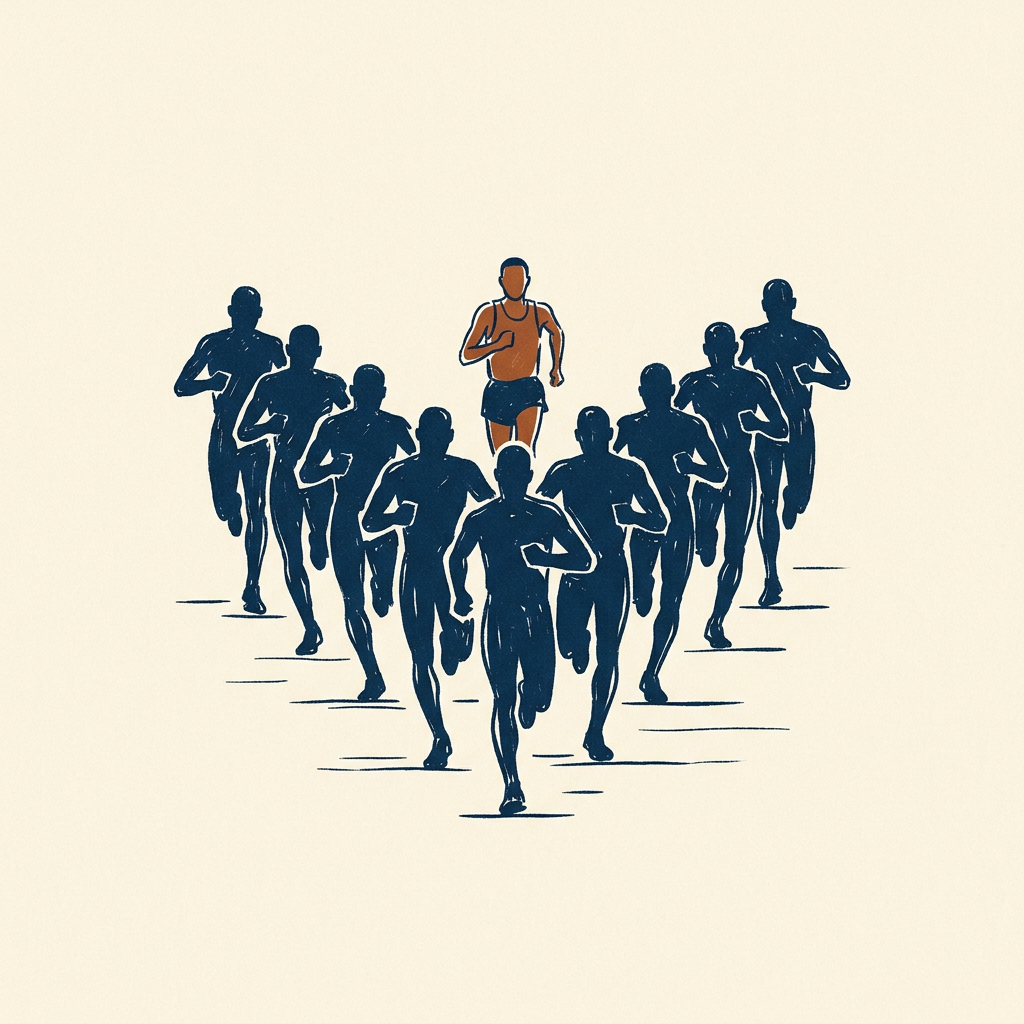
Belief and pacing were engineered just as deliberately: rotating pacers in an arrowhead to cut wind, a pace car showing exact target splits, public and internal framing as a symbolic round-number assault rather than a routine race, plus cooling and hydration plans.
Kipchoge finished in 2:00:25—short of two hours yet far under prior world-record pace—and later ran 1:59:40 in a similarly controlled but non-record-eligible Vienna event in 2019. Hutchinson gathers every earlier thread here. Peripheral tools and psychobiological tools had to move together. The most current picture of endurance treats body and mind as one system; the joint limit is the title’s subject.
In practice: Kipchoge’s 2:00:25 at Breaking2 combined carbon-plate shoes, wind-shielding pacers, exact split displays, cooling, and deliberate barrier-breaking belief framing.
Key terms
- VO2 max The maximum rate the body can deliver and use oxygen; classic model treated it as the hard endurance ceiling.
- Central governor Noakes’s proposed subconscious brain mechanism that limits muscle recruitment before catastrophic failure.
- Psychobiological model Marcora’s account: you stop when perceived effort meets the maximum effort you are willing to give for the goal.
- RPE Rating of perceived effort on the Borg scale—how hard the work feels.
- Potential motivation How much discomfort someone will tolerate to achieve a given goal.
- Teleoanticipatory pacing Brain continuously forecasts remaining demand and meters effort to finish with an acceptable reserve.
- tDCS Weak electrical current on the scalp aimed at brain regions tied to effort perception; early sports results are promising but contested.
- Hyponatremia Dangerously diluted blood sodium from drinking too much water, sometimes fatal in long races.
What to do
- Build one weekly session that holds a deliberately high, uncomfortable perceived-effort level instead of only chasing pace or heart rate.
- Before a hard effort, write two or three short specific self-talk phrases that name the sensation and your response, then rehearse them in training.
- Run or ride parts of sessions without full distance or time feedback so internal effort sense learns to set pace.
- Drink to thirst rather than on a fixed schedule.
- Treat any single study or headline about a performance trick—including brain stimulation—with the same caution the book itself uses.
Questions to think with
- When you last quit a hard effort, what felt like it stopped you—muscle failure, or the sense that continuing was no longer worth the cost?
- Which of your training sessions deliberately raise discomfort tolerance, and which only build aerobic plumbing?
- How much of your pacing depends on the watch versus an internal forecast of what remains?
- If belief and framing can move performance without changing physiology, where are you accidentally framing a ceiling?
- Which claims in the fatigue science feel settled to you, and which still look like small-sample early results?
The other side
Endure is skilled science journalism, not primary research; its narrative weave is also its risk. Many key studies use small samples of roughly eight to twenty trained cyclists or runners, so generalization to untrained, older, or clinical groups is uncertain. Mental-fatigue and self-talk effects have met mixed replications and may be smaller or more context-bound than the flagship papers suggest. The tDCS chapter is the shakiest—broader brain-stimulation work has faced serious replication problems since about 2015—and Hutchinson’s own hedges are warranted. Noakes remains polarizing; critics still argue classic peripheral limits (including 1960s glycogen-biopsy work) explain everyday failure better than a governor without a clear neural circuit. The book is almost entirely about motivated athletes and says little about clinical fatigue or ordinary exhaustion. Its optimism that limits are negotiable also sits near popular willpower claims that themselves failed large replications after 2016.
Who it's for
Endurance athletes and coaches who want a science-grounded way to think about pacing, pain, and mental training beyond the logbook will get the most. General readers curious about willpower and fatigue, plus students needing a clear map of the central-governor versus peripheral-fatigue debate, are close behind; readers hunting a final settled verdict on what causes fatigue, or help with non-athletic exhaustion, will find less.