
Medical experts used anatomical diagrams and charts to testify on Thursday that George Floyd was killed by police pinning him to the ground, not a drug overdose, challenging a key assertion by former police officer Derek Chauvin in his murder trial for Floyd’s deadly arrest.
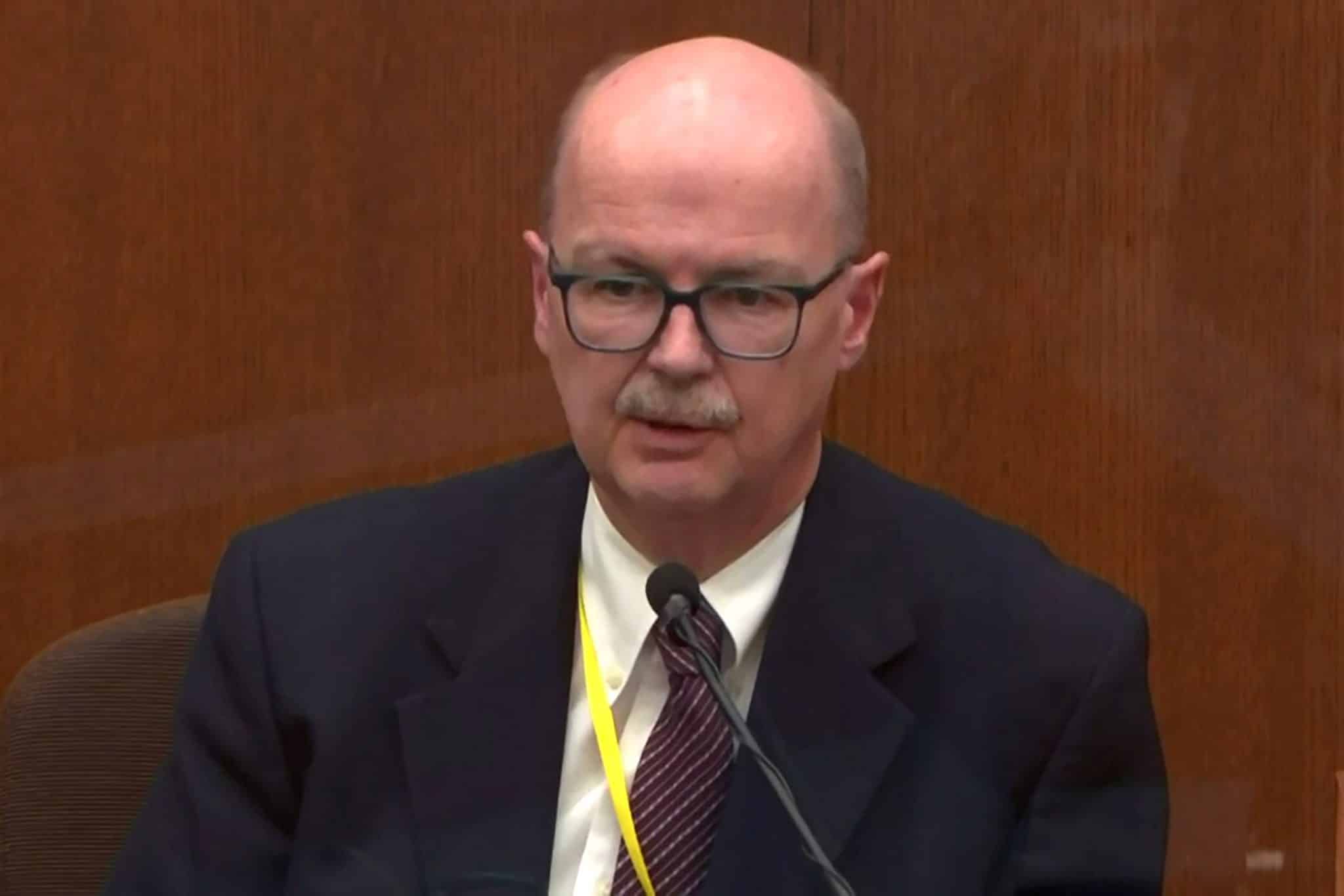
Dr. Martin Tobin, who treats patients in a Chicago hospital’s intensive care unit, told the jury that Floyd died “from a low level of oxygen” caused by being handcuffed face down in the street with the police officer’s knee on his neck. Video of the arrest last May sparked global protests.
Jurors touched various parts of their necks under Tobin’s guidance as the doctor gave impromptu anatomy lessons from the stand. Any “healthy person,” he said, would have died in a similar restraint, which he compared to a vise, supporting the county medical examiner’s finding that Floyd’s death was a homicide at the hands of police.
Dr. Daniel Isenschmid said the toxicology tests he performed on Floyd’s blood on behalf of the medical examiner found fentanyl, but at a level comparable to those found in samples taken from living people detained for driving under the influence of narcotics.
Dr. William Smock, a forensic pathologist who works with police, told the jury that Floyd died of “positional asphyxia” from the police holds, “which is a fancy way of saying he died because he had no oxygen left in his body,” he said.
Video of the arrest showed Chauvin, who is white, pinning Floyd’s neck to the ground with his knees for more than nine minutes as Floyd, a 46-year-old Black man, begged for his life, gasping more than two dozen times: “I can’t breathe.” Chauvin has pleaded not guilty to murder and manslaughter charges.
All three doctors called by prosecutors from the Minnesota Attorney General’s Office pointed to different moments from the video that they said undermined Chauvin’s defense.
Tobin said Floyd’s breathing became fatally shallow under the police restraint, but asked jurors to count along with him as they watched body-worn camera video of the dying Floyd’s torso, showing that the number of breaths he took per minute did not decrease up until the moment he lost consciousness.
A fentanyl overdose, in contrast, is marked by a sharp decrease in the frequency of breaths, he said.
The doctor also unbuttoned his shirt collar and began to feel parts of his neck, as he described how Chauvin’s knee compressed the delicate tissue of the hypopharynx, blocking that part of the respiratory system in the lower part of the throat.
Eric Nelson, Chauvin’s lead lawyer, objected to the hands-on anatomy lessons. Hennepin County District Judge Peter Cahill overruled the objection, but told jurors it was up to them whether they wanted to follow along with Tobin in feeling their own throats. Most continued to do so.
‘DEADLY MANTRA’
Tobin calculated that at times, Chauvin, who suspected Floyd of passing a fake $20 bill, was exerting 91.5 pounds (41.5 kg) of downward pressure on Floyd’s neck.
In cross-examination, Nelson asked Tobin if he had personally weighed Chauvin, who in police reports is recorded as 140 pounds (64 kg), or Chauvin’s equipment in order to calculate the pressure applied by his knee. Tobin said he had not.
Tobin discussed frames from the video that he said showed Floyd trying to push his chest up from the street using his fingers and his face as leverage as he struggled for breath beneath Chauvin and two other officers.
“They’re pushing the handcuffs into his back and pushing them high, then on the other side you have the street. The street is playing the crucial part,” Tobin said. “It’s like the left side is in a vise.”
Chauvin can be heard on video dismissing Floyd’s pleas, saying: “It takes a heck of a lot of oxygen to say things.”
Tobin called that a “dangerous mantra.”
“It’s a true statement, but it gives you an enormous false sense of security,” Tobin said. “Certainly at the moment you’re speaking, you are breathing, but it doesn’t tell you if you’re going to be breathing five seconds later.”
Tobin said Floyd’s leg could be seen jumping up in an involuntary seizure as his brain was starved of oxygen.
Soon after, Tobin said, the moment came when Floyd did not have even “an ounce of oxygen left in his entire body,” although Chauvin’s knee stayed on Floyd’s neck for three more minutes.
Isenschmid, the toxicologist, compiled data on samples taken from 2,345 people stopped for driving under the influence in 2020, noting that people addicted to opioids need to take higher doses as tolerance builds up. The mean average level of fentanyl found in the blood of those people, all of whom were alive, was 9.69 ng/ml, compared with the 11 ng/ml found in Floyd’s blood, he said.
Nelson is expected to call his own medical experts to testify in Chauvin’s defense as soon as next week.
(Reporting by Jonathan Allen in Minneapolis; Editing by Will Dunham and Peter Cooney)