




Meditation offers ambitious skeptics a modest secular lift
Driven professionals who dismiss mindfulness as soft or mystical get a journalist’s case for training attention without surrendering their edge.
IJR · Oct 21, 2026 · 13 min read
In 60 seconds
- Harris’s 2004 on-air panic attack showed ambition without inner regulation eventually produces its own crisis.
- Self-help is mostly unfalsifiable, yet testable attention-training claims can be extracted from it and from Buddhism.
- The compulsive inner narrator is not the self; observing it creates the gap where reactivity can loosen.
- Meditation’s real workout is noticing distraction and returning to the breath, not achieving blank stillness.
- Harris kept career drive and earned promotions while anxious, compulsive ambition declined.
- He frames the honest payoff as roughly ten percent better baseline happiness and faster stress recovery, treated like ordinary exercise.
The big idea
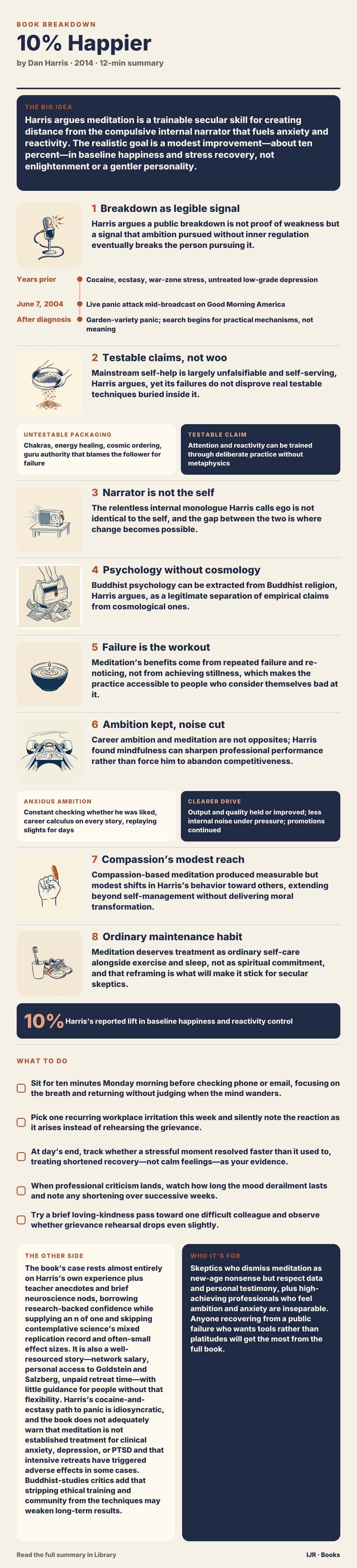
Harris argues meditation is a trainable secular skill for creating distance from the compulsive internal narrator that fuels anxiety and reactivity. The realistic goal is a modest improvement—about ten percent—in baseline happiness and stress recovery, not enlightenment or a gentler personality.
The book in brief
Harris begins with the June 7, 2004 panic attack that hit him live on Good Morning America—shortness of breath, racing heart, inability to speak. He traces it to years of cocaine and ecstasy self-medication, war-zone reporting, and untreated low-grade depression. A psychiatrist called it a garden-variety panic attack, biology collecting a bill rather than a mystical awakening. That mundane diagnosis launched his search for practical mechanisms.
ABC then assigned him the religion and self-help beat. He interviewed Deepak Chopra and motivational gurus and found chakras, energy healing, and cosmic ordering intellectually indefensible. The industry’s business model, he noted, resists accountability because failure can always be blamed on the follower. Still, he kept hearing one testable claim stripped of metaphysics: attention and reactivity can be trained through deliberate practice. Reporting on Eckhart Tolle pushed him toward older, more rigorous sources.
Buddhist teachers Joseph Goldstein, Sharon Salzberg, and Mark Epstein offered psychological observations he could test without accepting rebirth or karma. At a ten-day silent retreat he expected boredom or fraud. Early sits were physically uncomfortable and mentally chaotic. What shifted him were small, repeatable moments of noticing a thought, labeling it, and watching it pass without acting—reducing the thought’s power in real time.
He reframed meditation itself: the practice is not stopping thoughts but noticing when attention wanders and returning it to the breath. Losing count within seconds was the workout, not proof of failure. Concrete shifts followed—slightly longer pauses before reacting to colleagues, less compulsion to check his phone, catching himself mid-panic on assignment and breathing through it.
A core worry was that practice would sand down the ambition required for network news. Observing himself over months, Harris found compulsive ranking, slight-replaying, and constant self-monitoring declined while work output and quality held, and he advanced to correspondent and anchor roles. Loving-kindness practice produced only a modest drop in reactive hostility toward a resented producer, which he refused to oversell. Equanimity, not constant positive emotion, became the steadier baseline: professional criticism that once derailed him for days began to register as unpleasant but survivable within hours.
He closes by arguing meditation should be normalized as basic maintenance beside exercise and sleep. No belief system required. His own change was not dramatic enlightenment but roughly a ten percent improvement in happiness and reactivity control—still anger and insecurity, just shorter and less intense. That modest, honest return, he insists, is reason enough to sit daily rather than waiting for a transformation that does not arrive.
Context
Dan Harris was a hard-charging ABC News anchor when an on-air collapse forced him to investigate his own mind. The book mattered because it made mindfulness credible to secular, ambitious, skeptical readers who had assumed the practice required beliefs or naivety they could not accept.
The key ideas

1
Breakdown as legible signal
Harris argues a public breakdown is not proof of weakness but a signal that ambition pursued without inner regulation eventually breaks the person pursuing it.
- Years priorCocaine, ecstasy, war-zone stress, untreated low-grade depression
- June 7, 2004Live panic attack mid-broadcast on Good Morning America
- After diagnosisGarden-variety panic; search begins for practical mechanisms, not meaning
Harris opens with the event that forces the whole investigation. On June 7, 2004, live on Good Morning America, he suffered a panic attack mid-broadcast—shortness of breath, racing heart, an inability to speak.
He traces the cause not to a single trigger but to years of self-medicating stress with cocaine and ecstasy while covering war zones and chasing advancement at ABC. A psychiatrist diagnosed a garden-variety panic attack exacerbated by drug use and untreated low-grade depression. Not a nervous breakdown. Not a spiritual crisis. Just biology reacting to years of self-inflicted stress.
Harris is explicit that this was closer to a physiological bill coming due than a mystical awakening. That grounding establishes his credibility as a skeptic rather than a convert. He was looking for an explanation for why a successful, rational person melted down on national television.
The panic attack, he argues, was his internal narrator running without any check on its authority. The rest of the journey becomes a search for that check.
In practice: Mid-broadcast on Good Morning America he could not speak, after years of cocaine, ecstasy, and war-zone stress that a psychiatrist later tied to the attack.
2
Testable claims, not woo
Mainstream self-help is largely unfalsifiable and self-serving, Harris argues, yet its failures do not disprove real testable techniques buried inside it.
Untestable packaging
Chakras, energy healing, cosmic ordering, guru authority that blames the follower for failure
Testable claim
Attention and reactivity can be trained through deliberate practice without metaphysics
After the attack, ABC assigned Harris the religion and self-help beat, a job he initially found embarrassing. He interviewed Deepak Chopra and various motivational gurus. Much of what he heard—chakras, energy healing, cosmic ordering—struck him as intellectually indefensible.
His journalist’s instinct was to dismiss the entire category. He describes the industry’s business model as structurally resistant to accountability. Gurus profit whether or not techniques work, since failure can always be blamed on the follower’s insufficient effort or belief.
Yet he does not stop at cynicism. Across multiple traditions, once metaphysical packaging is stripped away, he notices a repeated claim: a person can train attention and reduce reactivity through deliberate practice. That claim is testable. It does not require reincarnation, energy fields, or a guru’s authority.
A reporting trip to interview Eckhart Tolle becomes his pivot. Tolle’s present-moment ideas struck him as repackaged, jargon-heavy versions of something older and more rigorous, steering him toward psychological technology he could extract and test on himself.
In practice: Interviewing Eckhart Tolle, Harris found present-moment teaching that felt like jargon-heavy versions of older, more rigorous practices.
3
Narrator is not the self
The relentless internal monologue Harris calls ego is not identical to the self, and the gap between the two is where change becomes possible.
Harris introduces a near-constant internal monologue that narrates, judges, and defends. He labels it his ego. The voice is not evil or even always wrong. It is compulsive. It runs whether or not it is asked to. It treats every event as either a threat or an opportunity for self-enhancement.
From his own career he lists mental drafting of comebacks during interviews, ranking himself against colleagues, and replaying minor slights for days. Through interviews with meditation teacher Joseph Goldstein, he draws the key distinction: this voice can be observed rather than simply obeyed.
Observation is not automatic. It takes training. But its possibility undercuts the assumption that thoughts and self are identical. Harris refuses to overclaim. He does not say the voice can be silenced permanently or that enlightenment is achievable in any complete sense.
He frames the goal modestly—a percentage improvement, a slight loosening of the voice’s grip. Meditation is presented not as relaxation but as a method for creating distance from the narrator so its content can be noticed rather than instantly believed and acted on.
In practice: He would mentally draft comebacks during interviews, rank himself against colleagues, and replay minor slights for days until he learned the voice could be watched instead of obeyed.

4
Psychology without cosmology
Buddhist psychology can be extracted from Buddhist religion, Harris argues, as a legitimate separation of empirical claims from cosmological ones.
Through his religion reporting Harris grows exposed to Buddhist teachers—Joseph Goldstein, Sharon Salzberg, and later Mark Epstein. He is upfront about discomfort with anything that smells like organized religion, given his secular, science-oriented background.
He argues Buddhism contains two separable layers. One is metaphysical claims about rebirth, karma, and cosmology that he does not accept. The other is psychological observations about attention, craving, and suffering that he finds empirically plausible and personally useful.
He treats the latter the way a scientist treats a hypothesis—worth testing regardless of its origin. His first serious retreat, a ten-day silent course, he approaches with ambivalence and even hostility, expecting boredom or fraud.
Early sessions are physically uncomfortable and mentally chaotic. His mind refuses to settle, puncturing the myth that meditation is instantly calming. What shifts his view is not mysticism but small repeatable observations: noticing a thought arise, labeling it, and watching it pass without acting, which reduced the thought’s power in real time.
In practice: At his first ten-day silent retreat early sits were chaotic and uncomfortable, then labeling a thought and watching it pass weakened its grip without any mystical breakthrough.

5
Failure is the workout
Meditation’s benefits come from repeated failure and re-noticing, not from achieving stillness, which makes the practice accessible to people who consider themselves bad at it.
This chapter is the practical hinge. Harris describes learning to sit and pay attention to his breath, and why early failures were not evidence the practice was failing.
Sessions wandered constantly—to work deadlines, arguments, imagined interviews. He grew frustrated that he could not achieve the blank stillness he associated with meditation from pop culture. Teachers corrected the expectation directly.
The practice is not to stop thoughts. It is to notice when attention has wandered and return it to the breath. That act of noticing and returning is the entire exercise, repeated as many times as necessary. Meditation is not a state you arrive at. It is a repetition you perform. The repetition trains the capacity to notice the internal narrator.
He also documents concrete life changes in this period: slightly longer pauses before reacting to a colleague’s provocation, reduced compulsion to check his phone, and catching himself mid-panic on assignment and breathing through it rather than letting anxiety escalate. He attributes those outcomes to accumulated practice rather than any single insight.
In practice: He would count breaths and lose count within seconds over and over, initially reading each miss as inadequacy before reframing the noticing itself as the workout.

6
Ambition kept, noise cut
Career ambition and meditation are not opposites; Harris found mindfulness can sharpen professional performance rather than force him to abandon competitiveness.
Anxious ambition
Constant checking whether he was liked, career calculus on every story, replaying slights for days
Clearer drive
Output and quality held or improved; less internal noise under pressure; promotions continued
A recurring worry Harris raises—and one he assumes many skeptical readers share—is that meditation will sand down the ambition and edge required for network news.
He examines his own career behavior: hunger for airtime, rivalry with colleagues, self-worth tied to ratings and assignments. He asks whether reducing the ego’s grip would also reduce his drive. Months of self-observation give him an answer: the two are separable.
The compulsive, anxious version of ambition declined—constant checking whether he was liked, whether a story would advance his career, replaying perceived slights. Actual work output and quality did not suffer. In some cases they improved because he was less distracted by internal noise.
He points to promotion to correspondent and later anchor roles during this period. Clearer thinking under pressure, not diminished ambition, is what he says the practice offered. He flags the risk of turning meditation into a pure productivity hack stripped of ethical content, and leaves the tension partly unresolved. His own use was substantially instrumental—to function better under stress—though greater compassion arrived somewhat as a side effect.
In practice: While compulsive rivalry and slight-replaying eased, Harris advanced to correspondent and anchor roles and credits clearer thinking under pressure rather than any loss of drive.

7
Compassion’s modest reach
Compassion-based meditation produced measurable but modest shifts in Harris’s behavior toward others, extending beyond self-management without delivering moral transformation.
Sharon Salzberg introduces Harris to metta, or loving-kindness meditation. The practice involves silently directing goodwill phrases toward oneself, loved ones, neutral people, and eventually people one dislikes.
He approaches it with visible skepticism, finding it corny and initially resisting the exercise of wishing well toward people who had wronged him professionally. Trying it on a producer he resented produced a small, specific shift: less rehearsal of grievance and a marginally easier working relationship. Not a dissolution of the conflict.
He resists inflated claims that loving-kindness transforms character wholesale. His honest assessment is a modest reduction in reactive hostility, not a personality overhaul. He explicitly warns readers against expecting more.
He also introduces equanimity as related but distinct from happiness. The aim is not constant positive emotion but a steadier baseline. Professional criticism that previously derailed his mood for days began, after sustained practice, to register as unpleasant but survivable within hours—the concrete standard he prefers to claims of transcendence.
In practice: Directing goodwill phrases toward a producer he resented did not end the conflict; it only reduced how much he rehearsed the grievance and made the working relationship marginally easier.

8
Ordinary maintenance habit
Meditation deserves treatment as ordinary self-care alongside exercise and sleep, not as spiritual commitment, and that reframing is what will make it stick for secular skeptics.
10%
Harris’s reported lift in baseline happiness and reactivity control
In the closing argument Harris consolidates his findings into a broader claim about how meditation should be understood in secular Western culture. Treating it as fringe or spiritual, he argues, keeps it inaccessible to exactly the people who need it most—driven, skeptical, time-poor professionals like his earlier self.
He proposes normalizing it as a basic maintenance habit, comparable to brushing teeth or exercising. No belief system required. Benefits are measurable if modest: reduced reactivity, better stress recovery, improved focus.
He cites his own change not as dramatic enlightenment but as roughly a ten percent improvement in baseline happiness and reactivity control. He insists that figure is both accurate and, properly understood, a huge practical gain given how much suffering comes from small daily reactions compounding over years.
He is explicit that he still experiences anger, insecurity, and professional anxiety. The difference is duration and intensity, not elimination. Sit daily. Expect modest returns. Treat those returns as sufficient reason to continue rather than waiting for a dramatic transformation that, he argues, does not actually happen and should not be the standard of judgment.
In practice: Harris still felt anger, insecurity, and work anxiety after years of practice; what changed was that the spikes were shorter and less intense, which he tallies as about a ten percent lift.
Key terms
- Ego (internal narrator) The compulsive monologue that judges, ranks, defends, and treats every event as threat or self-enhancement opportunity.
- Noticing and returning The core meditation move: catch when attention has wandered and bring it back; the repetition itself is the training.
- Non-attachment Reduced compulsive identification with one’s own thoughts and moods, not indifference to outcomes.
- Metta (loving-kindness) Silently offering goodwill phrases to oneself, friends, strangers, and eventually people one dislikes.
- Equanimity A steadier emotional baseline that does not collapse as easily under negative events, distinct from constant happiness.
- Ten percent happier Harris’s modest framing of real gains—shorter reactivity and slightly better baseline mood—rather than enlightenment.
What to do
- Sit for ten minutes Monday morning before checking phone or email, focusing on the breath and returning without judging when the mind wanders.
- Pick one recurring workplace irritation this week and silently note the reaction as it arises instead of rehearsing the grievance.
- At day’s end, track whether a stressful moment resolved faster than it used to, treating shortened recovery—not calm feelings—as your evidence.
- When professional criticism lands, watch how long the mood derailment lasts and note any shortening over successive weeks.
- Try a brief loving-kindness pass toward one difficult colleague and observe whether grievance rehearsal drops even slightly.
Questions to think with
- Where does your internal narrator most often treat a neutral event as a threat or a chance for self-enhancement?
- If noticing distraction is the workout rather than the failure, how would that change whether you continue after a chaotic sit?
- Can you separate the anxious, compulsive version of your ambition from the drive that actually produces good work?
- What would count as honest evidence the practice is working if dramatic calm never arrives?
- Does extracting technique from a religious tradition without its ethics change what results you should expect?
The other side
The book’s case rests almost entirely on Harris’s own experience plus teacher anecdotes and brief neuroscience nods, borrowing research-backed confidence while supplying an n of one and skipping contemplative science’s mixed replication record and often-small effect sizes. It is also a well-resourced story—network salary, personal access to Goldstein and Salzberg, unpaid retreat time—with little guidance for people without that flexibility. Harris’s cocaine-and-ecstasy path to panic is idiosyncratic, and the book does not adequately warn that meditation is not established treatment for clinical anxiety, depression, or PTSD and that intensive retreats have triggered adverse effects in some cases. Buddhist-studies critics add that stripping ethical training and community from the techniques may weaken long-term results.
Who it's for
Skeptics who dismiss meditation as new-age nonsense but respect data and personal testimony, plus high-achieving professionals who feel ambition and anxiety are inseparable. Anyone recovering from a public failure who wants tools rather than platitudes will get the most from the full book.