




Patience, not clever picks, creates hundredfold stock gains
Hundredfold stock returns come less from genius selection than from holding high-quality compounders through decades of volatility.
IJR · Nov 3, 2026 · 13 min read
In 60 seconds
- A 100-bagger turns one dollar into a hundred; Mayer reverse-engineers several hundred U.S. cases from 1962 through 2014, updating Phelps’ earlier list.
- At 20% a year a stock needs about 26 years to reach 100x; at 15% it takes roughly 35 years, so holding time outweighs chasing a higher rate.
- Nearly all past 100-baggers began as small or micro-caps, often under a few hundred million in market value and ignored by institutions.
- The shared profile is high returns on reinvested capital, owner-operators with real stakes, a market large enough to grow into, and a moat that protects those returns.
- Behavioral exits—locking in doubles, panicking in drawdowns, boredom—are why most investors who once owned a future 100-bagger never saw the full gain.
- The checklist only describes survivors, so it shows what winners shared without giving the odds a similar-looking company today will join them.
The big idea
Mayer argues that stocks that multiply a hundredfold share a recognizable structure—small starting size, high returns on capital, owner-operators, big markets, and durable moats—yet the scarcer ingredient is the discipline to hold them for two or three decades. Most investors who owned a future 100-bagger sold it far too soon out of fear, boredom, or the urge to lock in gains.
The book in brief
Mayer defines a 100-bagger as any stock that turns one dollar into a hundred, or $10,000 into $1 million. He builds on Thomas Phelps’ 1972 study of roughly 365 U.S. names from 1932 to 1971, then redoes the screen on equities from 1962 through 2014 and finds several hundred more. The method is openly backward-looking: reverse-engineer what past extreme winners had in common before anyone knew they would win. Names such as Sears, Monster Beverage, Wal-Mart, and Southern Copper sat beside obscure firms that looked unremarkable or risky at the moment an investor would have had to buy.
Before any buying traits, he lays out the compounding arithmetic. Twenty percent a year needs about 26 years to reach 100x; twenty-six percent shortens it to about 20 years; fifteen percent stretches it to roughly 35. The practical bottleneck is almost never the business’s growth rate. It is the psychological and structural inability to stay invested through multiple 50% drawdowns, recessions, and stretches of apparent stagnation.
The middle chapters then narrow the field. Starting market cap is a structural precondition—far easier for a small company to become large than for an already-huge one to become 100 times larger—so the hunt begins among small and micro-caps. High return on invested capital is the internal engine: businesses that can keep reinvesting at 20% or more compound value, not just sales. Founder or family owner-operators with heavy personal stakes tilt decisions toward long-horizon reinvestment and against casual dilution. A total addressable market big enough to absorb decades of growth sets the ceiling, and a durable moat—brand, network effects, scale, switching costs—keeps high returns from being competed away.
The closing argument flips the problem from selection to behavior. Even investors who buy the right stock usually sell after a double, a scare, a cash need, or simple distraction. Mayer invokes the coffee-can ideal of buying and then doing nothing for decades, selling only when the underlying business or moat truly weakens. The book lands on patience as the scarcest ingredient, while its own critique notes that the entire sample is survivors and the multi-decade hold exceeds many real-life horizons.
Context
Christopher W. Mayer updates Thomas Phelps’ 1972 study of 100-to-1 stocks with U.S. equity data running through 2014. The book gave long-term individual investors a modern, case-driven checklist at a moment when many still treated extreme compounders as pure luck rather than a pattern that could be studied—and held.
The key ideas

1
Reverse-engineer past winners
Mayer treats the historical existence of 100-to-1 stocks as evidence of shared structural traits that can be spotted before fame arrives, not as pure luck.
He opens by fixing the definition: one dollar becomes a hundred. The work sits squarely on Phelps’ earlier catalog and then expands the window to 1962–2014, surfacing several hundred U.S. names that hit the mark at some point.
The exercise is inductive and survivor-only. Mayer is candid that most of these companies looked ordinary or risky when an investor would actually have had to buy; the famous labels came later. Sears, Monster Beverage, Wal-Mart, and Southern Copper sit beside forgotten tickers few would have recognized.
What matters for the rest of the book is the question he refuses to ask—what should I buy today—and the one he insists on instead: what did the extreme winners share, structurally, before anyone knew. Qualitative traits, not multiples or charts, become the filter that separates potential 100-baggers from the far larger set of stocks that merely double or triple.
In practice: Wal-Mart in the early 1970s was still a small regional retailer easy to overlook beside established chains such as Sears.

2
The arithmetic of holding
A stock compounding at 20% needs about 26 years to reach 100x; the binding constraint is years held, not a heroic growth rate.
Years to turn $1 into $100
Before discussing what to buy, Mayer puts the pure math on the table. Raise the annual return to 26% and the same 100x arrives in about 20 years; drop to 15% and the clock stretches to roughly 35 years. Modest rates well within a strong business’s reach already produce extraordinary endings if time is allowed to work.
Investors who chase much higher annual returns simply to shorten the calendar take on volatility the payoff rarely justifies. Many names in the sample delivered their full hundredfold only to holders who sat through repeated 50% drawdowns and long flat stretches.
Every later trait—size, returns on capital, owners, markets, moats—is therefore useless without the willingness to stay invested for two or three decades. The chapter quietly relocates responsibility from stock-picking brilliance to holding discipline.
In practice: Mayer notes that numerous sample stocks reached 100x only for shareholders who endured multiple 50% drawdowns and recessions without selling.
3
Start small or stay ordinary
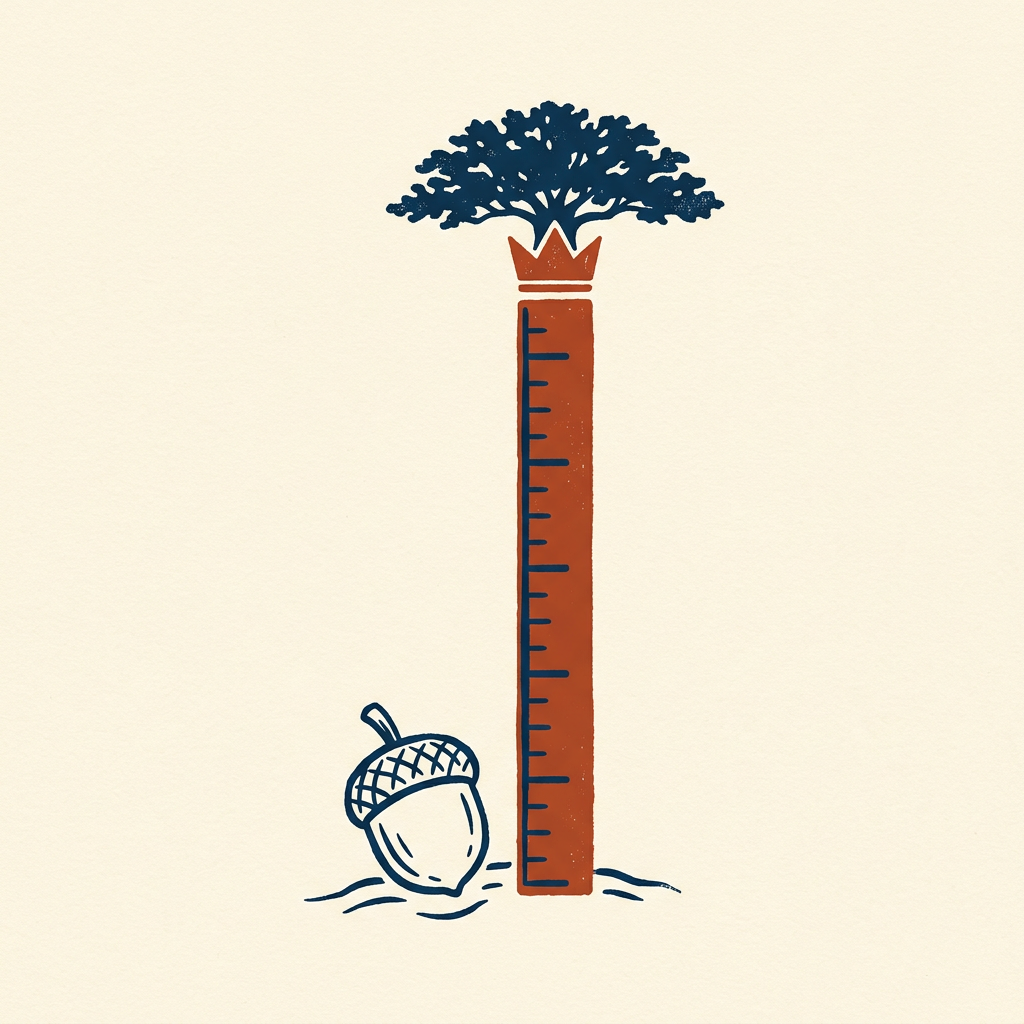
Starting market capitalization is a near-necessary precondition because multiplying a small base by 100 is far more realistic than multiplying a giant one.
Small start
A $50 million firm reaching $5 billion stays inside ordinary business growth
Large start
A $50 billion firm reaching $5 trillion would rank among history’s largest enterprises
The data show the overwhelming majority of 100-baggers began as small or micro-cap companies, frequently valued under a few hundred million dollars and ignored by institutions and analysts. Large-cap blue chips, however excellent, sit on the wrong side of the arithmetic.
A $50 million company becoming worth $5 billion fits inside a normal multi-decade growth path; a $50 billion company becoming worth $5 trillion would have to rank among the largest enterprises in economic history. Small size alone is not enough—most small caps fail or stagnate—but it is the floor below which the search must begin.
The practical effect is to force the reader to look away from familiar, well-covered names and toward less-followed businesses where a hundredfold runway still exists.
In practice: Monster Beverage, operating for years as Hansen Natural, remained a tiny obscure beverage company long before its energy-drink line exploded.

4
Returns on capital compound
The true engine is the ability to reinvest profits at consistently high rates—around 20% or more—rather than revenue growth alone.
- 1Earn high ROICBusiness returns 20% or more on capital employed
- 2Reinvest most earningsProfits flow back into the same high-return opportunities
- 3Raise intrinsic valueEach retained dollar exceeds its book cost
- 4Repeat for decadesThe internal engine keeps compounding under protection
↻ and round again
A company can grow sales while earning little on the capital it deploys; that merely compounds cash outward without compounding value inward. Mayer elevates return on invested capital as the metric that separates multi-decade compounders from businesses that simply get bigger.
When a firm earns high returns and still finds enough opportunities to plow most earnings back at those rates, every retained dollar becomes worth more than a dollar of book value. Capital-intensive businesses that must spend heavily just to stand still leave little surplus for real growth.
Consumer and branded-goods companies, certain retailers, and beverage makers illustrate the lighter capital model: incremental sales need comparatively little new plant, so profits can fund new stores, products, or markets instead of maintenance. Investors are told to look past headline growth and ask what each new dollar earns.
In practice: Branded beverage and retail businesses could redeploy profits into new products and stores rather than consuming capital just to maintain existing earnings.

5
Owners with skin in the game
Founder or family managers who hold large personal stakes consistently tilt decisions toward the long-horizon compounding 100-baggers require.
Owner-operator
Large personal stake favors long reinvestment horizons and resists dilution
Salaried management
Salary and short-term bonuses can prioritize quarterly optics over decades-long compounding
Across the sample, a disproportionate share of winners were run by founders or families whose net worth sat in the stock rather than in salary and short-term bonuses. When personal wealth is tied to the shares, choices about reinvestment, debt, dividends, and acquisitions favor multi-decade value over quarterly appearances.
That alignment matters most at the reinvestment stage. An owner-operator is more willing to keep capital inside a high-return business instead of paying it out to satisfy external earnings expectations. The same incentive reduces casual dilution through heavy stock compensation or repeated secondary offerings, because dilution hits the owner’s own stake.
Mayer does not claim perfection—some owners are poor stewards and some professional managers compound brilliantly—but as a probability-weighted signal, heavy insider ownership correlates with the patient behavior the arithmetic demands. Minimal stakes or persistent insider selling become caution flags.
In practice: Owner-operated firms in the sample were more likely to keep reinvesting at high rates and less likely to erode value through repeated share issuance.

6
A market big enough to grow
Even an excellent high-return business cannot become a 100-bagger if its total addressable market is too small to absorb decades of expansion.
- Too-small nicheHigh returns but a ceiling too low for 100x growth
- Expanding categoryMarket itself grows faster than first expected
- Vast runwayDecades of share-taking remain possible inside a huge addressable market
Mayer separates market size from current profitability. Investors must estimate how large the opportunity could plausibly become and how small the company’s present share of it is. A wonderful margin business trapped in a tiny niche is a good company and a poor 100-bagger candidate.
Sometimes the market itself expands faster than consensus expects; specialty beverages and discount retail both rewarded holders willing to underwrite a bigger future than the crowd assumed. The ceiling on growth is therefore set by the market long before it is set by execution quality.
Screening thus includes a deliberate sizing exercise: write down the plausible twenty-year market and the share the company could take, rather than stopping at today’s financials.
In practice: Monster competed inside a beverage market already worth tens of billions, while Wal-Mart expanded from Arkansas into a national retail market measured in hundreds of billions.

7
Moats keep returns alive
High returns on capital only compound for decades when a durable advantage stops rivals from competing them away.
Exceptional returns attract copycats. Without a structural barrier, margins and returns mean-revert toward the market average—the normal fate of unprotected high-profit businesses. The moat is what converts a multi-year growth story into a multi-decade compounding machine.
Mayer repeatedly finds the classic sources among his winners: brand loyalty that supports premium pricing, network effects that increase value with each new user, scale advantages that lower unit costs beyond what smaller rivals can match, and switching costs that keep customers from leaving even when cheaper options appear.
Moats are not permanent. They widen or narrow as competition shifts, so ongoing diligence for a long-term holder means watching whether the advantage is strengthening or eroding, not merely confirming it existed on the purchase date. A high return without protection is temporary; a high return behind a moat is the closer thing to sustained 100x math.
In practice: Brand-heavy consumer and beverage names could keep earning elevated returns because customer loyalty and scale kept rivals from simply undercutting them.

8
The discipline of not selling
Behavioral exits, not bad initial picks, are the main reason ordinary investors miss 100-baggers they once owned.
Typical exit triggers
Locking in doubles, panic after drawdowns, cash needs, boredom with newer ideas
Coffee-can hold
Buy quality and do nothing for decades; sell only if the moat or capital returns truly deteriorate
After the traits are listed, Mayer turns to the harder failure mode. Almost everyone who held an eventual 100-bagger sold long before the full gain arrived. Common triggers include the impulse to lock in a double or triple, fear during a sharp drawdown, a sudden need for cash, or simple boredom that redirects attention to newer ideas.
He invokes the coffee-can portfolio associated with Robert Kirby: buy good businesses and then do nothing, as if the certificates were sealed in a can and forgotten for twenty years. The extreme is impractical for most people, yet it isolates the lesson—the very actions investors take to feel in control usually destroy the returns that patient inaction would have kept.
Selling because the business or moat has genuinely weakened remains legitimate. Selling because of price volatility or housekeeping habits is usually value-destroying. The psychological cost of watching a large paper gain swing, or watching one position dominate a portfolio, is presented as the real obstacle standing between an investor and a hundredfold result.
In practice: The coffee-can image—certificates sealed away and left untouched for decades—stands for the passive extreme that would have preserved many sample 100x gains.
Key terms
- 100-bagger A stock that returns 100 times the original stake, turning one dollar into a hundred or $10,000 into $1 million.
- Return on invested capital What the company earns on each new dollar it puts back to work; the internal compounding engine.
- Owner-operator Founder or family management whose personal net worth is heavily tied to the stock rather than salary alone.
- Addressable market The total size of the opportunity the company could still grow into over decades.
- Moat A durable competitive advantage—brand, network, scale, or switching costs—that keeps high returns from being competed away.
- Coffee-can portfolio Buy strong businesses and leave them untouched for decades, as if the shares were sealed in a can.
- Survivorship bias Studying only the companies that succeeded and missing the many similar-looking ones that failed or stagnated.
What to do
- Build a watchlist of small or micro-cap businesses under a few hundred million in market value with return on invested capital sustained above 15 to 20 percent.
- Check insider ownership percentage and recent insider buying or selling on every candidate before looking at valuation.
- Write one paragraph estimating what the total addressable market could become in twenty years and what specific moat would block a well-funded rival.
- Decide in writing, before purchase, that you will sell only for a deteriorating moat or falling capital returns—not for price volatility.
- Stop screening exclusively inside large, well-covered names and deliberately look at less-followed smaller firms.
Questions to think with
- If this stock fell 50 percent and stayed quiet for years, would my reason for owning it still hold?
- Is the company’s market large enough that a hundredfold rise is even arithmetically possible from today’s size?
- Does management’s wealth rise and fall with the stock, or mainly with salary and bonuses?
- What concrete evidence would tell me the moat is eroding rather than the share price merely being volatile?
- Am I structurally able to leave this position alone for twenty or more years through taxes, life events, and boredom?
The other side
The sample contains only stocks that already succeeded, so the checklist is descriptive of survivors rather than predictive; without base rates or a comparison group of similar companies that failed, readers cannot know whether matching the traits yields one winner in ten or one in ten thousand. The required two-to-three-decade hold also exceeds many investors’ real horizons and offers little real-time help distinguishing temporary setbacks from true business decay, while position sizing and how to stay solvent while waiting receive almost no attention.
Who it's for
Long-term individual investors hunting growth outside the index, readers of value literature who prefer historical cases over formulas, and anyone who repeatedly sells winners too early and wants to understand the cost.