




Stop chasing recognition from parents who cannot give it
A child can be fed, housed, and never hit yet still starved of attunement—adults who leave parent visits drained but cannot say why get a four-type parent map and a path to freedom that needs no apology.
IJR · Oct 18, 2026 · 12 min read
In 60 seconds
- Many adults carry unresolved loneliness from parents who were present but could not offer real empathy, dominated or withdrew, and punished a child's separate identity.
- Gibson sorts those parents into four patterns—emotional, driven, passive, rejecting—each predicting a distinct kind of damage the child absorbed.
- Children split into self-blaming over-responsible internalizers and acting-out externalizers; the book is written mainly for internalizers who mistake hypervigilance for maturity.
- Ongoing pain often comes less from the parent's behavior than from a fantasy that enough explanation, achievement, or patience will finally produce recognition.
- Freedom is internal and unilateral: observe the pattern, drop the hope it will change, limit disclosure, and keep adult perspective during contact.
- The same hunger for approval quietly steers later friendships and romances, so healing means learning to treat calm reciprocity as safety instead of boredom.
The big idea
Gibson argues that a parent can meet every material need and still leave a child emotionally alone, because emotional immaturity—a stable trait of low empathy and rigid self-focus—blocks the attunement required for a secure self. Adult children, especially self-blaming internalizers, keep suffering by chasing a recognition that parent cannot give; her answer is to change your own expectations, limits, and later relationship choices whether or not the parent ever changes.
The book in brief
Gibson starts from a wound that leaves no bruises: a parent who is physically present but psychologically unavailable. The child learns to read the room instead of trusting their own feelings, because the parent's moods set the household weather. The adult result is a specific cluster—loneliness even in good relationships, trouble naming wants, guilt for having needs—often dismissed by the sufferer as being 'too sensitive' because the parent 'wasn't that bad.'
She then defines emotional immaturity as a stable trait, not a bad mood: low stress tolerance, rigid roles, resistance to self-reflection, and no emotional receptivity. Competence in other domains does not cancel it. From there she maps four parent patterns—emotional, driven, passive, rejecting—so a vague sense that something was off becomes a specific hypothesis about what was missing.
Children adapt in two directions. Internalizers turn inward, manage everyone's feelings, and pay in guilt and self-doubt; externalizers blame outward and often repeat the immaturity. The book speaks mainly to internalizers, who are the ones who show up in therapy mistaking hypervigilance for strength.
The pivot is the fantasy of finally being understood. Adult children keep returning, explaining, achieving, and waiting for a moment of recognition the parent's psychology makes structurally unlikely. Gibson's method is detachment with love: change your internal stance, observe without absorbing, name the old hope without acting on it. Full cutoff and repeated confrontation both fall short for most people.
Practically, that becomes selective disclosure, time-bounded contact, and brief non-revealing answers—staying connected on your own terms. She closes by widening the lens: the same patterns get replayed with partners, friends, and bosses, so the real payoff is learning to recognize mutual curiosity as safety instead of chasing familiar unavailability.
Context
Gibson writes from three decades of clinical case material rather than controlled studies. The book mattered because it gave a concrete name, typology, and unilateral path for a form of harm defined by absence—something standard trauma checklists and 'the parent did so much' narratives routinely missed.
The key ideas
1
The invisible wound
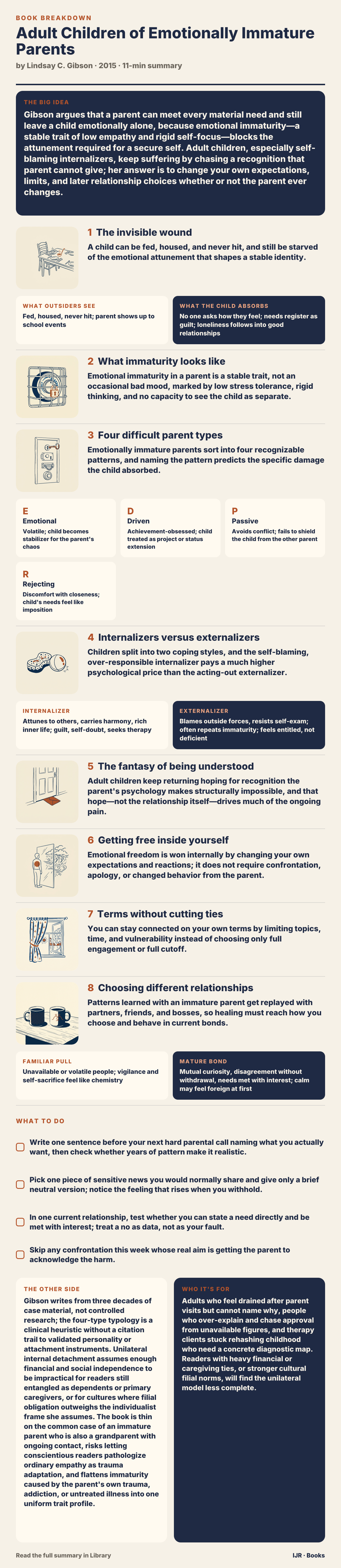
A child can be fed, housed, and never hit, and still be starved of the emotional attunement that shapes a stable identity.
What outsiders see
Fed, housed, never hit; parent shows up to school events
What the child absorbs
No one asks how they feel; needs register as guilt; loneliness follows into good relationships
Gibson names a harm that leaves no bruises and often no single bad memory: a parent who is physically present but psychologically unavailable. The child's needs never set the emotional weather; the parent's moods do. The child learns to read the room instead of trusting what they feel.
In clinic she keeps seeing the same adult cluster—nagging loneliness even inside good relationships, difficulty naming wants, guilt for having needs at all. Clients insist the parent 'wasn't that bad,' then describe years of being talked over, dismissed, or used as a sounding board for the parent's anxieties.
Because the wound is absence rather than event, standard trauma checklists miss it. Adults blame themselves for being too sensitive. Her foundation is simple: the problem is a chronic mismatch between what a developing child needs and what an emotionally immature parent can supply.
In practice: A woman cannot recall her mother ever asking how she felt about anything—only what she thought about the mother's problems.
2
What immaturity looks like
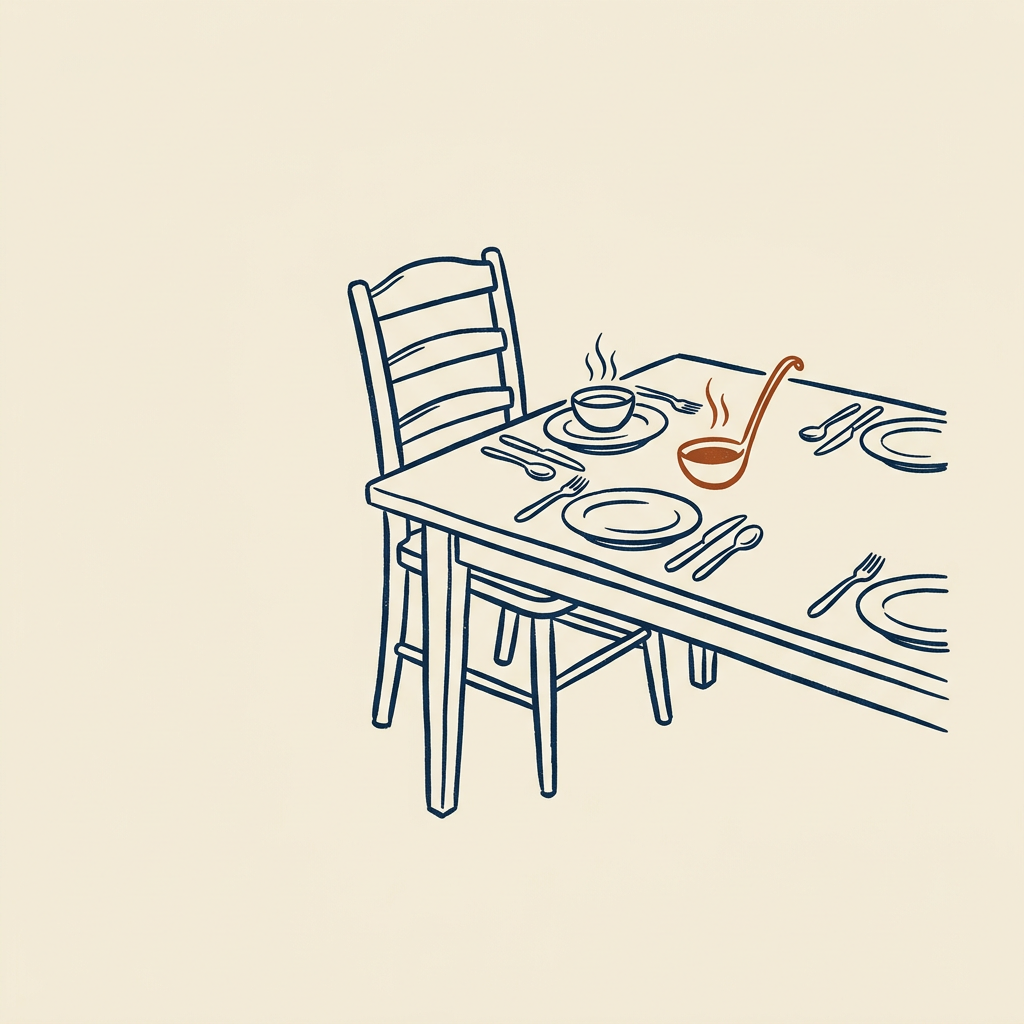
Emotional immaturity in a parent is a stable trait, not an occasional bad mood, marked by low stress tolerance, rigid thinking, and no capacity to see the child as separate.
Gibson locates the cause in a parent whose emotional development stalled, regardless of competence elsewhere. Stress brings disproportionate intensity or total shutdown. Any suggestion they contributed to a problem is treated as an attack.
They lock children into rigid roles—'the responsible one,' 'the difficult one'—and punish deviation with withdrawal or anger. The core missing piece is emotional receptivity: the ability to sit with someone else's feelings without fixing, minimizing, or turning the light back on themselves.
Material generosity and public competence do not prove maturity. Adult children distrust their own sense of neglect precisely because the parent 'did so much.' Naming the trait, apart from any single act, gives the rest of the book a stable target.
In practice: A child comes home upset about being excluded at school; the parent answers with a story about their own childhood exclusion, and the child's feeling goes unaddressed.
3
Four difficult parent types
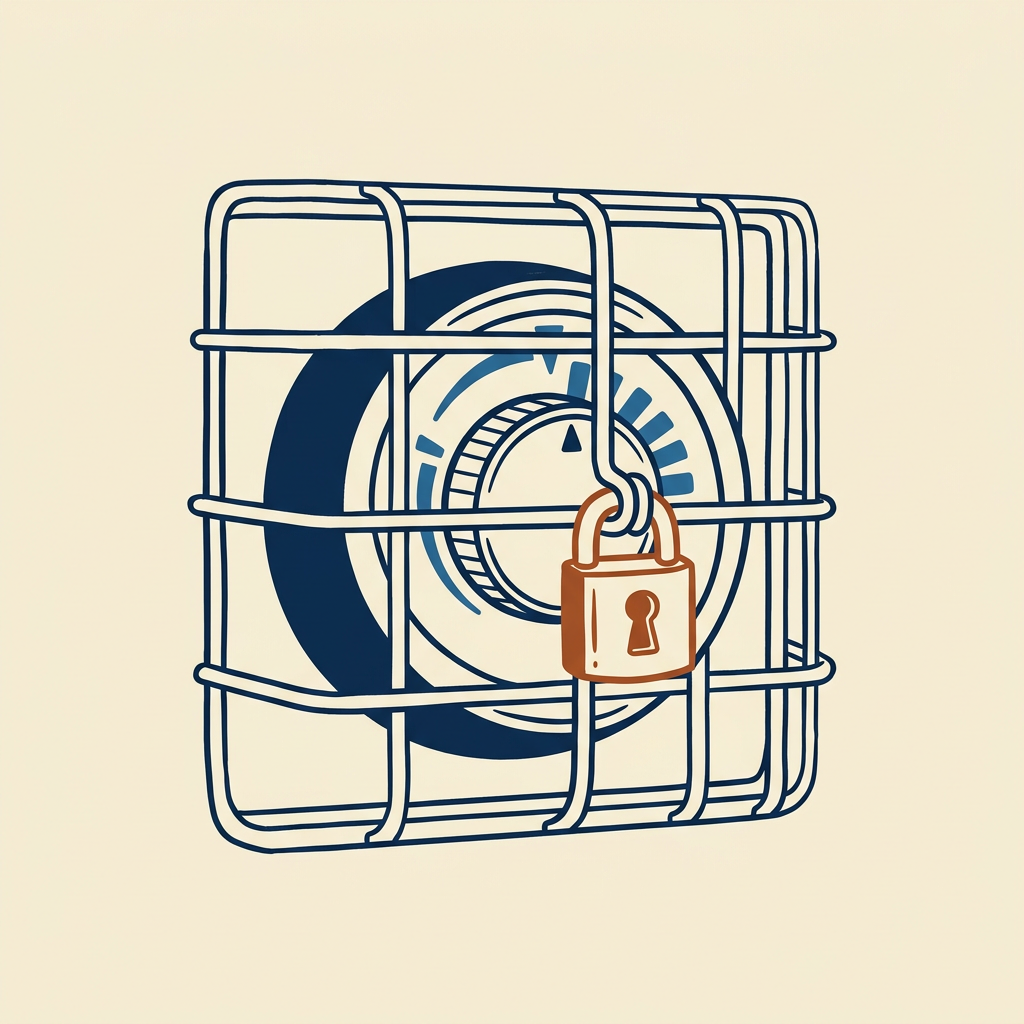
Emotionally immature parents sort into four recognizable patterns, and naming the pattern predicts the specific damage the child absorbed.
- EEmotionalVolatile; child becomes stabilizer for the parent's chaos
- DDrivenAchievement-obsessed; child treated as project or status extension
- PPassiveAvoids conflict; fails to shield the child from the other parent
- RRejectingDiscomfort with closeness; child's needs feel like imposition
Gibson offers a working typology. The emotional parent is volatile and uses the child as a stabilizer for chaotic feelings. The driven parent is achievement-obsessed and treats the child as a project or status extension. The passive parent avoids conflict and fails to protect the child from the other parent's excesses. The rejecting parent shows discomfort with closeness and treats the child's needs as an imposition.
One-size-fits-all 'bad parenting' talk fails here. A driven parent's child learns that love equals performance. A passive parent's child learns that safety means not needing protection, because none will come. Rejecting parents are often invisible to outsiders: flat affect, preference for solitude, unease with affection that the child stores as personal unlovability.
Real parents are usually blends, she notes. The framework still moves a reader from 'something was off' to a testable hypothesis about what was missing and which adult pattern to watch for.
In practice: A passive father never steps in when the mother rages, so the children conclude their distress is not worth defending.
4
Internalizers versus externalizers
Children split into two coping styles, and the self-blaming, over-responsible internalizer pays a much higher psychological price than the acting-out externalizer.
Internalizer
Attunes to others, carries harmony, rich inner life; guilt, self-doubt, seeks therapy
Externalizer
Blames outside forces, resists self-exam; often repeats immaturity; feels entitled, not deficient
Internalizers cope by looking inward. They track everyone else's moods, carry responsibility for family harmony, and grow rich inner lives because the outer world gave little reliable feedback. Externalizers cope by looking outward: they blame circumstances and other people, resist self-examination, and often replicate the parent's immaturity instead of suffering it as deficit.
Gibson writes chiefly for internalizers. They are the ones who seek therapy. Their adaptation produces guilt, self-doubt, and a chronic sense of not doing enough, while externalizers tend to feel entitled rather than deficient.
The split explains a familiar family picture: one sibling becomes the anxious overachiever managing feelings; another causes trouble and feels little remorse. Outsiders often rate the internalizer as healthier because they function well on the outside. Many readers will see decades of hypervigilance they had been calling maturity.
In practice: A client managed her mother's moods from age eight by monitoring tone before entering a room, then grew into an adult who still scans every relationship for conflict before she has spoken.
5
The fantasy of being understood
Adult children keep returning hoping for recognition the parent's psychology makes structurally impossible, and that hope—not the relationship itself—drives much of the ongoing pain.
Gibson names the fantasy of the ideal relationship: the often unconscious belief that clearer explanations, higher achievements, or longer patience will finally produce the missing attunement. Childhood need does not expire on a schedule. The eight-year-old's hope still sits inside the adult on a hard phone call.
Emotional immaturity is stable, not a temporary lapse. The parent's capacity for empathic response is unlikely to expand no matter which tactic the adult child tries. Years of confrontation, appeasement, and distance can all serve the same buried wish to be seen at last.
The move is not abandoning the parent; it is retiring the fantasy of transformation. Clinging to it keeps the adult in a reactive, hopeful posture that guarantees fresh disappointment. Once the fantasy is visible, contact without emotional need becomes possible.
In practice: A woman spends a decade cycling through approaches with her mother, all aimed at finally being seen, and finds relief only when she stops treating the relationship as a problem to solve and starts examining her own expectation.

6
Getting free inside yourself
Emotional freedom is won internally by changing your own expectations and reactions; it does not require confrontation, apology, or changed behavior from the parent.
Gibson's method is detachment with love—emotional self-sufficiency practiced while the parent is still in the room. Full estrangement can leave unresolved grief and guilt. Repeated confrontation rarely yields the acknowledgment internalizers want, because immature people answer challenge with defensiveness, not insight.
The real shift is stance. Watch the parent's behavior with curiosity rather than absorption. Notice the old hope for validation rise, name it, and do not act on it. Keep your adult perspective during moments that once triggered a childlike scramble for approval.
One technique is to cast yourself as a calm outside observer during a difficult visit, tracking patterns almost clinically. That reduces the hijacking that makes these encounters so draining. The reframing does not warm the parent. It changes what the relationship can do to you. Healing, on her account, is primarily unilateral.
In practice: A man who left his father's house anxious and self-doubting after every visit found relief by rehearsing beforehand that the criticism was a predictable pattern unrelated to his worth.

7
Terms without cutting ties
You can stay connected on your own terms by limiting topics, time, and vulnerability instead of choosing only full engagement or full cutoff.
Gibson turns the internal stance into rules of engagement. Selective disclosure means offering surface updates while withholding the emotionally significant material the parent has repeatedly failed to hold with care. She frames this as self-protection, not deceit: vulnerable shares will be used, minimized, or redirected, and repeated exposure to that response is itself harmful.
Decide in advance what a call or visit is for. Time-bound it. Leave before the interaction slides into the old pattern, rather than waiting for a natural ending that may never arrive.
Guilt about limits is not proof you are wrong. It is the predictable cost of stepping out of a role the family system assigned long ago. The chapter answers the concrete Thanksgiving problem instead of leaving freedom abstract.
In practice: A client who once answered every probing maternal question out of felt duty to transparency learned to give brief, non-revealing replies that ended the interrogation without a fight.
8
Choosing different relationships
Patterns learned with an immature parent get replayed with partners, friends, and bosses, so healing must reach how you choose and behave in current bonds.
Familiar pull
Unavailable or volatile people; vigilance and self-sacrifice feel like chemistry
Mature bond
Mutual curiosity, disagreement without withdrawal, needs met with interest; calm may feel foreign at first
Gibson widens the frame beyond the original dyad. Internalizers, trained to earn love through vigilance and self-sacrifice, often select people who recreate the dynamic—unavailable, self-focused, quick to anger—because the pain feels unconsciously familiar.
She contrasts that with emotionally mature relationships: mutual curiosity, disagreement without withdrawal, reciprocal attention to inner states. The diagnostic is plain—can you state a need directly and meet interest rather than deflection or irritation?
The remedy is not a partner checklist. It is a change in what registers as safety. While calm reciprocity still feels foreign, it will be avoided or undermined even when it is available. Understanding the parent was always in service of stopping the pattern from running the rest of your relational life.
In practice: A client first experienced a calm, responsive partner as boring next to the anxious intensity of earlier relationships, showing familiarity mistaken for chemistry.
Key terms
- emotional immaturity A stable parental trait: low stress tolerance, rigid roles, little self-reflection, and weak capacity to see the child as a separate person.
- emotional receptivity The ability to sit with another person's feelings without fixing, minimizing, or turning attention back to yourself.
- internalizer The child who copes by attuning to others, carrying family harmony, and turning distress inward into guilt and over-responsibility.
- externalizer The child who copes by blaming outside forces, resisting self-examination, and often repeating the parent's immaturity.
- fantasy of the ideal relationship The lingering hope that enough clarity, success, or patience will finally produce the parental attunement that never came.
- detachment with love An internal stance of observing the parent with curiosity and keeping adult perspective without needing them to change.
- selective disclosure Sharing surface facts while withholding vulnerable material the parent has shown they cannot hold with care.
- four parent types Gibson's clinical patterns: emotional (volatile), driven (achievement-obsessed), passive (non-protective), and rejecting (closeness-averse).
What to do
- Write one sentence before your next hard parental call naming what you actually want, then check whether years of pattern make it realistic.
- Pick one piece of sensitive news you would normally share and give only a brief neutral version; notice the feeling that rises when you withhold.
- In one current relationship, test whether you can state a need directly and be met with interest; treat a no as data, not as your fault.
- Skip any confrontation this week whose real aim is getting the parent to acknowledge the harm.
Questions to think with
- Which of the four parent patterns most closely matches what you grew up with, and which adult habit did it train?
- Where are you still waiting for a moment of recognition that the other person's psychology makes unlikely?
- In which current bond does calm reciprocity feel boring or unsafe, and what might that signal?
- What would shift in your next family visit if you treated your own expectation, not the parent's behavior, as the work?
- When limit-setting brings guilt, is that guilt evidence of wrongdoing or of an old assigned role being broken?
The other side
Gibson writes from three decades of case material, not controlled research; the four-type typology is a clinical heuristic without a citation trail to validated personality or attachment instruments. Unilateral internal detachment assumes enough financial and social independence to be impractical for readers still entangled as dependents or primary caregivers, or for cultures where filial obligation outweighs the individualist frame she assumes. The book is thin on the common case of an immature parent who is also a grandparent with ongoing contact, risks letting conscientious readers pathologize ordinary empathy as trauma adaptation, and flattens immaturity caused by the parent's own trauma, addiction, or untreated illness into one uniform trait profile.
Who it's for
Adults who feel drained after parent visits but cannot name why, people who over-explain and chase approval from unavailable figures, and therapy clients stuck rehashing childhood who need a concrete diagnostic map. Readers with heavy financial or caregiving ties, or stronger cultural filial norms, will find the unilateral model less complete.