




Most companies stall from low intensity, not bad strategy
Slootman argues leaders grow companies by raising standards, speed, and bluntness rather than refining plans or adding process.
IJR · Nov 1, 2026 · 12 min read
In 60 seconds
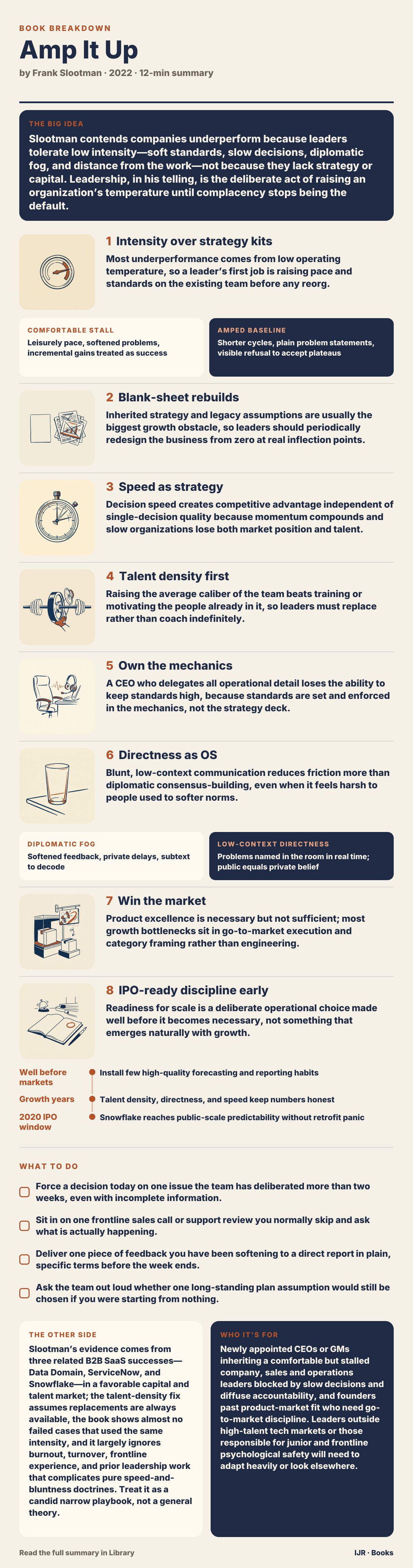
- Stalled companies usually lack intensity, not strategy or resources; a leader’s first job is raising the operating temperature.
- Periodically rebuild the plan from a blank sheet instead of tweaking inherited assumptions and sunk costs.
- Decision speed compounds into advantage because slow yeses lose markets and talent the same way nos do.
- Raise talent density by replacing weak performers fast rather than coaching mediocrity forever.
- Stay hands-on with sales and product mechanics, speak bluntly in the room, and treat go-to-market framing as the real growth bottleneck.
- Build forecasting and reporting discipline long before an IPO; intensity, speed, talent, and directness reinforce one system.
The big idea
Slootman contends companies underperform because leaders tolerate low intensity—soft standards, slow decisions, diplomatic fog, and distance from the work—not because they lack strategy or capital. Leadership, in his telling, is the deliberate act of raising an organization’s temperature until complacency stops being the default.
The book in brief
Slootman opens by rejecting the usual turnaround kit of new org charts, tools, and capital. At Data Domain he found a sound company moving at a leisurely pace and treating incremental gains as success. His first moves shortened meetings, demanded faster customer follow-up, and forced plain problem statements; output rose from pace and expectation, not headcount. Intensity, he argues, is contagious downward: if the top treats a quarter as fixed, so does everyone else.
He then insists leaders periodically ignore the inherited roadmap and rebuild from a blank sheet, as he did at Snowflake in 2019 when the team still framed the product as a faster on-prem warehouse and priced like legacy licenses. Incremental planning carries dead assumptions forward; a blank sheet forces every element to justify itself against present reality at true inflection points, not as permanent flux.
Once a direction is set, speed itself becomes strategy. Long pilots and multi-quarter proofs often hide the discomfort of committing. At ServiceNow he compressed release and decision loops, treating a slow yes as a functional no. Faster shipping yields faster feedback and better decisions over time; most business calls are reversible enough that delay costs more than occasional error, and people who need process as self-protection tend to leave—which he calls a feature.
Talent density matters more than talent management. A-players hire A-players; B-players hire C-players out of insecurity, so one weak leadership hire degrades the pool for years. He brought senior sales and engineering leaders into Snowflake to reset what ‘good’ looked like, then moved on misfits quickly rather than running endless improvement plans. Leaders must also own the mechanics—sitting in on sales calls, reading pipeline line by line, attending demos—because dashboards lag and filter, and absence signals what does not really matter.
Direct, low-context talk is the cultural operating system: name weak results in the room immediately so no one wastes energy decoding subtext. That same bluntness filters for people who can handle it. Product excellence is necessary but not enough; growth bottlenecks usually sit in positioning, pricing, and sales motion. Snowflake was framed as a ‘data cloud’ category and priced on consumption so expansion followed usage. The closing move is building IPO-grade forecasting and clean metrics early, treating the whole set of habits as one reinforcing machine rather than a menu of tips.
Context
Frank Slootman draws on turning around Data Domain, ServiceNow, and Snowflake. The book landed as a counter-narrative to the consensus-driven, process-heavy management style fashionable in late-2010s tech, offering a first-person operating doctrine instead of another framework deck.
The key ideas

1
Intensity over strategy kits
Most underperformance comes from low operating temperature, so a leader’s first job is raising pace and standards on the existing team before any reorg.
Comfortable stall
Leisurely pace, softened problems, incremental gains treated as success
Amped baseline
Shorter cycles, plain problem statements, visible refusal to accept plateaus
Slootman rejects the belief that turnarounds require new tools, charts, or capital. Complacency, not incompetence, is the default failure mode of established teams, and fixing it is a leadership behavior rather than a hiring exercise.
When he joined Data Domain the company was technically sound yet leisurely, treating steady incremental gains as success. He shortened meetings, demanded faster follow-up on customer commitments, and pushed people to state problems plainly instead of softening them for comfort. Output changed because expectation and pace changed.
Intensity travels downward. If the CEO treats a quarter’s numbers as fixed, VPs and the frontline will too. If leadership visibly refuses plateauing results and keeps pressing in real time, that discomfort becomes the new baseline. Most untapped performance is behavioral, not structural; amp the existing team first.
In practice: At Data Domain, Slootman’s early moves were pace and plain speech rather than new headcount or a new plan, and results moved with the temperature.

2
Blank-sheet rebuilds
Inherited strategy and legacy assumptions are usually the biggest growth obstacle, so leaders should periodically redesign the business from zero at real inflection points.
Slootman describes entering each company by deliberately ignoring the existing roadmap, deck, and org chart long enough to ask what the business would look like if designed today with no sunk cost. Incremental planning systematically underweights the cost of carrying forward assumptions that were true years earlier.
A blank sheet forces every element of the current plan to justify itself against present reality rather than past momentum. This is not constant pivoting; the exercise is periodic and disciplined—at a new CEO, a funding round, or a stalled growth curve.
He also hired executives with no attachment to the old plan so they would ask naive, structurally threatening questions insiders had stopped asking. The method assumes leaders can actually separate themselves from sunk-cost thinking, which is harder than the retelling admits, and his own success is the main evidence offered.
In practice: Joining Snowflake in 2019, he pushed the team to stop treating the product as a faster on-premises-style warehouse and to reprice around consumption instead of legacy licensing habits.

3
Speed as strategy
Decision speed creates competitive advantage independent of single-decision quality because momentum compounds and slow organizations lose both market position and talent.
Once a plan is set, Slootman argues the next lever is compressing the time between decision and action. He is openly hostile to long planning cycles, extended pilots, and multi-quarter proofs of concept, which often substitute for the discomfort of committing.
A slow yes is functionally a no because competitors and customers move on. Speed compounds: decide and ship faster, get market feedback faster, correct faster, and end up with better decisions over time even if any one call had less analysis than a slower rival’s.
Most business decisions are reversible enough that delay costs more than occasional error. Speed also exposes people who prefer deliberation as self-protection; they often self-select out, which he treats as a feature. Critics note speed-first cultures can produce hard-to-reverse mistakes and burn out staff who need more processing time—a tension the book leaves unresolved.
In practice: At ServiceNow he pushed shorter release cycles and faster internal decision loops so the company would not lose ground while still deliberating.

4
Talent density first
Raising the average caliber of the team beats training or motivating the people already in it, so leaders must replace rather than coach indefinitely.
Slootman argues most management effort goes into improving underperforming or mediocre employees when the higher-leverage move is raising the floor by upgrading who is on the team. A new hire performing at a visibly higher standard lifts the organization more than a training program aimed at existing staff.
A-caliber leaders hire other A-caliber people; B-caliber leaders, out of insecurity or convenience, hire C-caliber people. One weak leadership hire can degrade the talent pool for years if left alone. The operating rule is faster personnel action: identify misfits early and move on rather than run extended improvement plans that consume time without changing trajectory.
He distinguishes this from a mercenary culture by insisting the goal is fit and caliber, not obedience, and that high standards should apply to how people are treated on the way out. The unaddressed weakness is the assumption of a labor market that can supply top-tier replacements on demand—an assumption far easier in 2010s Silicon Valley SaaS than in most other industries or climates.
In practice: At Snowflake he brought in senior sales and engineering leaders specifically to reset the internal definition of what good looked like.

5
Own the mechanics
A CEO who delegates all operational detail loses the ability to keep standards high, because standards are set and enforced in the mechanics, not the strategy deck.
Slootman pushes back on the venture-backed idea that senior leaders should stay at vision and leave execution to specialists. Dashboards and status updates are lagging and filtered; a leader who only sees them cannot sense quiet failure before it hits the numbers.
He sat in on sales calls, reviewed pipeline data line by line, and attended product demos well after leading billion-dollar companies—not from distrust but because direct exposure revealed what summaries hid. Presence also signals what actually matters: if the CEO never appears in a sales review, sales quality is implicitly deprioritized no matter what the strategy document says.
The goal is not to make subordinates’ decisions but to keep enough contact with ground truth to ask sharp questions and recognize excuses. This matters most during scaling, when the temptation to hire a management layer and step back is strongest. The claim is harder to sustain at tens of thousands of employees than in the relatively centralized, founder-adjacent companies he led.
In practice: Even as CEO of large companies he kept attending demos and reading pipeline line by line so filtered reports could not replace ground truth.

6
Directness as OS
Blunt, low-context communication reduces friction more than diplomatic consensus-building, even when it feels harsh to people used to softer norms.
Diplomatic fog
Softened feedback, private delays, subtext to decode
Low-context directness
Problems named in the room in real time; public equals private belief
Vague or overly polite feedback is a hidden cost center: it slows correction, lets problems fester, and forces people to guess what leadership actually thinks. Slootman’s preferred style is to state problems plainly in the room, in real time, rather than saving criticism for private one-on-ones or review cycles.
Ambiguity about whether something is a problem is itself a drag on performance. Directness also scales trust, because people learn that what leadership says in public is what it believes, removing the need to decode subtext or manage up. It connects to talent density: people who thrive under low-context feedback stay; people who need diplomatic framing often leave, which he treats as cultural filtering rather than a flaw.
He acknowledges the style can read as harsh, especially to backgrounds where indirectness signals respect, but treats the tradeoff as worth making. Critics argue it suits confident senior operators far better than junior employees, diverse workplaces trying to build psychological safety, or external-facing roles where tone matters as much as internal clarity.
In practice: Internal meetings named a weak result as a weak result immediately, without the cushioning language common in corporate settings.
7
Win the market
Product excellence is necessary but not sufficient; most growth bottlenecks sit in go-to-market execution and category framing rather than engineering.
Engineers and founders overweight product quality as the explanation for growth or stagnation. In practice the harder work is how the product is positioned, priced, and sold. Category creation is a strategic choice, not a marketing afterthought; it changes which competitors a company is measured against and what customers will pay.
A clear category story also lets the sales force move faster because reps are not relitigating what the product is in every deal. Pricing models can make expansion a natural byproduct of usage rather than a separate upsell campaign.
Slootman claims companies with technically superior products routinely lose to clearer positioning and faster sales execution. The claim is well supported by his three examples but not tested against counterexamples where superior technology won on its own merits.
In practice: At Snowflake the offering was framed as the foundation of a ‘data cloud’ rather than a faster database, and consumption pricing aligned expansion with customer usage.

8
IPO-ready discipline early
Readiness for scale is a deliberate operational choice made well before it becomes necessary, not something that emerges naturally with growth.
- Well before marketsInstall few high-quality forecasting and reporting habits
- Growth yearsTalent density, directness, and speed keep numbers honest
- 2020 IPO windowSnowflake reaches public-scale predictability without retrofit panic
Slootman closes with the discipline required to move from startup chaos to the predictability public markets demand. Forecasting accuracy, clean board reporting, and consistent internal metrics must be built long before a company approaches those markets; retrofitting under investor scrutiny costs far more.
He ties the earlier habits together: talent density supplies leaders who can run disciplined functions, directness surfaces problems before they surprise the board, and speed lets the company correct small forecasting misses before they become large ones. Discipline here is not bureaucracy—fewer, higher-quality processes that produce reliable numbers, not more approval layers.
The habits—intensity, blank-sheet thinking, speed, talent upgrades, hands-on leadership, directness, and market focus—form one reinforcing system; remove any one and the others weaken. This is the payoff chapter and also the most narrowly evidenced, resting on three related enterprise-software successes in one favorable market cycle.
In practice: Snowflake’s 2020 IPO, one of the largest software IPOs on record, is his central case for building clean metrics and forecasting well before the public spotlight.
Key terms
- Amping up Raising an existing team’s pace, standards, and intolerance for drift without first adding headcount or new structure
- Operating temperature How urgently and directly the organization actually works day to day
- Blank sheet of paper Periodically redesigning strategy as if the company were founded today, ignoring sunk-cost roadmaps
- Talent density The average caliber of the team; raised more by upgrading who is on it than by coaching who already is
- Mechanics The concrete sales calls, pipeline lines, and demos where standards are enforced, not the vision slides
- Low-context directness Naming problems plainly in the room in real time so no one has to decode soft language
- Category framing Positioning the product as the foundation of a new buying category rather than a faster version of an old one
- Consumption pricing Charging based on usage so account expansion follows naturally from customer value
What to do
- Force a decision today on one issue the team has deliberated more than two weeks, even with incomplete information.
- Sit in on one frontline sales call or support review you normally skip and ask what is actually happening.
- Deliver one piece of feedback you have been softening to a direct report in plain, specific terms before the week ends.
- Ask the team out loud whether one long-standing plan assumption would still be chosen if you were starting from nothing.
Questions to think with
- Where is our organization treating incremental comfort as success, and what would a visible refusal of that plateau look like this quarter?
- Which inherited assumption would not survive a true blank-sheet redesign, and who is still defending it from sunk cost?
- Are we using long pilots and proof cycles to avoid the discomfort of committing, and what reversible decision could we make this week instead?
- If we raised talent density rather than coaching around weak performers, whose departure would most lift the standard of ‘good’?
- Does our culture punish blunt problem statements, and what friction is that politeness actually costing us?
The other side
Slootman’s evidence comes from three related B2B SaaS successes—Data Domain, ServiceNow, and Snowflake—in a favorable capital and talent market; the talent-density fix assumes replacements are always available, the book shows almost no failed cases that used the same intensity, and it largely ignores burnout, turnover, frontline experience, and prior leadership work that complicates pure speed-and-bluntness doctrines. Treat it as a candid narrow playbook, not a general theory.
Who it's for
Newly appointed CEOs or GMs inheriting a comfortable but stalled company, sales and operations leaders blocked by slow decisions and diffuse accountability, and founders past product-market fit who need go-to-market discipline. Leaders outside high-talent tech markets or those responsible for junior and frontline psychological safety will need to adapt heavily or look elsewhere.