




Television turns serious public life into entertainment and pleasure
Readers who sense that news, politics, faith, and school now feel more like shows than serious talk get Postman's 1985 framework for why the screen's form, not any one host, drives the change.
IJR · Oct 24, 2026 · 13 min read
In 60 seconds
- Postman holds that Huxley's pleasure-fed passivity describes mid-1980s America better than Orwell's forced tyranny.
- Every medium carries a built-in bias about what counts as knowledge; television favors image, brevity, and emotional punch over sustained argument.
- Print-era America trained long abstract reasoning, shown by Lincoln-Douglas debates running three hours while ordinary crowds stood and listened.
- The telegraph and photograph first severed facts from local context, building the peek-a-boo world television later perfected.
- Once news, religion, politics, and education move onto the screen, each is reshaped to entertain regardless of producers' aims.
- He sketches media literacy in schools as the main reply, not bans, while noting a culture already hooked on amusement may lack patience for the cure.
The big idea
Postman contends television is no neutral pipe but a medium whose form demands entertainment, so news, politics, religion, and education lose the patience and logic democracy needs. By his account America drifts toward Huxley's amused passivity rather than Orwell's coerced silence.
The book in brief
Postman opens by setting Orwell's 1984 against Huxley's Brave New World. Orwell feared control by pain, surveillance, and banned books. Huxley feared control by pleasure, in which people stop wanting truth because distraction feels free. By the mid-1980s, he says, America had slid toward Huxley: serious books were not banned; people simply stopped craving them, and television buried hard information under amusement.
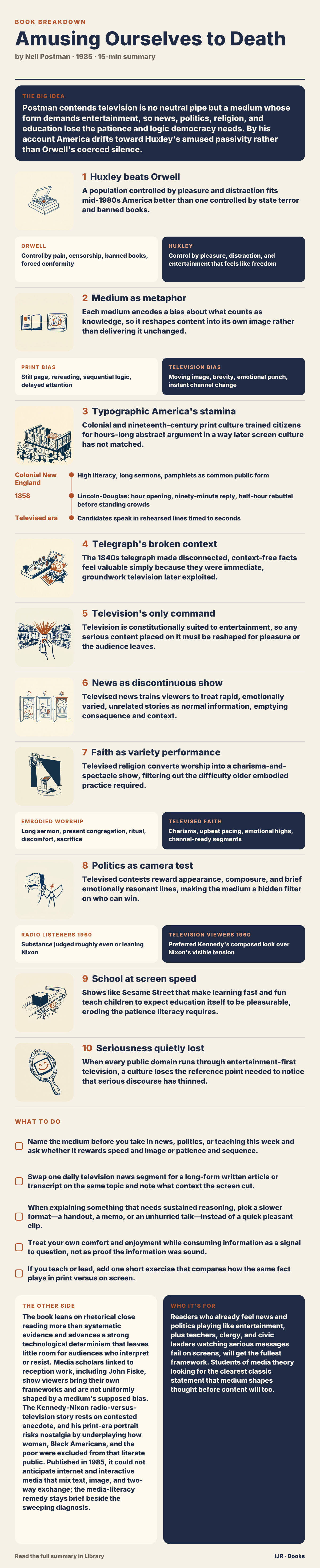
He then argues that every medium is a metaphor with its own epistemology, not a passive vessel. Smoke signals cannot carry philosophy; print rewards linear, rereadable argument. Television's bias toward spoken image and rapid pacing, he claims, is incompatible with patience, memory, and logical sequence, so fairer anchors or smarter viewers cannot fix what the form itself forbids.
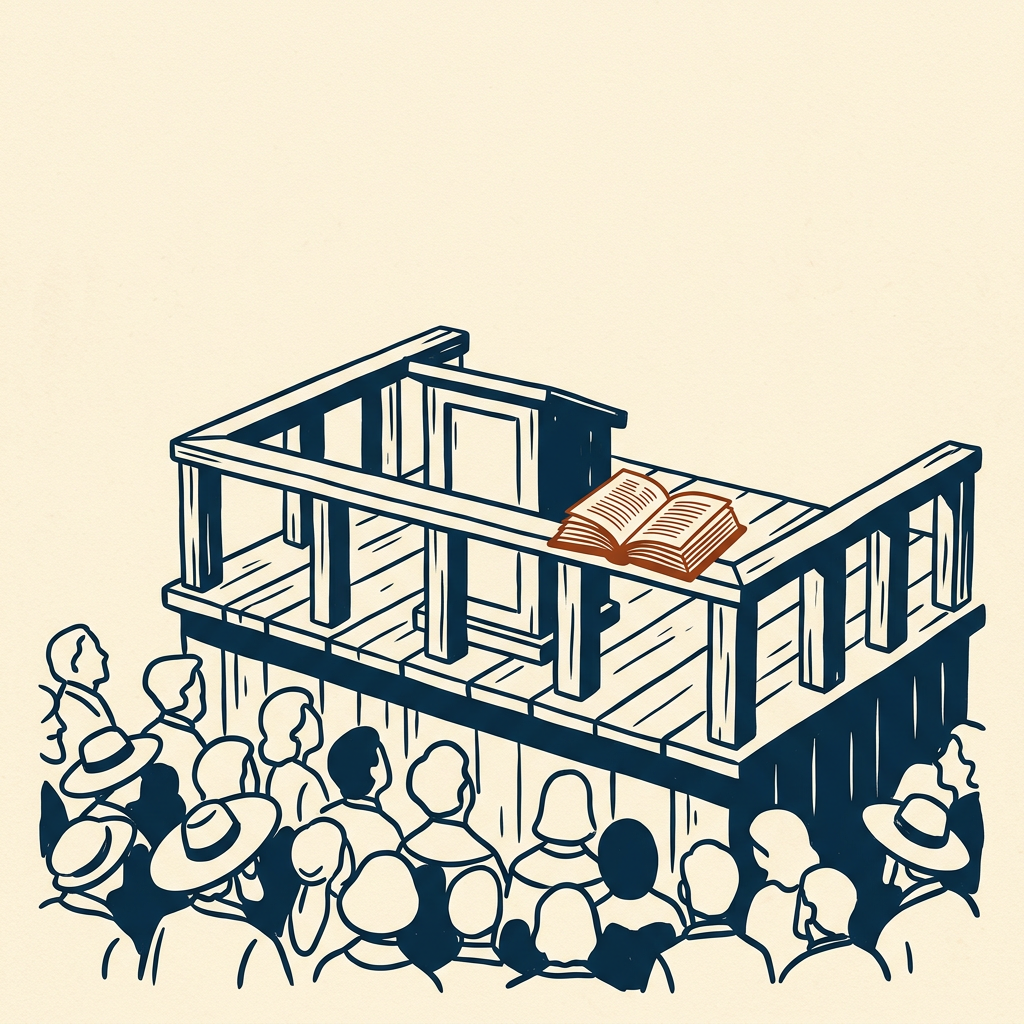
As baseline he paints colonial and nineteenth-century America as a typographic culture of high literacy, long sermons, and stamina for abstract talk. The Lincoln-Douglas debates of 1858 stand as proof: one candidate opened for an hour, the other answered for ninety minutes, the first rebutted for half an hour, and farmers and townspeople listened throughout—a format unthinkable in second-timed televised debates.
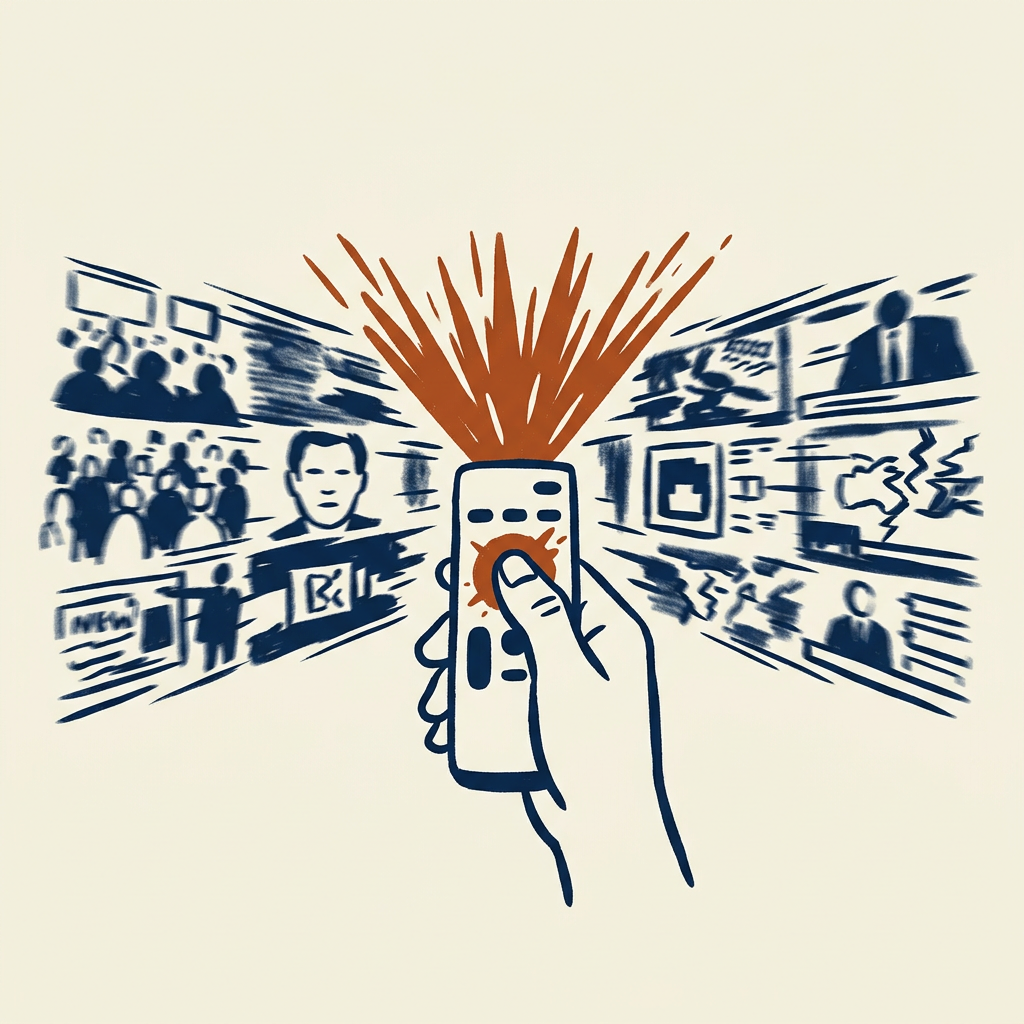
The break begins earlier than TV. The 1840s telegraph collapsed distance and delivered facts valued only for being new and far away, stripped of local relevance. Photography added explanation-free images that invited reaction over analysis. Together they produced what he calls a peek-a-boo world of discontinuous fragments. Television inherits that habit and adds the single command embedded in its form: entertain, or lose the channel-switching viewer.
He then walks the domains. Televised news moves from famine to celebrity divorce to detergent ads under the cheerful bridge "Now this," training audiences that incoherence is normal and no story deserves lingering judgment. Televangelism turns worship into variety performance rewarded for charisma and uplift, not doctrinal difficulty. Politics after the 1960 Kennedy-Nixon debate elevates composed appearance and brief resonant lines over multi-hour rebuttal. Educational shows such as Sesame Street teach letters by commercial pacing and, he argues, teach children that learning itself should be effortless and fast, undercutting the slow sequential habits literacy still requires.
The cumulative result, in his closing, is not one ruined institution but a public that can no longer recognize serious discourse because the contrasting reference point has vanished. The danger arrives as pleasure, so resistance looks like rejecting what feels free. He rejects bans and urges schools to teach media awareness beside traditional literacy, then leaves the irony hanging: a culture already reshaped by entertainment may lack the patience a demanding book asks for.
Context
Neil Postman's 1985 book mattered because it reframed media criticism around form rather than content, asking not what television shows but what the medium itself permits us to think. It gave teachers, clergy, civic leaders, and media-theory students a clear statement that medium shapes thought before any particular message does.
The key ideas

1
Huxley beats Orwell
A population controlled by pleasure and distraction fits mid-1980s America better than one controlled by state terror and banned books.
Orwell
Control by pain, censorship, banned books, forced conformity
Huxley
Control by pleasure, distraction, and entertainment that feels like freedom
Two dystopias open the case. Orwell imagined surveillance, censorship, and pain; truth hidden by force. Huxley imagined so much entertainment that people lose the desire to seek truth at all.
By Postman's reading, no agency had to suppress information; television buried it under amusement. No one banned serious books; people stopped wanting them. The missing public outcry against television's civic takeover is his blunt evidence that Huxley's warning already looked more accurate.
Resistance therefore changes shape. Fighting Orwell means fighting coercion. Fighting Huxley means fighting a captivity that feels like freedom, because nobody forces anyone to watch, laugh, or stay distracted. Pain controls one world; pleasure controls the other.
In practice: Postman points to the simple absence of organized protest against television's takeover of civic life as proof the Huxleyan pattern had already taken hold.
2
Medium as metaphor
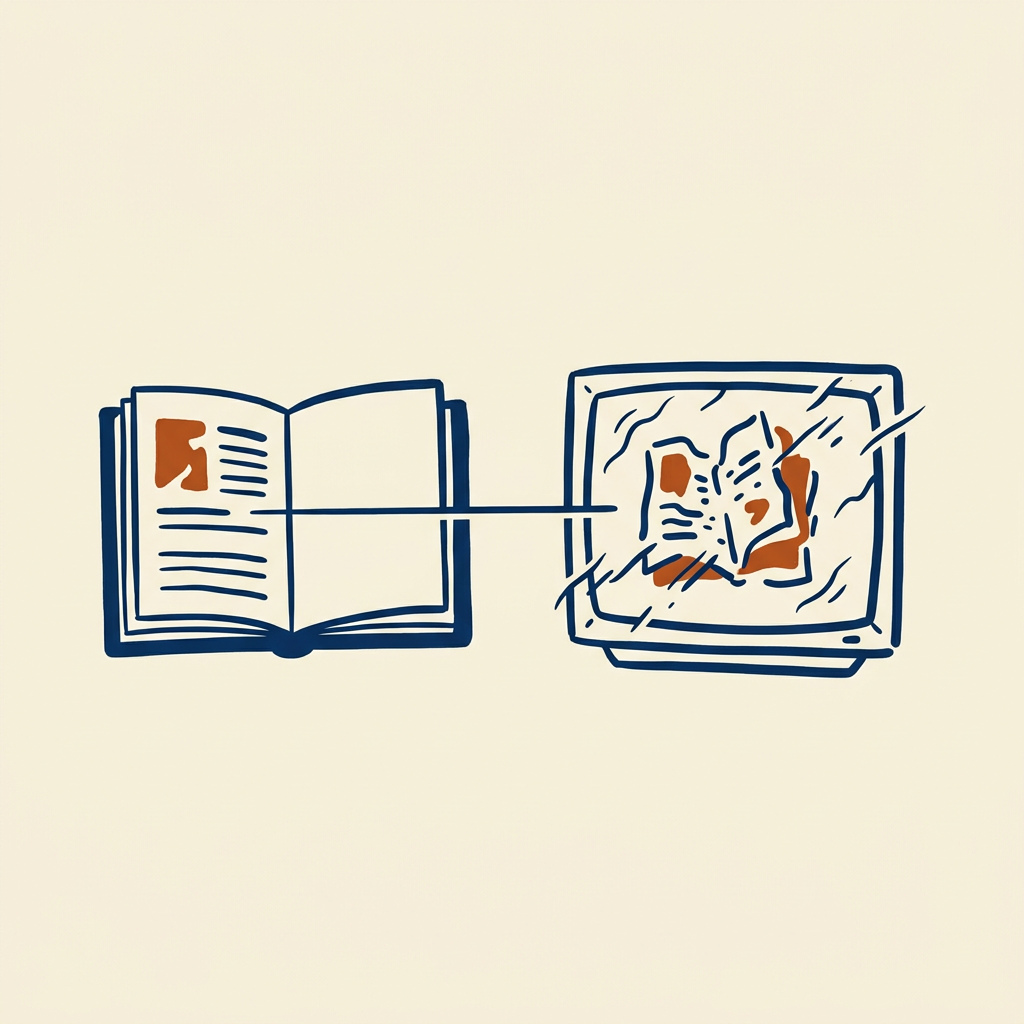
Each medium encodes a bias about what counts as knowledge, so it reshapes content into its own image rather than delivering it unchanged.
Print bias
Still page, rereading, sequential logic, delayed attention
Television bias
Moving image, brevity, emotional punch, instant channel change
A medium is not a passive pipe. It carries an implicit epistemology—an assumption about how truth should be organized and what is even sayable.
Smoke signals support only simple urgent messages; they cannot carry philosophy no matter how skilled the sender. Print holds still, can be reread, and demands sequential attention, so it rewards linear argument from writer and reader alike.
Asking whether television news is politically "biased," he says, misses the deeper bias: the format favors images, brevity, and emotional impact over context, nuance, and sustained argument, regardless of which party a story helps. Better producers cannot repair a deficiency built into the form.
In practice: Smoke signals cannot carry philosophy; the limit sits in the medium, not in the philosopher's skill.
3
Typographic America's stamina
Colonial and nineteenth-century print culture trained citizens for hours-long abstract argument in a way later screen culture has not matched.
- Colonial New EnglandHigh literacy, long sermons, pamphlets as common public form
- 1858Lincoln-Douglas: hour opening, ninety-minute reply, half-hour rebuttal before standing crowds
- Televised eraCandidates speak in rehearsed lines timed to seconds
Before television, Postman calls America perhaps the most print-obsessed society in history. Colonial New England literacy ran exceptionally high; pamphlets circulated widely; sermons lasted hours and expected congregants to track multi-part theology without visual aids.
Typographic intelligence meant attention to logic, tolerance for delayed gratification, and holding an argument across pages. Public discourse was not a fixed human gift; the dominant medium trained it.
He offers this era as baseline, not pure golden age. Demagoguery existed, yet the format itself demanded stamina and logical follow-through that second-timed modern debates make unthinkable. Later claims about television shrinking attention rest on this concrete historical contrast.
In practice: In the 1858 Lincoln-Douglas debates one candidate opened for an hour, the other replied for ninety minutes, the first rebutted for half an hour, and ordinary farmers and townspeople stood listening throughout.
4
Telegraph's broken context
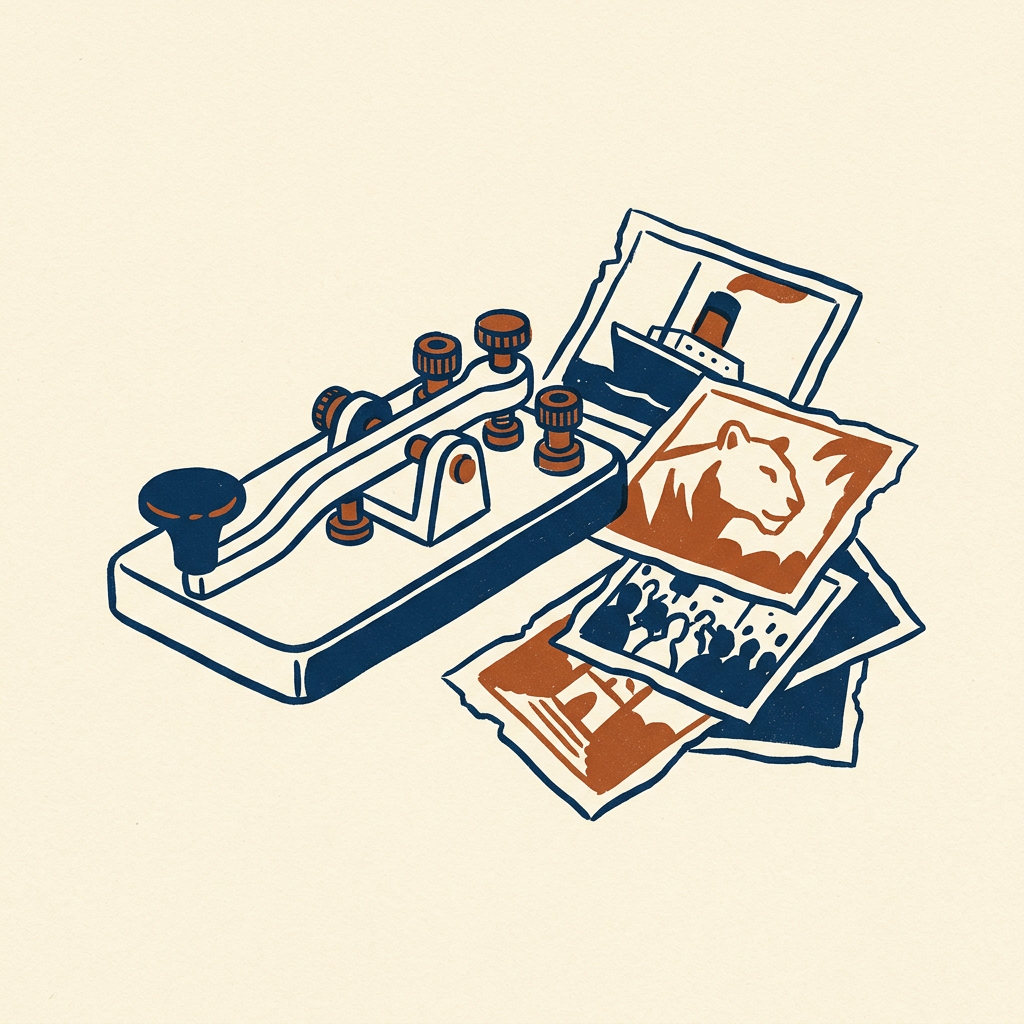
The 1840s telegraph made disconnected, context-free facts feel valuable simply because they were immediate, groundwork television later exploited.
Before the telegraph, news moved at horse or ship speed, so what reached a town was almost always locally relevant; distant events arrived too late to be more than curiosities.
The telegraph collapsed distance. An earthquake or coronation could arrive the same day, creating information without context—facts with no bearing on the listener's life, prized only for newness and remoteness. Photography compounded the effect: fragments of scenes without argument or narrative, inviting emotion over analysis.
Postman labels the result a peek-a-boo world where facts appear and vanish with no duty to connect. Television did not invent discontinuity; it inherited and accelerated a nearly century-old erosion of the link between information and relevance, then added moving, emotionally compelling images.
In practice: News of a far-off coronation or earthquake could reach a town the day it happened, valued for speed and distance rather than any local consequence.
5
Television's only command
Television is constitutionally suited to entertainment, so any serious content placed on it must be reshaped for pleasure or the audience leaves.
Visual drama, short segments, emotional immediacy, and constant motion hold viewers who can change channels at once; a still or slow image loses them.
Whatever content arrives—news, religion, politics, education—must meet those demands. The bias is formal: just as smoke signals cannot carry philosophy, television cannot carry sustained complex argument without translating it into image, personality, and pacing.
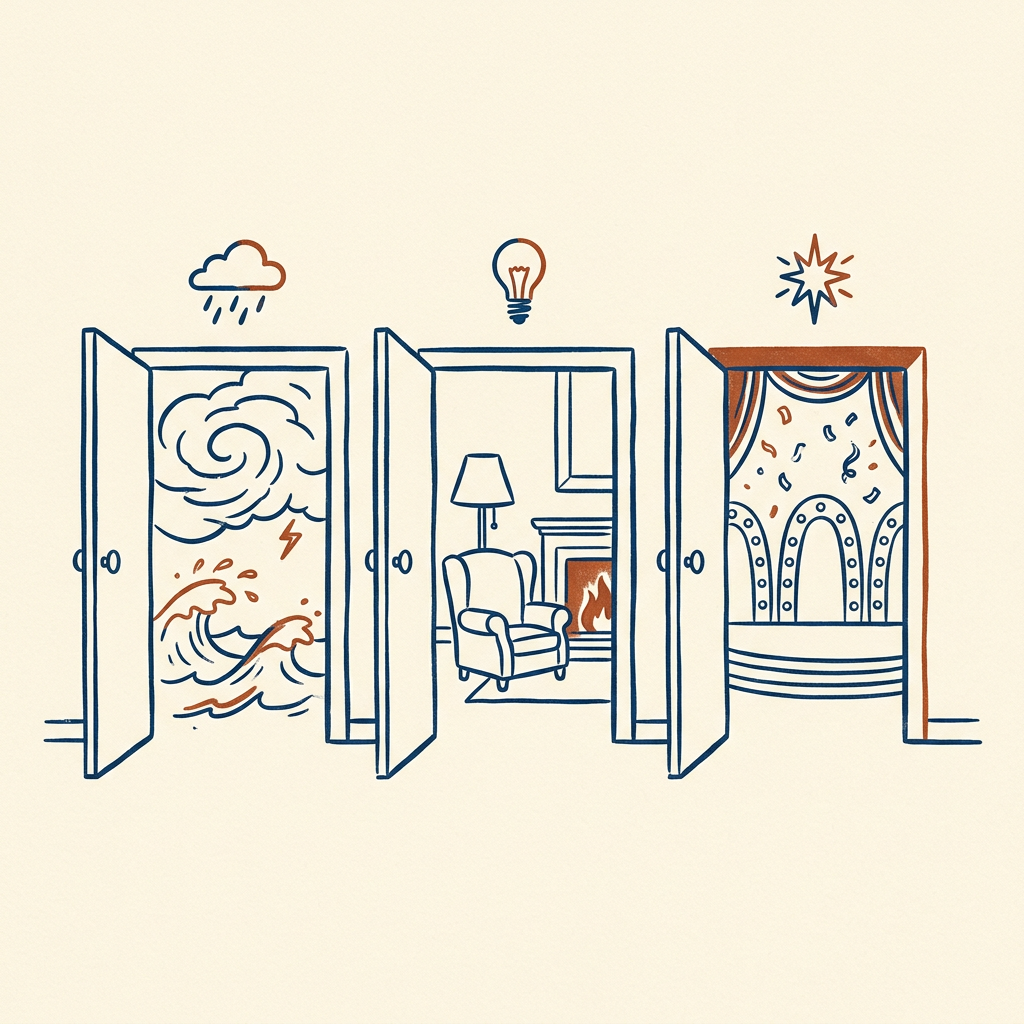
Print can wait for a reader to finish a paragraph. Television cannot wait for a viewer to finish a thought. The cheerful announcer bridge "Now this" becomes his recurring symptom: no logical or emotional link between items is expected, because the job is to keep attention moving.
In practice: The near-universal "Now this" after a tragedy signals that no story is heavy enough to stop the show's forward momentum.
6
News as discontinuous show
Televised news trains viewers to treat rapid, emotionally varied, unrelated stories as normal information, emptying consequence and context.
A single broadcast can move from famine to celebrity divorce to a detergent ad within minutes, each delivered in the same controlled telegenic tone. After tragedy the anchor smiles or briskly advances, a small habit that tells the viewer no story deserves prolonged reflection.
Postman calls this the aesthetic of the discontinuous: information arrives as self-contained fragments, not parts of a developing picture. Competition for attention pushes striking footage, telegenic faces, and dramatic music over patient investigation, because exposition-heavy material gets cut.
He does not blame individual journalists' integrity. Anchors and producers work skillfully inside a structure that rewards brevity, drama, and closure inside a fixed slot. The public then consumes vast volume while losing the contextual understanding that turns knowledge into judgment or civic action; information becomes momentary entertainment.
In practice: A famine report can sit beside a celebrity divorce and a detergent commercial, all given the same composed delivery and quick exit.
7
Faith as variety performance
Televised religion converts worship into a charisma-and-spectacle show, filtering out the difficulty older embodied practice required.
Embodied worship
Long sermon, present congregation, ritual, discomfort, sacrifice
Televised faith
Charisma, upbeat pacing, emotional highs, channel-ready segments
Traditional practice leaned on sustained attention, communal ritual, discomfort, sacrifice, and difficulty as spiritual discipline—qualities television actively discourages.
The screen rewards the opposite: visual warmth, upbeat pacing, emotional highs delivered inside a broadcast slot. Successful television preachers of the era became skilled media performers first; theology bent to fit the format rather than the reverse.
A preacher once spoke from a fixed pulpit to a present congregation obliged to endure a long sermon. On screen the audience is distant and channel-switching, ready to leave at the first tedium. Reassurance and uplift win; doctrinal complexity or moral challenge that cannot be made entertaining inside the segment tends to be dropped or softened. The medium's entertainment bias overrides participants' intentions, turning the activity closer to show business than worship.
In practice: A preacher who dwells too long on uncomfortable teaching risks losing viewers to another channel, so difficult material is shortened or sweetened.
8
Politics as camera test
Televised contests reward appearance, composure, and brief emotionally resonant lines, making the medium a hidden filter on who can win.
Radio listeners 1960
Substance judged roughly even or leaning Nixon
Television viewers 1960
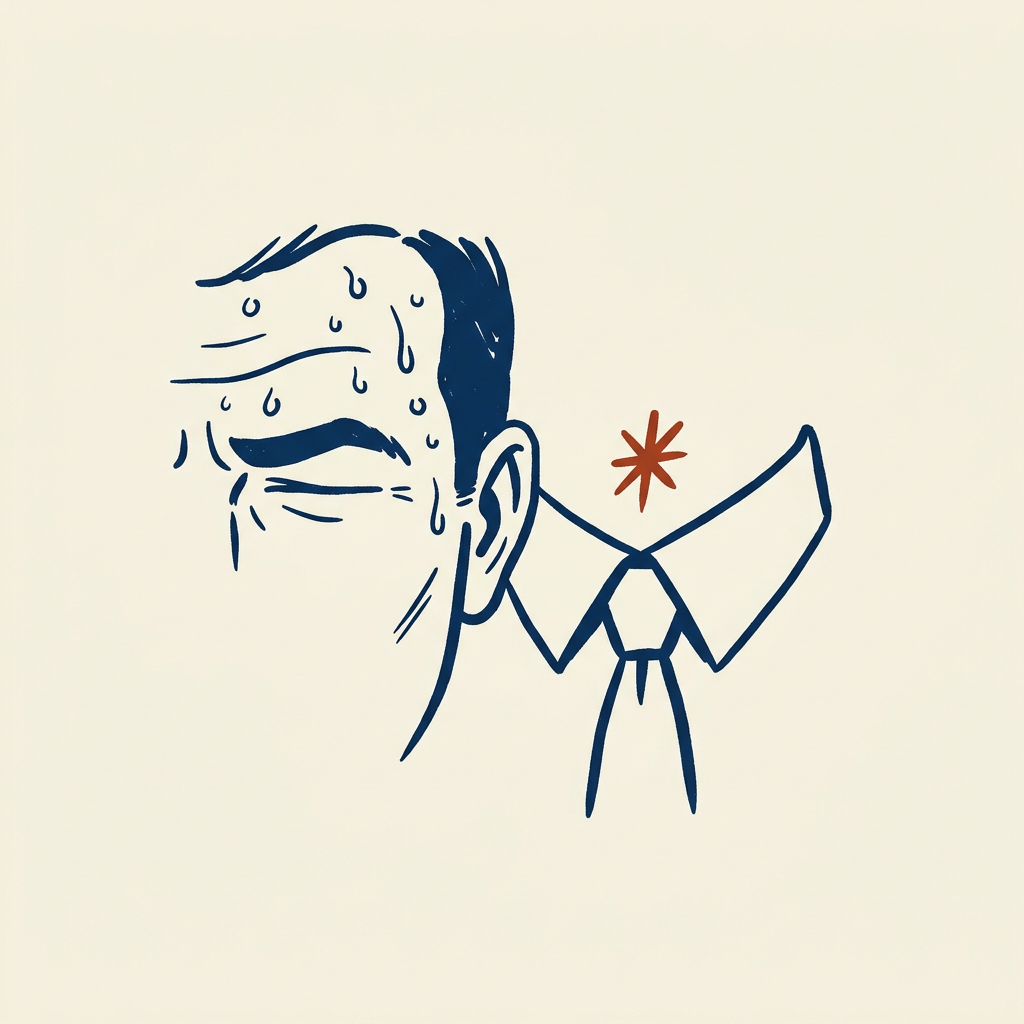
Preferred Kennedy's composed look over Nixon's visible tension
Television changes not only campaign tactics but the kind of person who can plausibly lead. Visual performance becomes a new criterion beside the coherence of argument.
Campaign ads and stump spots compress thought into short charged phrases the medium can hold. Where Lincoln-Douglas required multi-part development and rebuttal over hours, the screen favors the memorable line and confident bearing over demonstrated policy command.
Selection pressure shifts. A candidate who reasons well but performs poorly on camera is disadvantaged regardless of ideas; a strong performer can succeed regardless of depth. Image and brevity function as an invisible qualification for office.
In practice: In the 1960 Kennedy-Nixon debate, radio listeners judged substance roughly even or favored Nixon, while television viewers favored Kennedy's composed appearance against Nixon's tense, sweating demeanor.
9
School at screen speed
Shows like Sesame Street that make learning fast and fun teach children to expect education itself to be pleasurable, eroding the patience literacy requires.
Sesame Street imitated commercial television's pacing, humor, and visual variety to teach letters and numbers, and it held attention and taught basic recognition.
Postman's objection targets the success itself. The show teaches something larger than letters: that learning should be effortless, immediately entertaining, and delivered in short stimulating bursts.
Traditional schooling needs sitting still, tolerating boredom, following argument across many pages, and slow unglamorous repetition—habits television trains away. A child calibrated by years of screen pacing before school finds the classroom dull not because the classroom changed but because expectations did. Education made painless, he argues, becomes something other than education, quietly disabling the cognitive habits the school system still assumes.
In practice: Sesame Street's commercial-style bursts teach basic recognition while recalibrating children to find slow sequential classroom work frustrating by comparison.

10
Seriousness quietly lost
When every public domain runs through entertainment-first television, a culture loses the reference point needed to notice that serious discourse has thinned.
The damage is cumulative. Once news, religion, politics, and education share the same entertainment bias, audiences no longer hold a widely shared experience of patient, argument-based talk against which screen offerings can be measured.
That is why the threat tracks Huxley: nobody experiences television as imposition. It delivers pleasure, ease, and constant stimulation—what most people want—so a public that enjoys its condition has little motive to resist.
Postman does not call for bans or heavy regulation. The viable reply he sketches is cultural literacy about media: citizens and especially educators must see that different media carry different biases and choose when a medium fits a purpose. He wants schools to treat analysis of television's form as seriously as analysis of a written text. The final irony is unresolved: a culture already reshaped by amusement may lack the patience a sober book demands.
In practice: He proposes that school curricula teach media awareness alongside traditional literacy so students can judge when a medium fits a purpose and when it does not.
Key terms
- Huxleyan danger Control by pleasure and distraction so people stop wanting truth, feeling free while growing passive.
- Medium as metaphor A communication form that reshapes what passes through it and carries its own assumptions about knowledge.
- Typographic culture Print-shaped society trained for logic, delayed gratification, and long held arguments.
- Peek-a-boo world Facts that appear and vanish without connecting to one another or to a larger relevant picture.
- Now this The cheerful bridge between unrelated TV items that signals no lasting weight or logical link is expected.
- Entertainment bias Television's formal demand for image, speed, emotion, and motion that rewrites whatever content it carries.
- Media literacy Teaching people to see each medium's bias and choose when it fits a serious purpose.
What to do
- Name the medium before you take in news, politics, or teaching this week and ask whether it rewards speed and image or patience and sequence.
- Swap one daily television news segment for a long-form written article or transcript on the same topic and note what context the screen cut.
- When explaining something that needs sustained reasoning, pick a slower format—a handout, a memo, or an unhurried talk—instead of a quick pleasant clip.
- Treat your own comfort and enjoyment while consuming information as a signal to question, not as proof the information was sound.
- If you teach or lead, add one short exercise that compares how the same fact plays in print versus on screen.
Questions to think with
- Where in your week does "Now this" pacing show up outside news—in meetings, feeds, or classrooms?
- If radio listeners and television viewers split on Kennedy-Nixon, what similar form-versus-substance splits do you notice now?
- Which serious task you care about most still assumes print-era patience your daily screens may be untraining?
- Does making learning or worship more entertaining change its nature, or only its packaging?
- What would media literacy look like in a school schedule already packed with tested content?
The other side
The book leans on rhetorical close reading more than systematic evidence and advances a strong technological determinism that leaves little room for audiences who interpret or resist. Media scholars linked to reception work, including John Fiske, show viewers bring their own frameworks and are not uniformly shaped by a medium's supposed bias. The Kennedy-Nixon radio-versus-television story rests on contested anecdote, and his print-era portrait risks nostalgia by underplaying how women, Black Americans, and the poor were excluded from that literate public. Published in 1985, it could not anticipate internet and interactive media that mix text, image, and two-way exchange; the media-literacy remedy stays brief beside the sweeping diagnosis.
Who it's for
Readers who already feel news and politics playing like entertainment, plus teachers, clergy, and civic leaders watching serious messages fail on screens, will get the fullest framework. Students of media theory looking for the clearest classic statement that medium shapes thought before content will too.