




Precise emotion words unlock empathy and real belonging
Most adults can name only three emotions in the moment—happy, sad, and angry—so therapists, managers, parents, and Brown readers who keep talking past each other get a shared map of eighty-seven near-neighbor states.
IJR · Oct 18, 2026 · 13 min read
In 60 seconds
- Most adults flatten every feeling into happy, sad, or angry, which blocks asking for needs and offering usable empathy.
- Anxiety and excitement share nearly the same bodily arousal; the label attached decides whether an event feels like threat or opportunity.
- Guilt says a behavior was bad and tends to motivate repair; shame says the self is bad and tends to drive hiding, blame, or aggression.
- Envy wants what someone else has; jealousy fears losing what one already holds—and collapsing the two leaves both unresolved.
- Resentment is anger aimed at others for a boundary never set or a need never voiced, so it cannot resolve through the other person changing.
- Trust accumulates in small consistent behaviors, and true belonging requires acceptance as one is rather than fitting in by self-erasure.
The big idea
Brown argues that a thin emotional vocabulary is not a minor word gap but a structural barrier to self-awareness, empathy, and belonging. Naming near-neighbor emotions with precision is the first act that makes asking for needs, setting boundaries, and genuine connection possible.
The book in brief
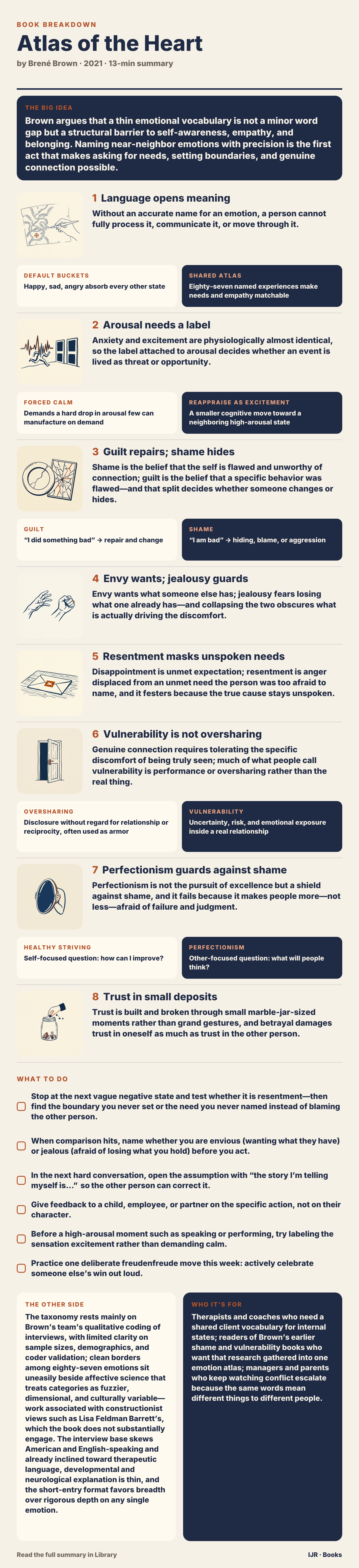
Brown opens from a finding drawn across thousands of interviews: most adults, in the moment, can identify only three emotions—happy, sad, and angry—and everything else collapses into those buckets. She treats that collapse as practical harm. Without an accurate name, people cannot process what they feel, ask for what they need, or offer empathy that matches another person’s actual state. A partner who says “stressed” while living in overwhelm gets time-management tips instead of reassurance. The book’s project is a shared atlas of emotion families, not clinical detachment.
She then walks clusters that arise under uncertainty and risk. Anxiety, fear, worry, excitement, dread, and overwhelm are sorted by object and by what the body is doing. Anxiety and excitement produce nearly identical arousal, so reappraisal toward excitement is often more reachable than a forced calm. Fear has a specific target; anxiety is freer-floating; worry is the looping cognition; dread anticipates a bad outcome already treated as certain. Each calls for a different response.
The middle chapters draw hard lines Brown has worked for decades. Guilt is “I did something bad”; shame is “I am bad.” Guilt tends to open repair; shame tends to open hiding or aggression. Envy wants what another has; jealousy guards what one already holds. Disappointment is unmet expectation; resentment is anger displaced from an unmet need or unheld boundary the resentful person never named. Mislabeling any of these pairs traps people in the wrong fix.
She reseats vulnerability as uncertainty, risk, and emotional exposure—not weakness and not oversharing without reciprocity. Foreboding joy, the pre-armoring that dampens good fortune by imagining loss, is met with gratitude practice as a correlational antidote from her interviews. The phrase “the story I’m telling myself” is offered as a way to voice interpretation without treating it as fact. Perfectionism is framed as an other-focused shame shield (“what will people think”) rather than healthy striving (“how can I improve”), and it fails because mistakes remain unavoidable.
Later sections treat trust, betrayal, and belonging as outcomes of the earlier work. Trust is composite—built through small, consistent behaviors captured in her BRAVING framework—rather than a single grand feeling. Betrayal damages self-trust as well as trust in the other. Belonging is separated from fitting in: the former accepts the person as they are; the latter requires self-alteration. The throughline lands simply: you cannot fix, request, or connect over a feeling you have mislabeled, so accurate naming comes before action.
Context
Brown draws on her research team’s decade of qualitative interview coding and on decades of her own shame and vulnerability work, including material revisited from Daring Greatly. Atlas of the Heart gathers that line of inquiry into a taxonomy of eighty-seven emotions and experiences aimed at giving readers a usable shared vocabulary rather than a single-topic deep dive.
The key ideas
1
Language opens meaning
Without an accurate name for an emotion, a person cannot fully process it, communicate it, or move through it.
Default buckets
Happy, sad, angry absorb every other state
Shared atlas
Eighty-seven named experiences make needs and empathy matchable
Brown reports from thousands of interviews that most adults, while feeling something, can reliably name only happy, sad, and angry. Every finer state gets forced into those three buckets. She treats the gap as structural, not cosmetic.
If you cannot name the state, you cannot ask for the matching need, and you cannot meet another person whose words point to a different inner experience than yours. Emotions also cluster in easily confused families; the confusion itself produces real harm in marriages and in therapy.
Her method for the rest of the book follows from this opening: take a cluster, draw the boundary using qualitative coding of transcripts, and show why the boundary changes what someone should do next. The atlas is meant for connection, not for turning people into clinicians of their own moods.
In practice: One partner says “I’m stressed” when the lived state is overwhelm—the sense of being unable to cope, not merely having too much to do—so the other offers scheduling tips instead of reassurance.

2
Arousal needs a label
Anxiety and excitement are physiologically almost identical, so the label attached to arousal decides whether an event is lived as threat or opportunity.
Forced calm
Demands a hard drop in arousal few can manufacture on demand
Reappraise as excitement
A smaller cognitive move toward a neighboring high-arousal state
Under uncertainty Brown sorts anxiety, fear, worry, excitement, dread, and overwhelm. The bodily signatures of anxiety and excitement—raised heart rate, sweaty palms, a cortisol spike—run nearly the same. Context and self-talk tip the experience one way or the other.
She points to anxiety-reappraisal work in which people told to say “I am excited” before a stressful task such as public speaking did better than those told to say “I am calm.” Excitement sits next to anxiety; calm demands an actual drop in arousal that is hard to produce on command. Telling someone to calm down asks for the harder move.
Fear, in her framing, has a specific identifiable target. Anxiety often floats toward an imagined future. Worry is the repetitive thinking that rides along with anxious arousal. Dread anticipates an event already treated as certain to be bad. Conflating them sends people to the wrong coping tool.
In practice: Waiting on medical test results: dread is certainty of a bad outcome, anxiety is the discomfort of not knowing, and worry is the mental loop trying to solve an unsolvable uncertainty.
3
Guilt repairs; shame hides
Shame is the belief that the self is flawed and unworthy of connection; guilt is the belief that a specific behavior was flawed—and that split decides whether someone changes or hides.
Guilt
“I did something bad” → repair and change
Shame
“I am bad” → hiding, blame, or aggression
Brown carries her long shame research into the atlas with a plain behavioral line: guilt sounds like “I did something bad,” shame like “I am bad.” Guilt attaches to a discrete action and, in her coded interview data, tends to motivate repair. Shame attaches to identity and tends to motivate hiding, blame, or aggression because the self feels under attack.
Her interview patterns link shame with addiction, violence, bullying, and depression; guilt does not show the same correlations and can even be adaptive. Humiliation sits nearby when the person believes the negative judgment is unjust, and it can feed resentment and retaliation rather than shame’s collapse. Embarrassment is the mild, short-lived, nearly universal end of the cluster.
The practical stake is how adults praise and criticize. Character-level labels build a shame-prone self-concept; behavior-level labels build a guilt-prone, change-capable one.
In practice: A parent who yells and thinks “I made a mistake yelling” moves toward apology; the same parent thinking “I am a terrible parent” often withdraws or over-explains, and neither repairs the bond.
4
Envy wants; jealousy guards
Envy wants what someone else has; jealousy fears losing what one already has—and collapsing the two obscures what is actually driving the discomfort.
Comparison emotions get their own family. Brown defines envy as the ache of lacking a quality, achievement, or possession another person holds. Jealousy is the fear that a valued relationship or possession already in hand is threatened by a third party.
People often say “jealous” for both, which muddies the next move. Envy invites a look at one’s own goals; jealousy invites a look at an actual relational threat. She also names freudenfreude—deliberately taking joy in another’s success—as a trainable counter to envy, with interview-linked reports of higher life satisfaction among people who practice it. Admiration and reverence respond to others’ qualities without envy’s sense of lack.
Like guilt and shame, these states share an uncomfortable self-referential feel, which is why they get swapped. Each still demands a different internal question.
In practice: An employee passed over for promotion who feels envy toward the colleague who got it, then mislabels the state as pure anger at the company, never clarifies what they actually want for themselves.

5
Resentment masks unspoken needs
Disappointment is unmet expectation; resentment is anger displaced from an unmet need the person was too afraid to name, and it festers because the true cause stays unspoken.
Brown groups disappointment, regret, discouragement, and resentment around unmet expectations. Disappointment is grief over an expectation that did not arrive; its intensity tracks the size of the expectation, which is why unspoken or unrealistic ones produce outsized pain.
Regret she treats as the cognitive act of imagining how things could have gone differently. She notes established work on counterfactual thinking associated with Kahneman and Tversky suggesting people regret inaction more than action over the long term, even when action-regret stings more in the short term.
Resentment is the chapter’s sharpest claim: anger that appears after someone failed to set or hold a boundary, then blames the other person for taking advantage of what was allowed. The real grievance is self-located—an unvoiced need—so the other person cannot fix it, and the feeling accumulates.
In practice: A spouse resents a partner for never planning date nights when the unspoken issue is that they never directly asked for what they wanted and expected it to be intuited.

6
Vulnerability is not oversharing
Genuine connection requires tolerating the specific discomfort of being truly seen; much of what people call vulnerability is performance or oversharing rather than the real thing.
Oversharing
Disclosure without regard for relationship or reciprocity, often used as armor
Vulnerability
Uncertainty, risk, and emotional exposure inside a real relationship
Brown reseats her signature idea inside the atlas. Vulnerability means uncertainty, risk, and emotional exposure. It is not weakness, and it is not indiscriminate disclosure. Oversharing, in her account, dumps information without regard for relationship or reciprocity and often functions as a shield against real exposure.
She revisits foreboding joy: the habit, common among parents and others with good fortune, of damping positive feeling by imagining loss in advance as pre-armor against future pain. Interview patterns in her work associate explicit gratitude practices with less of that foreboding, though she flags the evidence as correlational qualitative finding rather than a randomized trial.
A practical language move ties the chapter together: saying “the story I’m telling myself is…” signals interpretation rather than settled fact and leaves room for correction without immediate defensiveness. Shame research explains why exposure feels dangerous; comparison research explains why oversharing gets mistaken for closeness.
In practice: A coworker goes two days without answering an email; naming “the story I’m telling myself is that you’re ignoring me” invites missing context—such as a family emergency—instead of a silent verdict of disrespect.

7
Perfectionism guards against shame
Perfectionism is not the pursuit of excellence but a shield against shame, and it fails because it makes people more—not less—afraid of failure and judgment.
Healthy striving
Self-focused question: how can I improve?
Perfectionism
Other-focused question: what will people think?
Brown draws a hard line between healthy striving and perfectionism even though both can look like high standards from outside. Healthy striving is self-focused and asks how to improve. Perfectionism is other-focused at the root and asks what people will think.
Her research links perfectionism with depression, anxiety, and addiction. The mechanism she offers is that perfectionism tries to avoid shame and blame by never handing others anything to criticize—an impossible strategy because mistakes are unavoidable. Feedback then lands as an existential verdict rather than data about the work.
She ties the pattern back to the guilt/shame split: perfectionists have collapsed “I made a flawed thing” into “I am flawed.” Comparison culture and social media act as accelerants of a pre-existing ranking tendency. Unlearning the pattern requires the vulnerability skills of being willing to be seen making mistakes, and decoupling self-worth from outcome.
In practice: A student rewrites a paper a dozen times not to improve it but to preempt every possible criticism, then reads a low grade as proof of unworthiness rather than information about the paper.

8
Trust in small deposits
Trust is built and broken through small marble-jar-sized moments rather than grand gestures, and betrayal damages trust in oneself as much as trust in the other person.
In the later stretch Brown treats trust, betrayal, and belonging as outcome states of the whole atlas. She revisits BRAVING—boundaries, reliability, accountability, vault (confidentiality), integrity, non-judgment, and generosity—as the composite behaviors that build trust in increments. Trust erodes through many minor breaches more often than through a single collapse.
Betrayal, as she defines it, involves secrecy, breaking a specific commitment, or withholding critical information. It differs from plain disappointment because the betrayed person also has to reckon with having misjudged the relationship, so self-trust takes a hit. The pattern runs across a spectrum from dramatic breaches to quieter ones such as a friend sharing a confidence.
Belonging is split from fitting in. Fitting in demands changing oneself to be accepted. Belonging accepts the person as they are, and in her arc it only holds after the shame and vulnerability work of earlier chapters; otherwise the appearance of belonging is successful fitting-in. Boundary skill from the resentment chapter, guilt/shame clarity for repair, and tolerance for exposure all feed this ending.
In practice: Infidelity sits at one end of her betrayal spectrum; a friend passing on a confidence sits further along the same continuum of secrecy and broken commitment.
Key terms
- Shame The belief that the self is flawed and therefore unworthy of connection—“I am bad.”
- Guilt The belief that a specific behavior was flawed—“I did something bad”—which can motivate repair.
- Overwhelm The sense of being unable to cope, distinct from simply having too much to do.
- Foreboding joy Damping a good feeling by imagining future loss as pre-armor against pain.
- Freudenfreude The practice of taking genuine joy in someone else’s success.
- BRAVING Brown’s trust checklist: boundaries, reliability, accountability, vault, integrity, non-judgment, generosity.
- Belonging vs fitting in Belonging is being accepted as you are; fitting in requires changing yourself to be accepted.
- The story I’m telling myself A phrase that marks an interpretation as a story, inviting correction instead of defensiveness.
- Resentment Anger aimed at others after you failed to set or hold a boundary or voice a need.
- Vulnerability Uncertainty, risk, and emotional exposure—not weakness and not reckless oversharing.
What to do
- Stop at the next vague negative state and test whether it is resentment—then find the boundary you never set or the need you never named instead of blaming the other person.
- When comparison hits, name whether you are envious (wanting what they have) or jealous (afraid of losing what you hold) before you act.
- In the next hard conversation, open the assumption with “the story I’m telling myself is…” so the other person can correct it.
- Give feedback to a child, employee, or partner on the specific action, not on their character.
- Before a high-arousal moment such as speaking or performing, try labeling the sensation excitement rather than demanding calm.
- Practice one deliberate freudenfreude move this week: actively celebrate someone else’s win out loud.
Questions to think with
- Which of your recurring conflicts might be two people using the same emotion word for different inner states?
- Where are you calling something stress, anger, or jealousy when a finer name—overwhelm, resentment, envy—would change the next step?
- What boundary have you never set that is now feeding a quiet resentment you blame on someone else?
- In feedback you give at home or work, do your words target character or behavior?
- When good news arrives, do you let yourself feel it or immediately rehearse loss?
The other side
The taxonomy rests mainly on Brown’s team’s qualitative coding of interviews, with limited clarity on sample sizes, demographics, and coder validation; clean borders among eighty-seven emotions sit uneasily beside affective science that treats categories as fuzzier, dimensional, and culturally variable—work associated with constructionist views such as Lisa Feldman Barrett’s, which the book does not substantially engage. The interview base skews American and English-speaking and already inclined toward therapeutic language, developmental and neurological explanation is thin, and the short-entry format favors breadth over rigorous depth on any single emotion.
Who it's for
Therapists and coaches who need a shared client vocabulary for internal states; readers of Brown’s earlier shame and vulnerability books who want that research gathered into one emotion atlas; managers and parents who keep watching conflict escalate because the same words mean different things to different people.