




How black edge wrecked SAC and left Cohen free
Anyone who trades, manages risk, or reads courtroom sagas will see how a named spectrum of illegal tips ran a $15 billion fund—and why the founder walked.
IJR · Nov 4, 2026 · 12 min read
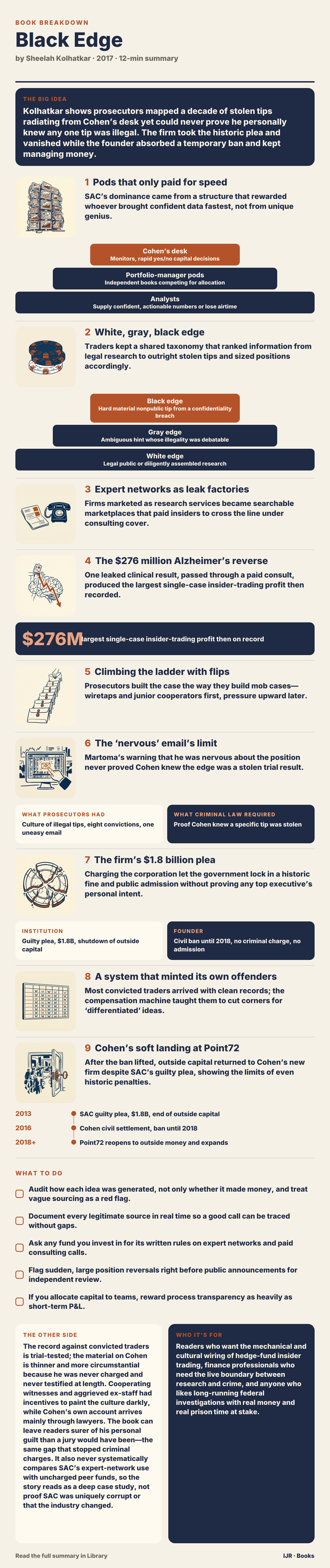
In 60 seconds
- SAC’s pod structure paid for speed and conviction, not for how ideas were sourced.
- Floor slang ranked edge as white, gray, or black; the darkest tips got the biggest bets.
- Expert networks turned paid doctor calls into an industrial leak channel.
- Martoma’s reverse on a failed Alzheimer’s drug netted a $276 million illegal profit.
- Prosecutors flipped eight SAC staff with wiretaps yet never charged Cohen himself.
- The firm pleaded guilty, paid $1.8 billion, and died; Cohen later ran billions again at Point72.
The big idea
Kolhatkar shows prosecutors mapped a decade of stolen tips radiating from Cohen’s desk yet could never prove he personally knew any one tip was illegal. The firm took the historic plea and vanished while the founder absorbed a temporary ban and kept managing money.
The book in brief
In July 2008 Mathew Martoma learned a University of Michigan neurologist’s unblinded Alzheimer’s trial data before the public did. SAC dumped a long book and built a short, reversing roughly $700 million in exposure. When the failure hit the tape the stocks crashed; prosecutors later called the $276 million haul the largest single insider-trading profit then on record.
Kolhatkar backs up from that trade to show how Steven Cohen built SAC. He began as a 1970s floor trader and grew the firm to roughly $15 billion by seating independent portfolio managers in competing pods. Each manager needed a constant stream of high-conviction ideas to keep capital; Cohen sat at a wall of monitors and often acted on a single phone call before the speaker finished. Vague research was dismissed. Actionable data points were rewarded. The system never asked how the data arrived.
Traders already had names for the spectrum. White edge was legal public work. Gray edge sat in the fog. Black edge was hard, material, nonpublic information stolen through a breach. Portfolio managers sometimes asked juniors outright whether an idea was black before sizing the position. Expert-network firms such as Gerson Lehrman supplied the pipeline: doctors and engineers paid tens of thousands per call who crossed from general knowledge into unreleased trial numbers and earnings figures.
Federal investigators, led by Preet Bharara’s office and FBI agent B.J. Kang, worked bottom-up the way they chase organized crime. Wiretaps and cooperation deals flipped junior traders; each conviction raised pressure on the next. By the time they reached Martoma they had already locked up several SAC employees and could argue the flow was systemic. The one piece aimed at Cohen—an email from Martoma saying he was “nervous” about the Elan position—never proved Cohen knew the source was a leaked clinical result rather than ordinary analysis.
In 2013 the firm itself pleaded guilty to securities fraud, paid $1.8 billion, and quit managing outside money. Cohen settled a civil failure-to-supervise case, sat out until 2018, then reopened Point72 with much of the old staff. Investors returned. The book closes on that imbalance: the people who placed the illegal trades took prison time; the architect of the incentive system did not.
Context
Sheelah Kolhatkar’s 2017 reconstruction of the decade-long federal probe into Steven Cohen and SAC Capital Advisors matters because it shows how power, wealth, and the need to prove individual knowledge can leave a founder untouched even after the institution around him collapses under a guilty plea.
The key ideas

1
Pods that only paid for speed
SAC’s dominance came from a structure that rewarded whoever brought confident data fastest, not from unique genius.
- Cohen’s deskMonitors, rapid yes/no capital decisions
- Portfolio-manager podsIndependent books competing for allocation
- AnalystsSupply confident, actionable numbers or lose airtime
Cohen started on the floor in the 1970s and scaled SAC to roughly $15 billion by giving each portfolio manager a slice of capital and making them compete for more. Risk was decentralized; pressure was not. Every manager needed a steady flow of ideas that justified the allocation.
Cohen himself sat at the center of a wall of monitors, absorbing pitches from dozens of subordinates and firing off trades, sometimes before the caller finished a sentence. Analysts who arrived with hedged opinions were waved off. Those who arrived with a hard, actionable number got capital and bonuses.
Nothing in the rulebook ordered anyone to break the law. The marketplace inside the firm simply treated information—source unknown—as the only currency that counted. When pay is tied solely to who knows more right now, and no one asks how the knowing happened, illegal sourcing becomes the rational next step.
In practice: A trader who could finish a sentence with a precise data point walked out with more capital; a trader who hedged left empty-handed.

2
White, gray, black edge
Traders kept a shared taxonomy that ranked information from legal research to outright stolen tips and sized positions accordingly.
- Black edgeHard material nonpublic tip from a confidentiality breach
- Gray edgeAmbiguous hint whose illegality was debatable
- White edgeLegal public or diligently assembled research
Kolhatkar lifts the book’s title straight from floor slang. White edge meant advantage built from public filings, customer checks, or industry experts talking about observable trends. Gray edge lived in the middle: material-feeling hints whose legal status was debatable. Black edge was unambiguous—hard nonpublic facts obtained by breaching a duty, such as an insider’s earnings number or an unreleased trial result.
The existence of the vocabulary itself is the point. Traders did not stumble into illegal tips; they had names and categories for them. Some portfolio managers asked juniors outright whether an idea was black before deciding how large to go. Full-conviction bets, several admitted, were reserved for the surest, darkest information.
That naming practice flourished inside SAC and peer funds under the cover of plausible deniability. Proving what a trader actually knew versus merely suspected remained hard, so the category survived.
In practice: Managers sometimes asked, before sizing a trade, whether the idea was black; the answer often decided position size.

3
Expert networks as leak factories
Firms marketed as research services became searchable marketplaces that paid insiders to cross the line under consulting cover.
Gerson Lehrman and similar networks connected hedge-fund analysts with doctors, engineers, and corporate employees for a fee. On paper the product was general expertise—how a drug class works, standard manufacturing timelines. In practice analysts quickly learned which experts would go further.
Specific unreleased trial data and internal performance numbers moved across those calls. Payments sometimes ran into the tens of thousands of dollars per conversation. Because the frame was “consulting,” both sides could tell themselves the exchange was legitimate.
The infrastructure explains why insider trading scaled industry-wide in the 2000s instead of staying rare. What once required a personal relationship became a searchable catalog of willing leakers. SAC was a heavy user; several of its analysts built careers around the same experts who repeatedly crossed the line.
In practice: A former SAC manager’s paid calls with a university researcher on an Alzheimer’s drug became the government’s central case.

4
The $276 million Alzheimer’s reverse
One leaked clinical result, passed through a paid consult, produced the largest single-case insider-trading profit then recorded.
$276M
largest single-case insider-trading profit then on record
Martoma cultivated Dr. Sidney Gilman, a University of Michigan neurologist on the safety-monitoring committee for bapineuzumab, an Elan-Wyeth Alzheimer’s drug. Gilman was paid through an expert network and, over repeated conversations, shared confidential interim data.
In July 2008 Gilman told Martoma the full unblinded result ahead of the public presentation: the drug had failed. Within days SAC sold its entire long exposure and built a short, reversing roughly $700 million. When the news hit, both stocks dropped sharply. Prosecutors put the illegal profit at $276 million.
Phone records, travel records, and trial testimony reconstructed the sequence: Martoma flew to Michigan to meet Gilman just before the books flipped. The size and abruptness of the reverse became the evidence that exposed the scheme.
In practice: Martoma’s Michigan meeting with Gilman immediately preceded SAC’s full long-to-short flip on Elan and Wyeth.

5
Climbing the ladder with flips
Prosecutors built the case the way they build mob cases—wiretaps and junior cooperators first, pressure upward later.
The Southern District under Preet Bharara and FBI agent B.J. Kang, fresh from the Galleon case, did not start with Cohen. They targeted lower-level analysts and portfolio managers whose specific illegal trades could be proved, then offered reduced sentences for testimony against the next tier.
Noah Freeman and Jon Horvath pleaded guilty and implicated others. Wiretaps—authorized under standards usually reserved for narcotics and organized crime—caught traders discussing tips in real time, giving prosecutors direct audio instead of only circumstantial patterns.
The work stretched years because each case had to prove the trader knew the information was both material and improperly obtained. By the time Martoma was reached, several SAC employees had already been convicted, strengthening the claim that illegal flow was systemic rather than a few rogue acts.
In practice: Wiretaps captured live tip talk; each guilty plea added leverage on the person one rung higher.

6
The ‘nervous’ email’s limit
Martoma’s warning that he was nervous about the position never proved Cohen knew the edge was a stolen trial result.
What prosecutors had
Culture of illegal tips, eight convictions, one uneasy email
What criminal law required
Proof Cohen knew a specific tip was stolen
Eight current or former SAC employees were convicted; Cohen was never charged criminally. The closest documentary link was an email Martoma sent before the Elan reverse saying he was “nervous” about the position. It showed unease; it did not show that Cohen knew the conviction came from Gilman’s leaked data rather than ordinary analysis.
Cohen’s defense held that he trusted dozens of managers’ judgment every day and that trusting a subordinate’s call is not the same as knowingly trading on a tip. The SEC brought a civil failure-to-supervise case with a lower burden of proof; it settled in 2016 with a ban on managing outside money until 2018 and no admission of insider trading.
Kolhatkar treats the gap as structural: years of work mapped illegal flow outward from Cohen’s desk, yet the demand to prove personal knowledge communication-by-communication protected the person at the center while subordinates carried the risk.
In practice: The ‘nervous’ email became the key exhibit aimed at Cohen and still fell short of criminal knowledge.

7
The firm’s $1.8 billion plea
Charging the corporation let the government lock in a historic fine and public admission without proving any top executive’s personal intent.
Institution
Guilty plea, $1.8B, shutdown of outside capital
Founder
Civil ban until 2018, no criminal charge, no admission
In 2013 SAC Capital pleaded guilty to criminal securities fraud, agreed to pay $1.8 billion in fines and forfeiture—the largest insider-trading settlement then on record—and stopped managing outside client money, ending the public firm.
A corporation can be held liable for employees’ acts inside the scope of employment, a far lower bar than proving an individual executive’s knowledge and intent. That path let prosecutors establish, through the firm’s own plea, that insider trading had been substantial and had run for more than a decade.
Negotiators insisted on that “substantial” and “more than a decade” language, shaping public perception of Cohen even though he faced no personal criminal charge—an efficient institutional win while the founder stayed several communications removed from any single provable act.
In practice: The guilty plea language forced the firm to admit fraud spanning more than a decade, a public branding Cohen himself never had to accept in court.

8
A system that minted its own offenders
Most convicted traders arrived with clean records; the compensation machine taught them to cut corners for ‘differentiated’ ideas.
Martoma, Freeman, Horvath and others were not career criminals. Several came from strong academic backgrounds and first built legitimate research skills. What changed, according to people Kolhatkar interviewed, was relentless pressure: underperformance was punished, conviction-weighted bets were rewarded, and sourcing questions were rarely asked.
Martoma had earlier been expelled from Harvard Business School for fabricating a transcript—a corner-cutting habit the SAC environment amplified rather than filtered. Cohen’s standing demand for ideas nobody else had created a structural hunger that could be fed, again and again, only by information nobody else legally possessed.
Individual prosecutions remove individual people. The book’s claim is that the reward architecture itself was designed to produce the same behavior in whoever next occupied the seat.
In practice: Martoma’s prior transcript fabrication met a culture that prized unobtainable edges and multiplied the risk-taking.

9
Cohen’s soft landing at Point72
After the ban lifted, outside capital returned to Cohen’s new firm despite SAC’s guilty plea, showing the limits of even historic penalties.
- 2013SAC guilty plea, $1.8B, end of outside capital
- 2016Cohen civil settlement, ban until 2018
- 2018+Point72 reopens to outside money and expands
Barred from outside money until 2018, Cohen kept managing his own multibillion-dollar fortune through the family office Point72, retaining much of SAC’s staff and infrastructure. When the clock ran out, investors lined up again; Point72 grew into a major hedge fund once more.
Kolhatkar frames the ending as evidence that a $1.8 billion fine and temporary ban may not deter someone whose personal wealth can absorb the hit without lifestyle change. Meanwhile Martoma and other convicted employees took significant prison time and permanent career destruction—the opposite distribution of consequences from the pressure system that produced the trades.
Expert networks kept operating; funds kept paying for differentiated information; no later case reached as close to a founder. The investigation was among the most thorough in securities history, yet its effect on the underlying incentive structure remains unsettled.
In practice: Once the 2018 ban expired, outside investors returned capital to Point72 despite the prior firm’s criminal plea.
Key terms
- Black edge Hard, material, nonpublic information obtained by breaching confidentiality.
- White edge Legal advantage from public data or ordinary expert research.
- Gray edge Ambiguous mid-zone tips whose illegality is debatable.
- Expert network Paid matching service connecting funds with industry insiders under a consulting frame.
- Pod structure Independent portfolio-manager teams competing for capital from the center.
- Differentiated idea Cohen’s demand for an insight nobody else already had.
- Failure to supervise Civil charge used against Cohen that required less proof than criminal insider trading.
- Point72 Cohen’s family office that later reopened to outside capital after the ban.
What to do
- Audit how each idea was generated, not only whether it made money, and treat vague sourcing as a red flag.
- Document every legitimate source in real time so a good call can be traced without gaps.
- Ask any fund you invest in for its written rules on expert networks and paid consulting calls.
- Flag sudden, large position reversals right before public announcements for independent review.
- If you allocate capital to teams, reward process transparency as heavily as short-term P&L.
Questions to think with
- Where does your own information diet sit on the white-gray-black spectrum, and who decides?
- If a subordinate emailed you that they were ‘nervous’ about a winning position, what follow-up would you require?
- Does charging the firm while the founder walks strengthen or weaken deterrence for the next fund?
- Would investors still return capital to a brand after a $1.8 billion criminal plea if the returns stayed high?
- What single change in compensation would most reduce the hunger for black edge?
The other side
The record against convicted traders is trial-tested; the material on Cohen is thinner and more circumstantial because he was never charged and never testified at length. Cooperating witnesses and aggrieved ex-staff had incentives to paint the culture darkly, while Cohen’s own account arrives mainly through lawyers. The book can leave readers surer of his personal guilt than a jury would have been—the same gap that stopped criminal charges. It also never systematically compares SAC’s expert-network use with uncharged peer funds, so the story reads as a deep case study, not proof SAC was uniquely corrupt or that the industry changed.
Who it's for
Readers who want the mechanical and cultural wiring of hedge-fund insider trading, finance professionals who need the live boundary between research and crime, and anyone who likes long-running federal investigations with real money and real prison time at stake.