




Shame keeps millennials broke more than bad math does
Erin Lowry’s Broke Millennial is for young adults who freeze at bank apps out of dread, not laziness.
IJR · Nov 4, 2026 · 12 min read
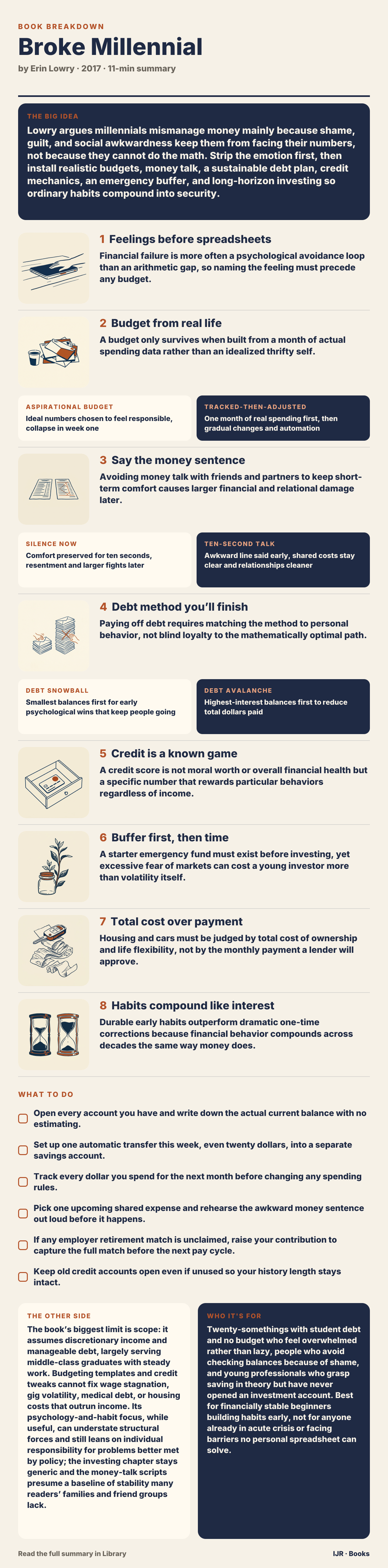
In 60 seconds
- Lowry argues money failure is usually psychological avoidance, not missing arithmetic, so mindset work must come before any spreadsheet.
- Budgets collapse when built on aspirational numbers instead of a month of real tracked spending, then adjusted slowly.
- Silence with friends and partners over shared costs delays conflict and breeds resentment a ten-second talk would prevent.
- Debt payoff should follow the method a person will actually finish—snowball for early wins or avalanche for lower total cost.
- A credit score is a gameable number rewarding payment history, low utilization, and long account age, not income or moral worth.
- Build a one-month emergency buffer before investing, claim any employer match, then use time in low-cost index funds rather than waiting out fear.
The big idea
Lowry argues millennials mismanage money mainly because shame, guilt, and social awkwardness keep them from facing their numbers, not because they cannot do the math. Strip the emotion first, then install realistic budgets, money talk, a sustainable debt plan, credit mechanics, an emergency buffer, and long-horizon investing so ordinary habits compound into security.
The book in brief
Lowry starts from a blunt diagnosis: young adults who overspend or hide from their balances are rarely ignorant of basic math. They are stuck in avoidance loops powered by shame about past mistakes, anxiety at opening an app, and guilt over small pleasures. Until those feelings are named, no budgeting tool sticks, because people will not sustain habits they experience as self-punishment.
She then moves into mechanics that respect that psychology. Spending is tracked honestly for a stretch before any cuts. A budget is built from actual history rather than an idealized version of thrift, and the reader chooses a framework—zero-based or percentage buckets—that matches their temperament. Automation handles savings and bills so daily willpower is not the only glue.
The middle stretch treats money as a social act. Lowry supplies scripts for the moments millennials dodge: splitting checks, declining costly trips, disclosing debt to a partner, and dividing rent by income instead of fifty-fifty. Private plans fail the moment shared costs stay unspoken and quiet resentment compounds.
Debt and credit come next as systems, not moral tests. Student loans and cards are stripped of shame; the reader picks snowball or avalanche by what they will finish. Credit scores are demystified as five weighted behaviors that can be worked even on modest income. Only after high-interest balances and a starter cash buffer are handled does investing begin—employer matches first, then simple index funds—because lost compounding from a decade of fear costs more than riding out downturns.
Big purchases close the practical arc. Cars and homes are judged by total ownership cost and life flexibility, not the monthly payment a lender will approve. The final thread is that none of these steps are one-time fixes. Automated contributions, quarterly budget check-ins, and honest money talk become habits that compound across decades the same way interest does, turning competence into a maintained relationship with money rather than a crash diet.
Context
Erin Lowry published Broke Millennial in 2017 for readers carrying student debt, money anxiety, and little formal teaching. It stood out by treating emotional avoidance and awkward money conversations as core skills rather than footnotes to spreadsheets.
The key ideas

1
Feelings before spreadsheets
Financial failure is more often a psychological avoidance loop than an arithmetic gap, so naming the feeling must precede any budget.
Lowry rejects the idea that overspending or neglected accounts are mainly knowledge problems. Most people who hide from money already understand basic math; they are dodging an emotional confrontation. Shame over old mistakes, anxiety at a bank balance, and guilt about small pleasures create loops no app can break alone.
Her first move is separation of work: name the attached feeling—fear, guilt, peer competitiveness on social media—then address the behavior it produces. A financial audit is framed as diagnosis, not punishment, and is done without self-judgment because judgment itself caused the avoidance.
Everything later in the book depends on looking at numbers regularly. People do not keep habits they experience as self-punishment. Structural pressures like stagnant wages and high rent still matter, yet her mechanism is simple: you cannot budget what you refuse to see.
In practice: A reader kept multiple bank accounts partly so she never had to confront the full picture of her debt—a willful blindness driven by fear rather than laziness.

2
Budget from real life
A budget only survives when built from a month of actual spending data rather than an idealized thrifty self.
Aspirational budget
Ideal numbers chosen to feel responsible, collapse in week one
Tracked-then-adjusted
One month of real spending first, then gradual changes and automation
Once emotional blocks ease, Lowry’s practical start is honest tracking for a set period, usually a month, before any restrictions. Most plans fail because they are modeled on aspiration: someone assigns a responsible-sounding dining number that bears no relation to how they live, then the whole plan collapses in week one.
The fix is reverse order. Build from historical spending first, then adjust gradually. She offers frameworks without crowning one universal winner: zero-based budgeting that gives every dollar a job, or broader percentage splits across needs, wants, and savings. A detail-loving person may thrive on zero-based rules; someone exhausted by receipts does better with loose buckets.
Automation of savings and bills removes willpower from the pieces that should not depend on daily motivation. Invisible leaks—small recurring subscriptions and daily coffee—matter not as moral failures but as costs that erode a plan without being noticed. The budget must feel realistic rather than punitive so it does not re-trigger the earlier avoidance.
In practice: Someone allocates fifty dollars for dining out because it sounds responsible, not because it matches real habits, and the budget breaks within days.

3
Say the money sentence
Avoiding money talk with friends and partners to keep short-term comfort causes larger financial and relational damage later.
Silence now
Comfort preserved for ten seconds, resentment and larger fights later
Ten-second talk
Awkward line said early, shared costs stay clear and relationships cleaner
Lowry treats social discomfort as a core literacy gap. Many millennials grew up in households where money was taboo and now face group dinners, shared vacations, and dates where nobody wants to be the person who mentions the bill.
Silence does not prevent conflict; it delays and escalates it. An unspoken forty-dollar imbalance or a hidden card balance compounds into resentment that a brief upfront conversation would have stopped. She supplies concrete scripts: splitting a check when one person ordered less, declining a destination wedding, negotiating date costs, and disclosing debt before finances join.
A private budget is useless the moment rent, trips, or gifts stay undiscussed. Financial communication is part of literacy, and most advice books ignore this layer. Proportional splits based on income, rather than flat halves, often prevent quiet bitterness between partners who earn differently.
In practice: Partners with unequal incomes who default to fifty-fifty rent and utilities quietly build resentment that proportional splitting would have avoided.

4
Debt method you’ll finish
Paying off debt requires matching the method to personal behavior, not blind loyalty to the mathematically optimal path.
Debt snowball
Smallest balances first for early psychological wins that keep people going
Debt avalanche
Highest-interest balances first to reduce total dollars paid
Lowry strips the moral failing narrative from student loans and card balances. These debts are common and heavily marketed to young adults; carrying them does not prove irresponsibility. What matters is a plan the reader will sustain.
Two dominant strategies sit side by side. The snowball pays smallest balances first for quick psychological wins. The avalanche pays highest-interest balances first to minimize total cost. Avalanche wins on pure math; snowball often wins on motivation. The better method is whichever one gets finished.
She also draws a line between debt that builds future earning power—reasonable student loans or a mortgage—and high-interest consumer debt with no asset behind it. Surplus dollars created by the budget should hit the costly balances first, not the emotionally preferred ones, once the reader can face the full total without panic moves like an unresearched consolidation loan.
In practice: A reader throws every spare dollar at a low-interest student loan while paying only the minimum on a high-interest card, which costs more over time.

5
Credit is a known game
A credit score is not moral worth or overall financial health but a specific number that rewards particular behaviors regardless of income.
Lowry demystifies the score by naming its five weighted factors: payment history, amounts owed, length of credit history, credit mix, and new inquiries. Low income does not automatically mean a low score; high income does not guarantee a good one.
Young adults often err in opposite directions. Some avoid credit entirely out of debt fear and thereby stall history. Others max cards or miss payments and damage the number. Practical moves include keeping old accounts open even when unused, because length of history counts, and holding utilization to a small percentage of the limit even when balances are paid monthly.
The score becomes the record behind future mortgages, apartment approvals, and even some job screens. Someone who has just built a debt payoff plan needs to understand how that repayment behavior is scored and reused by other institutions. The system is to be worked, not feared or moralized.
In practice: A reader closed her oldest card to dodge an annual fee, shortened her credit history, and watched her score drop.

6
Buffer first, then time
A starter emergency fund must exist before investing, yet excessive fear of markets can cost a young investor more than volatility itself.
Lowry sets a clear order. Build a small starter buffer—roughly one month of expenses—before aggressive extra debt payments or investing. Later expand toward three to six months once high-interest debt is under control. The cash stops a single car repair or medical bill from undoing months of progress and forcing new debt.
After the buffer, she pushes against the millennial instinct to avoid markets entirely after growing up around the 2008 crisis. Time in the market matters more than timing it. A twenty-five-year-old who delays a full decade out of volatility fear loses more to missing compounding than a downturn they simply rode out would have cost.
Basic vehicles come next: never leave an employer retirement match unclaimed, treat low-cost index funds as a beginner default over stock-picking, and choose traditional versus Roth accounts by expected future tax bracket. Surplus dollars only reach this stage after debt, credit, and the cash buffer are handled.
In practice: A reader turns down a 401(k) match to feel her debt is gone first; the lost match exceeds the interest saved by the extra debt payment.

7
Total cost over payment
Housing and cars must be judged by total cost of ownership and life flexibility, not by the monthly payment a lender will approve.
Lowry turns to first-time big-ticket decisions: renting versus buying, car loans, mortgages. Lenders and salespeople often green-light more than a person should take because their math only checks whether payments clear, not whether the rest of a healthy financial life still fits.
For cars she insists on total cost of ownership—insurance, maintenance, depreciation—not just the loan payment. Comparing affordability by monthly size alone lets buyers stretch terms into worse overall deals. On housing, buying only makes sense with enough job and geographic stability; transaction costs can wipe out gains if someone must move within a few years.
These purchases compete directly with retirement contributions and emergency savings for the same limited dollars. No decision gets evaluated in isolation from the whole picture built earlier.
In practice: A reader nearly bought a house because the monthly mortgage looked low, without pricing property taxes, maintenance, or the chance of relocating for work inside two years.

8
Habits compound like interest
Durable early habits outperform dramatic one-time corrections because financial behavior compounds across decades the same way money does.
In the close, Lowry gathers mindset, budgeting, communication, debt, credit, investing, and big purchases into one claim: none are single fixes. They are ongoing habits. A twenty-five-year-old who automates a modest retirement contribution and revisits her budget quarterly will beat, over decades, someone who makes a few dramatic corrections but sustains no system.
She returns to the opening emotional theme. Financial health is less a destination than a maintained relationship with money that needs periodic honest check-ins, similar to the original audit. The procedural systems installed earlier—automated savings, money-talk scripts, a chosen debt method—require less willpower over time once they are running.
Competence is learnable at any income level. The aim was never quick riches; it was removing the fear and avoidance that made money feel unmanageable so ordinary habits could compound into long-term security.
In practice: Two people start with identical salaries; the one who begins investing modestly at twenty-five ends far ahead at retirement of the one who waits until thirty-five, purely from the extra decade of compounding.
Key terms
- financial audit A nonjudgmental look at every balance and debt to diagnose avoidance, not to punish yourself
- zero-based budget Every dollar of income is assigned a job until nothing is left unallocated
- debt snowball Pay the smallest balances first to collect quick psychological wins
- debt avalanche Pay the highest-interest balances first to minimize total interest cost
- credit utilization The percentage of available credit you are currently using; lower is better for the score
- emergency fund Cash buffer starting at roughly one month of expenses, later growing to three to six months
- good debt Borrowing that builds future earning power, such as reasonable student loans or a mortgage
- total cost of ownership All lifetime costs of a car or home—insurance, maintenance, taxes, depreciation—beyond the monthly payment
What to do
- Open every account you have and write down the actual current balance with no estimating.
- Set up one automatic transfer this week, even twenty dollars, into a separate savings account.
- Track every dollar you spend for the next month before changing any spending rules.
- Pick one upcoming shared expense and rehearse the awkward money sentence out loud before it happens.
- If any employer retirement match is unclaimed, raise your contribution to capture the full match before the next pay cycle.
- Keep old credit accounts open even if unused so your history length stays intact.
Questions to think with
- What feeling hits first when you open your banking app, and what behavior does it produce?
- Which debt method would you actually finish—fast small wins or the lower total-interest path?
- Where do you stay silent about money with friends or partners, and what quiet resentment is building?
- Are you leaving an employer match on the table or delaying investing out of old market fear?
- For your next car or housing decision, have you priced total ownership cost or only the monthly payment?
The other side
The book’s biggest limit is scope: it assumes discretionary income and manageable debt, largely serving middle-class graduates with steady work. Budgeting templates and credit tweaks cannot fix wage stagnation, gig volatility, medical debt, or housing costs that outrun income. Its psychology-and-habit focus, while useful, can understate structural forces and still leans on individual responsibility for problems better met by policy; the investing chapter stays generic and the money-talk scripts presume a baseline of stability many readers’ families and friend groups lack.
Who it's for
Twenty-somethings with student debt and no budget who feel overwhelmed rather than lazy, people who avoid checking balances because of shame, and young professionals who grasp saving in theory but have never opened an investment account. Best for financially stable beginners building habits early, not for anyone already in acute crisis or facing barriers no personal spreadsheet can solve.