




Your body stays stressed until the cycle finishes
The Nagoskis argue stress and its trigger are separate problems, so solving the crisis never automatically calms the body.
IJR · Oct 21, 2026 · 11 min read
In 60 seconds
- Stressors and stress need two different solutions; fixing the event does not end the arousal.
- Unfinished stress cycles stack like debt and raise the baseline for whatever comes next.
- Movement, longer exhales, held touch, shared laughter, tears, and creative work signal safety to the body.
- Burnout has three separable faces: exhaustion, depersonalization, and collapsed accomplishment.
- Human Giver Syndrome and appearance pressure culturally demand endless giving, especially from women.
- Daily cycle-completion and structural change work on different scales; neither replaces the other.
The big idea
Emily and Amelia Nagoski argue modern life leaves people stuck partway through a physiological stress response they never finish, so arousal accumulates after the original problem is solved. Practices that complete the cycle are necessary, yet cultural demands for endless giving mean personal technique alone cannot end burnout without institutional change.
The book in brief
The Nagoskis start from a confusion most people never name: the external event that upsets you and the internal arousal it produces get treated as one problem. They show why animals finish the cascade with physical discharge while human stressors rarely send a clean all-clear, then argue unfinished responses do not fade.
The argument next turns to what actually ends the cascade, before reframing burnout itself as a three-part syndrome rather than plain tiredness. Cultural forces follow: some people are cast as endless givers, and appearance norms add another unpaid background demand.
Meaning and social connection appear as real energy sources that institutions often drain without refill. An internal tracking system decides whether effort still links to reward, and when it concludes the link is broken, drive collapses even if capacity remains.
The book lands on a dual claim. Daily practices can discharge today’s arousal. Lasting relief also requires changing the institutions and norms that keep generating unfinished cycles.
Context
Emily Nagoski and Amelia Nagoski published Burnout in 2019, drawing on physiology, psychology, and feminist theory. They aim the argument at exhaustion that outlasts the hard part of the day, especially among women and caregivers.
The key ideas
1
Two separate problems
A stressor is the external trigger; stress is the internal cascade, and solving one does not finish the other.
Stressor
External event: email, deadline, fight, sick child
Stress
Internal hormonal and nervous-system cascade that outlasts the event
The Nagoskis open with a split most people skip. A hostile email, sick child, or deadline is a stressor. Stress is the hormonal and nervous-system activation that follows.
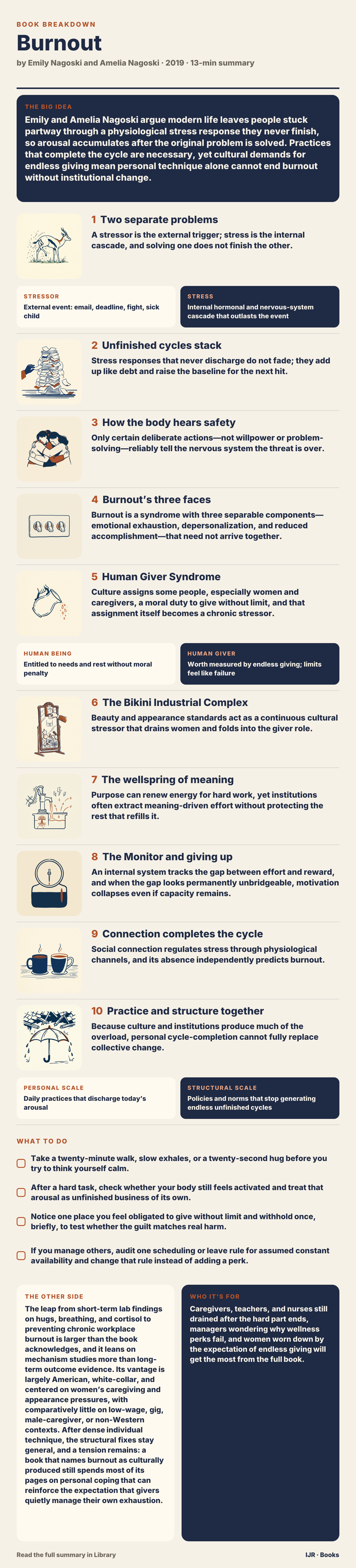
They describe a gazelle that escapes a lion, then physically shakes off surplus adrenaline before grazing again. Its system completes the loop. Human stressors rarely deliver that finish line; an email gets answered and often spawns another.
Without a clear safety signal, arousal can linger long after the event ends. Handling the to-do list is necessary but not enough. The body needs its own deliberate practice for standing down.
In practice: A parent may resolve a morning argument by lunch yet still feel tense at dinner because the stress response never received the signal to stop.

2
Unfinished cycles stack
Stress responses that never discharge do not fade; they add up like debt and raise the baseline for the next hit.
The authors claim an incomplete cycle behaves like debt rather than a mood that passes. Each one lifts the floor of arousal the next stressor builds on.
That is why someone can manage one hard day and collapse after a week of ordinary ones. The human prefrontal cortex can replay a stressor and re-trigger the same hormones without any discharge.
Drawing on stress physiology associated with Robert Sapolsky and Peter Levine, they reframe burnout as the slow pile-up of many small unfinished loops, not one dramatic crisis.
In practice: A commuter whose stress fires in traffic can still show measurable arousal hours later if they sit at a screen and never move, breathe deliberately, or connect.
3
How the body hears safety
Only certain deliberate actions—not willpower or problem-solving—reliably tell the nervous system the threat is over.
The Nagoskis list concrete ways to complete the cycle, ranked roughly by reliability. Physical activity leads: twenty to sixty minutes of movement mimics the fight-or-flight discharge the body evolved to expect.
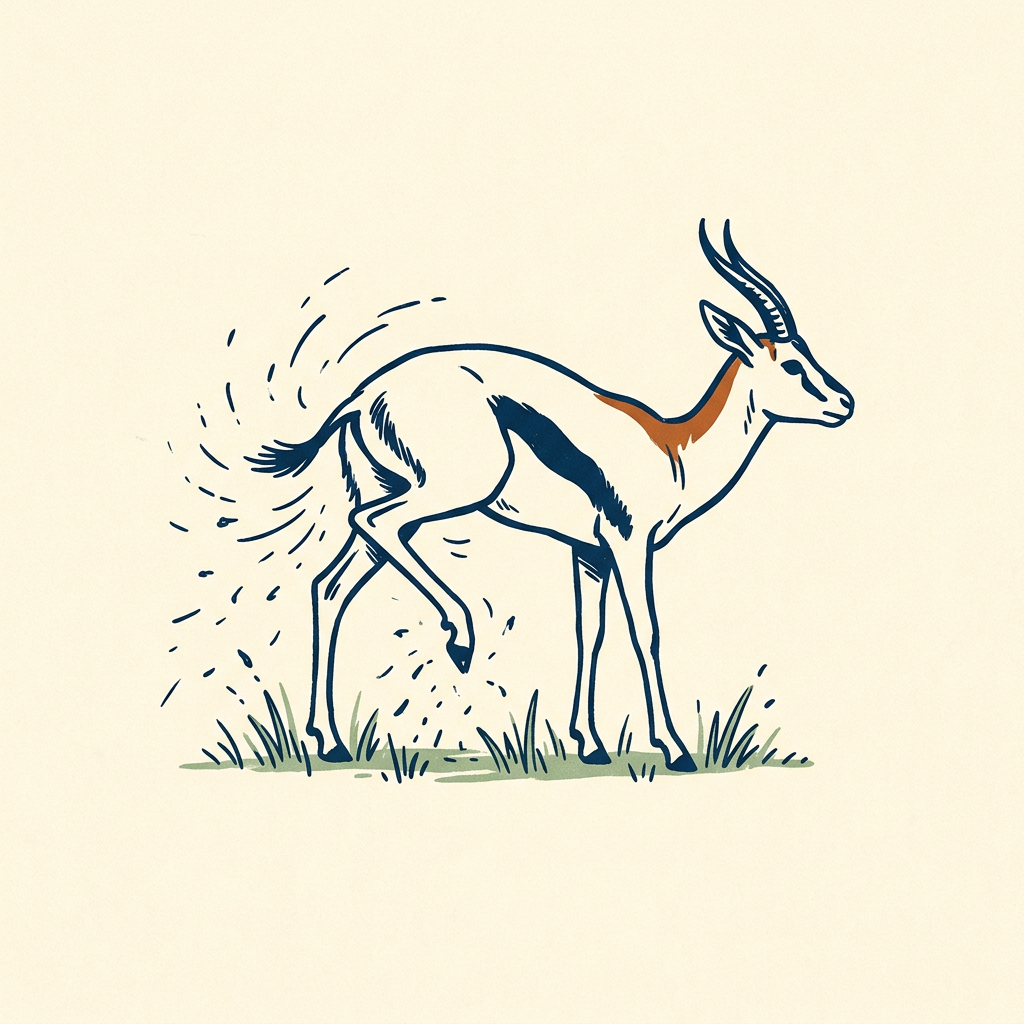
Slow breathing that lengthens the exhale activates the vagus nerve and can lower heart rate within minutes. Positive contact matters; they cite a hug lasting around twenty seconds, or extended affectionate touch, as enough to release oxytocin and reduce cortisol. Emily Nagoski also points to a six-second kiss in related work.
Shared laughter, crying allowed to run its course, and creative outlets such as painting, journaling, or music give the system a path to finish when the original problem cannot be fixed. These are not indulgences; they are the known mechanisms for ending the response.
In practice: A nurse who cannot undo a patient’s death can still run, cry with a colleague, or hold a twenty-second hug that night so her body gets the completion the day never gave.
4
Burnout’s three faces
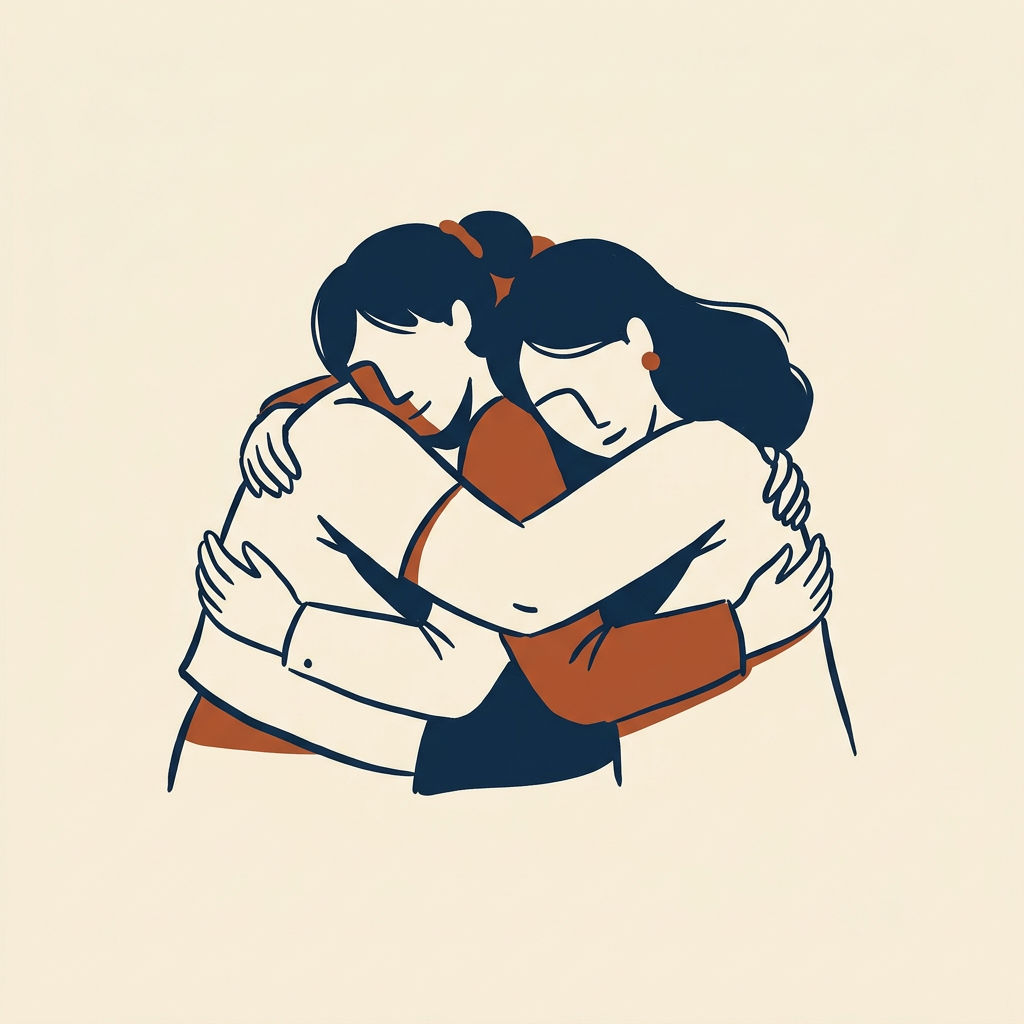
Burnout is a syndrome with three separable components—emotional exhaustion, depersonalization, and reduced accomplishment—that need not arrive together.
The authors adopt Christina Maslach’s framework from her 1981 Maslach Burnout Inventory. Emotional exhaustion is one face. Depersonalization is a cynical, detached stance toward the people you serve. The third is a collapsed sense that your work matters.
One teacher might feel drained yet still believe the work is good. Another might feel energetically fine while treating students as problems to process. A third might feel neither exhausted nor numb yet privately sure nothing she does counts.
The split matters because a perk aimed only at exhaustion misses the other faces. It also explains high-energy people who still meet Maslach’s criteria: adrenaline can mask fatigue while accomplishment quietly erodes.
In practice: A teacher may feel emotionally fine yet have gone numb to her students, handling them as tasks rather than people.
5
Human Giver Syndrome
Culture assigns some people, especially women and caregivers, a moral duty to give without limit, and that assignment itself becomes a chronic stressor.
Human being
Entitled to needs and rest without moral penalty
Human giver
Worth measured by endless giving; limits feel like failure
The Nagoskis adapt a concept from philosopher Kate Manne. Some people get treated as human beings entitled to needs. Others get cast as human givers whose worth depends on meeting everyone else’s needs.
Women, caregivers, and marginalized groups land in the giver role more often. Rest, self-care, or a boundary can then feel like moral failure rather than a neutral choice.
Givers who cannot keep the pace either burn out trying or go numb to protect themselves, then feel guilt for the numbness. Ordinary rest advice falls short because resting itself can trigger the moral distress the syndrome produces.
In practice: A mother who takes an hour to nap may feel guilt not because napping is wrong but because she has internalized that her value depends on constant availability.
6
The Bikini Industrial Complex
Beauty and appearance standards act as a continuous cultural stressor that drains women and folds into the giver role.
The authors coin Bikini Industrial Complex for the industries and norms that make body monitoring a constant background job, mainly for women. They frame it not as vanity but as another layer of unfinished cycles: time, money, and attention spent chasing an unattainable standard.
Diet culture and beauty marketing often borrow wellness language, so routines sold as relief become more appearance labor. When exercise serves an appearance target instead of physiological discharge, its cycle-completing effect blunts.
Appearance pressure joins Human Giver Syndrome because looking pleasant gets treated as part of a woman’s duty to stay available to others.
In practice: A woman who exercises to hit an appearance goal rather than to discharge stress experiences the same workout as obligation, which weakens its reset.
7
The wellspring of meaning
Purpose can renew energy for hard work, yet institutions often extract meaning-driven effort without protecting the rest that refills it.
The Nagoskis describe a psychological resource they call the wellspring: the sense of purpose that helps people keep going. A hospice worker who believes her work honors dignity draws real energy from that belief even on exhausting days.
The danger is institutional extraction. Meaning-driven workers will push through for the purpose they feel, so employers can take more labor while treating meaning as sufficient reward.
Over time output is sustained by borrowing against the wellspring faster than rest, connection, and completed cycles can refill it. Purpose is necessary but cannot replace physiological recovery.
In practice: A hospice worker scheduled for mandatory overtime shift after shift spends the meaning down until even meaningful moments stop restoring her.
8
The Monitor and giving up
An internal system tracks the gap between effort and reward, and when the gap looks permanently unbridgeable, motivation collapses even if capacity remains.
The book names this tracking system the Monitor, related to research on goal pursuit and learned helplessness. When effort produces visible progress, the Monitor sustains drive. When effort repeatedly fails to close the gap, it shifts toward giving up.
The authors link this pattern to Martin Seligman’s learned-helplessness experiments. The demoralizing phase of burnout is not only tiredness but a conviction that nothing will change no matter what you do.
Hope, in this frame, is a cognitive assessment that effort and outcome still connect. Restoring it needs either real changes to the odds or a reframed goal the Monitor can register as reachable. Individual coping cannot repair a Monitor that has accurately read a rigged system.
In practice: An employee passed over for promotion five times despite strong reviews may stop applying effort because the Monitor has recalibrated toward futility, not from laziness.
9
Connection completes the cycle
Social connection regulates stress through physiological channels, and its absence independently predicts burnout.
The Nagoskis treat connection as one of the most reliable cycle-completers and a buffer against future stress, operating through oxytocin and vagal tone, not mere comfort. Talking through a hard day with someone who listens, without fixing anything, can lower cortisol much as movement or touch can.
They note a broader decline in close ties and community participation, echoing findings popularized in Robert Putnam’s work, as a background condition that leaves more people without this buffer.
Isolation removes a discharge channel. People in demanding but connected jobs can fare better than people with lighter but isolated loads. Connection cannot be manufactured by apps alone; it needs time and mutual vulnerability.
In practice: Two employees with similar workloads may diverge over a year if one debriefs daily with a trusted coworker and the other works remotely with almost no contact.
10
Practice and structure together
Because culture and institutions produce much of the overload, personal cycle-completion cannot fully replace collective change.
Personal scale
Daily practices that discharge today’s arousal
Structural scale
Policies and norms that stop generating endless unfinished cycles
The final move turns from technique to responsibility. Movement, breath, connection, meaning, and hope work on the individual body. Human Giver Syndrome and unsustainable workloads are produced at institutional and cultural scale.
The authors warn against a reading of their own advice that dumps all duty back on exhausted people—complete your cycles more carefully while the structures stay put. They call for recovery time built into policy, parental leave, schedules that do not assume constant availability, and norms that stop treating caregiver self-sacrifice as the moral default.
Self-care and systemic change are two scales of one problem. Individuals need daily practices to survive current conditions. Communities need to change those conditions so fewer people must merely survive them.
In practice: A wellness program that hands meditation apps to staff on mandatory unpaid overtime may help at the margins but cannot cancel the structural driver.
Key terms
- Stressor The external event or demand that triggers arousal
- Stress The internal hormonal and nervous-system cascade the stressor sets off
- Completing the cycle Deliberate actions that signal safety so the body can stand down
- Human Giver Syndrome Cultural assignment of endless giving as a moral duty, especially to women and caregivers
- Bikini Industrial Complex Industries and norms that make appearance maintenance a constant unpaid obligation
- Wellspring The store of meaning and purpose people draw on through hard work
- The Monitor Internal system that tracks whether effort is closing the gap to a goal and can shift toward giving up
- Depersonalization Cynical detachment from the people you serve; one face of burnout
What to do
- Take a twenty-minute walk, slow exhales, or a twenty-second hug before you try to think yourself calm.
- After a hard task, check whether your body still feels activated and treat that arousal as unfinished business of its own.
- Notice one place you feel obligated to give without limit and withhold once, briefly, to test whether the guilt matches real harm.
- If you manage others, audit one scheduling or leave rule for assumed constant availability and change that rule instead of adding a perk.
Questions to think with
- Where in your week does a finished task still leave your body activated?
- Which of burnout’s three faces shows up most clearly for you right now?
- What in your routine is genuine cycle-completion, and what is really appearance labor?
- When has your Monitor decided effort no longer connects to reward, and was that reading accurate?
- What one structural change would cut unfinished cycles more than another wellness app?
The other side
The leap from short-term lab findings on hugs, breathing, and cortisol to preventing chronic workplace burnout is larger than the book acknowledges, and it leans on mechanism studies more than long-term outcome evidence. Its vantage is largely American, white-collar, and centered on women’s caregiving and appearance pressures, with comparatively little on low-wage, gig, male-caregiver, or non-Western contexts. After dense individual technique, the structural fixes stay general, and a tension remains: a book that names burnout as culturally produced still spends most of its pages on personal coping that can reinforce the expectation that givers quietly manage their own exhaustion.
Who it's for
Caregivers, teachers, and nurses still drained after the hard part ends, managers wondering why wellness perks fail, and women worn down by the expectation of endless giving will get the most from the full book.