




Spend profit to buy back hours, not hours to save money
Operators who cannot leave daily work will get a concrete sequence for valuing time, hiring, and systems so growth stops depending on their grind.
IJR · Nov 2, 2026 · 13 min read
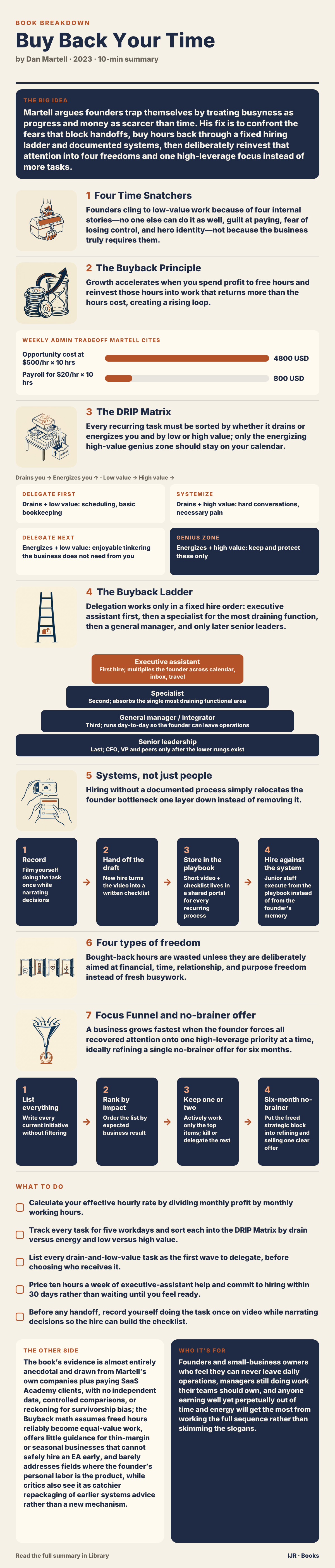
In 60 seconds
- Founders stay stuck in low-value work because four Time Snatchers—perfectionism, guilt, control fear, and hero identity—make them cling to tasks the business no longer needs from them.
- Martell’s Buyback Principle says calculate your effective hourly rate, pay less for low-value hours, and reinvest the freed time into work that raises that rate again.
- The DRIP Matrix sorts every task by drain versus energy and low versus high value so only the energizing high-value genius zone stays with the founder.
- Hire in ladder order: executive assistant first, then a specialist for the worst drain, then a general manager, and only later senior leaders.
- Pair every hire with video-to-checklist SOPs so the bottleneck is removed instead of copied one layer down.
- Point reclaimed hours at financial, time, relationship, and purpose freedom, then run one Focus Funnel priority—ideally a single six-month no-brainer offer—rather than scattering attention.
The big idea
Martell argues founders trap themselves by treating busyness as progress and money as scarcer than time. His fix is to confront the fears that block handoffs, buy hours back through a fixed hiring ladder and documented systems, then deliberately reinvest that attention into four freedoms and one high-leverage focus instead of more tasks.
The book in brief
Martell opens on the trap: entrepreneurs stay buried in operations not because the business truly demands it, but because unresolved fears keep them doing everything. He names four Time Snatchers—the belief no one else can match their quality, guilt at paying for work they could do, fear of losing control, and attachment to being the hero—and uses his own call-center years answering tickets long after he could afford help to show how those stories, not economics, freeze growth. Time, he insists, is the only non-renewable resource; money can be raised again, hours cannot.
From that groundwork he states the Buyback Principle: use profit to purchase hours, then pour those hours into activities that return more than they cost, creating a compounding loop. A founder whose effective rate is $500 an hour but who spends ten hours a week on $20 admin work burns $4,800 a week to avoid an $800 payroll line. He has coaching clients write the rate down and audit a real week so the math stops feeling abstract, and he pushes starting the trade as soon as even ten hours of help is affordable.
The DRIP Matrix turns the math into a weekly sort. Tasks are plotted by whether they drain or energize and by low or high value. Drain-plus-low goes first; energize-plus-low next, because enjoyment alone does not justify founder time; drain-plus-high gets systemized; only energize-plus-high—the genius zone—stays. A marketing-agency owner still hand-building every client report for the design pleasure is the cautionary case: a $15 contractor could free her to close accounts worth far more.
Hiring then follows the Buyback Ladder in fixed order—executive assistant, specialist for the most draining function, general manager or integrator, senior leaders last—because an EA multiplies capacity across everything while a premature VP fixes only one slice. Martell’s own early EA reclaimed roughly fifteen hours a week on calendar, travel, and inbox and paid for itself inside two months. Each rung only works if paired with systems: record yourself doing the task on video while narrating decisions, then have the hire turn that into a written checklist. His Client Portal of short videos and checklists let junior staff become productive in days rather than months, and he argues the founder’s value rises the less operationally essential they become.
Freed time is worthless if it refills with new busywork. Martell defines four freedoms—financial, time, relationship, and purpose—and tells the post-exit story of having money and hours yet sliding into depression until he rebuilt the other three. A quarterly score on each freedom directs the next buyback. Finally the Focus Funnel forces the founder to rank every initiative by impact, keep only the top one or two, and kill or delegate the rest, ideally through a six-month no-brainer offer that concentrates strategic attention on one growth lever. A SaaS Academy client who dropped parallel product, fundraising, and website rebuilds to fix core-offer conversion outgrew the scatter. The arc ends where it began: time, not capital, is the scarce resource that decides whether a founder ever leaves the operational grind.
Context
Dan Martell writes from building a call-center company, coaching founders inside his SaaS Academy, and living through a hollow post-exit stretch. The 2023 book mattered because it gave operators a usable order of operations—mindset, math, matrix, ladder, systems, reinvestment—rather than another general plea to delegate, reframing growth as replacing yourself below your value instead of stacking more hours.
The key ideas

1
Four Time Snatchers
Founders cling to low-value work because of four internal stories—no one else can do it as well, guilt at paying, fear of losing control, and hero identity—not because the business truly requires them.
Martell treats busyness as a psychological problem before it is an operational one. The same instinct that makes someone a strong early-stage builder—doing every task themselves—later caps the company once revenue could fund help.
He separates the feeling of being needed from actually being valuable. Most founders who say they cannot delegate have never built a real handoff system; they have only felt the discomfort of training someone and watching early mistakes.
Until those four stories are named and chosen against, any later hiring or process work gets quietly sabotaged. The conscious first move is to decide to buy time rather than simply chase more money, because at a certain income those goals compete.
In practice: Martell personally answered support tickets at his call-center company long after revenue supported a hire, avoiding the discomfort of training rather than saving meaningful money.

2
The Buyback Principle
Growth accelerates when you spend profit to free hours and reinvest those hours into work that returns more than the hours cost, creating a rising loop.
Weekly admin tradeoff Martell cites
Martell frames the trade as a repeatable cycle, not a one-time luxury. Calculate effective hourly rate, hire at a lower rate for low-value tasks, then put the recovered hours into sales, product vision, or strategic relationships that lift the rate again and fund the next round.
He rejects the idea that help is only for later-stage companies. The compounding of reinvested time, he claims, outpaces the payroll cost once a founder can afford even ten hours a week of support.
The chapter still depends on the prior psychological work: the pure math rarely convinces anyone who has not first faced their control issues. Founders in his program are told to write the current rate down and audit a real calendar week against it so the opportunity cost stops feeling theoretical.
In practice: A founder effective at $500 an hour who spends ten hours a week on $20 admin work burns $4,800 weekly to avoid an $800 payroll expense.

3
The DRIP Matrix
Every recurring task must be sorted by whether it drains or energizes you and by low or high value; only the energizing high-value genius zone should stay on your calendar.
Drains you → Energizes you ↑ · Low value → High value →
Delegate first
Drains + low value: scheduling, basic bookkeeping
Systemize
Drains + high value: hard conversations, necessary pain
Delegate next
Energizes + low value: enjoyable tinkering the business does not need from you
Genius zone
Energizes + high value: keep and protect these only
Vague guilt about delegating produces random handoffs. Founders keep enjoyable low-value work and push away high-value work that feels uncomfortable—the reverse of what the Buyback Principle needs.
Drain-and-low tasks such as scheduling or basic bookkeeping leave first. Energize-and-low tasks leave next, because passion does not justify founder time when the business does not need that skill from them. Drain-and-high work such as hard firing conversations gets systemized so the discomfort is managed. Energize-and-high work remains untouched.
The weekly practice is simple: audit the calendar, drop every recurring item into one of the four quadrants, and write a delegation plan for everything outside the genius zone. That turns the earlier hourly-rate math into an actual list.
In practice: A marketing-agency owner manually built every client report because she liked the design work, even though a $15-an-hour contractor could do it and free her to close far higher-value accounts.

4
The Buyback Ladder
Delegation works only in a fixed hire order: executive assistant first, then a specialist for the most draining function, then a general manager, and only later senior leaders.
- Executive assistantFirst hire; multiplies the founder across calendar, inbox, travel
- SpecialistSecond; absorbs the single most draining functional area
- General manager / integratorThird; runs day-to-day so the founder can leave operations
- Senior leadershipLast; CFO, VP and peers only after the lower rungs exist
Most founders reverse the sequence, waiting for a CFO or VP while their own calendar and inbox still eat the week. An executive assistant multiplies capacity across every other task; a senior specialist repairs only one function.
Martell also answers the objection that a young or simple business does not need structure. Complexity is not the trigger—hours lost is. Even a solo founder benefits from buying back the first ten hours a week.
He pushes hiring before you feel ready. The discomfort of paying for capacity you have not yet grown into is what forces the growth. The ladder only functions if the DRIP Matrix has already shown which tasks transfer first.
In practice: Martell hired an executive assistant years before he thought he could afford one; the role reclaimed roughly fifteen hours a week on scheduling, travel, and inbox triage and paid for itself within two months.

5
Systems, not just people
Hiring without a documented process simply relocates the founder bottleneck one layer down instead of removing it.
- 1RecordFilm yourself doing the task once while narrating decisions
- 2Hand off the draftNew hire turns the video into a written checklist
- 3Store in the playbookShort video + checklist lives in a shared portal for every recurring process
- 4Hire against the systemJunior staff execute from the playbook instead of from the founder’s memory
Delegation fails most often because no transferable method existed, not because the wrong person was chosen. The SOP is what makes a role independent of one person’s memory.
Martell’s preferred method: record yourself performing the task on video while narrating decisions, then have the new hire turn that recording into a written checklist. Writing the SOP yourself is itself low-value work that should be delegated.
Systems are what let the company scale past the founder’s personal capacity. Without them every new person still has to ask how things are done, reproducing the original choke point. The fear that documentation makes the founder less essential is backwards: value rises the less operationally necessary they are, because that is what makes the business sellable and scalable.
In practice: At one of his companies a Client Portal playbook of short videos plus checklists for every recurring process—from customer onboarding to refunds—let junior staff become productive within days rather than months.

6
Four types of freedom
Bought-back hours are wasted unless they are deliberately aimed at financial, time, relationship, and purpose freedom instead of fresh busywork.
Many founders who finally delegate still feel trapped because they immediately refill the calendar with new tasks. Martell defines the four targets so reinvestment has a destination.
Financial freedom means enough passive or business income to cover a chosen lifestyle. Time freedom means real control over the calendar. Relationship freedom means enough presence for family and friends. Purpose freedom means work that feels meaningful, not merely profitable.
The practical habit is a quarterly score on each freedom, then steering the next buyback toward whichever score is lowest. The whole hiring-and-systems architecture is instrumental: a means to buy attention for a life outside the business, not an end focused only on scaling revenue.
In practice: After selling a company Martell had money and open hours yet grew anxious and adrift, sliding into depression until he rebuilt intentional structure around relationships and purpose.

7
Focus Funnel and no-brainer offer
A business grows fastest when the founder forces all recovered attention onto one high-leverage priority at a time, ideally refining a single no-brainer offer for six months.
- 1List everythingWrite every current initiative without filtering
- 2Rank by impactOrder the list by expected business result
- 3Keep one or twoActively work only the top items; kill or delegate the rest
- 4Six-month no-brainerPut the freed strategic block into refining and selling one clear offer
Bought-back hours are raw material; without a filter they dissolve into parallel half-efforts. The Focus Funnel asks the founder to list every current initiative, rank by expected impact, keep only the top one or two, and explicitly kill or delegate the rest.
Martell pairs the funnel with the 6-Month No-Brainer Offer: design one product or service so clearly valuable that strategic time goes into sales of that offer alone for a fixed window instead of scattering across marketing, product, and fundraising at once.
The move depends on everything earlier. The ladder and systems free the hours; the funnel stops those hours from being wasted. Concentrated founder attention on one protected lever, he claims, produces disproportionate results compared with the same attention spread thin.
In practice: A SaaS Academy client was launching a new product line, fundraising, and rebuilding a website at once; narrowing solely to core-offer conversion rate produced faster revenue growth than any of the parallel efforts.
Key terms
- Time Snatchers The four internal stories—perfectionism, guilt, control fear, hero identity—that keep founders doing work they should hand off.
- Buyback Principle Use profit to purchase hours, then reinvest those hours into higher-value work that raises your effective rate and funds the next buyback.
- DRIP Matrix Two-axis sort of tasks by drain versus energy and low versus high value; only the genius zone stays with you.
- Genius zone Work that both energizes you and produces high value; the only quadrant the founder should keep.
- Buyback Ladder Fixed hiring order: executive assistant, then draining-function specialist, then general manager, then senior leaders.
- SOP Standard operating procedure; preferably a founder video turned into a hire-written checklist so the role is transferable.
- Four types of freedom Financial, time, relationship, and purpose—the four places reclaimed hours should be deliberately spent.
- Focus Funnel Filter that ranks every initiative by impact and forces the founder to keep only the top one or two.
- 6-Month No-Brainer Offer One clearly valuable offer that receives all strategic attention for a fixed six-month window.
What to do
- Calculate your effective hourly rate by dividing monthly profit by monthly working hours.
- Track every task for five workdays and sort each into the DRIP Matrix by drain versus energy and low versus high value.
- List every drain-and-low-value task as the first wave to delegate, before choosing who receives it.
- Price ten hours a week of executive-assistant help and commit to hiring within 30 days rather than waiting until you feel ready.
- Before any handoff, record yourself doing the task once on video while narrating decisions so the hire can build the checklist.
Questions to think with
- Which of the four Time Snatchers most often stops you from handing work off?
- What is your real effective hourly rate this month, and how many hours sit far below it?
- If you plotted last week on the DRIP Matrix, which quadrant ate the most time?
- Which of the four freedoms—financial, time, relationship, purpose—would a bought-back ten hours help most right now?
- What single offer is clear enough to deserve your next six months of undivided strategic attention?
The other side
The book’s evidence is almost entirely anecdotal and drawn from Martell’s own companies plus paying SaaS Academy clients, with no independent data, controlled comparisons, or reckoning for survivorship bias; the Buyback math assumes freed hours reliably become equal-value work, offers little guidance for thin-margin or seasonal businesses that cannot safely hire an EA early, and barely addresses fields where the founder’s personal labor is the product, while critics also see it as catchier repackaging of earlier systems advice rather than a new mechanism.
Who it's for
Founders and small-business owners who feel they can never leave daily operations, managers still doing work their teams should own, and anyone earning well yet perpetually out of time and energy will get the most from working the full sequence rather than skimming the slogans.