




America's racial divide runs on caste, not just race
Wilkerson claims inherited rank, not skin color alone, is what keeps American hierarchy in place across law, custom, and daily life.
IJR · Oct 23, 2026 · 13 min read
In 60 seconds
- Wilkerson argues race names appearance while caste names the fixed ranking of human worth assigned at birth.
- She places the United States beside India and Nazi Germany to show a shared architecture of birth-ascribed rank, a policed bottom tier, and naturalized hierarchy.
- Eight recurring pillars—heritability, purity rules, endogamy, occupational sorting, dehumanization, violence, and assumed superiority—keep the system running even without open hatred.
- A hierarchy needs a bottom rung more than a top one, which is why immigrant groups learned Black Americans' place and why merit like Satchel Paige's could not break the ceiling.
- Everyday deference rituals and historical terror reinforce each other; small encounters become her main evidence that caste outlasts formal law.
- She offers radical empathy, not colorblindness, as the personal way out, while critics note the three-nation analogy is looser than it sounds and the remedy thinner than the diagnosis.
The big idea
Wilkerson argues that what Americans call racism is the visible surface of a caste system that ranks people at birth and maintains that rank through law, ritual, and violence. Placing the United States alongside India and Nazi Germany, she holds that the same underlying grammar—not identical histories—explains why individual goodwill has never dissolved the hierarchy.
The book in brief
Wilkerson starts from a blunt distinction: race describes how people look; caste describes where they stand. She treats the United States as an old house whose load-bearing walls were built long before anyone now alive, so inheritance of structure matters more than personal intent. Appeals to colorblindness or goodwill fail, she says, because they treat a system-level fact as a personality problem.
She then sets three societies side by side—the American racial order, India's varna and jati hierarchy, and Nazi Germany's racial laws—not as identical regimes but as systems sharing birth-ascribed rank, a policed bottom, and mechanisms that make hierarchy feel natural. Historical links, including Nazi study of American race statutes and correspondence between Ambedkar and Du Bois, support the comparison without erasing differences in duration or theology.
From that frame she extracts repeatable pillars of caste and shows how a fixed floor does more work than open contempt. Immigrant groups learned where Black Americans stood; individual brilliance could not override rank maintenance. Rituals of deference and memories of terror operate as one enforcement system.
Costs fall hardest on the subordinate caste, yet she claims the dominant caste also loses moral range and accurate self-knowledge. She extends the argument into 2010s politics as status anxiety more than pocketbook distress alone, then treats ordinary encounters—credentials challenged, seats disputed—as pattern evidence that survives after Jim Crow falls.
She closes with radical empathy: imagining another's specific position rather than generic sympathy or colorblind erasure. The arc ends on a personal practice offered against a problem she has described as deeply institutional.
Context
Isabel Wilkerson published Caste in 2020 as synthesis and narrative journalism drawn from comparative history and her own reporting, not as original quantitative research. On publication, philosopher Kwame Anthony Appiah reviewed the book and questioned how elastic her definition of caste becomes when stretched across unlike societies.
The key ideas
1
Race names; caste ranks
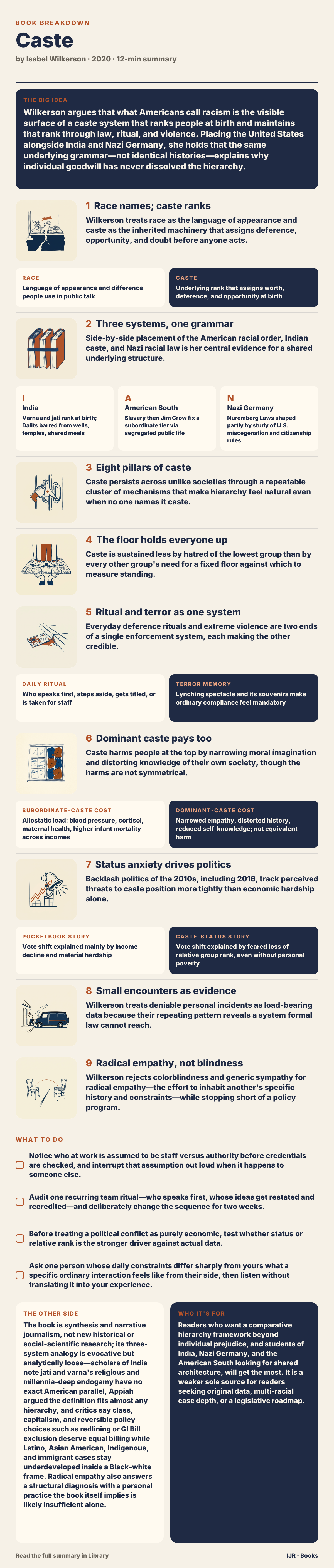
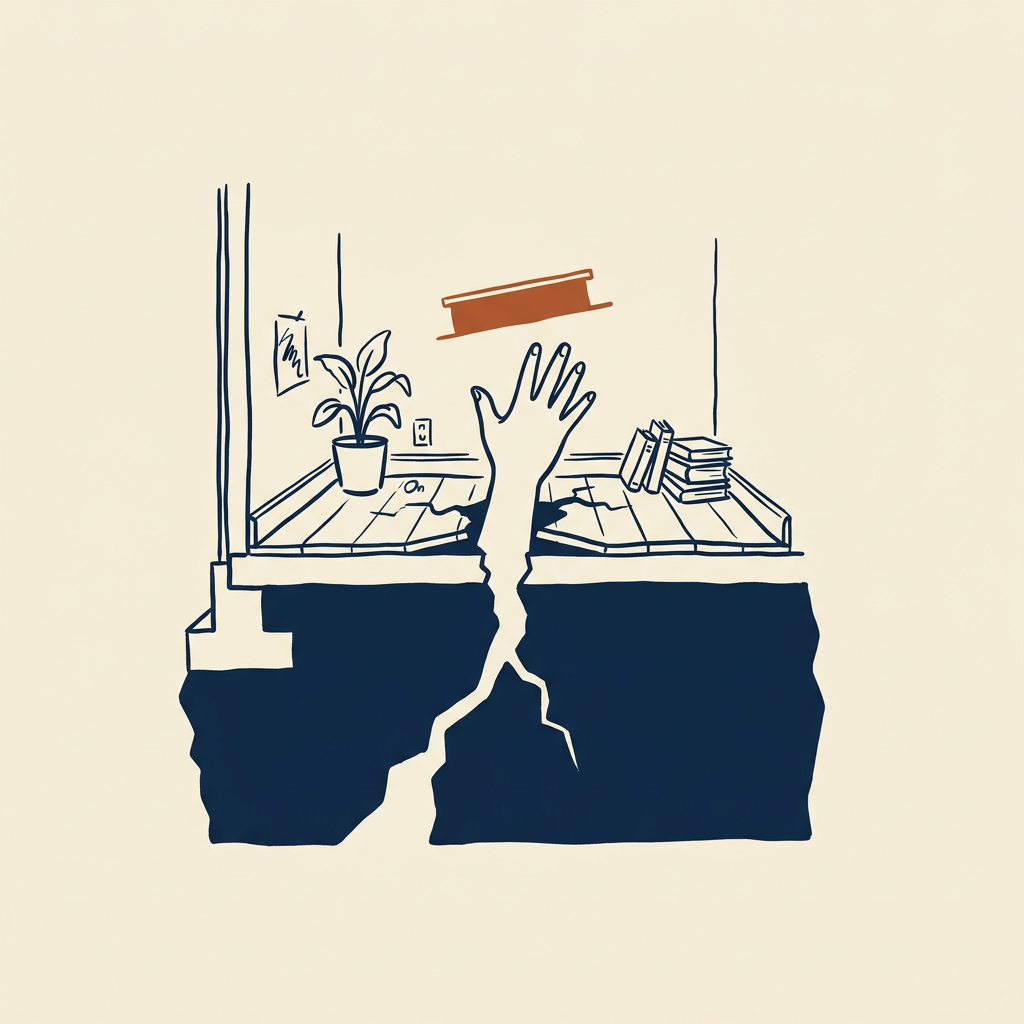
Wilkerson treats race as the language of appearance and caste as the inherited machinery that assigns deference, opportunity, and doubt before anyone acts.
Race
Language of appearance and difference people use in public talk
Caste
Underlying rank that assigns worth, deference, and opportunity at birth
Wilkerson opens by separating two ideas people usually fuse. Race, she says, is how difference gets talked about. Caste is the ranking that decides who receives the benefit of the doubt.
She compares the country to an old house handed down through generations. Nobody living built the foundation, yet everyone inherits the cracks, wiring, and load-bearing walls. You need not have owned slaves or drafted a Jim Crow statute to benefit from, or be constrained by, that structure.
The shift matters because it moves the debate off individual intent. A person can hold no conscious racial animosity and still occupy a caste position and receive caste treatment. That is why, in her view, goodwill and colorblindness have historically failed to dislodge inequality: caste is systemic, not a personality trait.
Once the mechanisms are named, she previews, they become visible in hospitals, courtrooms, airplanes, and family dinners—places racial vocabulary alone often cannot reach.
In practice: She frames ordinary American life inside an inherited house whose basement wiring still shapes every floor above it.

2
Three systems, one grammar
Side-by-side placement of the American racial order, Indian caste, and Nazi racial law is her central evidence for a shared underlying structure.
- IIndiaVarna and jati rank at birth; Dalits barred from wells, temples, shared meals
- AAmerican SouthSlavery then Jim Crow fix a subordinate tier via segregated public life
- NNazi GermanyNuremberg Laws shaped partly by study of U.S. miscegenation and citizenship rules
Wilkerson juxtaposes three systems usually kept in separate scholarly lanes. In India, birth sorts people into varna and jati, with Dalits historically barred from wells, temples, and shared eating spaces. In the American South, slavery and Jim Crow fixed Black Americans in a subordinate position, with segregated fountains and courtroom Bibles echoing purity logic.
In Nazi Germany she tracks legal history: architects of the 1935 Nuremberg Laws studied American miscegenation statutes and race-based citizenship rules, and some Nazi lawyers found parts of the American code too harsh to copy outright. She also notes B.R. Ambedkar's 1940s correspondence with W.E.B. Du Bois, each recognizing his struggle in the other's.
She does not claim equal severity or shared theology. India's order is scriptural and millennia deep; American racial caste grew from demand for enslaved labor; Nazi Germany compressed its project into twelve years of state violence. What she asks readers to study is the common grammar: birth-ascribed rank, a policed bottom tier, and naturalization of hierarchy.
That shared architecture, more than any single national story, carries the book's comparative weight.
In practice: Nazi drafters of the 1935 Nuremberg Laws examined American race statutes while writing their own.

3
Eight pillars of caste
Caste persists across unlike societies through a repeatable cluster of mechanisms that make hierarchy feel natural even when no one names it caste.
Building on the three-nation comparison, Wilkerson isolates recurring pillars drawn from research and comparative sociology. Rank is cast as divine or natural law, removing it from ordinary argument. It is heritable through birth, not earned or chosen.
It polices marriage and intimacy because mixing threatens boundaries; anti-miscegenation laws in dozens of American states, some lasting until the 1967 Loving v. Virginia decision, served that function. It speaks the language of purity and contamination, from segregated pools to one-drop ancestry rules that could rewrite a person's entire status.
It sorts people into occupational lanes so certain jobs stay coded to a caste regardless of skill. It dehumanizes the subordinate group through stereotype, strips individual identity, and backs the structure with violence or its memory. It rests on unexamined assumptions of dominant superiority and subordinate inferiority.
No single pillar defines the system, she argues; the cluster does. Once all eight are nameable, ordinary events stop reading as accidents and start reading as systemic.
In practice: Black professionals are mistaken for service staff in rooms where their credentials should have made the error impossible.

4
The floor holds everyone up
Caste is sustained less by hatred of the lowest group than by every other group's need for a fixed floor against which to measure standing.
Wilkerson complicates the idea that caste runs mainly on contempt. She argues it runs on the usefulness of a group that cannot fall further. Relative standing needs a floor.
Newly arrived immigrant groups, she notes, were quickly taught—formally and informally—where Black Americans stood. Many adopted the racial hierarchy to secure footing above the bottom rung even while facing discrimination themselves. The driver is structural comfort, not always personal animus.
Rank maintenance overrides accuracy about talent. The system's job is to keep positions fixed, not to reward the best performer. That makes dismantling caste harder than persuading individuals to drop prejudice, because the floor itself does work for people who never think of themselves as biased.
She leaves unresolved the tension between treating this as a near-universal human tendency and treating it as the product of specific historical choices that could have gone otherwise.
In practice: Satchel Paige, widely regarded as one of the best pitchers alive, was kept out of the major leagues for decades despite overwhelming merit.

5
Ritual and terror as one system
Everyday deference rituals and extreme violence are two ends of a single enforcement system, each making the other credible.
Daily ritual
Who speaks first, steps aside, gets titled, or is taken for staff
Terror memory
Lynching spectacle and its souvenirs make ordinary compliance feel mandatory
Wilkerson holds that caste runs on two registers at once. On one end sit small constant rituals: who speaks first, who steps off the sidewalk, who gets a first name versus a title, who is assumed to be staff.
On the other end sits organized terror—most visibly the lynching of Black Americans, thousands of documented cases from post-Reconstruction into the twentieth century, some staged as public spectacle with postcards sold as souvenirs. The rituals feel survivable and therefore easy to obey daily; the memory of terror gives those rituals weight.
Noncompliance carries an implicit link to that history. She draws evidence at the ritual end from her reporting life: credentials questioned before an interview, reseating on a flight when a passenger refused to believe she belonged in the assigned seat.
These are not violent scenes, she argues, yet they are legible only against a system that has used violence, in living or family memory, to police the same boundary. Narrative accumulation carries more of this claim than statistical proof.
In practice: An airline passenger's disbelief that she belonged in her assigned seat forced a reseating she reads as caste enforcement, not mere rudeness.

6
Dominant caste pays too
Caste harms people at the top by narrowing moral imagination and distorting knowledge of their own society, though the harms are not symmetrical.
Subordinate-caste cost
Allostatic load: blood pressure, cortisol, maternal health, higher infant mortality across incomes
Dominant-caste cost
Narrowed empathy, distorted history, reduced self-knowledge; not equivalent harm
After mapping enforcement, Wilkerson turns to costs. Harm to the subordinate caste is documented in the physical toll of chronic stress—sometimes called allostatic load—visible in blood pressure, cortisol, maternal health, and higher infant mortality among Black mothers across income levels.
Her further claim is more speculative: the dominant caste also pays. Empathy narrows. History distorts. Self-knowledge shrinks. Maintaining a worldview that requires ignoring visible suffering carries a psychological price.
She illustrates with white Americans who describe relief or grief on first recognizing the caste system's shape after a lifetime of not seeing it. She is careful to deny equivalence. The subordinate caste endures the severe, measurable injury.
Still she wants caste read as corrosive to the whole society, not as a clean zero-sum prize fully enjoyed by everyone above the bottom. Critics have pressed hardest here, where narrative persuasion outruns comparative data.
In practice: White Americans in her account describe relief or grief when they first see the system's shape after years of not seeing it.

7
Status anxiety drives politics
Backlash politics of the 2010s, including 2016, track perceived threats to caste position more tightly than economic hardship alone.
Pocketbook story
Vote shift explained mainly by income decline and material hardship
Caste-status story
Vote shift explained by feared loss of relative group rank, even without personal poverty
Wilkerson applies the framework to recent elections. She argues the 2016 outcome is better read as status anxiety than as pure pocketbook distress. Support for hardline candidates, in the research she cites, correlated more strongly with perceived loss of relative group standing than with actual income decline.
Dominant-caste members need not be poor to feel threatened; they need to feel their position slipping relative to others. Demographic projections of a future with no single racial numerical majority function, in her account, as a caste-level alarm independent of any one person's wages.
The chapter pushes the core claim from interpersonal ritual and historical law into live electoral behavior. Caste becomes a present political force, not a relic.
It is also among the book's empirically thinnest stretches: she synthesizes existing political science rather than offering new analysis, and the weight given to status anxiety versus partisan sorting, media, or regional economic dislocation remains contested.
In practice: She links 2016 hardline support more tightly to felt loss of group standing than to measured personal income drop.

8
Small encounters as evidence
Wilkerson treats deniable personal incidents as load-bearing data because their repeating pattern reveals a system formal law cannot reach.
Throughout, she returns to concrete encounters: a repairman who waits outside for the 'real' homeowner; an airline employee who challenges a first-class seat despite a valid ticket; a source who demands identification before an interview already arranged by phone.
These moments matter, she argues, precisely because they are small and deniable. That deniability is what lets caste survive in a legal order that has formally outlawed discrimination. Courts could strike Jim Crow; a stranger's split-second assumption cannot be legislated away.
The incidents recur across education, income, and public standing. Methodologically she asserts that structural claims are validated, not weakened, by individual-level detail, because the pattern across many encounters is the system showing itself.
Any single scene admits alternatives—rudeness, mistake, unrelated bias. Her answer is accumulation across regions, professions, and decades of reporting, offered like a long-running natural experiment rather than one data point.
In practice: A repairman assumes she cannot be the homeowner and waits outside for someone else to appear.
9
Radical empathy, not blindness
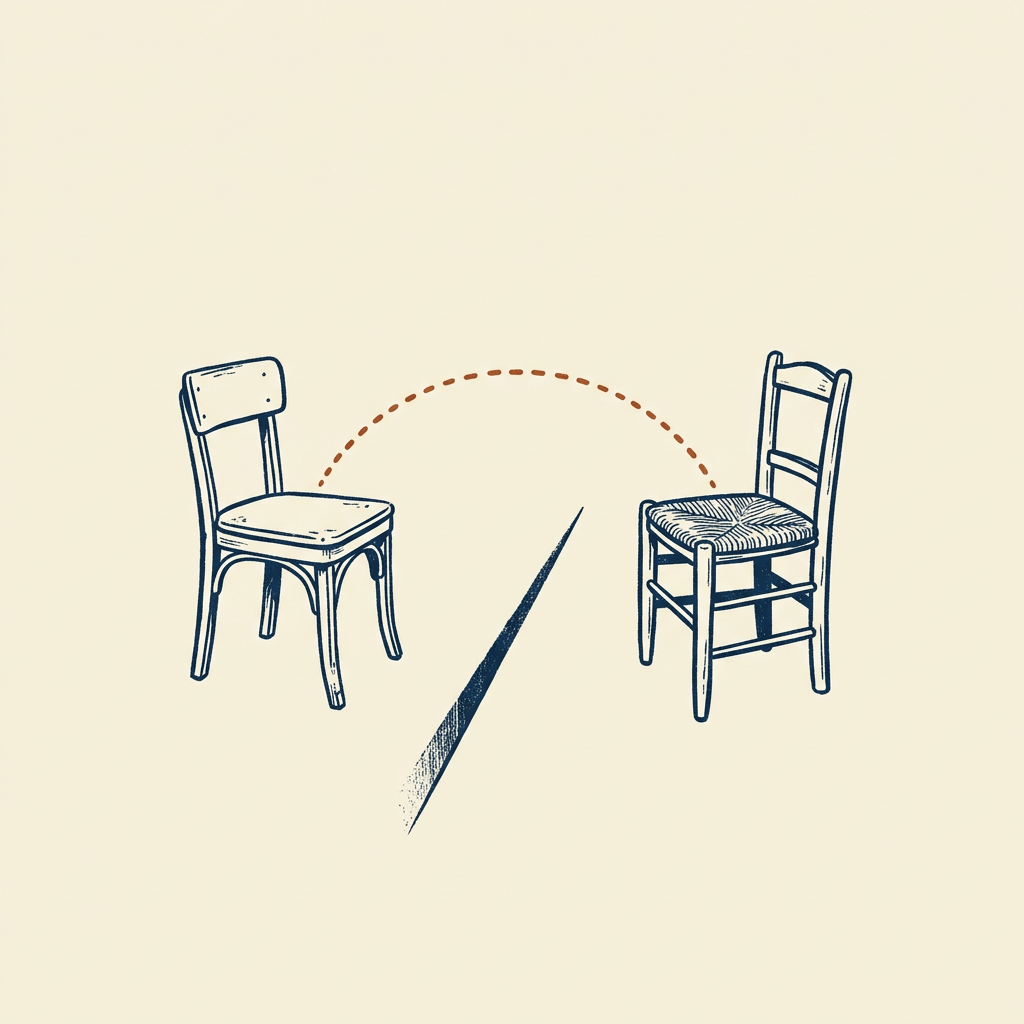
Wilkerson rejects colorblindness and generic sympathy for radical empathy—the effort to inhabit another's specific history and constraints—while stopping short of a policy program.
She closes by discarding two common responses. Colorblindness, she argues, erases the specific history that must be reckoned with. Generic sympathy keeps the observer safely distant from the person observed.
In their place she proposes radical empathy: not imagining what you would feel in their circumstances as yourself, but what it is actually like to be that person, with their history and limits, standing where they stand. Small turning points—friends, colleagues, strangers crossing a caste boundary by deliberate full seeing—illustrate the practice.
This is a moral and psychological prescription more than a legislative one. She leaves reparations, statutes, and institutional redesign largely to other books, focusing on the reader's capacity to notice caste in daily life.
The choice is deliberate and limiting. The book diagnoses a structural problem with deep institutional roots, then offers a personal relational remedy. By her own account of how embedded caste is, individual refusal to play assigned roles is necessary yet likely insufficient alone.
In practice: A friend, colleague, or stranger crosses a caste boundary not through policy but through a deliberate act of seeing someone fully.
Key terms
- Caste A fixed, inherited ranking of human worth assigned at birth and enforced by law, custom, and violence
- Race In Wilkerson's usage, the surface language of appearance layered over deeper rank
- Pillars of caste The cluster of mechanisms—heritability, purity, endogamy, occupational sorting, dehumanization, violence, assumed superiority—that keep hierarchy in place
- Dominant caste The group positioned to receive deference and the benefit of the doubt under the ranking
- Subordinate caste The group held to the fixed bottom tier against which others measure standing
- Radical empathy Actively imagining another's specific position and history rather than offering colorblindness or distant sympathy
- Allostatic load The measurable bodily wear from chronically navigating a hostile hierarchy
- Status anxiety Fear of slipping in relative group rank, used to explain political backlash beyond income loss alone
What to do
- Notice who at work is assumed to be staff versus authority before credentials are checked, and interrupt that assumption out loud when it happens to someone else.
- Audit one recurring team ritual—who speaks first, whose ideas get restated and recredited—and deliberately change the sequence for two weeks.
- Before treating a political conflict as purely economic, test whether status or relative rank is the stronger driver against actual data.
- Ask one person whose daily constraints differ sharply from yours what a specific ordinary interaction feels like from their side, then listen without translating it into your experience.
Questions to think with
- If race is the language and caste the ranking, what changes in how you read a workplace slight or a policy fight?
- Where do you see a 'floor' group doing structural work for people who do not think of themselves as prejudiced?
- Can radical empathy scale into institutional change, or does the book's own structural diagnosis demand tools it does not supply?
- How far can the India–U.S.–Nazi comparison stretch before unlike theologies and timelines break the shared grammar?
- When a small encounter goes wrong, how would you tell caste pattern from ordinary rudeness without relying only on accumulation of stories?
The other side
The book is synthesis and narrative journalism, not new historical or social-scientific research; its three-system analogy is evocative but analytically loose—scholars of India note jati and varna's religious and millennia-deep endogamy have no exact American parallel, Appiah argued the definition fits almost any hierarchy, and critics say class, capitalism, and reversible policy choices such as redlining or GI Bill exclusion deserve equal billing while Latino, Asian American, Indigenous, and immigrant cases stay underdeveloped inside a Black–white frame. Radical empathy also answers a structural diagnosis with a personal practice the book itself implies is likely insufficient alone.
Who it's for
Readers who want a comparative hierarchy framework beyond individual prejudice, and students of India, Nazi Germany, and the American South looking for shared architecture, will get the most. It is a weaker sole source for readers seeking original data, multi-racial case depth, or a legislative roadmap.