




Childhood abandonment rewires the self, not just memory
Years of neglect install automatic survival personalities that keep running adult life long after the danger ends.
IJR · Oct 31, 2026 · 13 min read
In 60 seconds
- Walker holds that prolonged childhood abandonment produces Complex PTSD, a developmental injury distinct from single-incident PTSD built for combat and accidents.
- Children adapt through one dominant 4F style—fight, flight, freeze, or fawn—that hardens into the adult’s default personality structure.
- Most Complex PTSD flashbacks are sudden childhood feeling-states of shame or terror, not visual memories, so survivors misread them as present-day truth.
- Recovery shortens flashbacks through real-time naming and body relaxation, then dismantles the inner critic as an internalized parent rather than debating its content.
- Active grief for the childhood that never arrived, plus deliberate self-reparenting practice, replaces the old survival default.
- Internal gains collapse without outward boundary work and safer relationships, because each 4F pattern sabotages intimacy in a predictable way.
The big idea
Big Idea
Walker contends that chronic childhood abandonment, neglect, and abuse warp the forming personality itself, producing Complex PTSD marked by emotional flashbacks, toxic shame, and 4F survival styles rather than a single traumatic memory. Recovery is identity repair: recognize flashbacks in the moment, grieve what was missing, dismantle the inner critic’s authority, reparent the self through repetition, and rebuild boundaries so isolation and toxic bonds cannot undo the work.
The book in brief
Book in Brief
Walker starts from a diagnostic gap. Classic PTSD assumes a healthy personality cracked by one discrete horror; Complex PTSD arises from years of criticism, neglect, or abuse while the self is still forming, so the child’s entire way of relating grows around threat and unworthiness. Without its own name, survivors get treated for depression, anxiety, or personality disorders while the underlying pattern—an internalized sense of being flawed and unsafe—stays untouched. His own childhood with a rage-prone mother and passive father seeds the clinical interest that follows.
He then maps the four survival adaptations children invent under chronic threat. Fight types control and dominate; flight types perfect and overwork; freeze types withdraw and dissociate; fawn types erase their needs to appease. These are not character flaws but rational childhood strategies that become automatic adult defaults, usually as a blend with one or two modes leading. Naming the dominant pattern is the prerequisite for interrupting it.
The middle of the book redefines the flashback. In Complex PTSD it is typically a wave of shame, fear, or worthlessness with no image attached, so the person assumes the present situation fully explains it and keeps trying to fix jobs or partners. Walker’s working test: if the reaction dwarfs the trigger, especially with shame or the urge to vanish, treat it as a flashback. Naming it—“this is a flashback”—begins to separate past from present. He then supplies a repeatable sequence: remind yourself the feelings are old, affirm adult safety, relax jaw and shoulders, ground in the room, and speak kindly to the frightened inner child. Practiced over months, the spiral shortens because the nervous system repeatedly fires without real danger arriving.
From there the work turns inward on toxic shame and the inner critic—the parent’s voice installed as a permanent monitor running perfectionism and endangerment scans. Arguing with each critical thought fails; the job is to strip the critic’s authority and reduce shame itself. Grief follows as the avoided engine of change: active mourning for the safety and love that never came, moving through rage and defense into settled sadness that no longer needs a parental verdict. Only then does self-reparenting take hold—lists of real strengths, out-loud self-compassion, choosing safer people—practiced until a new internal default starts to rival the old wound.
The arc closes outward. Each 4F style wrecks intimacy differently, and isolation or repeated harmful bonds erase internal progress. Boundary-setting is taught as a skill practiced first in low-stakes refusals, once shame and grief have loosened enough that fear no longer collapses every attempt. The book lands as a clinician’s daily toolkit for identity repair rather than incident processing.
Context
Context
Pete Walker wrote from clinical practice and his own abandoned childhood, publishing in 2013 a field guide that named the 4F survival responses and gave survivors a practical map of flashback management, shame work, grief, and self-reparenting. Those tools became widely adopted in trauma therapy circles even though the book rests on case observation rather than controlled trials, and even though Complex PTSD gained formal ICD-11 recognition only in 2018, after the book appeared and with a somewhat different triad of criteria.
The key ideas
1
A different kind of trauma
Prolonged childhood abandonment produces character-level damage that standard PTSD diagnosis and short-term symptom treatment never reach.
Classic PTSD
Healthy personality disrupted by one discrete event; recovery processes that incident
Complex PTSD
Personality still forming under years of abandonment; recovery repairs identity and survival patterns
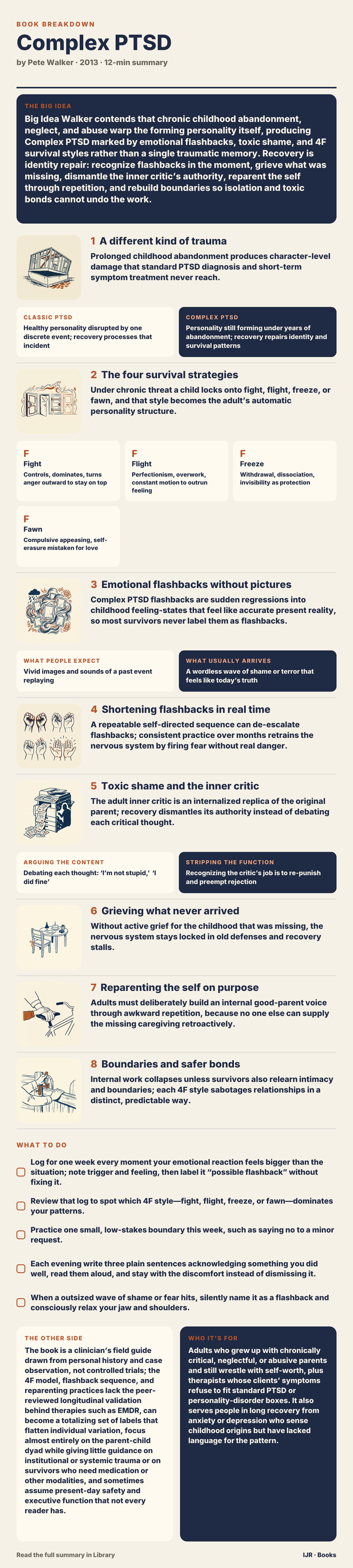
Walker separates Complex PTSD from the model built for combat veterans and accident survivors. Classic PTSD assumes a formed, healthy personality disrupted by one discrete event; recovery means processing that event. Complex PTSD grows from years of repeated abandonment, criticism, neglect, or abuse while the personality is still under construction.
The result is not an isolated wound but a warped foundation. The child’s whole way of relating to self and others organizes around threat and unworthiness. Walker holds that the DSM’s failure to recognize the category at the time left millions misdiagnosed with depression, anxiety, bipolar disorder, or personality disorders and treated only for surface symptoms.
The therapeutic question therefore changes. Instead of “what happened to you once,” it becomes “what did you have to become to survive years of this.” That shift turns recovery into identity repair. The core symptom cluster he tracks—toxic shame, self-abandonment, emotional flashbacks, and a harsh inner critic—all trace to a child who had no safe adult to turn to.
In practice: Walker traces his own clinical focus to a childhood marked by a rage-prone mother and a passive father, the seed of the developmental injury he later saw in clients.
2
The four survival strategies
Under chronic threat a child locks onto fight, flight, freeze, or fawn, and that style becomes the adult’s automatic personality structure.
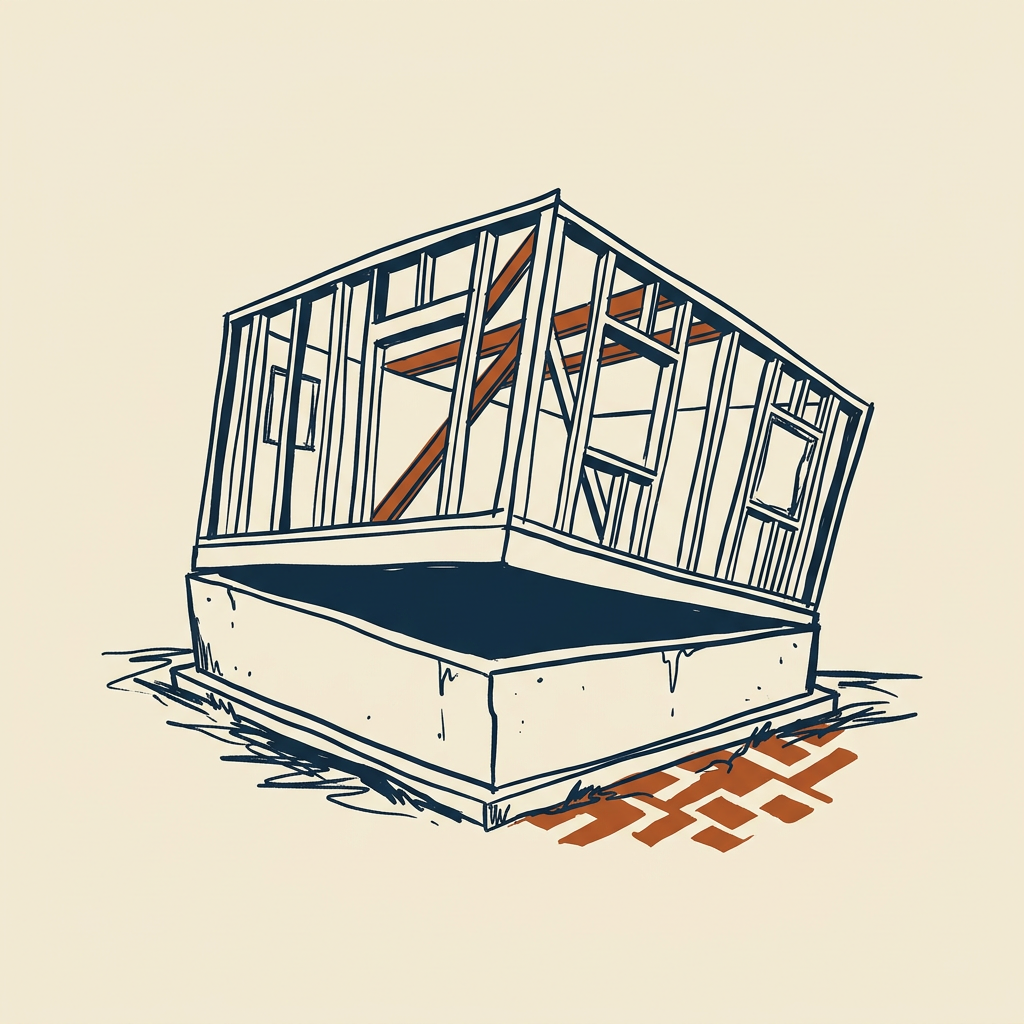
- FFightControls, dominates, turns anger outward to stay on top
- FFlightPerfectionism, overwork, constant motion to outrun feeling
- FFreezeWithdrawal, dissociation, invisibility as protection
- FFawnCompulsive appeasing, self-erasure mistaken for love
Walker’s best-known contribution is the 4F typology. Fight types survive by dominating and later appear controlling, angry, or narcissistic-presenting. Flight types stay busy and hypervigilant as anxious perfectionists and workaholics. Freeze types withdraw, dissociate, and isolate because stillness once reduced harm. Fawn types erase their own needs to appease, often mistaking the pattern for kindness or love.
He stresses these are adaptations, not flaws. A child facing a rageful parent may learn fawning works better than fighting back; a child in an emotionally absent house may drift into freeze. Most people carry a blend with one or two modes dominant. The pattern runs outside conscious choice, triggered by anything that resembles the original threat.
Real change therefore starts with identification. The anxious overachiever is not “just ambitious”; she is running a flight response installed young. Each later recovery tool is calibrated differently once the reader knows which F leads.
In practice: A fawn-type client could not refuse any request until she linked the pattern to growing up in a violent household and saw people-pleasing as the old safety strategy.
3
Emotional flashbacks without pictures
Complex PTSD flashbacks are sudden regressions into childhood feeling-states that feel like accurate present reality, so most survivors never label them as flashbacks.
What people expect
Vivid images and sounds of a past event replaying
What usually arrives
A wordless wave of shame or terror that feels like today’s truth
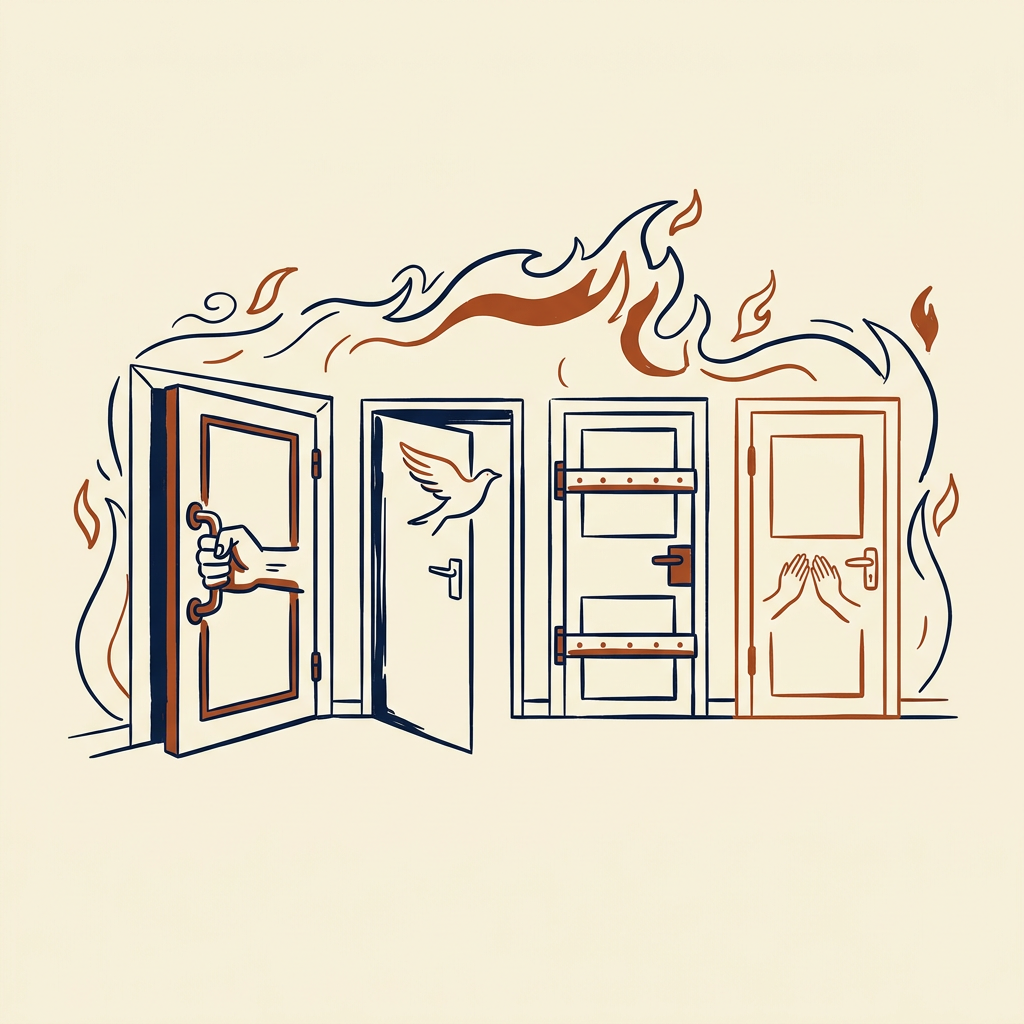
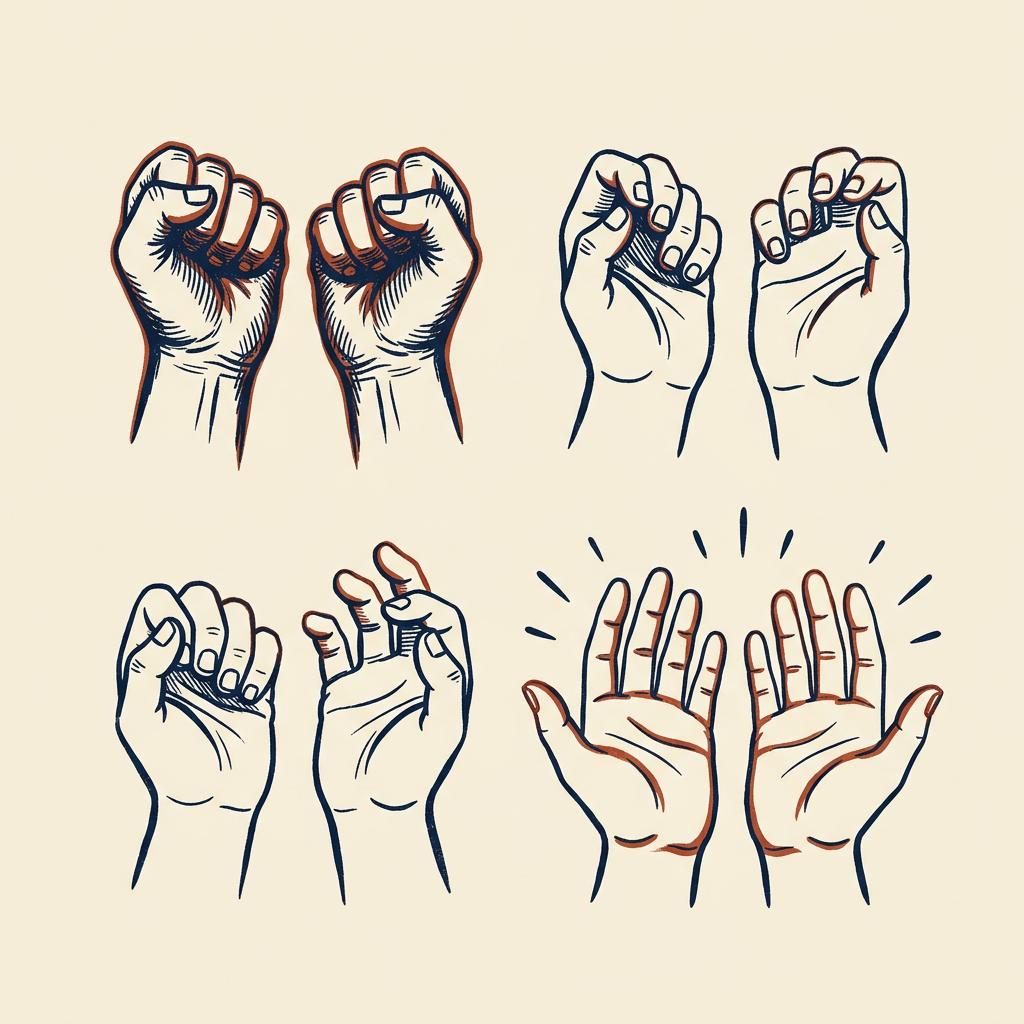
Combat-style flashbacks are often vivid and sensory. Walker expands the term for Complex PTSD: a wave of shame, fear, or worthlessness arrives with no clear trigger and no attached image, yet feels like a true read on the current moment.
A curt email from a boss can drop a survivor into the same helplessness once felt before an angry parent, without any memory playing. Because nothing visual appears, the person assumes the present fully causes the feeling and spends years rearranging jobs and relationships to make it stop.
Walker’s working definition is practical. If the emotional reaction seems larger than the situation warrants—especially when shame, fear, or the urge to disappear floods in—suspect a flashback. Silently or aloud naming it (“this is a flashback”) begins to separate present safety from past reenactment. Without that recognition skill, therapy keeps treating symptoms as current-life problems and never reaches the root.
In practice: A survivor flooded with childhood helplessness after a supervisor’s curt email assumes the reaction is about the job, not an old wound reactivated.
4
Shortening flashbacks in real time
A repeatable self-directed sequence can de-escalate flashbacks; consistent practice over months retrains the nervous system by firing fear without real danger.
Once recognition is possible, Walker supplies concrete steps. Say you are having a flashback. Remind yourself the feelings are old and out of proportion. Affirm that you are safe now as an adult in a way you were not as a child. Scan for tension—especially face, jaw, and shoulders—and consciously release it. Speak reassuringly to the frightened inner child, sometimes in second or third person, the way you would comfort an actual frightened kid. Add slow breathing and orientation to the physical room.
The claim is not instant erasure. Repeated practice shortens duration and intensity because each time the fear response runs and no catastrophe follows, the nervous system recalibrates slightly. He likens it to strength training: awkward and insufficient at first, capacity builds through repetition.
A common failure mode is willpower suppression. Pushing the feeling down only delays and compounds it. Working through the sequence, not overpowering it, is what eventually shrinks the spiral.
In practice: A client triggered into panic by a supervisor’s neutral tone watched the reaction shrink from hours to minutes over a year of naming the flashback and physically relaxing.

5
Toxic shame and the inner critic
The adult inner critic is an internalized replica of the original parent; recovery dismantles its authority instead of debating each critical thought.
Arguing the content
Debating each thought: ‘I’m not stupid,’ ‘I did fine’
Stripping the function
Recognizing the critic’s job is to re-punish and preempt rejection
Chronic childhood criticism does not merely bruise self-esteem. It installs a permanent internal voice that keeps doing the parent’s job. Walker describes two fronts: perfectionism that demands flawlessness to dodge shame, and endangerment scanning that hunts for signs of coming abandonment or attack. Toxic shame—the sense that the core self is defective—fuels both, and differs from healthy guilt about a specific action.
The key move is separating content from function. Arguing “I’m not actually stupid” loses because the critic’s real job is to keep re-punishing the child for supposedly deserving the original mistreatment. The specific accusations can shift while the shame-generating function stays constant.
Techniques follow that logic: thought-stopping the moment a spiral is noticed, deliberately generating self-compassionate counters, and tracking which situations reliably summon the critic. The 4F link matters too—fight types often aim the critic outward as contempt; fawn types aim it entirely inward as self-blame. Shame reduction, not confidence slogans stacked on top of unaddressed defectiveness, is the actual mechanism, because unaddressed shame collapses under stress.
In practice: A client who excelled professionally still felt like a fraud every day; the critic’s accusations kept changing, yet its job of generating preemptive shame never did.
6
Grieving what never arrived
Without active grief for the childhood that was missing, the nervous system stays locked in old defenses and recovery stalls.
Many survivors understand intellectually that their childhood was harmful yet have never grieved it. Sadness was unsafe, punished, or irrelevant to parents absorbed in their own needs. Walker treats unprocessed grief as the lock that keeps defensive patterns running: the person stays attached to fantasies of a perfect family that might still appear, or stays armored against the full weight of the loss, so the body never registers that the danger is over and irreversible.
He distinguishes this work from self-pity. It is active, time-limited mourning—similar to grieving a death—for the safety, attention, and unconditional love a child needed and did not receive. Practices include crying, journaling specific losses, and sometimes writing letters to the childhood self or to parents that are never sent.
Survivors often oscillate between rage at parents and defense of them. Genuine grief moves through anger into a settled sadness that does not require a parental verdict or forgiveness to be complete. That settled sadness, not confrontation or absolution, is what lets the nervous system stand down.
In practice: A client spent years alternating between excusing her mother’s neglect and furious blame; she moved forward only after sustained crying over the specific birthday parties and school events her mother never attended.
7
Reparenting the self on purpose
Adults must deliberately build an internal good-parent voice through awkward repetition, because no one else can supply the missing caregiving retroactively.
Walker’s central recovery method is self-reparenting: cultivating protection, encouragement, and comfort inside oneself as a practiced skill, closer to learning a language late in life than to positive thinking. Concrete drills include lists of real accomplishments and qualities to counter the critic’s selective memory, out-loud self-compassionate talk especially during flashbacks, and consciously choosing safer relationships and settings over familiar harmful ones that feel like “home.”
Resistance tracks the 4F pattern. Fawn types experience self-advocacy as selfish; fight types experience softness as weakness; freeze types experience any active self-care as a threat to the passivity that once kept them safe. The practice therefore has to counter the dominant style rather than arrive as a generic pep talk.
He insists the work is not a substitute for real relationships. Isolation is itself a symptom. Ideally the internal practice runs alongside therapy or supportive connection. Done consistently, the new voice can become as automatic as the original wounding, replacing the old default.
In practice: A client who kept a nightly log of small self-kindnesses, feeling foolish at first, developed a genuinely different baseline mood over two years.
8
Boundaries and safer bonds
Internal work collapses unless survivors also relearn intimacy and boundaries; each 4F style sabotages relationships in a distinct, predictable way.
Walker argues that shame work and reparenting are necessary but not sufficient. Complex PTSD specifically damages the capacity for healthy closeness, so isolation or repeated toxic bonds undo internal gains. Fight types dominate and criticize partners, recreating the abusive parent. Fawn types over-give and disappear, recreating the neglected child while attracting takers. Flight types stay too busy for real intimacy. Freeze types avoid bonds or stay peripheral inside them.
Boundary-setting is treated as a learnable skill, not an innate trait. Children raised without respected limits never internalized how to set their own. Practice starts in low-stakes refusals before high-stakes ones, and includes learning to tolerate the discomfort of disappointing someone without collapsing into shame.
Recovery is not a solo project. “Safe enough” relationships and communities supply corrective experience that self-talk alone cannot. This final stage depends on earlier grief and shame work; without them, every attempt at a boundary collapses under old fear.
In practice: A fawn-type client who had not told anyone no in twenty years of friendships built tolerance by practicing small refusals first with low-risk acquaintances.
Key terms
- Complex PTSD Developmental injury from prolonged childhood abandonment or abuse that warps personality formation, not a single-incident fear wound
- 4F responses Fight, flight, freeze, and fawn—the four childhood survival styles that become automatic adult defaults
- Emotional flashback A sudden regress into childhood shame, fear, or worthlessness with little or no visual memory, felt as present truth
- Toxic shame A pervasive sense that the core self is defective, distinct from guilt about a specific action
- Inner critic The internalized parental voice that keeps punishing and scanning for abandonment long after childhood
- Self-reparenting Deliberate, repeated practice of supplying yourself the protection and comfort that were missing
- Fawn The survival pattern of erasing your needs and appeasing others to avoid conflict or harm
- Thought-stopping Interrupting a critical spiral the moment you notice it, before debating its content
What to do
- Log for one week every moment your emotional reaction feels bigger than the situation; note trigger and feeling, then label it “possible flashback” without fixing it.
- Review that log to spot which 4F style—fight, flight, freeze, or fawn—dominates your patterns.
- Practice one small, low-stakes boundary this week, such as saying no to a minor request.
- Each evening write three plain sentences acknowledging something you did well, read them aloud, and stay with the discomfort instead of dismissing it.
- When a outsized wave of shame or fear hits, silently name it as a flashback and consciously relax your jaw and shoulders.
Questions to think with
- Which of the four survival styles shows up most automatically when you feel criticized or unsafe?
- When did an emotional reaction last far outrun the present trigger, and what childhood feeling might it have echoed?
- What specific childhood losses—missed protection, attention, or ordinary care—have you understood intellectually but never actually grieved?
- Where does your inner critic sound most like an old parental voice rather than an accurate present assessment?
- Which current relationships recreate a familiar childhood dynamic, and what small boundary would begin to interrupt it?
The other side
The book is a clinician’s field guide drawn from personal history and case observation, not controlled trials; the 4F model, flashback sequence, and reparenting practices lack the peer-reviewed longitudinal validation behind therapies such as EMDR, can become a totalizing set of labels that flatten individual variation, focus almost entirely on the parent-child dyad while giving little guidance on institutional or systemic trauma or on survivors who need medication or other modalities, and sometimes assume present-day safety and executive function that not every reader has.
Who it's for
Adults who grew up with chronically critical, neglectful, or abusive parents and still wrestle with self-worth, plus therapists whose clients’ symptoms refuse to fit standard PTSD or personality-disorder boxes. It also serves people in long recovery from anxiety or depression who sense childhood origins but have lacked language for the pattern.