




Virality is a design problem, not luck
Word of mouth follows six learnable psychological levers rather than luck or ad budgets.
IJR · Oct 20, 2026 · 10 min read
In 60 seconds
- Products and ideas spread because of six controllable features, not chance or media spend.
- People share what flatters them—insider knowledge, games, remarkable objects—more than what merely informs.
- Daily environmental cues compound into more total talk than a single launch spike.
- High-arousal emotions such as awe and anger drive sharing more than pleasant low-arousal feelings.
- Visible residue, useful tips, and stories that cannot shed their brand turn private choices into free distribution.
The big idea
Berger argues word of mouth is design, not luck or ad spend. His STEPPS framework—Social Currency, Triggers, Emotion, Public, Practical Value, and Stories—gives six levers builders can install so people choose to pass a product or message along.
The book in brief
A blender maker with no consumer marketing budget put its CEO on YouTube crushing marbles, iPhones, and rake handles. The Will It Blend? clips spread because the content itself made people want to talk, not because money pushed them. Berger opens on cases like that to dismantle the belief that virality is mystery, celebrity luck, or pure ad spend.
He asks a narrower question than why things go viral: which controllable features make any product, idea, or story more likely to be discussed and passed along. The answer is STEPPS—Social Currency, Triggers, Emotion, Public, Practical Value, and Stories. Each lever works alone; the strongest work stacks several. The frame turns word of mouth from an unpredictable outcome into a checklist. Broadcast ads can only tell you about a product. Person-to-person recommendation arrives already loaded with trust and relevance.
The chapters then walk each lever with psychology experiments and business cases. Social currency shows people share to look smart or in-the-know. Triggers show everyday cues beat a one-time spike. Emotion, backed by analysis of thousands of New York Times articles plus lab work, shows physiological arousal predicts sharing better than whether a feeling is positive or negative. Public visibility turns private choices into walking ads. Practical value makes useful tips gifts worth giving. Stories smuggle brand facts inside plots people retell for their own sake.
The book lands on a marketing shift: stop asking how to buy attention and start asking why someone would tell a friend. That reframe puts psychological mechanism, not media budget, at the center of how ideas move.
Context
Jonah Berger drew on Wharton colleagues, lab experiments, and a large New York Times sharing analysis. Published in 2013, Contagious reframed marketing around psychology rather than media buying and treated virality as something designers could engineer.
The key ideas

1
Six levers, not luck
Virality becomes a checklist of six controllable features rather than a bet on chance or spend.
Berger's research program narrowed the question from why things go viral to which controllable features make any content more likely to be discussed and passed along. Much of that work ran with Wharton colleagues and through experiments on thousands of shared New York Times articles.
The answer is STEPPS: Social Currency, Triggers, Emotion, Public, Practical Value, and Stories. Each principle is independent enough to apply on its own. The strongest campaigns and products layer several together.
The framework's power is the conversion itself. Word of mouth stops being an unpredictable outcome and becomes a design problem. Before launch, a marketer or builder can ask which of six levers is missing and install it on purpose.
In practice: Scoring a draft campaign on all six levers and fixing the two weakest turns share counts from fate into a pre-flight check.

2
Sharing as status
People share less to inform others than to look smart, insider, or interesting by association.
Talking about impressive things makes the talker look impressive, the same way a nice suit does. Berger calls this social currency. People preferentially pass along what makes them seem sharp or in-the-know.
Secret menus show the pattern. In-N-Out and Starbucks keep unadvertised items that regulars discover and then tell others about. The motive is less pure helpfulness than displaying insider status. Passing the knowledge transfers some of that status to the listener, so the story keeps moving.
Three levers drive the effect. Give scarce resources or hidden knowledge so people feel like insiders. Use game mechanics—rankings, near-misses, achievable challenges—because people talk about how close they came. Make the product intrinsically remarkable, surprising enough to break routine expectations.
The design question shifts. Not is this good, but does talking about this make the talker look good. That second question predicts sharing better than quality alone.
In practice: Philadelphia's Barclay Prime built reputation partly on a $100 cheesesteak people discussed without ordering it.
3
Cues beat spikes
Habitual environmental cues produce more total word of mouth than a single viral burst.
- 1Daily cueCoffee break, Friday, commute
- 2Top of mindProduct resurfaces without a new ad
- 3Fresh mentionAnother round of word of mouth
- 4Cue repeatsThe environment fires again
↻ and round again
Immediate virality is one burst right after launch. Habitual triggers are cues embedded in daily life that keep reminding people and prompting fresh mentions. Berger argues marketers overvalue the burst and undervalue the cue, because a daily trigger compounds into far more total talk.
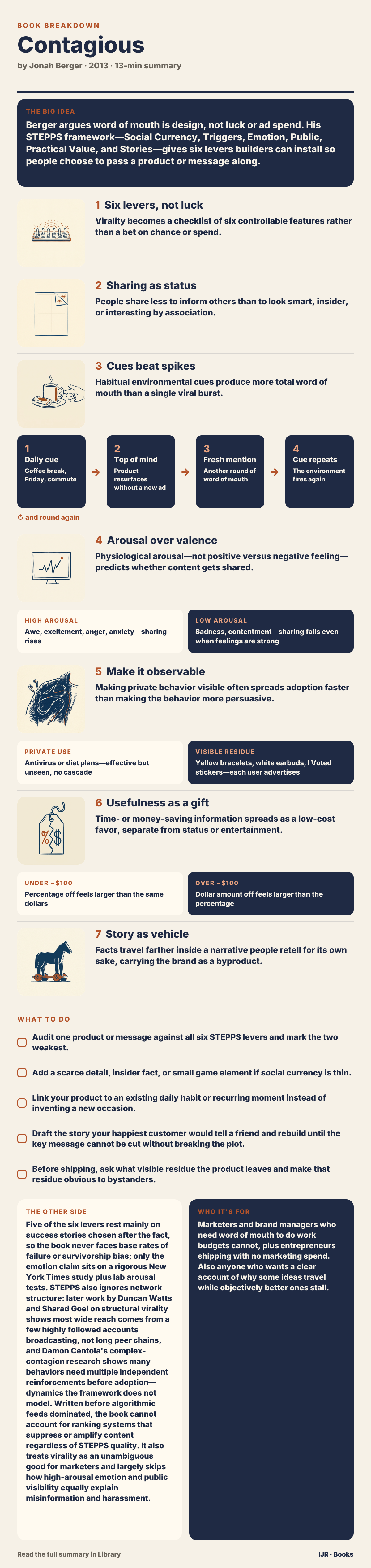
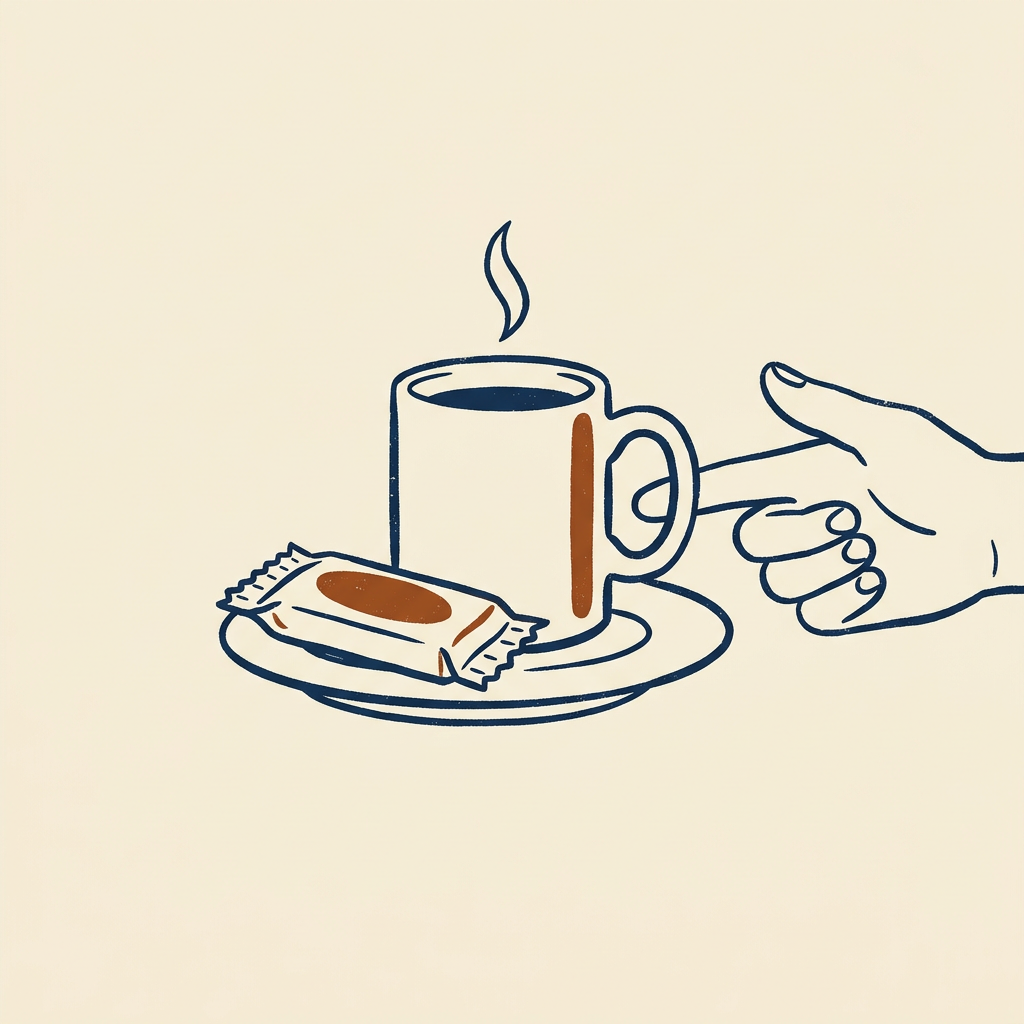
Kit Kat's Australian campaign paired the bar with have a break and the coffee-break ritual. Coffee breaks already happen every workday. The link gave Kit Kat a recurring prompt competitors without a tied cue lacked. Sales rose after the campaign with no change to the product itself.
Products hitched to rare or unpredictable cues get far less consistent mention. Rebecca Black's song Friday kept returning partly because Friday itself recurs every week, pulling the track back long after the first mockery spike faded.
Map the environment customers already inhabit. Piggyback on a mealtime, a weekday, or a location they already pass. A trigger that needs an artificial reminder is weaker than one that rides something habitual.
In practice: Kit Kat's coffee-break pairing turned an ordinary workplace ritual into a daily sales cue.

4
Arousal over valence
Physiological arousal—not positive versus negative feeling—predicts whether content gets shared.
High arousal
Awe, excitement, anger, anxiety—sharing rises
Low arousal
Sadness, contentment—sharing falls even when feelings are strong
With Katherine Milkman, Berger analyzed roughly seven thousand New York Times articles against the paper's most-emailed list. Positive pieces were more likely to be shared on average, yet valence alone predicted poorly.
The stronger predictor was physiological arousal. Emotions that activate the body—awe, excitement, anger, anxiety—increased sharing whether they felt good or bad. Low-arousal emotions such as sadness or contentment decreased sharing even when the feeling was strong.
Lab work supported a causal reading. Subjects who jogged in place before watching a video shared more regardless of content. The body seeks an outlet; sharing serves as one.
Campaigns built only to leave people warm and satisfied may underperform ones that deliver a jolt of delight, outrage, or wonder. Manufactured outrage spreads efficiently but can attach arousal to the brand in ways hard to steer once released.
In practice: An anger story about corporate wrongdoing can travel as far as an uplifting piece because both activate the body.

5
Make it observable
Making private behavior visible often spreads adoption faster than making the behavior more persuasive.
Private use
Antivirus or diet plans—effective but unseen, no cascade
Visible residue
Yellow bracelets, white earbuds, I Voted stickers—each user advertises
Many good products fail not because people dislike them privately but because use is invisible. Potential adopters never see the social proof that would nudge them. Berger's public principle holds that visibility turns individual choices into advertisements for themselves.
The yellow Livestrong bracelet, distributed by the Lance Armstrong Foundation starting in 2004, made every wearer's wrist a walking billboard. Sheer visible numbers created pressure and curiosity that drove tens of millions of additional purchases, independent of the foundation's message.
Apple shipped the original iPod with white earbuds against the black cords then standard. Every user's ears became a visible ownership signal. The I Voted sticker at American polling places converts a private civic act into a public cue that measurably raises others' odds of voting.
Ask what physical or behavioral residue a product leaves. Engineer that residue to be seen. Visibility recruits people who have never been persuaded by a message at all.
In practice: White iPod earbuds turned a private purchase into public information at a glance.
6
Usefulness as a gift
Time- or money-saving information spreads as a low-cost favor, separate from status or entertainment.
Under ~$100
Percentage off feels larger than the same dollars
Over ~$100
Dollar amount off feels larger than the percentage
Content that saves time, money, or effort gets shared because sharing it is a cheap way to help a friend. That psychology sits behind deal newsletters, recipe forwards, and life-hack lists. Usefulness itself is a distinct driver.
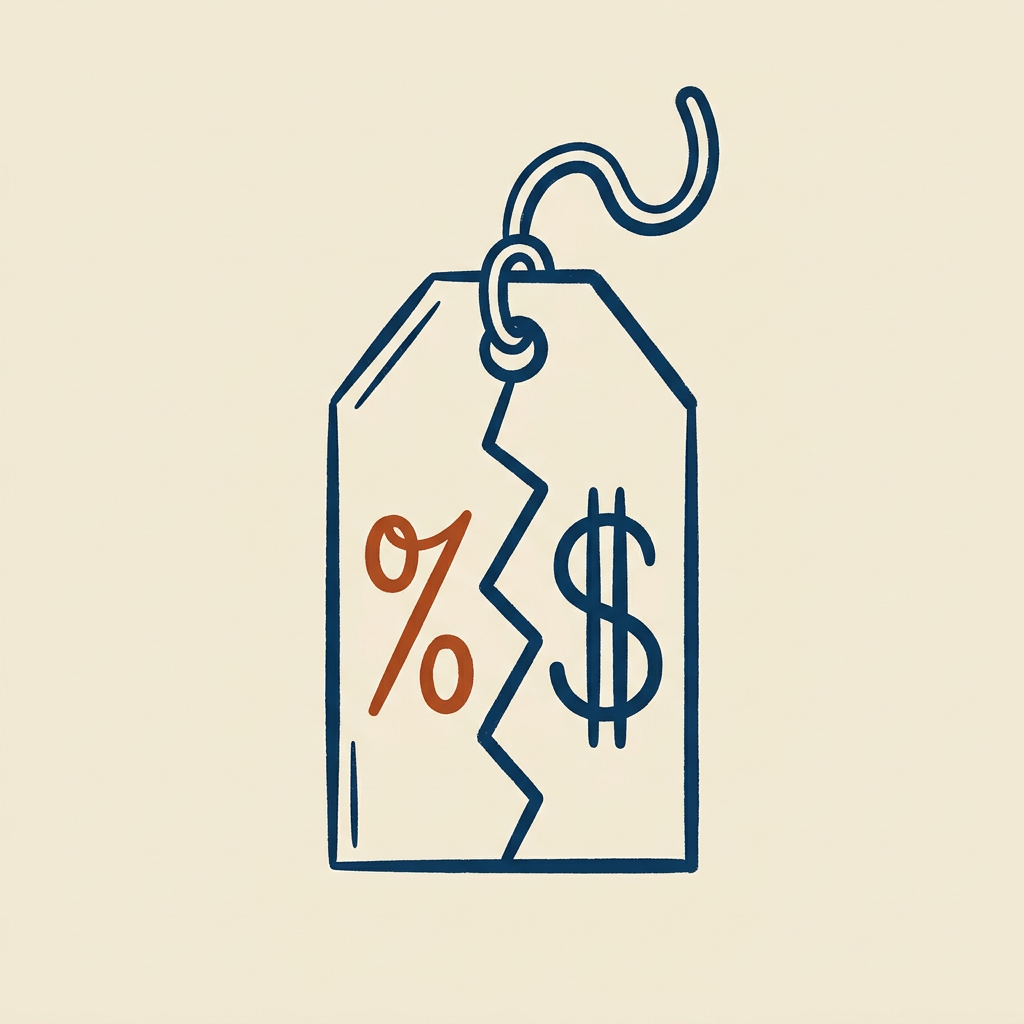
Pricing research Berger draws on, including work by Priya Raghubir, supports the rule of one hundred. For items under about one hundred dollars, a percentage discount feels larger than the same dollars off—so 50% off a twenty-dollar item beats $10 off. Above one hundred dollars the reverse holds: $200 off feels bigger than a percentage.
Perceived value, not only actual value, is what people talk about. Mundane tips—stain removal, fuel-efficiency comparisons—spread without emotional hooks because they fulfill a norm of reciprocal helpfulness.
Practical value alone rarely explodes. It yields steady, durable diffusion useful for retention and ongoing referral. It works best layered with the other STEPPS principles.
In practice: Framing a deal on a sub-hundred-dollar item as a percentage rather than dollars can raise the talk it generates.

7
Story as vehicle
Facts travel farther inside a narrative people retell for its own sake, carrying the brand as a byproduct.
People do not typically retell bare facts. They retell stories. If useful information is stitched tightly into the plot, it survives automatically, like a Trojan horse carrying content past the usual filter for ads.
Jared Fogle's Subway narrative is the central case. He reportedly lost over two hundred pounds eating Subway sandwiches. A college newspaper picked it up, then Subway's own advertising. The story worked as personal transformation with a clear before-and-after. The brand was so structural that removing it would break the plot.
Fragile messaging differs. A brand mention tacked onto an unrelated joke or meme tends to get dropped as successive sharers retell and re-edit. Stories also carry social currency and emotional arousal more efficiently than facts alone, because a narrative arc builds tension and payoff.
Flip the question. Stop asking how to make an advertisement more shareable. Start asking what story already contains the message as an inseparable structural element. A good story gets repeated for entertainment and pulls the embedded information along free.
In practice: Subway's weight-loss story kept the brand inside every retelling because cutting Subway destroyed the plot.
Key terms
- STEPPS Berger's six levers: Social Currency, Triggers, Emotion, Public, Practical Value, Stories
- Social currency Status people gain by sharing something that makes them look smart or in-the-know
- Habitual triggers Everyday cues that keep a product top of mind long after launch buzz fades
- Physiological arousal Body activation from emotions like awe or anger that pushes people to share
- Public principle Visible behavior becomes its own advertisement and recruits new adopters
- Rule of one hundred Under about $100, percentage discounts feel bigger; above it, dollar discounts do
- Structural virality Later research term for reach that depends more on network shape and who shares first than on content design alone
What to do
- Audit one product or message against all six STEPPS levers and mark the two weakest.
- Add a scarce detail, insider fact, or small game element if social currency is thin.
- Link your product to an existing daily habit or recurring moment instead of inventing a new occasion.
- Draft the story your happiest customer would tell a friend and rebuild until the key message cannot be cut without breaking the plot.
- Before shipping, ask what visible residue the product leaves and make that residue obvious to bystanders.
Questions to think with
- Which of the six STEPPS levers is entirely missing from your current message?
- Does talking about this make the talker look good, or only helpful?
- What daily cue already in your customer's life could carry your product for free?
- If someone retold your best customer story, would the brand still be inside it?
- Are you building for one spike or for triggers that fire every week?
The other side
Five of the six levers rest mainly on success stories chosen after the fact, so the book never faces base rates of failure or survivorship bias; only the emotion claim sits on a rigorous New York Times study plus lab arousal tests. STEPPS also ignores network structure: later work by Duncan Watts and Sharad Goel on structural virality shows most wide reach comes from a few highly followed accounts broadcasting, not long peer chains, and Damon Centola's complex-contagion research shows many behaviors need multiple independent reinforcements before adoption—dynamics the framework does not model. Written before algorithmic feeds dominated, the book cannot account for ranking systems that suppress or amplify content regardless of STEPPS quality. It also treats virality as an unambiguous good for marketers and largely skips how high-arousal emotion and public visibility equally explain misinformation and harassment.
Who it's for
Marketers and brand managers who need word of mouth to do work budgets cannot, plus entrepreneurs shipping with no marketing spend. Also anyone who wants a clear account of why some ideas travel while objectively better ones stall.