




Creative excellence comes from candor systems, not genius hires
Catmull argues creative excellence comes from systems that surface problems early and make truth-telling safer than silence, not from hiring geniuses.
IJR · Oct 20, 2026 · 12 min read
In 60 seconds
- Catmull argues creative excellence is built by organizational systems that surface problems early, protect candor, and tolerate mess—not by hiring isolated geniuses.
- The Braintrust lets peer directors critique films without power to mandate changes, catching fatal story problems while they are still cheap to fix.
- Every Pixar film starts weak; expecting early ugliness and iterating turns bad screenings into data instead of hidden failure.
- Talent alone fails; porous boundaries, shared classes, and chance hallway encounters shape how people actually work together.
- Disney Animation revived with largely the same people once Braintrust-style feedback and trust replaced fear and executive decree.
- Notes Day shut production so employees could air internal dysfunction with leadership committed to visible follow-through.
The big idea
Catmull argues that creative excellence is not the product of hiring geniuses but of building organizational systems that surface problems early, protect candor, and tolerate the mess of the creative process. Management's real job, he holds, is removing fear and hidden dysfunction so talented people can do their best work.
The book in brief
Catmull starts from a management failure mode: talented teams still produce mediocre work when hierarchy, politeness, and fear hide problems until they are expensive. He centers the Braintrust—peer directors and story people who say exactly what is not working, with no authority to force changes—as the mechanism that separates critique of the work from judgment of the person and keeps disagreement cheap.
He then insists every Pixar film is bad early. Finding Nemo and Up looked little like their finished versions in early screenings; Toy Story 2's weak cut forced a nine-month rebuild under punishing conditions. Demanding early polish, he argues, trains teams to hide messes; schedules and review cycles that treat failure as the normal first state turn rough reels into usable data instead of career risk.
Hiring brilliant individuals is not enough. Catmull claims mediocre ideas from a well-functioning team beat great ideas mishandled by a dysfunctional one, because creative work is thousands of small collective decisions. He kept boundaries porous through Pixar University classes open to any employee and redesigned the campus to force cross-department encounters that scheduled meetings miss.
New ideas need different protection than finished products. Early concepts are fragile and often embarrassing; exposing them too soon to judgmental audiences kills them. He shielded early pitches from executive and financial pressure and warns that success itself breeds risk-aversion that pushes teams toward safe, imitative bets.
After Disney acquired Pixar in 2006, Catmull and Lasseter applied the same principles to a demoralized Disney Animation. Structural changes—Braintrust-style sessions, fewer unaccountable notes layers, separation of story feedback from budget pressure—preceded personnel change. The same workforce later delivered Tangled, Wreck-It Ralph, and Frozen, which he treats as evidence that process, not irreplaceable founders alone, moved the output.
He complicates the internal-culture story with ownership: Steve Jobs kept Pixar alive through years of losses before Toy Story in 1995 and insisted on structural guarantees in the 2006 deal so Pixar's process would not be absorbed. In 2013, Notes Day shut the studio for a full day of facilitated employee critique of internal processes, with public commitment to act on some recommendations—extending structured candor from films to the organization itself. The arc lands on continuous maintenance: culture drifts toward silence without deliberate, costly mechanisms that reopen it.
Context
Ed Catmull, cofounder of Pixar and longtime president of Pixar and Disney Animation, published the book in 2014. It draws on Pixar's near-collapses and hits to treat management as organizational design for art, not only inspiration.
The key ideas
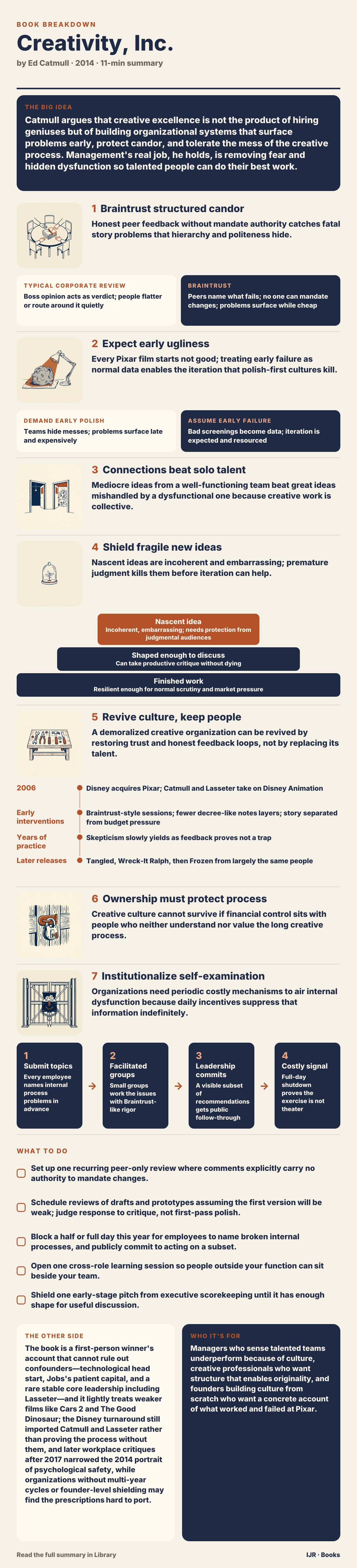
1
Braintrust structured candor
Honest peer feedback without mandate authority catches fatal story problems that hierarchy and politeness hide.
Typical corporate review
Boss opinion acts as verdict; people flatter or route around it quietly
Braintrust
Peers name what fails; no one can mandate changes; problems surface while cheap
Catmull centers the Braintrust: Pixar directors and story people review each film in progress and say exactly what is not working. The director is not obligated to accept any suggestion. The point is not consensus; it is exposing problems while they are still cheap to fix.
He traces part of Toy Story 2's early weakness to a review process that had not yet matured into later Braintrust rigor, after which the crew scrapped and rebuilt the film in nine months. Talented people produce mediocre work, he argues, when the environment does not reward telling the truth about it.
The mechanism works because critique of the work is separated from judgment of the person, and because attendance carries no authority to mandate changes, which lowers the stakes of speaking up. He contrasts this with typical corporate reviews where a boss's opinion functions as a verdict, so people flatter it or route around it quietly.
Candor has to be designed for: meeting norms, seating, and speaking order all shift how honest a room can be. Without structure, he insists, smart organizations still drift toward silence because the social cost of disagreeing with someone senior outweighs the abstract benefit of a better outcome.
In practice: Toy Story 2's weak early cut forced a full rebuild in nine months once review rigor caught up.
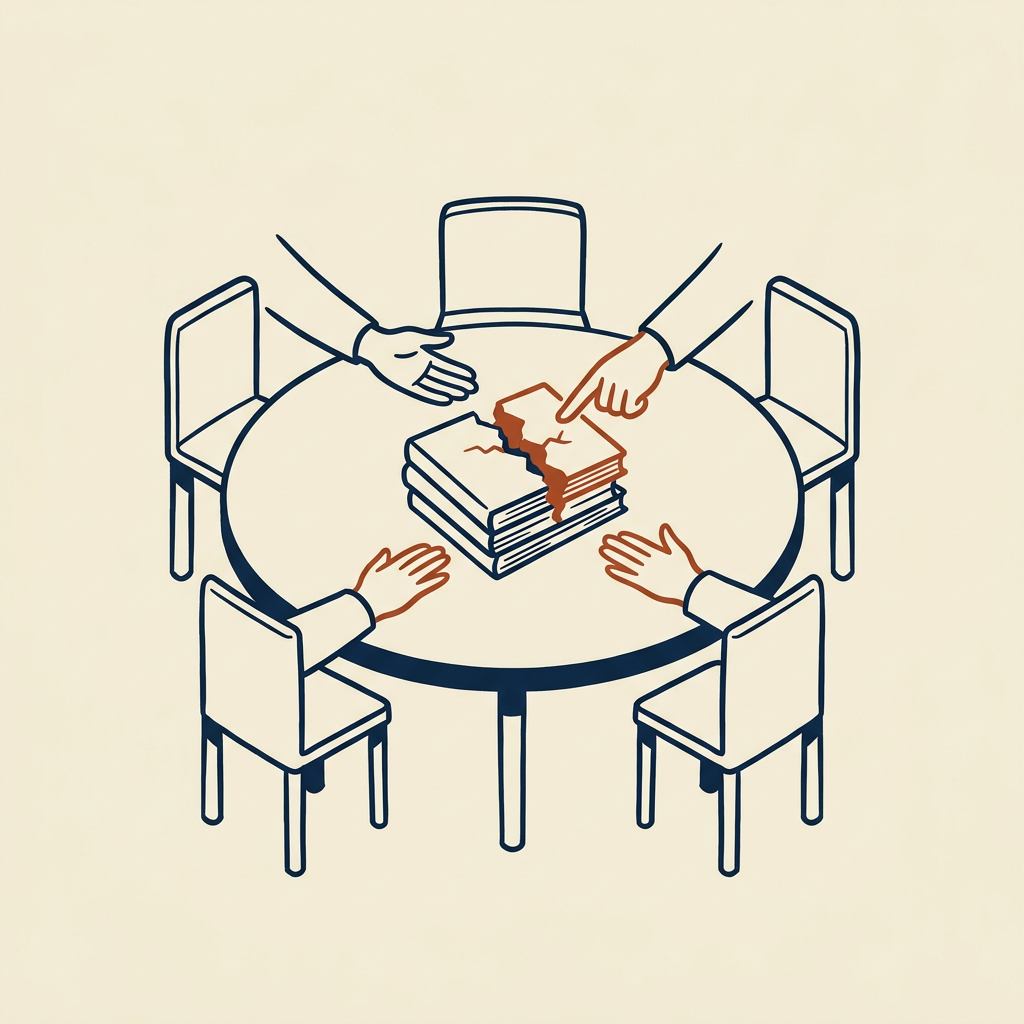
2
Expect early ugliness
Every Pixar film starts not good; treating early failure as normal data enables the iteration that polish-first cultures kill.
Demand early polish
Teams hide messes; problems surface late and expensively
Assume early failure
Bad screenings become data; iteration is expected and resourced
Catmull states plainly that all of Pixar's films are not good early on. The studio's advantage is expecting that state and building schedule and psychology to survive it, not avoiding it.
Finding Nemo and Up finished versions bore little resemblance to early screenings that were confusing, tonally off, or narratively broken. If leadership demands early perfection, teams hide problems because admitting a mess feels like admitting failure.
Pixar builds review cycles that assume failure is the normal first state, so a bad screening becomes data rather than evidence of incompetence. Studios that punish visible failure end up punishing visibility itself; problems go underground and surface later, closer to release, more expensively.
Story reels and rough animation passes stay deliberately unpolished so reviewers judge storytelling rather than surface quality—a discipline against getting seduced by production value before the story is right. Polish before the story works is wasted labor.
In practice: Finding Nemo and Up early screenings were confusing or broken; finished films barely resembled them.
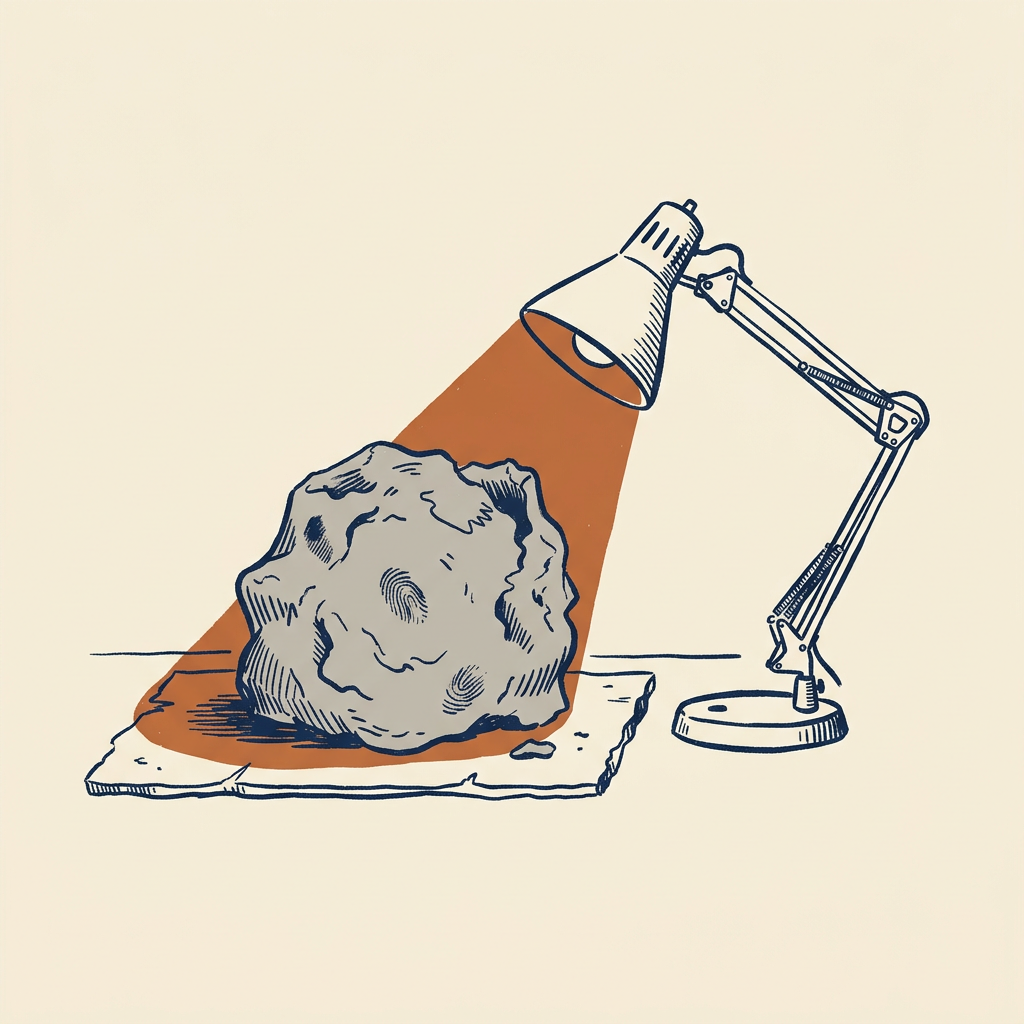
3
Connections beat solo talent
Mediocre ideas from a well-functioning team beat great ideas mishandled by a dysfunctional one because creative work is collective.
Catmull rejects the assumption that hiring brilliant people and giving them freedom automatically produces good work. Creative output depends more on how people interact than on any single hire's talent.
He recounts early frustration: hiring accomplished animators and technical people did not by itself prevent friction, miscommunication, or wasted work. Connections between people, not just individual skill, determined output.
He kept internal boundaries porous, funding Pixar University with free classes open to any employee regardless of department so production assistants and janitors could take life-drawing beside animators. The purpose was shared culture and candid speech across roles, which fed the Braintrust's ability to function.
He also redesigned the Pixar campus, with Steve Jobs's involvement, to force cross-departmental encounters on the theory that chance hallway conversations solve problems scheduled meetings miss. He treats the building as a genuine bet, not decoration.
In practice: Pixar University let janitors and production assistants take life-drawing with animators to build cross-department candor.

4
Shield fragile new ideas
Nascent ideas are incoherent and embarrassing; premature judgment kills them before iteration can help.
- Nascent ideaIncoherent, embarrassing; needs protection from judgmental audiences
- Shaped enough to discussCan take productive critique without dying
- Finished workResilient enough for normal scrutiny and market pressure
Catmull distinguishes the vulnerability of a nascent idea from the resilience a finished film eventually needs. Early-stage concepts are almost always incoherent or embarrassing, and organizations kill good ideas by exposing them too early to audiences primed to judge rather than help.
He uses the metaphor of protecting new ideas the way one protects a baby—different treatment than something grown enough to withstand normal scrutiny. Concretely, he shielded early pitches from executives or financial pressure until they had enough shape to be discussed productively, and resisted greenlighting or killing projects on a two-page pitch.
Fear of failure is not the same as risk itself. Management often confuses eliminating risk with eliminating the appearance of risk, which produces cautious, imitative work dressed up as safe bets.
Commercial success creates its own danger: institutional risk-aversion and a temptation to repeat what worked rather than trust the same uncertain process that produced it. Demanding early certainty about a creative bet forces premature convergence on derivative ideas.
In practice: Early pitches were shielded from executive and financial pressure until they had enough shape for useful discussion.
5
Revive culture, keep people
A demoralized creative organization can be revived by restoring trust and honest feedback loops, not by replacing its talent.
- 2006Disney acquires Pixar; Catmull and Lasseter take on Disney Animation
- Early interventionsBraintrust-style sessions; fewer decree-like notes layers; story separated from budget pressure
- Years of practiceSkepticism slowly yields as feedback proves not a trap
- Later releasesTangled, Wreck-It Ralph, then Frozen from largely the same people
When Disney acquired Pixar in 2006 and put Catmull and John Lasseter in charge of Disney Animation, Catmull treated the struggling division as a test of whether his principles generalized. He found a talented but fearful workforce that had learned through executive interference and canceled projects to distrust management and withhold bad news.
His first interventions were structural: Braintrust-style review sessions, removal of notes-giving layers that made feedback feel like unaccountable decree, and separation of story feedback from budget and marketing pressure. Disney veterans were skeptical after previous culture initiatives had come and gone; proving new feedback was not a trap took repeated practice.
The turnaround culminated in films like Tangled and Wreck-It Ralph, and later Frozen. Catmull cites them as evidence that the same team, largely unchanged in personnel, could produce dramatically better work once organizational conditions changed.
This addresses the objection that Pixar's success was only gifted founders: Disney Animation had many of the same people before and after, and the delta in output coincided with the delta in process. He notes the change took years, not a single retreat or memo.
In practice: Tangled, Wreck-It Ralph, and Frozen followed years of structural candor changes with largely the same Disney Animation workforce.
6
Ownership must protect process
Creative culture cannot survive if financial control sits with people who neither understand nor value the long creative process.
Catmull describes Steve Jobs less as a creative contributor than as the person who kept Pixar financially alive through nearly a decade of losses before Toy Story's 1995 success, and later as an advocate who protected creative independence in Disney negotiations.
No amount of internal candor or iteration protects a studio whose ownership or financing incentivizes short-term extraction over long-term craft. He notes Disney's earlier interference with Pixar sequels and Jobs's insistence, during 2006 acquisition talks, on structural guarantees that Pixar's culture and leadership would be preserved rather than absorbed into existing Disney management layers.
Catmull credits Jobs with understanding that Pixar's value was inseparable from its process, so protecting the process was a financial decision, not a cultural nicety. Internal systems remain fragile without external protection at the ownership or governance level.
Without Jobs's financial patience during the early money-losing years of hardware and shorts, none of the later cultural infrastructure would have had time to exist. The chapter corrects any reading of the book as purely middle-management technique.
In practice: Jobs insisted in 2006 acquisition talks on guarantees that Pixar's culture and leadership would not be absorbed into Disney's layers.
7
Institutionalize self-examination
Organizations need periodic costly mechanisms to air internal dysfunction because daily incentives suppress that information indefinitely.
- 1Submit topicsEvery employee names internal process problems in advance
- 2Facilitated groupsSmall groups work the issues with Braintrust-like rigor
- 3Leadership commitsA visible subset of recommendations gets public follow-through
- 4Costly signalFull-day shutdown proves the exercise is not theater
In 2013 Pixar ran Notes Day: production shut down for a full day and every employee could submit and discuss criticisms of the company's own internal processes, structured with Braintrust-like rigor. Despite pride in candor about films, the studio had accumulated unspoken frustrations about inefficient scheduling, unclear career paths, and cross-department communication breakdowns.
Rather than annual surveys or informal grumbling, Catmull made Notes Day an explicit, resourced intervention. Employees submitted topics in advance, small groups worked with facilitators, and leadership committed to visibly acting on a subset of recommendations.
He generalizes structured peer candor from film critique to organizational self-management: people tell the truth about dysfunction if they trust the process will not be used against them and if they see follow-through. A full-day shutdown of a profitable studio to solicit complaints looks like poor prioritization on paper.
He treats the expense as the evidence of seriousness. Cheap gestures toward transparency do not generate trust because employees correctly read costly signals as more credible than free ones. Even a studio built around candor drifts toward silence without periodic deliberate reopening.
In practice: Notes Day 2013 closed production for one facilitated day of process critique with public commitment to act on some recommendations.
Key terms
- Braintrust Peer directors and story people who critique a film in progress with no power to mandate changes, only to expose problems early.
- Candor by design Meeting norms, seating, and speaking order built so disagreement costs less than silence.
- Early ugly The expected weak first state of every film; rough reels judged as story data, not as polished failure.
- Protecting the new Shielding fragile early ideas from premature executive or financial judgment until they can withstand scrutiny.
- Notes Day A full production shutdown where employees formally air internal process dysfunction and leadership acts on some of it.
- Porous boundaries Open classes and campus layouts that force cross-department contact so people can speak candidly across roles.
- Hungry beast The organizational appetite and interaction patterns that matter more to output than any single talented hire.
What to do
- Set up one recurring peer-only review where comments explicitly carry no authority to mandate changes.
- Schedule reviews of drafts and prototypes assuming the first version will be weak; judge response to critique, not first-pass polish.
- Block a half or full day this year for employees to name broken internal processes, and publicly commit to acting on a subset.
- Open one cross-role learning session so people outside your function can sit beside your team.
- Shield one early-stage pitch from executive scorekeeping until it has enough shape for useful discussion.
Questions to think with
- Where does your team hide early messes because admitting them feels like personal failure?
- Which recurring meeting still treats the senior voice as a verdict rather than one data point?
- What would a costly, visible signal of seriousness about internal dysfunction look like in your organization this quarter?
- Are new ideas dying from premature judgment or from lack of later resilience?
- If your best people stayed but feedback norms changed, what output shift would you expect within two years?
The other side
The book is a first-person winner's account that cannot rule out confounders—technological head start, Jobs's patient capital, and a rare stable core leadership including Lasseter—and it lightly treats weaker films like Cars 2 and The Good Dinosaur; the Disney turnaround still imported Catmull and Lasseter rather than proving the process without them, and later workplace critiques after 2017 narrowed the 2014 portrait of psychological safety, while organizations without multi-year cycles or founder-level shielding may find the prescriptions hard to port.
Who it's for
Managers who sense talented teams underperform because of culture, creative professionals who want structure that enables originality, and founders building culture from scratch who want a concrete account of what worked and failed at Pixar.