




Most tech products die between early fans and the mainstream
Founders and marketers with enthusiastic users but flat revenue get a playbook for the gap that ends most technology launches.
IJR · Oct 20, 2026 · 11 min read
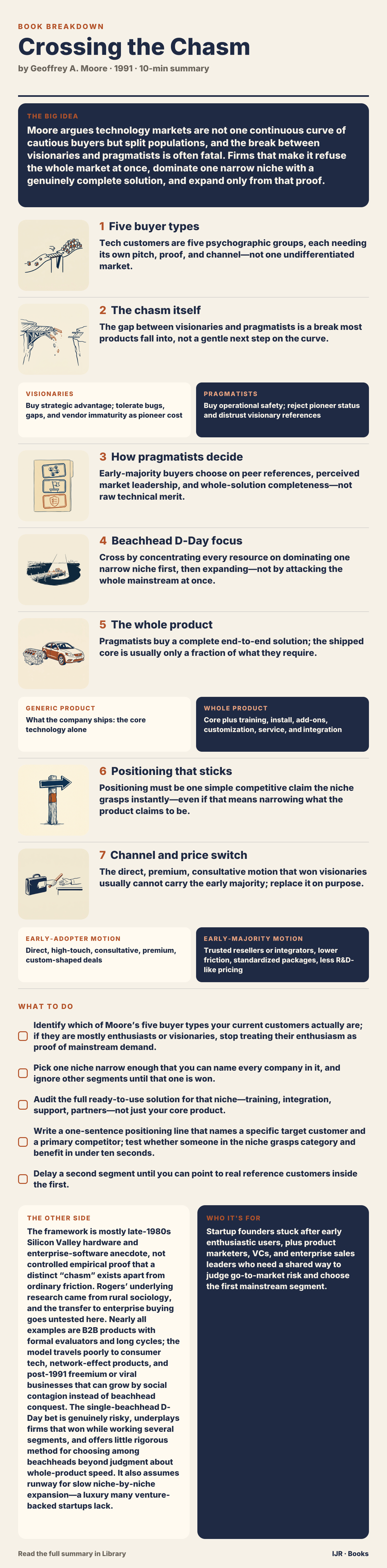
In 60 seconds
- New-tech buyers split into five psychographic groups with incompatible reasons to buy, not one smooth market.
- A chasm between visionaries and pragmatists is where most promising products stall and die.
- Pragmatists demand peer references in their own industry, market-leadership signals, and a complete ready solution.
- Cross by pouring all force into one narrow beachhead niche until you own it, not by chasing the whole market.
- Finish the whole product for that niche, claim leadership there, then rebuild channel and pricing for the majority.
- Early-adopter references, pitches, and direct sales motions almost never transfer; rebuild credibility from scratch.
The big idea
Moore argues technology markets are not one continuous curve of cautious buyers but split populations, and the break between visionaries and pragmatists is often fatal. Firms that make it refuse the whole market at once, dominate one narrow niche with a genuinely complete solution, and expand only from that proof.
The book in brief
In the 1980s, workstation and relational database firms won eager early customers, then watched growth flatten when the same pitch met corporate IT. Moore treats that stall as the chasm—and as diagnosable.
He starts from Rogers’ diffusion curve and names five buyer types: enthusiasts who love novelty, visionaries who chase revolutionary advantage, pragmatists who want proven evolutionary gains, conservatives who buy under pressure for simplicity and price, and skeptics who resist. Each group trusts different references and needs a different sales approach. A pitch that thrills a visionary actively repels a pragmatist.
The break between visionaries and the early majority is not a gentle slope. Visionaries tolerate bugs and vendor immaturity to leap ahead. Pragmatists want minimum operational risk and do not trust visionaries as references. A hospital IT director does not care that an aerospace lab loves the product; she wants another hospital. The early-adopter reference base is nearly worthless, so companies that raised money on visionary wins then burn cash for a year or more while identical-looking deals stop closing.
Moore’s remedy is concentration of force, not a broad assault. Pick one narrow niche—defined tightly enough to name, such as regional community banks under $2 billion in assets—and commit essentially all sales, marketing, and product resources to owning it. Pragmatists trust word of mouth inside their own community; total dominance there creates the peer proof and leadership perception that partial presence across many segments never does. Boards chasing total addressable market find this counterintuitive. Moore calls thin spread the most common execution failure after a firm admits the chasm exists.
Inside that beachhead, map the whole product: core offering plus training, installation, complementary tools, industry customization, service contracts, and integration. Visionaries will co-invent the missing pieces; pragmatists simply will not buy. Pair the finished offer with a single simple positioning claim that names a target customer, a category, a key benefit, and a primary competitor. Then treat channel and pricing as a deliberate switch: high-touch direct premium sales that won visionaries rarely scale to price-sensitive majority buyers who prefer trusted resellers and standardized packages.
Secure real references inside the first niche before you open a second. That is how stalled products start closing again.
Context
Geoffrey A. Moore published the book in 1991. It gave Silicon Valley a shared vocabulary for market segments and a practical playbook for moving from early adopters into the mainstream.
The key ideas

1
Five buyer types
Tech customers are five psychographic groups, each needing its own pitch, proof, and channel—not one undifferentiated market.
Moore borrows Rogers’ bell curve and renames the segments for technology marketers: technology enthusiasts (innovators), visionaries (early adopters), pragmatists (early majority), conservatives (late majority), and skeptics (laggards).
Enthusiasts buy novelty for its own sake. Visionaries buy to leap competitors and will live with rough edges. Pragmatists buy proven, evolutionary improvement. Conservatives buy when forced, wanting simplicity and low price. Skeptics resist buying at all.
A line that excites a visionary—be first in your industry—sounds unproven and risky to a pragmatist. Without this map, teams treat early momentum as proof the broader market will follow and get blindsided when it does not.
Marketing, pricing, and sales must change at each handoff. Treating “the market” as one population is the setup for the book’s central failure mode.
In practice: 1980s workstation and relational database companies won early enthusiasts and visionaries, then stalled when they told the same story to corporate IT departments.

2
The chasm itself
The gap between visionaries and pragmatists is a break most products fall into, not a gentle next step on the curve.
Visionaries
Buy strategic advantage; tolerate bugs, gaps, and vendor immaturity as pioneer cost
Pragmatists
Buy operational safety; reject pioneer status and distrust visionary references
Rogers treated adjacent groups as continuous, each influencing the next. Moore inserts a hard gap between early adopters and the early majority and argues this is where most promising technology products actually die.
The cause is social, not just statistical. Visionaries see themselves as pioneers. Pragmatists explicitly refuse that role. Crucially, pragmatists do not accept visionaries as valid references, so the proof base from the early phase does not carry.
Firms raise money and press on visionary wins, then watch revenue flatten for a year or more with no obvious product flaw. Sales fails on deals that look just like earlier ones.
Moore’s promise is that the stall is diagnosable and largely avoidable with the right target and product completeness—not an unlucky fluke.
In practice: A hospital IT director ignores raves from an aerospace R&D lab; she only trusts another hospital doing similar work.

3
How pragmatists decide
Early-majority buyers choose on peer references, perceived market leadership, and whole-solution completeness—not raw technical merit.
Pragmatists know immature infrastructure can create years of downstream cost if the vendor stumbles or the offer is incomplete. They hunt risk-reducing signals.
They prefer a vendor that looks like the market leader, expecting better support, more third-party add-ons, and longer product life. They want references from firms in their own industry doing similar work. They want a complete, ready-to-use solution, not a core they must finish.
The same pitch, case studies, and product scope that won visionaries will not win them. The go-to-market problem reframes from “get more customers” to “become the de facto standard in one defined community first.”
Manufacture leadership perception inside that narrow world even before broad share exists. That is what makes later expansion possible.
In practice: Unlike visionaries willing to co-invent with the vendor, pragmatists walk when the solution is still a kit of parts.

4
Beachhead D-Day focus
Cross by concentrating every resource on dominating one narrow niche first, then expanding—not by attacking the whole mainstream at once.
Allied forces in 1944 did not liberate Europe in one stroke; they overwhelmed a single beach, secured it, and pushed out. Moore applies the same logic to market segments.
Define the niche tightly—not “financial services” but a slice you can fully name. Commit essentially all sales, marketing, and product effort to winning it completely. Pragmatist word of mouth is intense inside one community and weak across unrelated ones.
Partial presence in many segments produces no leadership perception anywhere. Total win in one small niche produces the references needed for adjacent moves. Executives focused on total addressable market feel the discipline is irresponsible because it means ignoring real near-term revenue outside the beachhead.
Choose where the whole product can be finished fastest and where a compelling reason to buy already exists—not simply where the segment is largest. Thin spread after admitting the chasm is the single most common execution failure Moore flags.
In practice: Target “regional community banks with under $2 billion in assets,” not the entire financial-services category.

5
The whole product
Pragmatists buy a complete end-to-end solution; the shipped core is usually only a fraction of what they require.
Generic product
What the company ships: the core technology alone
Whole product
Core plus training, install, add-ons, customization, service, and integration
Borrowing from Levitt, Moore separates the generic product a company ships from the whole product the customer needs to solve the problem. The whole product adds training, installation support, complementary software, industry-specific customization, service contracts, and integration with existing systems.
Visionaries enjoy assembling missing pieces or paying for custom work. Pragmatists treat gaps as a reason not to buy. Crossing the chasm means mapping exactly what completeness looks like inside the chosen beachhead’s workflow, then partnering, reselling, or building every missing piece.
That often means allying with firms otherwise seen as competitors. Owning every component matters less than finishing the solution for the niche. Beachhead choice hinges on this: a niche where the whole product can be assembled quickly and cheaply beats a larger niche that needs years more development.
Superior core technology still loses when a less elegant rival shows up with the full ecosystem already in place.
In practice: Early relational database and workstation vendors with stronger cores lost mainstream deals to rivals that had resellers, consultants, and add-on tools already assembled.

6
Positioning that sticks
Positioning must be one simple competitive claim the niche grasps instantly—even if that means narrowing what the product claims to be.
Positioning is the message that lets a pragmatist drop an unfamiliar offer into a safe mental category. Moore’s template forces hard choices: for a target customer with a specific need, the product is a category that delivers a key benefit; unlike the primary alternative, it has one clear point of difference.
Broad lines like “for everyone who needs better data management” give pragmatists nothing to hold. Naming a primary competitor and a single target customer feels painful and is required. The goal is the minimum that triggers a correct, favorable categorization—not a tour of every impressive feature.
Founders and engineers often overload the statement with full technical sophistication until it communicates nothing. Inside the beachhead, claim leadership of that niche explicitly and repeatedly even before broad share exists.
Perception of leadership in a small, well-defined community is achievable quickly and becomes self-reinforcing as customers cite each other.
In practice: Filling the template compels the team to name one competitor and one target customer instead of hiding in universal claims.

7
Channel and price switch
The direct, premium, consultative motion that won visionaries usually cannot carry the early majority; replace it on purpose.
Early-adopter motion
Direct, high-touch, consultative, premium, custom-shaped deals
Early-majority motion
Trusted resellers or integrators, lower friction, standardized packages, less R&D-like pricing
Channel and pricing are not neutral ops details. They are part of crossing. Visionaries buy direct, tolerate heavy consultation, and pay a premium for solutions shaped around their specs.
Pragmatists want lower friction. They prefer established resellers, systems integrators, or channels they already trust. They resist prices that feel like financing the vendor’s R&D. Enterprise vendors that built high-touch national direct forces for visionary accounts later could not profitably serve a larger, more price-sensitive majority with the same motion.
Recruit or build a channel suited to the beachhead. That takes time and money and cannot simply sit on top of the old direct organization. Pricing may shift from negotiated value deals toward standardized, lower-price packages once the whole product needs less customization.
Sequence matters: do not build mainstream-scale distribution before the whole product and beachhead position are proven, and do not delay the rebuild forever once the beachhead is secure. The visionary sales model will not scale profitably into the majority.
In practice: Hardware and enterprise software vendors that won visionaries with direct national sales later struggled to serve the majority with that same expensive motion.
Key terms
- Chasm The dangerous gap between visionary early adopters and pragmatic early-majority buyers where most tech products stall and die.
- Technology adoption life cycle Moore’s five buyer groups—enthusiasts, visionaries, pragmatists, conservatives, skeptics—each with different motives and proof needs.
- Beachhead One narrowly defined niche a company fully dominates first to earn references and leadership perception.
- Whole product The core offering plus everything else required for a ready end-to-end solution: training, support, add-ons, customization, integration.
- Visionaries Early adopters who buy revolutionary advantage and will tolerate bugs, gaps, and co-invention with the vendor.
- Pragmatists Early-majority buyers who want proven, low-risk improvement, peer references, and a complete solution.
- D-Day strategy Concentrate all resources on winning one niche completely, then expand outward—like securing a single beach before liberating a continent.
- Positioning statement A short claim that names target customer, category, benefit, primary competitor, and one point of difference.
What to do
- Identify which of Moore’s five buyer types your current customers actually are; if they are mostly enthusiasts or visionaries, stop treating their enthusiasm as proof of mainstream demand.
- Pick one niche narrow enough that you can name every company in it, and ignore other segments until that one is won.
- Audit the full ready-to-use solution for that niche—training, integration, support, partners—not just your core product.
- Write a one-sentence positioning line that names a specific target customer and a primary competitor; test whether someone in the niche grasps category and benefit in under ten seconds.
- Delay a second segment until you can point to real reference customers inside the first.
Questions to think with
- Which of the five buyer types are your current customers, and what proof would a pragmatist in your target niche actually trust?
- If you named every account in one beachhead, what is still missing from the whole product they need to buy without custom invention?
- Who is the primary competitor in that niche’s mind, and can you state your point of difference in one plain line?
- Does your channel and pricing still match visionary deals, and what would a lower-friction majority motion require?
- What would have to be true before expanding beyond the first niche would strengthen, rather than dilute, leadership perception?
The other side
The framework is mostly late-1980s Silicon Valley hardware and enterprise-software anecdote, not controlled empirical proof that a distinct “chasm” exists apart from ordinary friction. Rogers’ underlying research came from rural sociology, and the transfer to enterprise buying goes untested here. Nearly all examples are B2B products with formal evaluators and long cycles; the model travels poorly to consumer tech, network-effect products, and post-1991 freemium or viral businesses that can grow by social contagion instead of beachhead conquest. The single-beachhead D-Day bet is genuinely risky, underplays firms that won while working several segments, and offers little rigorous method for choosing among beachheads beyond judgment about whole-product speed. It also assumes runway for slow niche-by-niche expansion—a luxury many venture-backed startups lack.
Who it's for
Startup founders stuck after early enthusiastic users, plus product marketers, VCs, and enterprise sales leaders who need a shared way to judge go-to-market risk and choose the first mainstream segment.