




Debts are power choices, not sacred arithmetic
Cliff notes of Graeber's Debt: The First 5,000 Years for anyone who treats 'pay your debts' as moral law rather than a policy choice.
IJR · Nov 5, 2026 · 14 min read

In 60 seconds
- The barter-to-money origin story has zero anthropological backing; gift systems, credit, and mutual obligation came first.
- Economic life runs on three irreducible logics—baseline communism, hierarchy, and exchange—and debt is precise exchange forced onto the other two.
- Turning a life into a calculable price required violence that stripped people of kin and context.
- Monetary history swings between virtual-credit ages of institutional trust and bullion ages driven by war and strangers.
- Coinage spread with armies and mass slavery; medieval credit returned with usury bans; modern bullion rode conquest and the Atlantic slave trade.
- Since the gold window closed, virtual credit returned and debt disciplines populations quietly; large-scale cancellations have worked before.
The big idea
Graeber argues that debt has always been a moral and political power relationship dressed as arithmetic, not a neutral technical fact, and that the textbook tale of money evolving from barter is a myth with no historical basis. Across five thousand years economies swing like a pendulum between virtual-credit systems that allow periodic cancellation and bullion ages of coinage, war, and slavery, proving societies can make and unmake debts when they choose.
The book in brief
The argument opens by demolishing the founding story of economics: that clumsy barter forced people to invent money. Fieldwork never finds that society. Inside communities people kept rough credit and gift tallies; spot barter appeared mainly between strangers or enemies. Once that ground is cleared, money looks social and political from the start.
Graeber next lays out three moral logics that actually govern economic life—sharing without scorekeeping among familiars, fixed hierarchical tribute, and precise reciprocal exchange that closes the books. Debt arises when the third logic is imposed on relationships that once ran on the first two, and the imposition is rarely gentle.
He then distinguishes human economies, where currency tracks permanent social bonds that are never meant to be fully paid, from commercial economies that price objects and extinguish ties. Making a person or a life exactly equivalent to a number required violence—war, slave raids, conquest—that cut victims out of their web of kin.
With that mechanism in place the book sweeps five millennia as a long pendulum. Early agrarian empires ran on temple and palace credit tablets and periodic royal clean slates. The Axial Age flipped to coined bullion to pay soldiers, seeding cash markets and expanding slavery without cancellation. After the great empires fragmented, credit instruments and religious usury bans returned. After 1450 American precious metal revived bullion, chattel slavery, and the modern apparatus of national war debt. Nixon's break with gold swung the system back to virtual credit, now used for consumer, corporate, and sovereign discipline.
The close attacks the moral claim that debts must always be repaid. Rulers have canceled them outright whenever enforcement threatened the free peasantry or social order. Treating every debt as sacred is a choice that usually protects creditors; history supplies precedent for asking which debts are just and wiping the rest.
Context
David Graeber, an anthropologist, published the book in 2011. It gave intellectual backstory to Occupy Wall Street and later debt-cancellation movements by treating 'pay your debts' as a political claim rather than natural law, and by offering a usable alternative history of money for readers tired of textbook economics.
The key ideas

1
The barter origin myth
No field anthropologist has ever found a society organized around spot-trade barter; gift economies, credit, and mutual obligation appear instead.
Textbook myth
Clumsy barter forces invention of money
What fieldwork finds
Gift, credit, and mutual obligation inside communities; barter only with strangers or enemies
Adam Smith told a clean story: before money, people swapped goods directly, found the coincidence-of-wants problem unbearable, and invented currency. Textbooks still repeat it as fact. Graeber's objection is blunt. Wherever ethnographers looked they found ongoing relationships of give-and-take, not haggling over exact equivalents.
Barter did occur, but mainly at the edges—between strangers, enemies, or during wartime—when no trust or future dealing existed. Inside a community people kept rough mental ledgers of who owed whom and let the balance drift, sometimes forever.
The myth is not harmless. It smuggles in the claim that humans are naturally self-interested market actors and that states and money are late add-ons. If the story is false, markets are one historically specific arrangement, usually built and enforced by governments, not the human default.
In practice: Among the Nuer of Sudan, the Iroquois, and highland New Guinea groups, fieldworkers recorded gift systems and credit, never a barter-based main economy.
2
Three moral logics
Everyday economic life runs on baseline communism, hierarchy, and reciprocal exchange at once; treating exchange as the universal human orientation reverses the historical order.
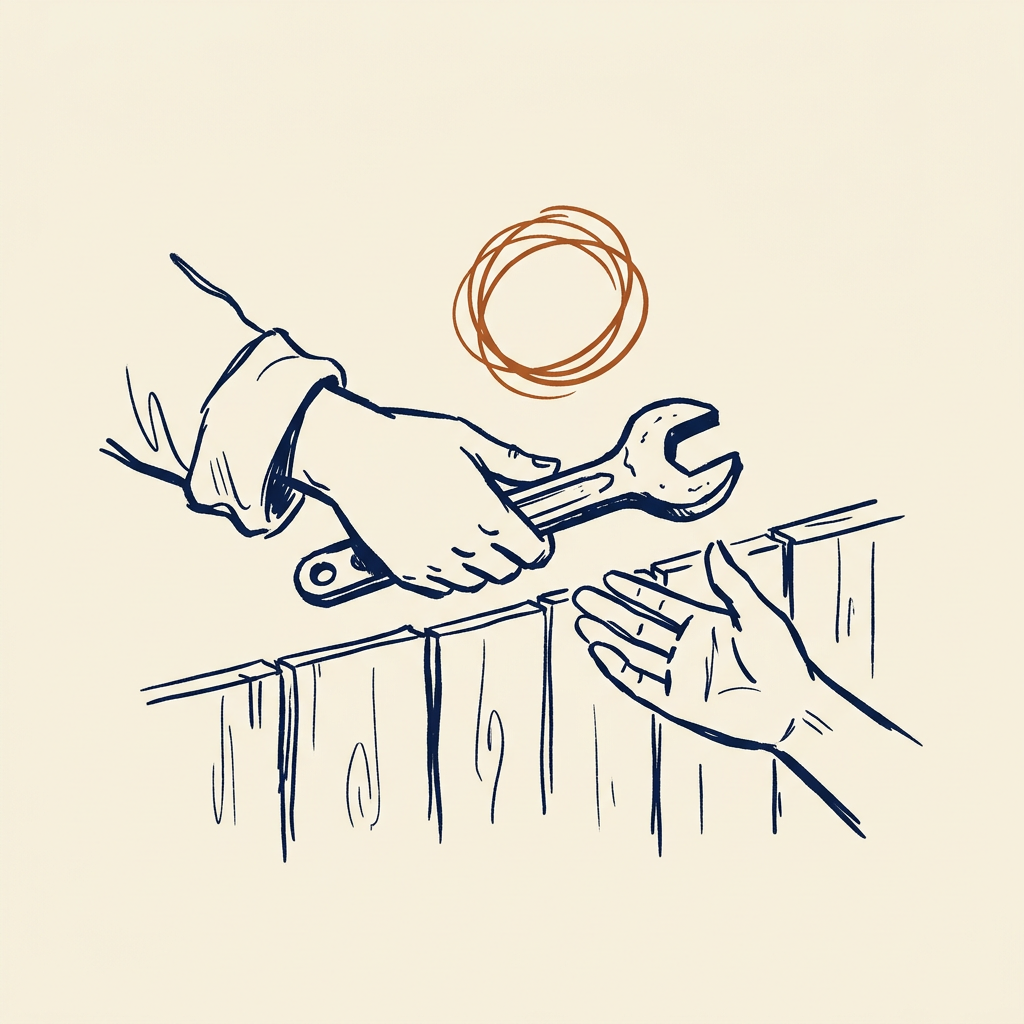
Graeber names three irreducible principles. Baseline communism is the everyday assumption that among people with ongoing ties you share according to need and keep no score—a wrench borrowed by a friend is not an invoice. Hierarchy moves goods and obligations by fixed rank and custom; the amount is not negotiated. Exchange treats the two sides as equals, settles accounts exactly, and ends the relationship.
Real societies run all three in different rooms of the same house. Families lean communist, tax systems hierarchical, street markets on exchange. Confusion starts when one logic is mistaken for the law of all human behavior.
Economists who treat precise exchange as fundamental, and sharing or rank as deviations, have the sequence backward. Sharing and rank are older; exchange is the special case usually reserved for outsiders. Debt, in this frame, is what happens when the exchange logic is forced onto relationships that once ran on the other two.
In practice: You pay for coffee and walk away owing nothing—pure exchange—while the same day you lend a tool to a neighbor without naming a due date.

3
Unpayable human debts
In human economies currency measured permanent social bonds that both sides knew could never be fully discharged, not commodity prices that end the tie.
Graeber splits 'human economies,' where money mainly tracks obligations between people, from 'commercial economies,' where it prices objects. The difference is purpose. Bridewealth or blood-debt payments were never meant to equal the market value of a woman or a life.
They acknowledged that no sum could actually replace what was lost or transferred. The payment kept the debt and the relationship open, sometimes for generations, binding lineages rather than closing the books. That is the opposite of a market sale, where payment extinguishes further claim.
Commercial debt—the idea that a sum should be exactly payable and, once paid, erase the relationship—is the later, stranger form. It required stripping obligations of social meaning and turning them into pure numbers.
In practice: Among the Tiv of Nigeria, brass rods called manillas moved for marriage payments and injury compensation but never bought yams; goods stayed in separate, non-convertible spheres.

4
Violence creates equivalence
Only force can cut a person from kin and community hard enough to make a life commensurable with a sum of money or a sack of grain.
- 1Capture or raidForce severs kin and community ties
- 2Loss of singularityPerson becomes interchangeable unit
- 3PricingLife or injury can now equal a sum of money
Traditional debts between people were permanent and non-equivalent. How, then, did money come to price a ransom or a slave exactly? Graeber's answer is violence. A war captive or raid victim has been torn out of the web of relationships that made them singular. Once reduced to that state they can be bought, sold, and numbered like any object.
Ancient legal codes that assign precise monetary values to injuries and lives become possible only after war and slavery have already shown that a person can, under extreme conditions, be treated as a unit. Commensurability is manufactured, usually by force, and then applied to people as readily as to barley.
A parallel strand is primordial debt—the religious idea that humans are born owing an unpayable sum to gods or ancestors for life itself. Rulers regularly translated that cosmic language into worldly tribute owed to the state.
In practice: Mesopotamian injury tariffs and slave prices became thinkable once conquest had already demonstrated that a person could be reduced to a number.

5
Credit and bullion swing
Monetary history oscillates between virtual-credit ages backed by institutional trust and cancellation, and bullion ages when strangers and armies need metal that clears on the spot.
- 1Virtual creditAccounts, trust, periodic cancellation
- 2Political breakdown or warPromises lose backing
- 3Bullion and coinSpot metal for strangers and armies
- 4Rebuilding authorityCredit instruments return
↻ and round again
Graeber refuses a straight line from primitive to modern money. He sees a long pendulum. The first agrarian empires centered on Mesopotamia ran on virtual credit: temple and palace scribes kept clay-tablet accounts, advancing grain and goods against future repayment. Units were silver or barley, yet actual metal rarely changed hands.
That system needed a strong center able to enforce accounts and, crucially, to reset them. Royal debt cancellations kept smallholders from sliding permanently into bondage. When trust and central authority fray—especially under war—physical coin takes over because it needs no institutional promise behind it.
Each swing carries different consequences for who is protected, who is indebted, and who is enslaved. Technology is secondary; political conditions decide the mode.
In practice: Mesopotamian temple administrators advanced grain on tablet credit and kings periodically voided agrarian loans to protect the free peasantry.

6
Coins, armies, slaves
Coinage spread across Eurasia in the Axial Age because states needed portable pay for soldiers; the resulting cash markets expanded slavery without any institutional cancellation.
Between roughly 800 BCE and 600 CE, coined money appears almost at once in Greece, India, and China. Graeber ties the timing to military logistics. An army far from home cannot be paid in grain or local promises; it can be paid in silver or gold that any merchant will take.
Once soldiers carried coins, markets grew around camps and garrisons to feed and supply them, then spread into civilian life. In a coin economy a human being becomes tradeable exactly like any other commodity. Unlike the earlier credit empires, no king's decree forced periodic resets.
Debtors who fell behind were routinely sold. Classical Athens and Rome both saw debt bondage and chattel slavery expand alongside coinage and long-distance trade. The celebrated rise of the ancient market rested on mass enslavement made possible by impersonal cash.
In practice: Roman slave markets, fed by conquest and by debt default, supplied much of the labor that underpinned the cash economy later praised as civilizational progress.

7
Medieval credit guardrails
After the Axial empires fragmented, coin grew scarce, credit instruments returned, and religions built near-universal bans on exploitative interest to block a repeat of debt slavery.
Axial cash era
Coin, impersonal markets, debt slavery without reset
Medieval credit era
Tally sticks, transfer networks, paper money, usury bans
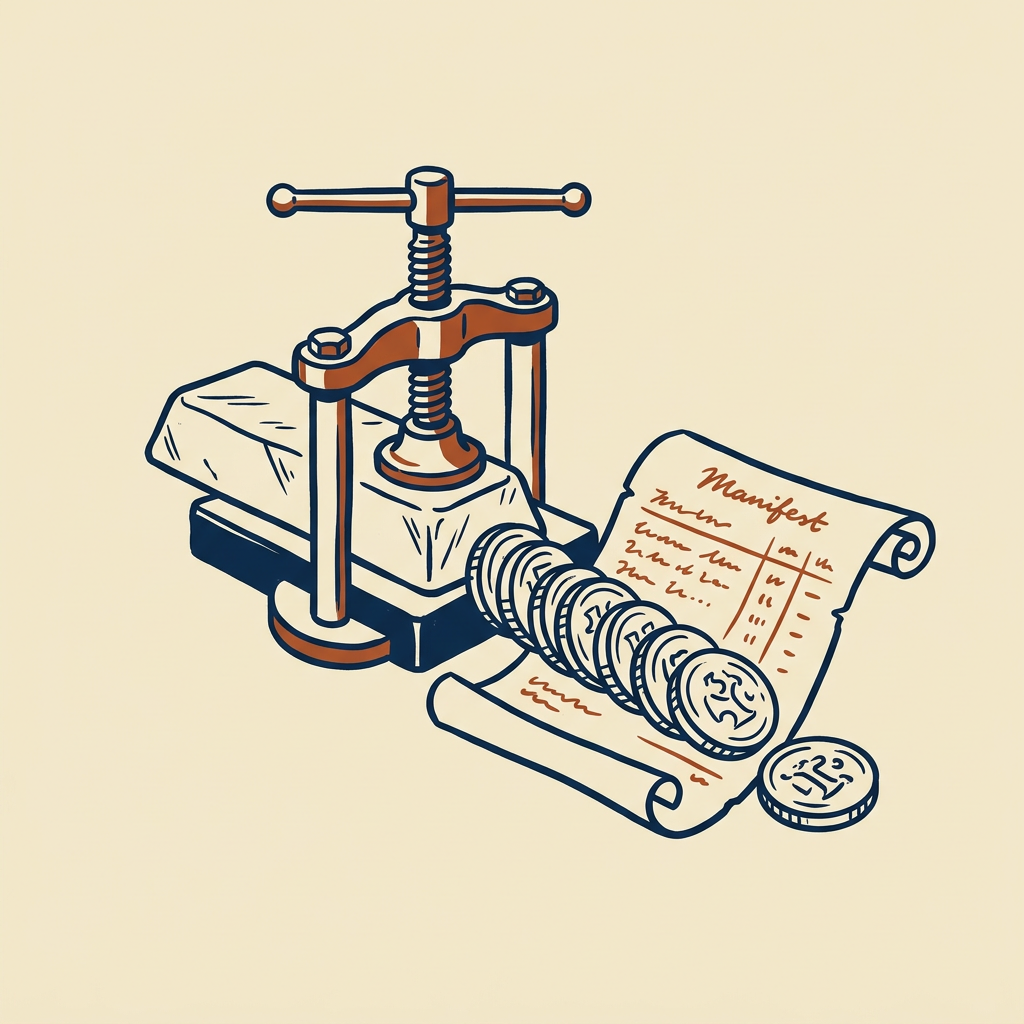
With Rome's fall in the west and the breakup of classical empires elsewhere, physical coin retreated from daily use across much of Eurasia. Credit reemerged as the ordinary way to do business. Medieval Europe relied on wooden tally sticks and running local accounts. Islamic merchants built long-distance transfer networks and check-like instruments. Song China issued early paper money.
What marks the period is the simultaneous rise of religious restrictions on interest-bearing debt. Christianity banned usury for centuries; Islam developed detailed rules on permissible profit; Hindu and Buddhist traditions carried deep suspicion of lending at interest.
Graeber reads the prohibitions as hard-won memory of Axial Age excesses. Credit still produced peonage and serfdom, yet it was more tightly bound to communal and religious obligation than pure profit-seeking—the contrast that sharpens when bullion and slavery return together.
In practice: A medieval European transaction might be recorded by splitting a wooden tally stick, each party keeping half as proof of the running balance.
8
Conquest silver returns
From 1450 the flood of American bullion revived mass chattel slavery on a new scale and created modern national debt as a tradeable instrument for financing war.
- 1450 onwardAmerican gold and silver flood Europe
- Atlantic systemBullion and credit finance mass chattel slavery
- 1694Bank of England founded to fund war debt as tradeable asset
- Colonial laborDebt peonage extends coercion into 'free' work
Graeber marks a new bullion age running to 1971, kicked off by silver from mines such as Potosí and gold seized across the Americas. The metal fed European-Asian trade and financed a vast expansion of the Atlantic slave trade. Plantations needed labor; purchases were themselves financed on credit from London and Amsterdam houses, forging debt chains that ended in people who existed legally only as collateral.
Violence again converted persons into fungible units that could be priced. The same era built the modern machinery of national debt. The Bank of England was founded in 1694 to let the English crown borrow for war against France, turning government IOUs into interest-bearing assets private investors could hold and trade. Other states copied the model.
Colonial debt peonage—indenture, company stores that kept workers permanently behind—carried slavery's logic into nominally free labor well into the twentieth century. The wealth celebrated as the birth of modern capitalism flowed through coerced labor and war finance.
In practice: Potosí silver and European merchant credit linked Andean mines to Atlantic slave purchases in a single extractive chain.

9
Virtual credit as discipline
Nixon's 1971 end to dollar-gold convertibility reopened an age of pure political credit money; consumer, corporate, and sovereign debt became a primary tool of social control.
- 11971 gold window closesCurrencies become pure political credit
- 2Debt explodesConsumer cards, corporate leverage, sovereign loans
- 3Crisis and conditionalityIMF austerity; 2008 household collapse
- 4Self-disciplineFear of default replaces older direct force
Freed from metal backing, major currencies became instruments of trust and credit expanded fast. Cards spread through households, leveraged buyouts loaded corporations, and sovereign debt gave international institutions leverage over poorer states.
After the 1980s debt crises, IMF structural-adjustment programs forced austerity and privatization on populations that had no voice in the original loans, often taken by unaccountable regimes. In wealthy countries household debt—student loans, mortgages—grew until the 2008 crash.
Earlier ages needed raids and armies to compel obedience. Graeber's claim is that large-scale direct coercion is now often unnecessary: indebted people police themselves, staying in unwanted jobs and deferring resistance for fear of default, repossession, or ruined credit.
In practice: IMF programs in Latin America, Africa, and Asia after the 1980s crises used old sovereign debts to impose austerity on citizens who never signed the loans.

10
Jubilee against sacred debt
The claim that debts must always be repaid is a moral preference, not an economic law; successful large-scale cancellations recur whenever enforcement threatens social order.
- Agrarian empiresRoyal andurarum clean slates free debt-slaves
- LeviticusJubilee releases debts and slaves every fifty years
- Early AthensSolon's seisachtheia cancels debts, bans bondage
- After 2008Banks rescued; ordinary debtors told obligation is sacred
Across the eras surveyed, rulers wiped debts when the cost of collection grew too high. Mesopotamian kings issued clean-slate decrees that freed debt-slaves and voided agrarian loans so the free peasantry needed for farming and fighting would not disappear. The biblical Jubilee released debts and slaves every fifty years. Solon's seisachtheia in early Athens canceled existing debts and banned debt bondage after inequality risked civil collapse.
Modern common sense, especially after 2008, holds that states may rescue banks yet must never forgive ordinary debtors, because debt is sacred. Graeber calls the asymmetry power, not principle: creditors' claims are protected while debtors are told repayment is duty regardless of origin or benefit.
His closing provocation is that societies remain free to ask which debts are just and sustainable and to cancel the rest, exactly as they have done before. The book supplies no detailed modern mechanism, only the historical proof that permanence is itself a choice.
In practice: Mesopotamian andurarum decrees periodically freed debt-slaves and voided farm loans to keep the kingdom's free population intact.
Key terms
- Baseline communism The everyday practice of sharing by need among people with ongoing ties, without keeping score.
- Human economy A system where currency mainly tracks lasting social obligations between people rather than pricing objects.
- Commercial economy A system where currency prices commodities and payment is meant to end the relationship.
- Primordial debt The religious idea that humans are born owing an unpayable sum to gods, ancestors, or the cosmos for life itself.
- Axial Age Roughly 800 BCE to 600 CE, when coinage, large-scale slavery, and cash markets expanded together across Eurasia.
- Virtual credit Money as recorded promises and accounts rather than physical metal changing hands.
- Bullion age A period when physical precious metal dominates exchange because trust and institutions are weak.
- Andurarum / Jubilee Periodic royal or religious decrees that void debts and free debt-slaves to restore social balance.
- Seisachtheia Solon's Athenian reforms that canceled debts and outlawed debt bondage.
What to do
- Question any claim that a debt is a neutral number that must be honored regardless of origin; ask who benefits from enforcement.
- When facing personal or household debt, separate moral pressure to repay from the actual leverage and options you hold.
- In teams or small organizations, notice where you default to strict reciprocal scoring and try baseline give-and-take without ledgers.
- Read one serious critique of the book beside it so historical claims stay starting points, not settled fact.
- Track news stories about sovereign or student debt and note whether cancellation is treated as unthinkable or as policy.
Questions to think with
- When has 'pay your debts' protected creditors more than it protected the social order those debts were straining?
- Which of your own economic relationships run on baseline communism, which on hierarchy, and which on pure exchange?
- If violence once made human lives priceable, what quieter mechanisms do the same work in a credit-score society?
- What would have to be true for a modern debt jubilee to avoid simply shifting losses onto pension holders and ordinary savers?
- Why did so many religious traditions independently restrain interest after the Axial Age, and what does that memory still protect?
The other side
The synthesis is vast, and the width is the vulnerability. The no-barter claim rests on solid fieldwork yet partly refutes a stylized economics illustration rather than the stronger claim serious critics (including economic historian Brad DeLong) say Smith actually made; attacking it as bad anthropology can look like fencing with a straw man even though textbooks do teach the story as literal history. The credit-versus-bullion periodization is elegant but pressed harder than messy specialist records in Mesopotamian, medieval Islamic, and Chinese finance always support; dates, causal links, and degrees of centralization draw objections. Some ethnographic cases (Tiv, Nuer, Iroquois) lean on older fieldwork later revised. The book is thinnest where readers most want rigor: it offers almost no workable mechanism for a modern jubilee that would not destabilize pensions, savings, and banks holding that debt as assets, leaving the call as moral provocation rather than policy. Readers wanting quantitative monetary analysis will find long illustration and short data; the book persuades best as moral-historical argument, less as technical account.
Who it's for
Readers who feel 'pay your debts' in their bones and want to know why, students of economics or anthropology looking for an alternative to textbook money origins, and anyone who followed Occupy or debt-cancellation campaigns and wants the deep backstory. Best paired with a critical review so the historical sweep stays a prompt for further reading.