




Culture, not ads, is the real engine of a lasting company
Founders and service leaders should care because Hsieh shows happiness and culture can be the product—and still build a billion-dollar retailer.
IJR · Nov 1, 2026 · 11 min read
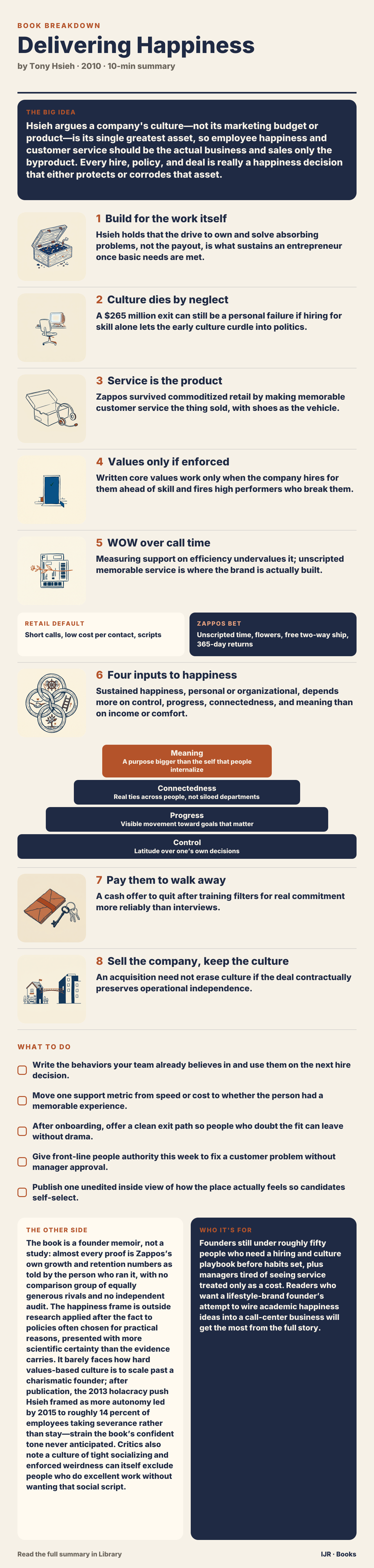
In 60 seconds
- Childhood side hustles taught Hsieh that ownership and absorbing work sustain founders longer than chasing payouts.
- LinkExchange sold to Microsoft for $265 million, yet he dreaded the office once culture decayed into politics.
- Zappos nearly folded, then bet on in-house memorable service and grew from under $2 million in sales in 2000 to over $1 billion by 2008 mostly via word of mouth.
- Ten core values only work if you refuse skilled culture misfits and fire high performers who violate them.
- Sustainable happiness rides on control, progress, connection, and meaning more than pay or perks.
- Amazon bought Zappos for about $1.2 billion while granting operational independence so the culture could stay intact.
The big idea
Hsieh argues a company's culture—not its marketing budget or product—is its single greatest asset, so employee happiness and customer service should be the actual business and sales only the byproduct. Every hire, policy, and deal is really a happiness decision that either protects or corrodes that asset.
The book in brief
Hsieh starts with childhood ventures—a worm farm, mail-order buttons, a Harvard newsletter, dorm pizza delivery—that paid little but taught him the pull of ownership and solving puzzles. Money after basic needs, he says, gives only a short lift; autonomy and mastery last. That personal pattern becomes the book's test for companies.
LinkExchange, the ad network he co-founded in 1996, scaled fast and sold to Microsoft in 1998 for $265 million. By the end he set alarms to arrive late and leave early. Hiring had shifted to credentials; the early friend culture turned political. The exit financed later bets, but the experience taught him culture must be selected at every hire or it dies before anyone formalizes it.
He invested in Zappos in 1999 and became CEO through near-bankruptcies in the dot-com crash, pouring in LinkExchange proceeds. Instead of outsourcing support, Zappos moved the call center in-house and measured memorable experiences, not handle time. Reps could stay on for hours, ship a rival's shoes, or send flowers. In a commoditized category, he argues, only the human experience differentiates, and growth from under $2 million in 2000 to over $1 billion by 2008 came largely from repeats and word of mouth.
The company codified ten core values drawn from what employees already believed—deliver WOW, embrace change, fun and a little weirdness—and trained every new hire, any role, through the call center. Fit beat pure skill in hiring and firing. Service was treated as brand-building spend: free two-way shipping, a 365-day return window, unscripted calls, a record call over ten hours. Hsieh even claims the business is service, with shoes only the current vehicle.
Mid-book he borrows a happiness frame—perceived control, progress, connectedness, meaning—and maps Zappos policies onto it: latitude on customer problems, growth paths, parties and shared space, a purpose people internalize. New hires later got a cash offer to quit after training so only the committed stay. Perks and an unedited culture book worked as self-selection, not just retention.
In 2009 Amazon acquired Zappos for a deal around $1.2 billion in stock. Hsieh used competing offers to lock in independence—own brand, HQ, management, policies—so he would not repeat the LinkExchange loss of control. The book ends optimistic that culture can survive a sale if the contract protects it; it cannot yet show whether that autonomy held.
Context
Tony Hsieh, former CEO of Zappos, wrote from the path of failed and successful startups into a billion-dollar shoe retailer. The book mattered because it gave a concrete, commercially successful counterexample to the idea that profit maximization and workplace culture must trade off.
The key ideas

1
Build for the work itself
Hsieh holds that the drive to own and solve absorbing problems, not the payout, is what sustains an entrepreneur once basic needs are met.
Early ventures—a worm farm, buttons by mail, a student newsletter, pizza run from a Harvard dorm—made little money. What stuck was control over time and rules, and the pleasure of cracking logistics.
He leans on the pattern in his own life rather than controlled studies: pure return-on-investment chases left him flatter than work he found gripping. Research he cites suggests money's lift to satisfaction is small and temporary after basics; autonomy and mastery endure.
That founder psychology is the book's first data point. A business built only for exit value, he warns, ends up run by someone unhappy—and an unhappy leader builds an unhappy company. Customers come later; the leader's motives come first.
In practice: The dorm pizza side business ran mainly because he liked the logistics puzzle, not because margins were strong.

2
Culture dies by neglect
A $265 million exit can still be a personal failure if hiring for skill alone lets the early culture curdle into politics.
LinkExchange grew from a dozen friends to hundreds. Credentials replaced shared values. The office Hsieh had built became a place he dreaded.
He treats the conventional triumph as a warning: culture is not a soft byproduct that takes care of itself after the model is proven. By the time a company is large enough to write values down, informal culture is often already lost to whoever was hired without regard for it.
Most firms reverse the order—prove the business, then fix culture. He says that order is backwards. The money from the sale later funded Zappos; the scar determined how he would run it.
In practice: In the final year before the Microsoft sale he set alarms to arrive as late as possible and left as early as he could.

3
Service is the product
Zappos survived commoditized retail by making memorable customer service the thing sold, with shoes as the vehicle.
Cash was so tight after 1999 that the company nearly folded more than once; Hsieh put in much of his earlier proceeds to keep it alive. Standard retail logic would have cut support cost and outsourced the phones.
Zappos did the opposite: moved the call center from Kentucky into headquarters and scored reps on whether the customer had a memorable experience, even if that meant hours on the line or shipping a competitor's pair. Systems and ads, he argues, cannot create that experience—people do.
In shoes, price and selection are copyable with capital. The only durable edge is how it feels to deal with the company. He ties the growth curve largely to repeats and word of mouth, not paid acquisition.
In practice: Gross merchandise sales moved from under $2 million in 2000 to over $1 billion by 2008 while support stayed central instead of a cost center.

4
Values only if enforced
Written core values work only when the company hires for them ahead of skill and fires high performers who break them.
Ten values—including deliver WOW through service, embrace change, and create fun and a little weirdness—were assembled by asking employees what the company already stood for, then used as explicit yardsticks for hire, fire, and promote.
Every new hire, regardless of role, spends multi-week training time in the call center so the whole company touches the customer relationship. A brilliant misfit is not hired; a metrics star who violates values is let go.
Short-term that is costly and visible. Long-term, he says, tolerating the talented culture violator is exactly how LinkExchange decayed. Most companies never break the pattern because the corrosion stays invisible longer than the star's numbers.
In practice: Candidates strong on skill but weak on fit were turned away; solid performers who broke the values were dismissed.

5
WOW over call time
Measuring support on efficiency undervalues it; unscripted memorable service is where the brand is actually built.
Retail default
Short calls, low cost per contact, scripts
Zappos bet
Unscripted time, flowers, free two-way ship, 365-day returns
Typical retailers chase shorter calls and lower cost per contact. Zappos removes scripts and call-length metrics and lets reps send flowers, upgrade shipping, or simply talk.
Free shipping both ways and a 365-day return window raise short-term cost. Hsieh treats them as advertising budget moved into the experience itself, on the bet that one exceptional story spreads farther and more credibly than a paid ad.
He goes further: the company's business is not shoes but delivering great service; shoes are only the current vehicle. Inside the book that wider claim stays aspirational—the identity remained footwear and apparel.
In practice: The longest call on record lasted over ten hours and was held up as philosophy, not an accident.

6
Four inputs to happiness
Sustained happiness, personal or organizational, depends more on control, progress, connectedness, and meaning than on income or comfort.
- MeaningA purpose bigger than the self that people internalize
- ConnectednessReal ties across people, not siloed departments
- ProgressVisible movement toward goals that matter
- ControlLatitude over one’s own decisions
Drawing loosely on positive psychology figures such as Csikszentmihalyi and Lyubomirsky, Hsieh names four inputs tied to lasting well-being rather than the spike of a bonus or purchase.
Most companies, he says, strip all four: rigid hierarchy kills control, vague goals kill progress, silos kill connection, hollow mission statements kill meaning. Zappos policies are framed as deliberate counters—latitude to solve customer problems, clear skill-growth paths, parties and shared space, a purpose employees must internalize.
The honesty gap is real: the frame is applied after the fact to choices often made for pragmatic reasons, and Zappos never published measured links between those four policies and its own well-being outcomes.
In practice: Reps chose how to fix a customer’s problem; the company ran shared events and published a purpose beyond selling shoes.

7
Pay them to walk away
A cash offer to quit after training filters for real commitment more reliably than interviews.
Once training ends, new hires get a one-time payment—grown over the years into the thousands—to leave if the fit feels wrong. Interviews predict fit poorly; someone who stays only because training already felt sunk-cost is costlier later than an honest early exit.
Most decline the offer. Hsieh reads the low take-up as proof the signal works: the company trusts them to choose, which feeds the control piece of the happiness frame.
The same logic covers generous health benefits, subsidized meals, an on-site life coach, and a yearly culture book of unedited employee submissions published for candidates to read before applying. These are self-selection tools meant to attract people who already share the values, not ordinary retention perks.
In practice: After training, the quit offer was put on the table; overwhelming majority stayed, which he took as the filter working.
8
Sell the company, keep the culture
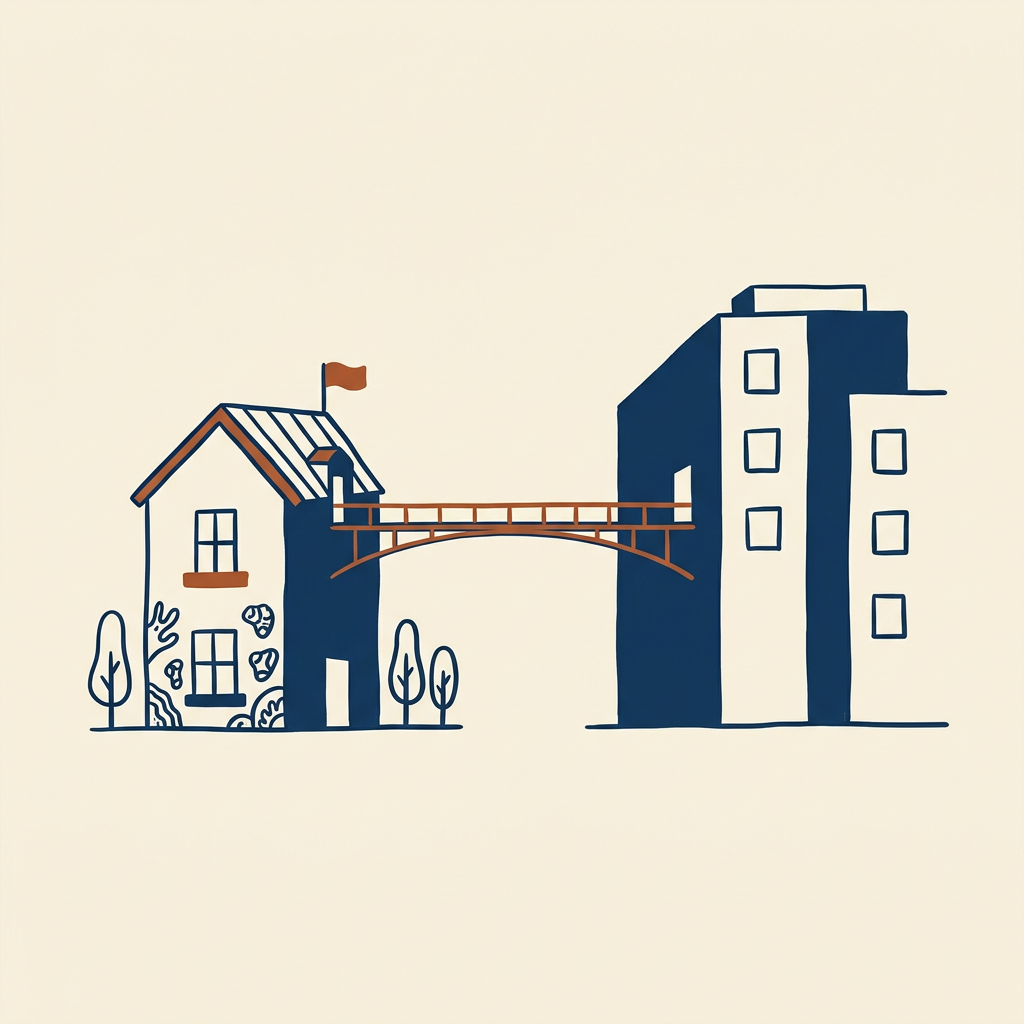
An acquisition need not erase culture if the deal contractually preserves operational independence.
After years of competing with Amazon in footwear, Zappos sold in 2009 for a deal valued around $1.2 billion in stock. Hsieh’s driving fear was repeating LinkExchange: cash out, lose the culture built over a decade.
Terms kept Zappos as its own brand and company—own headquarters, management, and largely its own policies—rather than folding into Amazon’s machine. That was not pure generosity; other offers gave leverage to put autonomy beside price.
The book closed right after the deal, so it cannot show whether independence survived Amazon’s later strategy or Zappos’s own leadership changes. Optimism outran the evidence then available.
In practice: Competing acquisition offers were used to negotiate continued independence as a hard term alongside the $1.2 billion valuation.
Key terms
- Delivering WOW Service so memorable a customer tells others; the standard Zappos hired and trained against
- Core values Ten specific beliefs pulled from employees and used as hard hire/fire/promote rules, not posters
- Culture fit Shared values ranked above pure skill when deciding who joins or stays
- Pay to quit Cash offered after training so unsure new hires leave early instead of becoming costly misfits
- Happiness framework Four inputs Hsieh uses—control, progress, connectedness, meaning—as the real drivers of lasting satisfaction
- Service as product The claim that the business is the experience of dealing with the company; shoes are only the current vehicle
- Culture book Yearly unedited employee submissions about the culture, published so candidates see it before applying
What to do
- Write the behaviors your team already believes in and use them on the next hire decision.
- Move one support metric from speed or cost to whether the person had a memorable experience.
- After onboarding, offer a clean exit path so people who doubt the fit can leave without drama.
- Give front-line people authority this week to fix a customer problem without manager approval.
- Publish one unedited inside view of how the place actually feels so candidates self-select.
Questions to think with
- Where are you still hiring for skill while hoping culture will catch up later?
- If support were scored only on memorable outcomes, what would you stop measuring tomorrow?
- Which of control, progress, connection, and meaning does your team lack most right now?
- Would you fire a top performer who steadily violates the values you claim to hold?
- If you sold next year, what terms would actually protect how the place feels to work?
The other side
The book is a founder memoir, not a study: almost every proof is Zappos’s own growth and retention numbers as told by the person who ran it, with no comparison group of equally generous rivals and no independent audit. The happiness frame is outside research applied after the fact to policies often chosen for practical reasons, presented with more scientific certainty than the evidence carries. It barely faces how hard values-based culture is to scale past a charismatic founder; after publication, the 2013 holacracy push Hsieh framed as more autonomy led by 2015 to roughly 14 percent of employees taking severance rather than stay—strain the book’s confident tone never anticipated. Critics also note a culture of tight socializing and enforced weirdness can itself exclude people who do excellent work without wanting that social script.
Who it's for
Founders still under roughly fifty people who need a hiring and culture playbook before habits set, plus managers tired of seeing service treated only as a cost. Readers who want a lifestyle-brand founder’s attempt to wire academic happiness ideas into a call-center business will get the most from the full story.