




Bubbles return whenever credit meets a future story
A comparative history of manias shows why euphoria and collapse keep the same shape across centuries.
IJR · Nov 3, 2026 · 13 min read

In 60 seconds
- Speculation is permanent: from Roman real estate to joint-stock shares, bubbles appear wherever claims on future value can be traded.
- A four-part sequence recurs—scarcity or transformation story, credit that amplifies demand, social contagion, then sudden collapse detached from use-value.
- Insiders can manufacture the wave: the South Sea Company financed purchases of its own stock while directors sold quietly.
- Genuine technological revolutions make manias more dangerous, because real progress lends false credibility to reckless price extrapolation.
- Margin structures and layered trusts turn ordinary declines into forced liquidation spirals that ignore fundamentals.
- New-era claims that old valuation rules no longer apply rise with the bubble itself and function as a warning, not an exception.
The big idea
Chancellor argues that speculative bubbles are not accidents or moral failures but a structural recurrence, produced whenever cheap credit meets a persuasive story about a transformed future. Real technological progress makes the danger worse, not better, because genuine change lends false credibility to reckless extrapolation.
The book in brief
Chancellor opens by rejecting the idea that speculative excess is a modern moral failure. He treats it as something built into how people price uncertain future value once tradable claims and easy credit exist, and he uses comparative history rather than models as his evidence against the claim that prices always track fundamentals.
Early episodes supply the working template: an asset with limited real scarcity becomes a pure resale vehicle, deferred payment multiplies buyers beyond cash demand, social proof replaces analysis, and the break is sudden because price has already detached from use. A later scheme adds deliberate agency—promoters who inflate public enthusiasm, finance the buying, and exit before the break—while reactive rules meant to contain the frenzy can accelerate the collapse.
The arc then tightens around technology and machinery. Transformative projects attract professionals as well as amateurs, overwhelm scrutiny, and still produce destructive overbuilding even when the underlying advance is real. Twentieth-century markets add leverage structures that change behavior qualitatively: modest price drops trigger mechanical selling with no link to revised fundamentals, turning a correction into a self-reinforcing spiral.
Institutional alignment stretches the cycle further when banks, corporations, and overseers all gain from rising collateral and share values, so the parties best placed to warn have the most to lose. Writing while a long bull market was still running, Chancellor applies the full set of earlier mechanisms to his own moment and closes on why monetary authorities rarely tighten soon enough: the political cost of prevention lands on them, while the cost of a later crash is easier to assign elsewhere.
Context
Chancellor published in 1999, while the U.S. bull market was still underway. The book’s warning about new-era valuation rhetoric arrived before the 2000–2002 collapse, which later gave it a reputation for foresight.
The key ideas

1
Speculation is permanent
Bubbles are not modern pathologies; they appear wherever tradable claims on future value exist, from ancient Rome onward.
- Ancient RomeReal estate and tax-farming contracts traded as speculative claims
- Medieval periodCommodity dealing draws pure price speculation
- 1600sJoint-stock trading spreads tradable claims on future profits
- Later centuriesSame mechanisms recur under new asset names
Chancellor pushes back against treating speculative excess as a symptom of one era’s greed. He points to Roman real estate and tax-farming contracts, medieval commodity dealing, and the rise of joint-stock trading in the 1600s to show the pattern is old.
The word “speculator” long carried moral weight distinct from “investor,” yet societies kept failing to draw a clean line between prudent holding and reckless gambling. That etymology is evidence, for him, that the urge is structural rather than a temporary ethical lapse.
Reframing matters for how readers should judge any hot market. The useful question is not how a uniquely irrational episode appeared, but which recurring mechanism—easy credit, a plausible future story, inexperienced entrants, officials reluctant to interrupt rising prices—is operating this time.
His method is comparative history, not statistical tests. He distrusts the claim that prices always reflect fundamentals and treats centuries of precedent as the counter-evidence.
In practice: Roman real-estate and tax-farming contracts already showed tradable claims on future value drawing speculative bidding long before modern exchanges.

2
The tulip template
Dutch tulip mania fixed a four-part sequence—scarcity story, credit-fueled buying, social contagion, disproportionate collapse—that later bubbles repeat.
- 1Scarcity storyAn asset with limited real scarcity becomes a pure resale vehicle once prices rise
- 2Credit amplificationDeferred payment lets buyers commit beyond cash means
- 3Social contagionNeighbors’ profits replace independent analysis
- 4Disproportionate collapsePrice breaks suddenly because it depended only on the next higher bid
Chancellor treats the 1636–37 bulb frenzy less as a curiosity about flowers than as a diagnostic. Rare varieties became vehicles for speculation once prices rose visibly, even though later moralizing accounts often exaggerated the absolute scale.
Futures on bulbs not yet grown, tavern trading outside formal exchanges, and buyers with no horticultural interest purchasing only to resell show how thin the link to real use can become. Credit and deferred payment let participants commit beyond what cash buyers alone could sustain.
Social proof then takes over: people buy because neighbors have profited, not from independent analysis. When the break comes, it is sudden and out of proportion to any change in the bulb’s usefulness, because price depended only on the next buyer’s willingness to pay more.
He carries this sequence forward as the book’s yardstick. Assets and centuries change; scarcity narrative, credit amplification, contagion, and detached collapse keep the same order.
In practice: Semper Augustus bulbs reportedly traded for sums equal to a skilled craftsman’s annual wages many times over, on futures bought in taverns by people who never meant to plant them.

3
Engineered enthusiasm
The South Sea Bubble shows manias can be deliberately manufactured by insiders who profit from the inflation phase and exit before the break.
Public story
Fabulous South American trade profits and a debt-for-monopoly mission sold to eager subscribers
Insider action
Company loans to stock buyers, quiet director selling, and a protective Act that instead sparked wider collapse
Building on the tulip sequence, Chancellor adds agency. The South Sea Company, formed to consolidate British government debt against trading monopoly rights, had directors spreading rumors of fabulous South American profits that never arrived in any serious way.
The company lent money to buyers of its own stock, directly financing the demand that lifted the price, while directors sold holdings quietly and still encouraged the public to keep buying. The same year, hundreds of smaller London ventures—some with prospectuses that barely described a business—still found subscribers.
Parliament’s Bubble Act, aimed at suppressing those smaller schemes to protect the South Sea position, undermined confidence in speculative shares generally and helped trigger the broader collapse. Reactive rules, poorly targeted, proved counterproductive.
Promoters are not merely riding crowd psychology; they often generate it because they capture disproportionate gains on the way up and can leave before the fall. That pattern of delayed, self-interested oversight returns in later centuries.
In practice: South Sea directors financed public purchases of the company’s shares, talked up trade riches that never materialized, and sold their own stock while the promotion continued.
4
When the technology is real
Genuinely transformative technologies make speculation more dangerous, not less, because real progress lends false credibility to excessive price and capacity extrapolation.
Real transformation
Railways genuinely changed transport, commerce, and land values in nineteenth-century Britain
Financial mania
Overbuilding, dividends paid from capital, overwhelmed scrutiny, and a wealth-destroying collapse
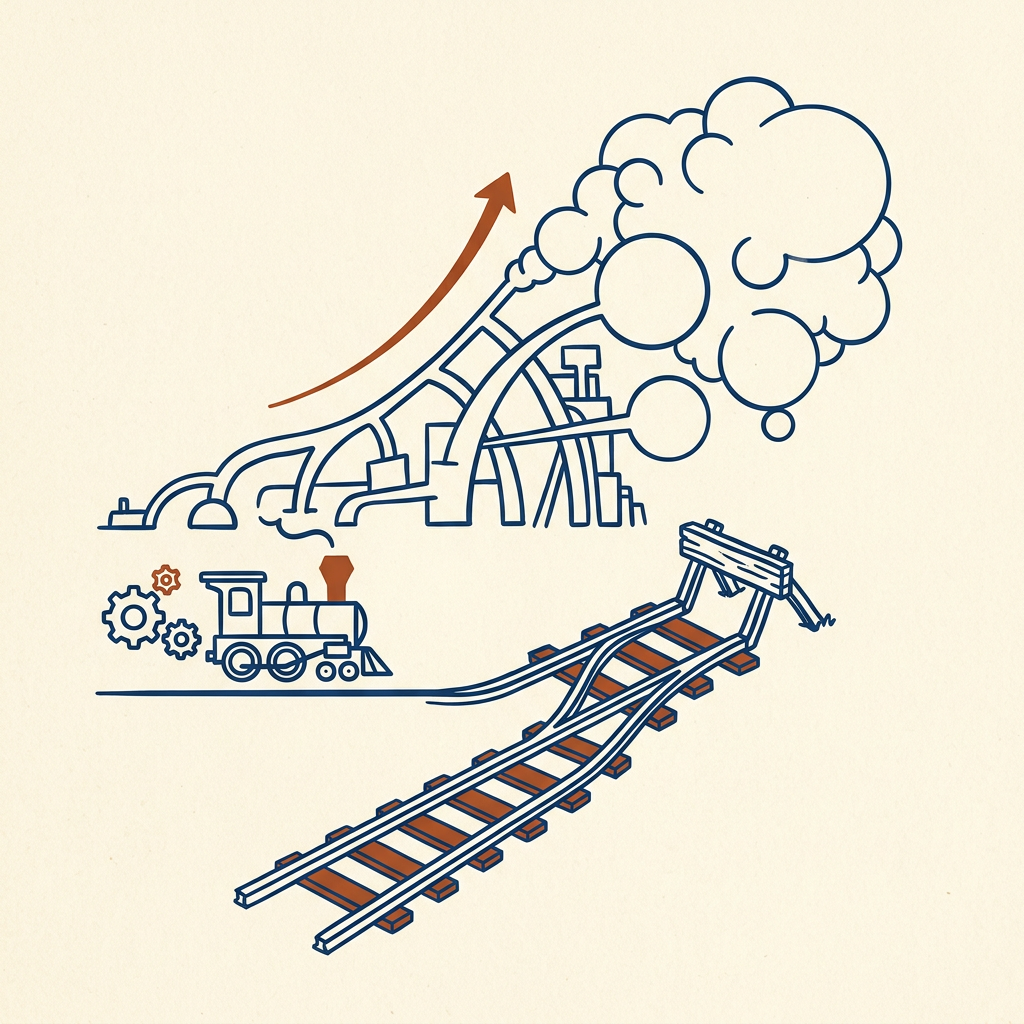
The British railway mania of the 1840s supplies the refinement. Railways did transform transport, commerce, and land values; that truth made it harder to separate justified enthusiasm from reckless overbuilding of duplicate lines and thin routes.
Ordinary investors arrived through newspaper coverage and promotional figures who sustained the appearance of profitability by paying dividends out of capital rather than earnings. Professional engineers and financiers were swept up alongside amateurs, undercutting the comfort that only naive retail buyers get caught.
Parliamentary approval processes drowned in the volume of competing bills, so scrutiny of each project weakened. The late-1840s collapse wiped out substantial wealth even though the railways themselves remained and later proved economically valuable.
Chancellor separates two questions manias systematically conflate: does this technology matter, and is this price justified. The first can be yes while the second is still disastrously no—the same confusion he later sees around internet shares.
In practice: George Hudson, the ‘Railway King,’ helped sustain the 1840s boom partly by paying dividends from capital rather than earnings while duplicate and low-demand lines multiplied.

5
Leverage forces the spiral
Margin lending and layered investment trusts can turn a market correction into systemic collapse by compelling mechanical, indiscriminate selling.
Chancellor’s account of the 1920s American bull market dwells less on familiar euphoria than on the machinery that amplified it. Margin lending let investors buy stocks with a thin cash slice, so modest declines could erase entire positions and trigger calls that forced more selling regardless of anyone’s view of value.
Investment trusts that held shares in other trusts multiplied leverage in ways opaque even to sophisticated observers. When the structure unwound, losses cascaded. Commercial banks marketing securities to retail customers blurred the line between ordinary banking and speculative promotion.
He does not pin the crash on one cause. Earlier easy-money policy, absent margin rules, and mass public participation worked together. The deeper claim is qualitative: leverage does not only scale gains and losses; it changes behavior by forcing sales with no link to fundamental reassessment.
That mechanical spiral becomes his bridge to later markets where similar leverage effects reappear in new legal forms.
In practice: Investors could buy stocks with as little as ten percent down, so small price drops wiped out positions and triggered margin calls that compelled further selling.

6
Institutions join the upside
Japan’s late-1980s bubble grew larger and lasted longer because banks, corporations, and regulators all had short-term interests aligned with rising prices.
- 1Asset prices riseStocks and land inflate collateral and cross-holdings
- 2Balance sheets look strongerBanks can lend more; firms raise cheap warrant-bond cash
- 3Credit reenters marketsNew lending and raised funds flow back into property and shares
- 4Regulators hesitateTightening would expose how much ‘capital’ is inflated collateral
↻ and round again
Chancellor’s Japan chapter shifts the cast from crowd psychology to institutional complicity. This was not only naive individuals; banks, keiretsu structures, and the Ministry of Finance had reasons to prefer continued inflation of assets.
Banks’ cross-shareholdings inflated their own balance sheets as stocks rose, which supported more lending, some of it flowing back into real estate and shares. Corporations used rising land as collateral for cheap warrant-bond financing, then partly recycled the proceeds into financial markets rather than productive capacity.
Regulators moved slowly because tightening risked revealing how much apparent banking health depended on inflated collateral. When the parties best placed to warn lose the most from warning, the bubble can run longer than one driven by public enthusiasm alone.
After the 1990 break, the hangover was not only a sharp crash but years of balance-sheet stagnation, because so much apparent capital had never been real—a coda still unfolding as he wrote.
In practice: Tokyo real-estate values reportedly implied the land under the Imperial Palace was worth more than the entire state of California, while bank cross-holdings and land-backed warrant bonds kept feeding the loop.

7
New-era storytelling
Every bubble brings a respectable intellectual case that old valuation rules no longer apply; that case is a reliable warning, not proof of a genuine exception.
Historical norm
Price reasoned from earnings, cash flows, and long-run ratios
New-era claim
Policy, technology, or national institutions said to retire those norms just as valuations stretch
Writing while the 1990s bull market was still rising, Chancellor isolates a recurring intellectual move. Respectable economists and commentators, not only promoters, argue that structural change—better policy, technology-driven productivity, globalization—justifies valuations that look absurd by historical norms.
Nearly identical rhetoric appeared in the 1920s around electrification and mass production, and in 1980s Japan around unique national institutions. He does not treat the underlying 1990s changes as fake; productivity gains and disinflation were real.
The narrower charge is that the narrative’s persuasiveness tracks how far prices have already run, because it lowers the resistance investors would otherwise apply. Stretched cyclically adjusted price-to-earnings measures and large capitalizations for profitless internet companies mark the swap from valuation reasoning to story reasoning.
The chapter applies credit, promotion, technology narrative, and institutional ease to his own moment, as a warning issued before the later crash.
In practice: Commentators in the 1920s, 1980s Japan, and the 1990s each claimed a ‘new economy’ or unique institutions made historical valuation norms obsolete while prices detached from earnings.

8
Why central banks wait
Cheap credit is the most consistent precondition for mania, yet central banks rarely act early because prevention risks blame they cannot deflect.
Across the case studies, Chancellor treats cheap credit as more consistent a precondition than new technology or fraud. He revisits late-1920s Federal Reserve policy, Bank of Japan rates in the 1980s, and Alan Greenspan’s 1996 warning about irrational exuberance followed by reluctance to tighten enough to cool the market he had flagged.
The argument is not ignorance. The asymmetry is political and economic: tightening to deflate a suspected bubble can cause a visible recession critics pin directly on the central bank, while a later crash is easier to blame on markets, irrational investors, or unforeseeable shocks.
That payoff structure biases policy toward accommodation. A harder theoretical problem reinforces it—rising prices may reflect speculative excess or a legitimate reset of future value, and a false-positive intervention still imposes real costs.
The focus shifts from describing patterns to assigning institutional responsibility, and to how little preemptive tools are used even when awareness exists.
In practice: Greenspan publicly flagged irrational exuberance in 1996 yet did not raise rates aggressively enough afterward to cool the advance he had already called concerning.
Key terms
- speculator The older, morally loaded label for someone trading claims on future value—kept distinct from ‘investor’ even though the line keeps failing.
- tulip template Chancellor’s four-part sequence: scarcity story, credit amplification, social contagion, then collapse detached from use.
- engineered mania A bubble actively inflated by promoters who finance demand, talk up prospects, and exit before the break.
- new era thinking The respectable claim that structural change has retired old valuation rules; its persuasiveness is treated as a warning sign.
- margin lending Buying assets with a thin cash slice so small price drops erase equity and force sales.
- investment trust layering Trusts holding shares in other trusts, multiplying opaque leverage and cascading losses when prices fall.
- institutional complicity Banks, firms, and regulators whose short-term interests align with rising prices, so warnings stay quiet.
- asymmetric intervention incentive Central banks face more direct blame for a recession they cause by tightening than for a later crash they allowed.
What to do
- Treat any highly persuasive ‘this time is different’ case as a warning, and write down what future cash flows or earnings would have to do to justify today’s price.
- Measure how much recent buying in a hot asset is financed with borrowed money rather than savings; rising leverage in a rising market is a checkable signal.
- Before joining a crowd, name who specifically profits from your enthusiasm this week—promoters, lenders, insiders—and whether their payoff matches your multi-year interest.
- Separate two questions on any transformative story: does the technology or asset class matter, and is this price justified; answer them independently.
- When officials praise rising asset wealth while credit is cheap, assume prevention is politically harder for them than cleanup and adjust your own caution upward.
Questions to think with
- Which of the four template steps—story, credit, contagion, detached price—is most advanced in a market you watch now?
- If a technology is genuinely transformative, what evidence would still falsify the current valuation rather than the technology’s long-run importance?
- Who in the current ecosystem loses the most if prices stop rising, and how does that shape the public narrative?
- Would you still hold this asset if rolled-over credit became unavailable next month?
- What would a central bank have to accept politically to tighten before a suspected bubble is obvious in hindsight?
The other side
The book is strongest as narrative history and weakest as causal proof: it selects episodes that fit credit, technology story, and contagion, without systematic cases where those ingredients appeared and no destructive bubble followed, so sufficiency is hard to test. Efficient-market defenders in the tradition of Eugene Fama argue many ‘bubbles’ were rational responses to real uncertainty about future cash flows, and that hindsight makes them look more obvious than they were; Chancellor treats that view more as a target than a position he rebuts. Published in 1999, it earned a reputation for foresight after the dot-com crash even though its 1990s mechanism is the same template applied again, which raises whether the framework predicts or mainly redescribes rising prices. It also cannot cover 2008 securitization and shadow banking, and it offers little practical treatment beyond cultivated skepticism.
Who it's for
Investors who want historical pattern-recognition before the next hot narrative, and students of economics or finance who need a character-driven map of how bubbles form and unwind. General financial-history readers will enjoy the episodes; practitioners looking for portfolio rules will find diagnosis far denser than prescription.