




Every hard talk is three conversations at once
Hard conversations fail when people fight only over facts while feelings and identity quietly decide the outcome.
IJR · Oct 20, 2026 · 12 min read
In 60 seconds
- Avoidance and blunt straight talk both fail because each tries to control a talk that force and silence cannot control.
- Every difficult conversation runs three layers at once: what happened, feelings, and identity.
- Your account is one partial interpretation; curiosity about the other person's information breaks stalemates.
- Blame is backward and binary; a contribution map finds systemic causes you can actually fix.
- Impact is real but is not proof of intent—report hurt without accusing motive.
- Shift purpose from delivering a verdict to joint learning and resolution becomes possible.
The big idea
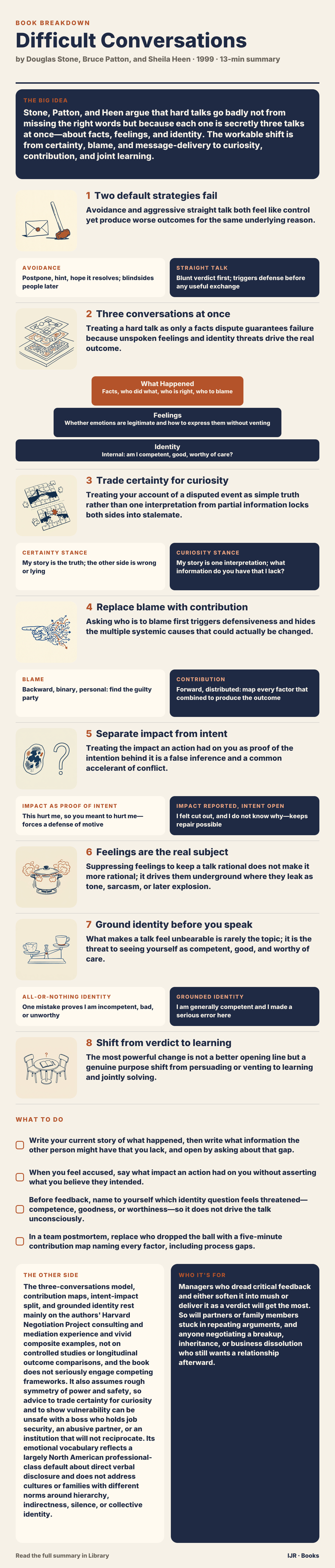
Stone, Patton, and Heen argue that hard talks go badly not from missing the right words but because each one is secretly three talks at once—about facts, feelings, and identity. The workable shift is from certainty, blame, and message-delivery to curiosity, contribution, and joint learning.
The book in brief
A manager has watched an employee's performance slide for three months. Vague encouraging check-ins never name the problem, so the review blindsides everyone. Opening with a verdict that the work has been unacceptable triggers defense at once. Both moves feel reasonable. Both leave a demoralized employee, a damaged relationship, and no real change.
The book starts from that bind. People either dodge hard talks or charge in to tell it like it is. Both responses are fear trying to seize control. Neither works. The trouble is not word choice. It is layered content sitting under the words.
The authors show that every hard conversation runs three tracks whether anyone notices. One track is the dispute over what happened and who is right. Another is the unspoken negotiation over feelings. A third is the private argument about what the situation says about who you are. Most people only fight on the first track. The other two decide the result.
From there the book rebuilds the approach layer by layer. Hold your own story as one reading built from partial information. Swap the hunt for a guilty party for a map of how many factors combined to produce the mess. Separate the real harm of an action from the motive people rush to invent. Treat named feelings as useful data rather than unprofessional noise. Steady the inner questions about competence and goodness so one mistake does not feel like total collapse.
The landing place is a purpose shift. Stop entering to transmit a verdict already reached. Enter to learn what neither side fully sees alone. That stance turns a contest into a shared problem both people have reason to solve.
Context
Stone, Patton, and Heen wrote from their association with the Harvard Negotiation Project. The 1999 book mattered because it reframed conflict skill as internal stance and curiosity rather than technique, giving readers a repeatable way to prepare for talks they would otherwise avoid or botch.
The key ideas

1
Two default strategies fail
Avoidance and aggressive straight talk both feel like control yet produce worse outcomes for the same underlying reason.
Avoidance
Postpone, hint, hope it resolves; blindsides people later
Straight talk
Blunt verdict first; triggers defense before any useful exchange
People facing a hard conversation usually pick one of two modes. They postpone, hint, and hope the problem dissolves. Or they say exactly what they think as bluntly as possible, on the theory that honesty covers any delivery.
Both strategies feel like control. Avoidance limits exposure. Bluntness tries to overpower the other position. The real difficulty is not the words chosen. It is the layered content underneath them.
Skill is not cleverer phrasing inside the old frame. It requires changing the frame itself. The authors call the new frame a learning conversation. The goal becomes understanding a situation together well enough to decide what to do.
In practice: A manager who has watched performance slide for three months either offers vague encouraging check-ins that never name the problem or opens with a verdict that the work has been unacceptable—both leave demoralization and no real change.

2
Three conversations at once
Treating a hard talk as only a facts dispute guarantees failure because unspoken feelings and identity threats drive the real outcome.
- What HappenedFacts, who did what, who is right, who to blame
- FeelingsWhether emotions are legitimate and how to express them without venting
- IdentityInternal: am I competent, good, worthy of care?
Any difficult conversation operates on three levels whether people notice or not. The What Happened conversation covers facts, who did what, who is right, and who is to blame. The feelings conversation covers whether emotions are legitimate and how to express them without collapsing into venting. The identity conversation is entirely internal: what this says about competence, goodness, or worthiness of care.
Most people only engage the first layer on purpose. When a talk feels stuck even after the facts seem settled, the block is rarely the facts. It is usually an unacknowledged feeling or an identity threat below the surface.
Recognizing which layer is driving resistance is the precondition for addressing it. The rest of the book gives separate tools for each layer.
In practice: A roommate fight about unpaid rent sounds like a due-date dispute, yet one person may feel disrespected and privately fear looking irresponsible or poor—so settling the date alone still leaves both worse.
3
Trade certainty for curiosity
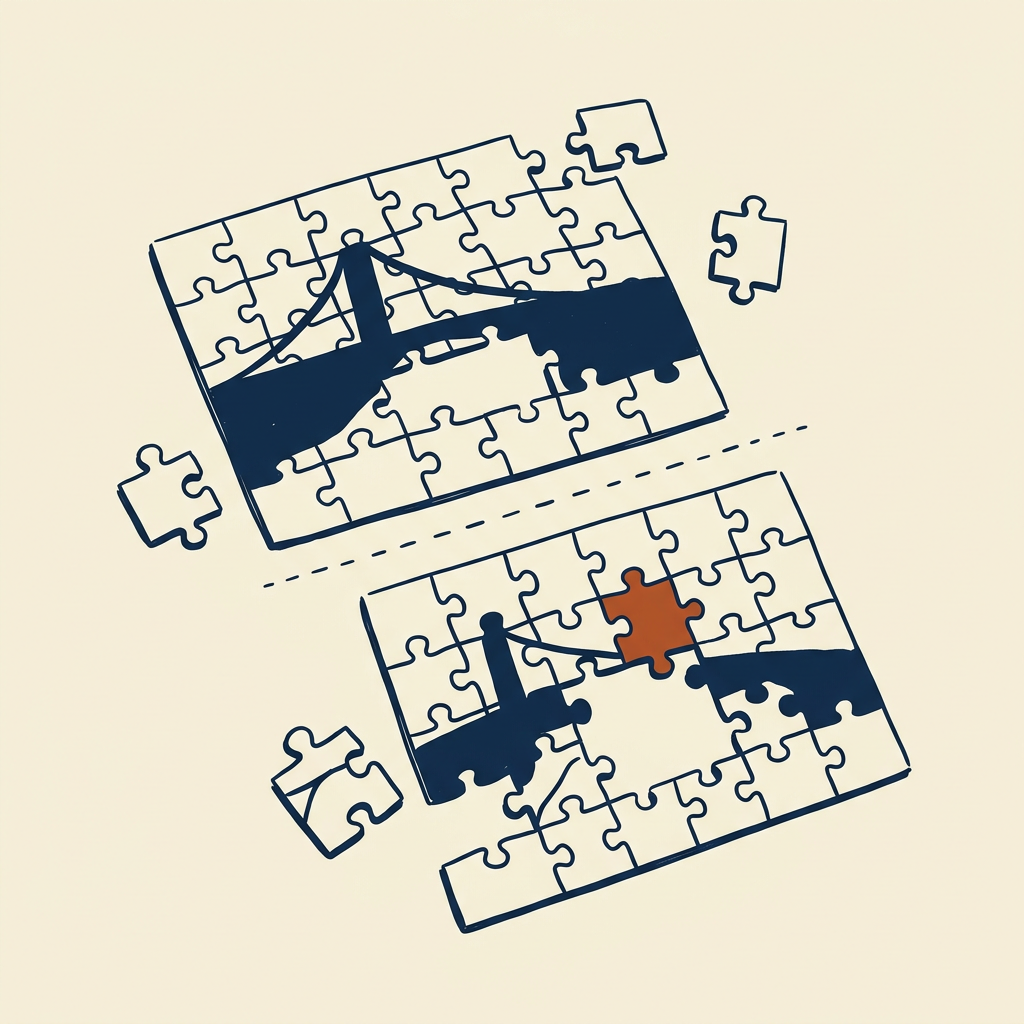
Treating your account of a disputed event as simple truth rather than one interpretation from partial information locks both sides into stalemate.
Certainty stance
My story is the truth; the other side is wrong or lying
Curiosity stance
My story is one interpretation; what information do you have that I lack?
In the What Happened conversation both parties usually believe they hold an accurate complete picture. The other side must be misinformed or lying. That confidence is almost always misplaced. Each person has different information, notices different details, and reads ambiguous behavior through a different history.
A common pattern seals the trap. When we act, we know our reasons, so we explain ourselves by context. When others harm us, we lack their reasons, so we explain them by character—carelessness, selfishness, or malice.
The proposed fix is a stance shift. Move from advocating a fixed story to jointly investigating an incomplete one. Ask what information the other person has that you lack. State your own reasoning as one interpretation, not settled fact. Genuine questions, not rhetorical ones, make the other person willing to loosen their grip too.
In practice: A colleague misses a meeting because of a family emergency and knows the full story; the person left waiting sees only an unexplained absence and may conclude the other is unreliable or disrespectful.
4
Replace blame with contribution
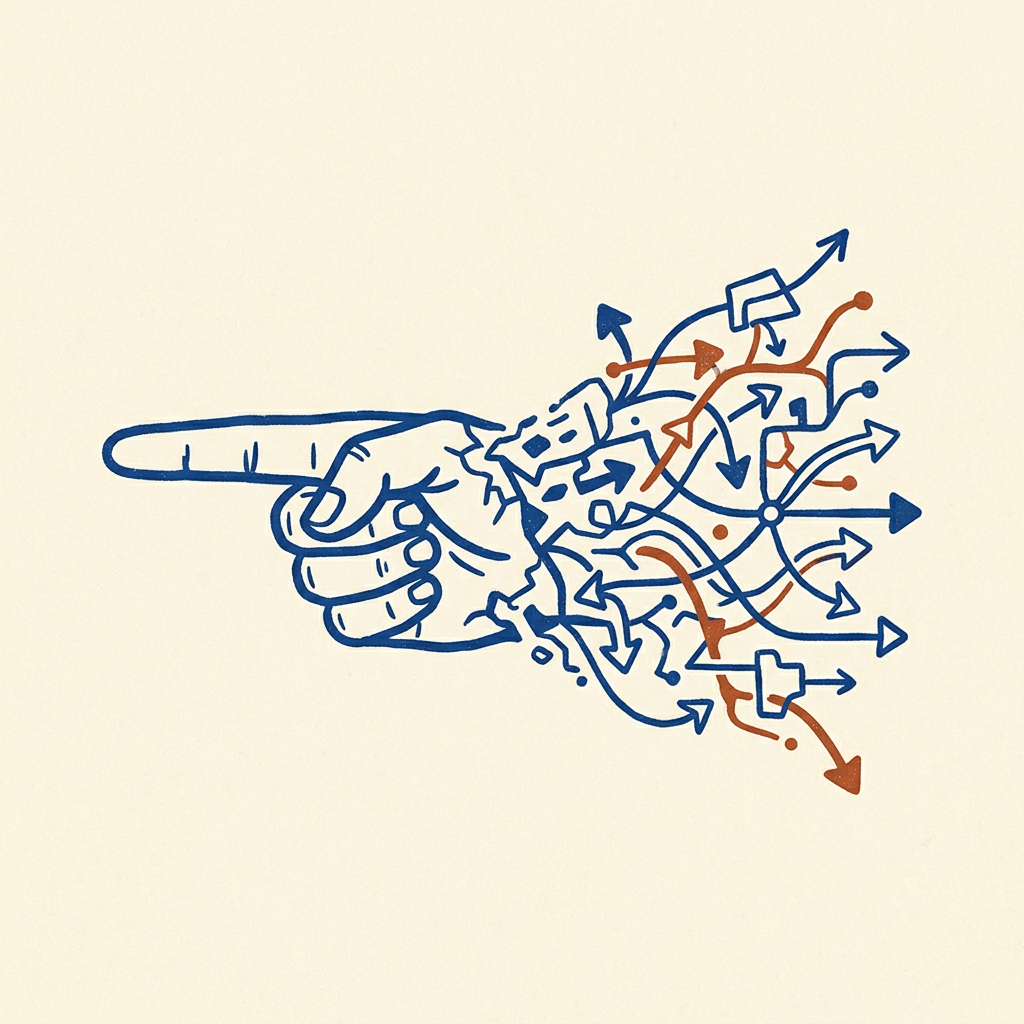
Asking who is to blame first triggers defensiveness and hides the multiple systemic causes that could actually be changed.
Blame
Backward, binary, personal: find the guilty party
Contribution
Forward, distributed: map every factor that combined to produce the outcome
Blame and contribution sound similar and work differently. Blame looks backward, stays binary, and stays personal. It asks who caused this and implies one party should feel bad. Contribution looks forward and spreads out. It asks what factors, actions, and omissions from many sources combined to produce the outcome, including conditions no single person controls.
Blame is nearly always resisted, even when partly deserved, because accepting it threatens identity. Contribution analysis lowers the stakes of acknowledging a role. You can own a piece without swallowing full responsibility or a character judgment.
The shift also produces better solutions. It surfaces systemic fixes rather than punitive ones that miss the real failure mechanism. The authors present the move from blame to contribution as one of the highest-leverage changes available in any conflict talk.
In practice: A project arrives late and over budget; blame hunts the slow vendor, under-specifying manager, or scope-changing client, while a contribution map finds an ambiguous brief, missing check-ins, insufficient lead time, and a culture that discourages midstream concerns.
5
Separate impact from intent
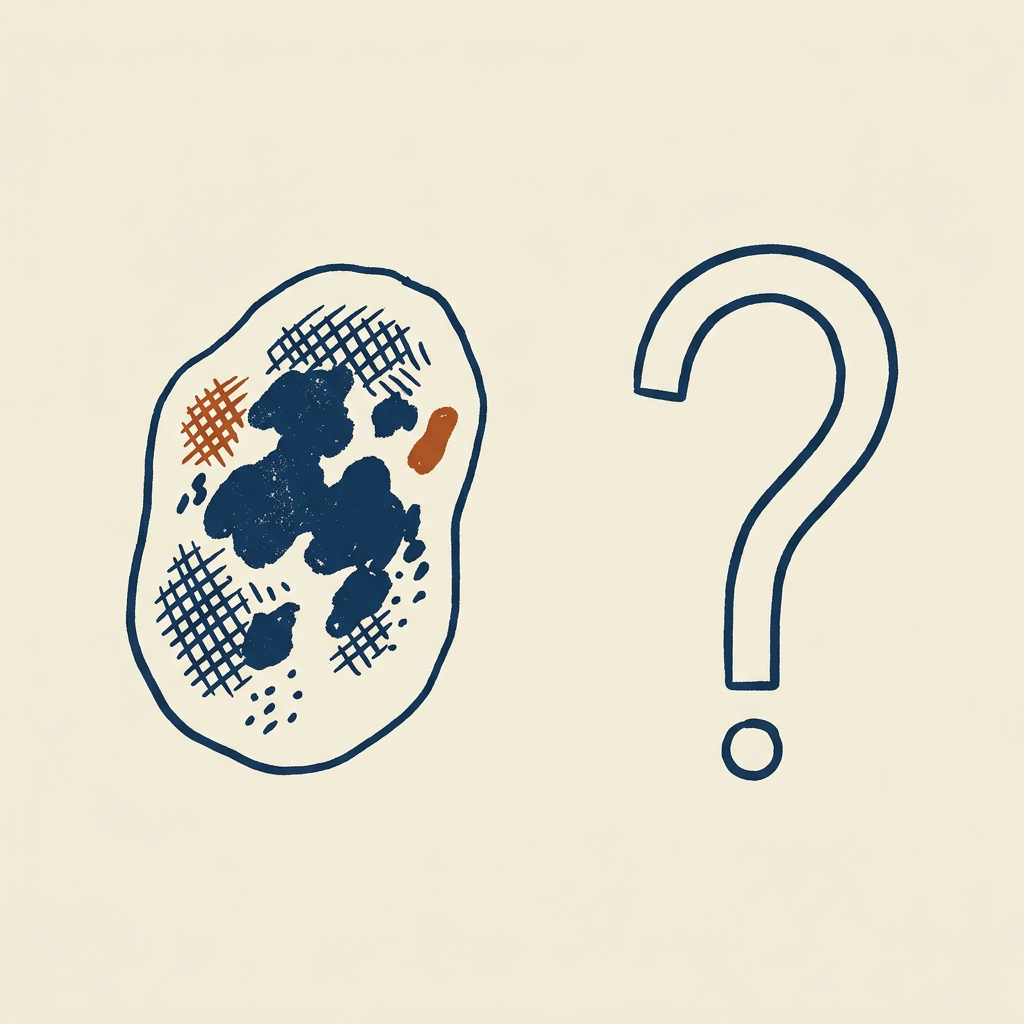
Treating the impact an action had on you as proof of the intention behind it is a false inference and a common accelerant of conflict.
Impact as proof of intent
This hurt me, so you meant to hurt me—forces a defense of motive
Impact reported, intent open
I felt cut out, and I do not know why—keeps repair possible
People experience impact directly and vividly. They can only infer intent. They usually infer it from the impact itself, reasoning from this hurt me to they meant to hurt me. The leap feels automatic. It is frequently wrong. Many actions with painful impact were never intended that way.
The practical guidance is simple. Report impact honestly; that much is not in question. Treat intent as an open question rather than a settled accusation. The distinction does not erase real ill intent. It stops manufacturing conflict where none needs to exist.
When the other person is forced to defend a motive they may not have had, the talk becomes about that defense instead of repairing the harm.
In practice: A friend fails to invite someone to a gathering; the excluded person feels rejected and infers the friend does not value the relationship, though the reason may be oversight, a wrong assumption about being busy, or a wish to keep the group small.
6
Feelings are the real subject
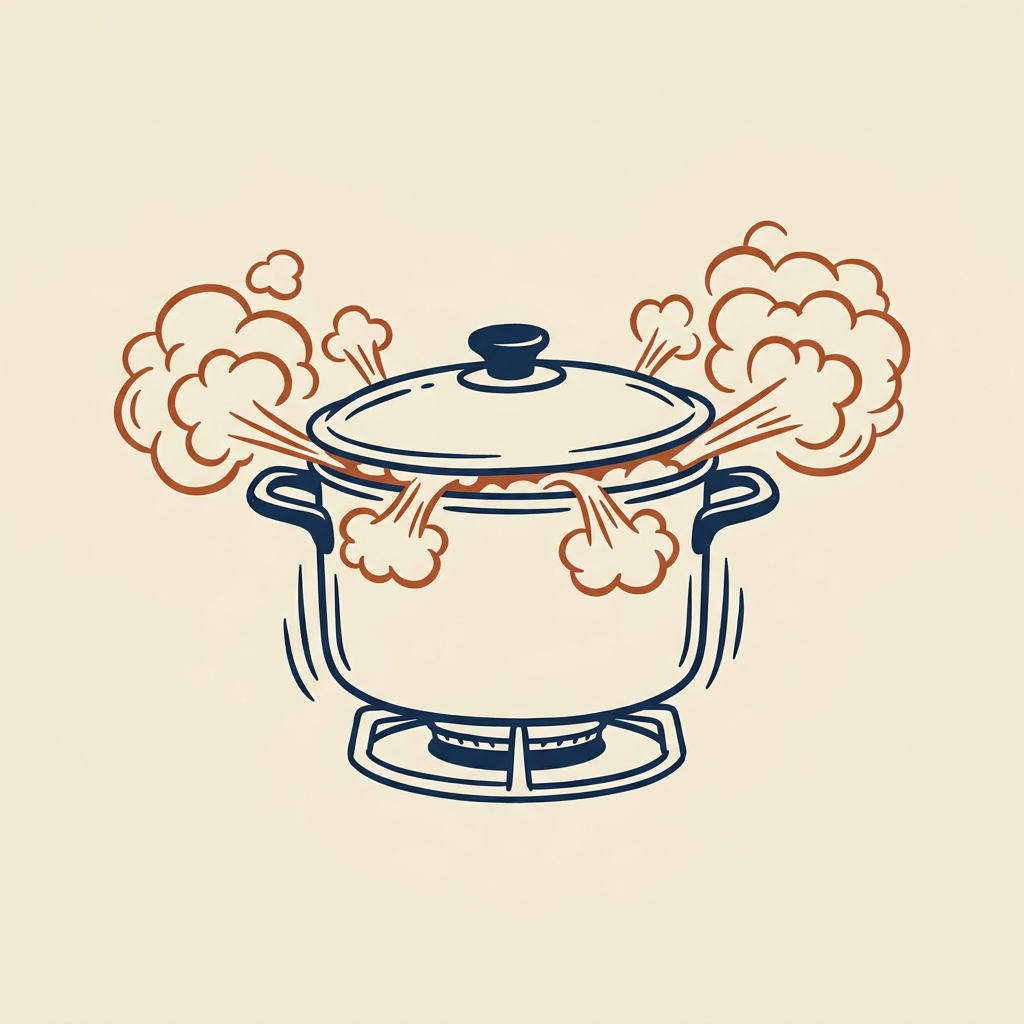
Suppressing feelings to keep a talk rational does not make it more rational; it drives them underground where they leak as tone, sarcasm, or later explosion.
Many people try to keep hard conversations professional by excluding feelings. The authors argue the goal is unachievable and counterproductive. Unstated feelings do not vanish. They surface as clipped tone, withheld cooperation, passive resistance, or a sudden overreaction weeks later to something minor.
The recommended approach is not unfiltered venting, which can overwhelm and shut the other person down. It is deliberate named acknowledgment. Identify the feeling precisely. Take responsibility for it as your own reaction, not an objective verdict on the other person. State it without blame's amplifying language.
Once named accurately and owned rather than weaponized, feelings often defuse rather than escalate. They give the other person something concrete to answer instead of something to defend against.
In practice: An employee quietly absorbs extra unpaid overtime for months; unspoken resentment shows up as reduced initiative, curt replies, and a disproportionate blow-up over a minor scheduling request the manager cannot trace to its real cause.
7
Ground identity before you speak
What makes a talk feel unbearable is rarely the topic; it is the threat to seeing yourself as competent, good, and worthy of care.
All-or-nothing identity
One mistake proves I am incompetent, bad, or unworthy
Grounded identity
I am generally competent and I made a serious error here
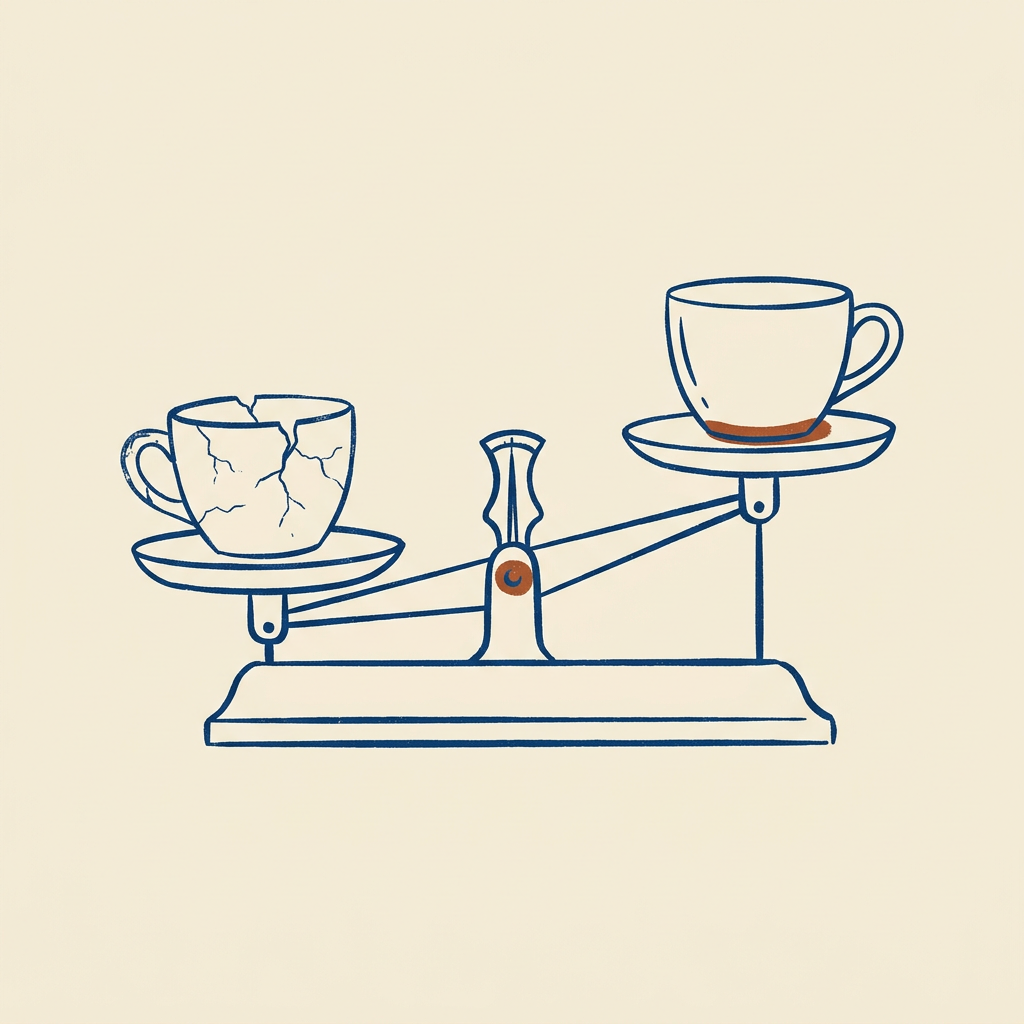
Beneath facts and feelings sits a third internal conversation: what does this mean about me. Three questions recur. Am I competent. Am I a good person. Am I worthy of love or respect. When a talk threatens one of these, people can hit an identity quake—a loss of footing that produces collapse into over-apology or rigid denial and counter-attack. Neither allows a productive exchange.
The destabilizing force is an all-or-nothing frame. Either I am competent or I am not. A single mistake then feels like categorical failure rather than an isolated event.
The alternative is a grounded identity. Hold complexity: generally competent and seriously wrong in this case; a caring partner and cruel when tired. That complexity is not cheap self-forgiveness. It is what lets a person stay present instead of needing to win or flee to protect a fragile self-image.
In practice: A doctor who made a diagnostic error may enter the follow-up with the patient's family so consumed by the internal verdict I am incompetent that they cannot give the information, apology, or reassurance the family actually needs.

8
Shift from verdict to learning
The most powerful change is not a better opening line but a genuine purpose shift from persuading or venting to learning and jointly solving.
Most people enter a hard talk to deliver a verdict already reached. They know what happened, whose fault it is, how they feel, and what should change. The conversation is only the vehicle for transmitting that finished conclusion. Resistance is nearly guaranteed, because the other party is asked to accept someone else's judgment about them.
A learning conversation treats your account as a hypothesis. The exchange becomes a joint investigation into a situation neither party fully understands alone. The content addressed may end up the same. The invitation is different, and that changes what the other person can do with it.
This purpose shift rests on everything earlier: story as interpretation, contribution instead of blame, impact separated from assumed intent, feelings named without weaponizing them, and identity steady enough that you do not need vindication. The authors also recommend an and stance—holding two things that feel contradictory as both true.
In practice: Instead of opening with a need to talk about how the other person has been dropping the ball, a learning opening might ask to understand what has been happening with the deadlines and to share some observations too.
Key terms
- What Happened conversation The layer about facts, who did what, who is right, and who is to blame
- Feelings conversation The layer about whether emotions are legitimate and how to express them without the talk collapsing
- Identity conversation The internal layer about what the situation says about your competence, goodness, or worth
- Learning conversation A talk whose purpose is joint understanding rather than delivering a pre-set verdict
- Contribution map A forward-looking list of every factor, action, and omission that combined to produce an outcome
- Identity quake A destabilizing loss of footing when a talk threatens your sense of being competent, good, or worthy
- Grounded identity A complex self-view that can hold both strength and failure at once so you can stay present
- And stance Holding two seeming opposites as both true, such as understanding someone's reasons and still naming the cost to you
- Intent versus impact The distinction between what someone meant and what their action actually did to you
What to do
- Write your current story of what happened, then write what information the other person might have that you lack, and open by asking about that gap.
- When you feel accused, say what impact an action had on you without asserting what you believe they intended.
- Before feedback, name to yourself which identity question feels threatened—competence, goodness, or worthiness—so it does not drive the talk unconsciously.
- In a team postmortem, replace who dropped the ball with a five-minute contribution map naming every factor, including process gaps.
Questions to think with
- Which of the three conversations—facts, feelings, or identity—usually derails your hardest talks?
- Where are you still hunting for someone to blame instead of mapping contribution?
- What identity question feels most at risk in the conversation you are avoiding?
- Can you state the impact of someone's action without also asserting their intent?
- What would change if you entered your next hard talk to learn rather than to deliver a verdict?
The other side
The three-conversations model, contribution maps, intent-impact split, and grounded identity rest mainly on the authors' Harvard Negotiation Project consulting and mediation experience and vivid composite examples, not on controlled studies or longitudinal outcome comparisons, and the book does not seriously engage competing frameworks. It also assumes rough symmetry of power and safety, so advice to trade certainty for curiosity and to show vulnerability can be unsafe with a boss who holds job security, an abusive partner, or an institution that will not reciprocate. Its emotional vocabulary reflects a largely North American professional-class default about direct verbal disclosure and does not address cultures or families with different norms around hierarchy, indirectness, silence, or collective identity.
Who it's for
Managers who dread critical feedback and either soften it into mush or deliver it as a verdict will get the most. So will partners or family members stuck in repeating arguments, and anyone negotiating a breakup, inheritance, or business dissolution who still wants a relationship afterward.