




Trace every policy past its first visible winner
Economics in One Lesson gives citizens, students, and small-business owners one plain habit for testing job promises, tariffs, and spending claims without jargon.
IJR · Nov 5, 2026 · 13 min read
In 60 seconds
- Hazlitt argues most economic mistakes stop at the first gain for one visible group and skip later losses spread across everyone else.
- A broken window funds the glazier only by canceling the baker’s suit and leaving the town short one window’s worth of wealth.
- Public-works jobs, he says, are matched by private jobs and purchases never created once taxes, debt, or inflation take the money.
- Labor-saving machines displace some workers yet free capital and spending that raise living standards and open new industries.
- Tariffs, price controls, wage floors, and money printing each help a seen few while raising costs, causing shortages or surpluses, or silently taxing savers.
- The method is weaker in deep demand slumps and silent on externalities, public goods, and monopoly power.
The big idea
Hazlitt argues that bad economics judges a policy by its immediate effect on one group, while good economics finishes the sentence “and then what happens” for every group over time. Apply that single test, he says, and many popular cures for jobs, trade, and prosperity reverse once the quieter costs appear.
The book in brief
A boy breaks a baker’s window. The crowd cheers the glazier’s new work and the money he will spend around town. Hazlitt says the cheer is the core error: the baker now owns a window instead of a window plus a suit, the tailor loses a customer, and the town is simply poorer by the glass that was destroyed. Repair redirects spending; it does not create it.
From that parable he states the discipline that organizes the rest of the book. Stop at the first, easy-to-see consequence and you practice bad economics. Follow the chain to delayed, scattered effects on people who never appear in the ribbon-cutting photo and you practice good economics. Every later chapter is the same test applied to a live policy fight.
Government bridges and dams look like pure job creation until the taxes, future taxes, or inflation that fund them are counted; those dollars would have expanded shops, bought cars, or built private capital. Machines that lay off factory hands look cruel until the lower prices and freed labor show up as demand and employment in industries that did not exist before. Tariffs save a sweater mill’s payroll while every household pays more and export and downstream jobs shrink by at least as much.
Price ceilings on rent and floors on farm goods sever the scarcity signal prices normally send, producing shortages of housing and mountains of unwanted crops that taxpayers then store or destroy. Wage floors and above-market union rates raise pay for those who keep jobs and quietly erase jobs for the least skilled. Expanding the money supply gives early recipients a boom and later recipients a hidden tax as prices rise.
Hazlitt lands on a habit, not a single verdict: before endorsing any claim of costless general gain, ask who is helped that you can see and who is hurt that you cannot. The book’s force is that repeated pattern; its limit is treating the pattern as enough even when demand has collapsed or prices fail to capture social costs.
Context
Hazlitt published the book in 1946 as a plain-language rebuttal to wartime and New Deal economic thinking. He used short parables so citizens could test political claims about jobs, trade, and spending without equations or professional training.
The key ideas

1
The one lesson
Nearly all economic fallacies come from judging a policy by its short-run effect on one group instead of its long-run effect on all groups.
Seen
New ships, dock jobs, a ribbon-cutting
Unseen
Taxpayer purchases and private jobs that never appear
Hazlitt opens with a deliberately sharp claim: economics shrinks to one discipline—the habit of asking what happens next, and to whom, after the obvious first result. Bad economics stops where the cameras are. Good economics keeps walking.
A subsidy to shipbuilders is easy to photograph in new hulls and dock jobs. Harder to photograph are the goods and jobs that never appear because taxpayers no longer have that money. A tariff that saves one factory’s payroll is easy to praise; the higher prices every buyer pays and the jobs never born in industries that would have used the savings are not.
He does not tell readers to ignore short-term pain. People live in the short term. He warns that policies which look generous when only the first winners are counted often look destructive once the larger, quieter group of losers is added. The rest of the book simply runs that test on spending, trade, wages, controls, and money.
In practice: A shipbuilding subsidy shows new ships and dock work; Hazlitt notes the unseen goods and jobs that taxpayers would otherwise have funded.

2
The broken window
Destroying wealth does not create net activity; the repair work is visible and the lost alternative is not.
Hazlitt retells Bastiat’s parable in its starkest form. A brick goes through a bakery window. Onlookers say the glazier gains business and will spend, so the town benefits. The flaw is simple arithmetic: the baker now has a window instead of a window and a suit. The glazier’s gain is the tailor’s loss. No new wealth appears; only its direction changes, and society is short the value of the destroyed glass.
He carries the same logic to the post-war claim that bombed cities stimulate recovery because reconstruction employs people. The rebuilding shows up in the statistics. The factories, homes, and goods that those same resources could have added as net new wealth do not. War destroys capital; it does not multiply it.
Natural disasters given a “silver lining” for local contractors fail the same test. The lesson is not that repair is worthless. Counting repair as net gain requires erasing what the money would have built if nothing had been broken.
In practice: Wartime destruction looks like prosperity in reconstruction payrolls, yet Hazlitt argues the resources spent rebuilding cannot also build new capital.

3
Public works crowding out
Government spending on bridges is not a net addition because every dollar is first taken from taxpayers who would have spent or invested it.
The finished highway and its construction crew are easy to see. What disappears is the private consumption and investment that never happen once the money is taxed away, borrowed for later taxes, or printed and taken through inflation.
A taxpayer who would have enlarged a shop, bought a car, or saved toward a farm simply cannot. Jobs on the bridge are matched by jobs and purchases foregone elsewhere, scattered across thousands of people and therefore hard to point at. Money does not multiply by moving from taxpayer to treasury to contractor.
Hazlitt does not say government should never build roads. He says judge a bridge the way a private investor would: against real need and real value produced. His target is the claim that spending itself, regardless of what is built, is a net gain because it “creates jobs.” The real question is always comparative—what the money would have produced if left in private hands versus what it produces after the diversion.
In practice: A government bridge employs visible workers; Hazlitt counters that the same funds, left with taxpayers, would have employed others in shops, cars, or farms.
4
Machines and jobs
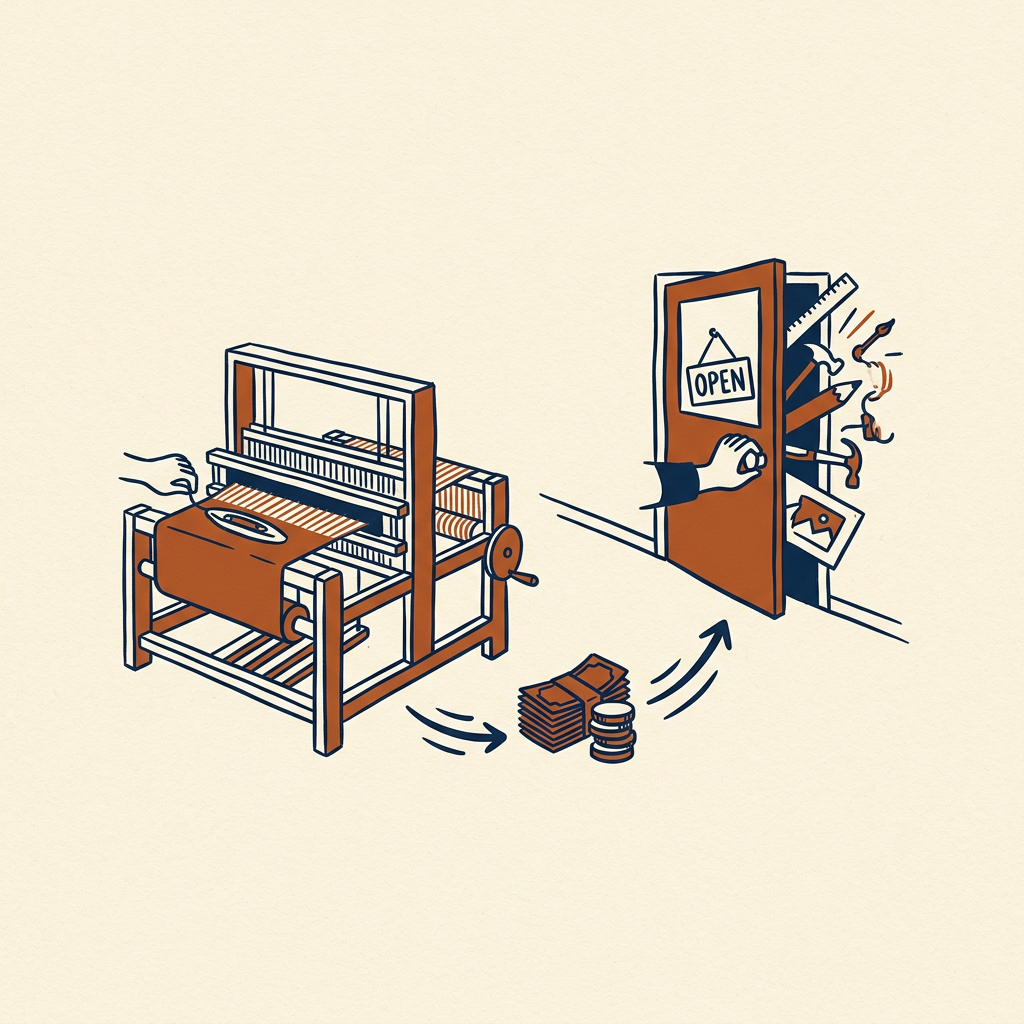
Labor-saving machinery that displaces some workers ultimately expands total employment and living standards because the savings are spent or invested elsewhere.
The immediate sight is workers laid off after a factory installs new equipment. Hazlitt asks readers to keep watching. Lower costs let the firm cut prices or expand output. Consumers keep more money and spend it on other goods, creating demand and jobs there. Or the firm hires more people overall because it can sell more cheaply.
He points to textiles and agriculture: mechanization displaced huge numbers over decades yet overall employment rose and living standards climbed, because fewer hands were needed for food and cloth and labor moved into entirely new industries. If the fear were right, the most primitive economies would be the richest and the most mechanized the most unemployed—the opposite of the record he cites.
He grants the real hardship of the individual worker who loses a post; aggregate gains can mask that concentrated cost. Still, he argues that blocking machines to save specific jobs trades broad, durable prosperity for the visible comfort of a smaller group, and that trade is rarely stated clearly to voters.
In practice: Textile and farm mechanization cut labor per unit of output while overall employment and living standards rose as workers moved into new industries.

5
Tariffs as transfer
A tariff that protects one domestic industry makes its workers better off only by making everyone else poorer by a larger total amount.
Put a tariff on imported wool sweaters. The domestic mill survives and its payroll stays intact; a politician can point to the factory. Every sweater buyer now pays more than the world price. That extra outlay, repeated across households, is money that cannot support other industries or be saved and invested.
Hazlitt extends the point to “saving American jobs.” Specific visible jobs are shielded; equal or greater jobs disappear in export sectors hit by retaliation and in domestic firms that would have used cheaper inputs or the cash consumers saved. The claim that tariffs must equalize wages with low-wage countries ignores productivity differences. The claim that a nation needs a permanent trade surplus confuses stacks of money with actual goods; a country that only exports and never imports ships real wealth abroad and receives paper claims in return.
Protectionism, on his account, moves wealth from the many who pay a little more for everything to the few who are shielded, and shrinks the total pie while it does so.
In practice: A wool-sweater tariff keeps one mill open while every household pays higher prices and other jobs never form with the money saved.

6
Price controls backfire
Ceilings and floors sever the scarcity signal prices send, producing shortages or surpluses that then invite still more intervention.
Result over time ↑ · Price set relative to market →
Ceiling below market
Shortage, less building and upkeep
Floor above market
Surplus, storage, destruction, or idle acres
Market signal intact
Buyers and sellers adjust to scarcity
Further decrees
Controls expand to manage the first distortion
Hazlitt treats prices as messengers, not arbitrary extractions. A rising price says a good is scarcer relative to demand; buyers economize and producers supply more. A falling price says the opposite. Fix a maximum below that level—rent control—and current tenants pay less. Landlords then have less reason to maintain or build, so stock deteriorates and units grow scarce, hurting future renters most.
The mirror case is a farm price floor set above the market. Producers grow more than buyers want at that price. Government must destroy the surplus, store it at public cost, or pay farmers not to grow—costs that rarely appear in the political sales pitch.
His general rule: a price fixed by decree away from the market level creates shortage if set too low and surplus if set too high, and the first intervention tends to breed further interventions to manage the distortion it caused. He does not claim market prices are always kind; he claims overriding the signal without fixing underlying scarcity rarely delivers the promised relief without a larger hidden bill.
In practice: Rent ceilings ease bills for current tenants yet, Hazlitt argues, shrink maintenance and new building until housing grows scarce.

7
Wage floors and exclusion
Minimum wages and above-market union rates can raise pay for those who keep jobs only by pricing other workers out of work entirely.
A wage is the price of labor. Set a legal floor above what a worker’s output is worth to an employer and the employer can absorb the loss, raise prices, or stop using that worker. Hazlitt says the third path is common for the least skilled and least experienced—the very group the law aims to help—and it shows up as hires that never happen rather than dramatic firings.
The same logic covers union bargains that push wages beyond productivity. Firms hire fewer people, raise prices and lose share, or both. Workers who remain enjoy a clear gain; workers not hired or displaced by leaner rivals bear an invisible cost.
He separates this from wage pressure that only corrects a real imbalance of bargaining power, which he allows can exist. His target is the case that forces pay above the value labor adds. Attempts to decree that gap away, he argues, move the cost onto fewer jobs instead of erasing it.
In practice: A wage floor above a low-skill worker’s output leads, on Hazlitt’s account, to jobs never offered rather than only to fatter paychecks.

8
Inflation as hidden tax
Inflation transfers real wealth from savers and fixed-income earners to government and early recipients of new money; printing claims cannot create goods.
Hazlitt separates real wealth—goods, services, productive capacity—from money, which is only a claim on that wealth. More currency chasing the same goods raises prices. The early scene often looks like a boom: new money reaches contractors or banks first and they spend before prices move.
As the money spreads, prices rise generally. Wage earners and pensioners who receive it last find their purchasing power cut. He calls this a tax with no statute and no vote—yet it moves real resources as surely as an income tax.
He also defends saving against the claim that spending alone drives prosperity and thrift is a drag. Saving, he says, is not money withdrawn from the economy; it is money aimed at tools, factories, and equipment that raise future output and wages. An economy that only consumes cannot grow its capacity. Policy that punishes saving for the sake of immediate spending trades lasting growth for a short-term appearance of health.
In practice: New money first lifts contractors and banks; later, fixed incomes buy less as prices catch up—the transfer Hazlitt labels a hidden tax.
Key terms
- the one lesson The habit of tracing a policy’s effects beyond the first visible group to all groups over time
- seen and unseen The split between immediate, photographable results and delayed, scattered costs or gains
- broken-window fallacy Treating the repair of destroyed wealth as a net economic gain
- price signal The information rising or falling prices send about relative scarcity and demand
- crowding out Public spending that displaces private spending or investment dollar for dollar
- hidden tax Inflation’s transfer of real resources without an explicit vote or statute
- purchasing power What a unit of money can actually buy once prices adjust
What to do
- Before endorsing any economic claim, ask out loud who is helped that you can see and who might be hurt that you cannot.
- When a story praises a subsidy, tariff, or spending program for visible jobs, spend five minutes tracing where the money came from and what it would have paid for instead.
- Treat any promise that a policy will pay for itself or create free prosperity as a cue to look harder, not to relax.
- At work, before green-lighting a cost-cutting or cost-adding change, list who gains at once and who may pay later or elsewhere.
- When you hear that saving is a drag on the economy, restate the claim as a redirect of money into tools and future output and test it that way.
Questions to think with
- For the last policy you cheered, who were the unseen parties and what happened to them a year later?
- When is the short-term pain of a visible group large enough to outweigh a larger long-term gain for everyone else?
- How would Hazlitt’s full-employment assumption change your view of stimulus in a deep slump?
- Which current price control or wage rule would you keep even after counting shortages or lost hires, and why?
- Where do externalities or monopoly power make his pure price-signal story incomplete in your market?
The other side
Hazlitt’s framework assumes an economy near full employment, so resources released in one place are quickly used elsewhere. That assumption weakens in a genuine demand shortfall such as the Great Depression or the 2008 financial crisis, when idle labor and capital may not find private uses on their own and public spending or monetary expansion need not fully crowd out private activity. Mainstream critics since 1946 have therefore called the book a weak guide to recession policy even while granting its force on tariffs and price controls. On minimum wages the empirical record is more contested than his flat prediction; the 1994 Card-Krueger comparison of New Jersey and Pennsylvania fast-food employment found no significant negative job effect, and later work has stayed mixed depending on the size of the hike and local conditions. The book also says little about externalities, environmental costs, public goods such as basic research, or monopoly and monopsony power—cases where unregulated prices need not equal social value. Built almost entirely on parables rather than data, it teaches a way of thinking more than it proves empirical laws, so its conclusions work best as hypotheses to test case by case.
Who it's for
Citizens who want to judge political promises on jobs, trade, and spending without an economics degree, students who want intuition without equations, and small-business owners trying to see why a well-meant rule might harm the people it aims to help will get the most from reading the full book.