




Quiet systems beat fear when egos decide the score
Jackson claims lasting titles come from redesigning the offense so selfishness cannot hide and treating each star as a different psychological case.
IJR · Oct 29, 2026 · 11 min read
In 60 seconds
- A coach's spiritual practice, not pure tactics, managed egos that wrecked other leaders.
- The triangle forced ball movement so Jordan could not dominate every possession by choice.
- Rodman got Vegas latitude; Pippen got co-leader trust; sameness failed both.
- Krause's preseason rebuild vow poisoned Bulls trust even on a sixth title run.
- Bryant's solitary will lost a Finals until benchings and talks redirected it to Gasol.
- Silent practices and a quiet bench beat constant chatter when playoff speed hits.
The big idea
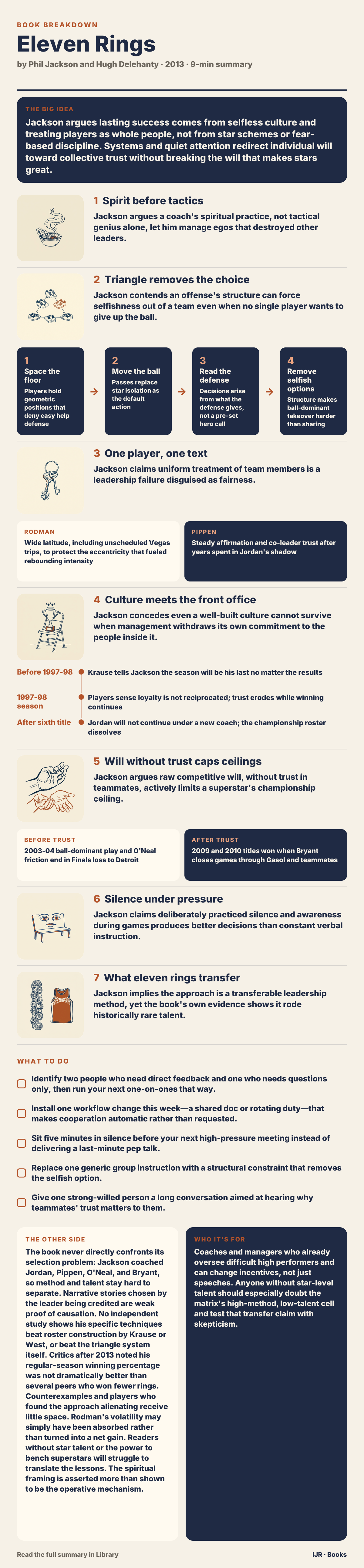
Jackson argues lasting success comes from selfless culture and treating players as whole people, not from star schemes or fear-based discipline. Systems and quiet attention redirect individual will toward collective trust without breaking the will that makes stars great.
The book in brief
Jackson starts from a strict Pentecostal childhood in North Dakota and the Zen and Lakota practices he later carried into NBA locker rooms. He meditated with players, burned sage before games, and handed out Marcus Aurelius to men used to playbooks. His claim is simple: basketball at the top is decided by attention and ego, and fear-and-control coaching cannot handle either. The 1989 Bulls room, talented and fractured after ordinary tactics had already failed, became the first real test.
He refused to build the offense around Jordan. Tex Winter's triangle used spacing, ball movement, and reading the defense so a star could not simply take every possession. Jordan resisted in 1989 and 1990 while leading the league in scoring. The structural bet paid off in the 1991 Finals, when Jordan passed to a wide-open John Paxson in the closing minutes of Game 5 instead of shooting. Mindfulness could change the coach; only system design changed everyone else's incentives at once.
Uniform treatment, Jackson insists, is fairness that fails. He gave Dennis Rodman wide latitude, including unscheduled Las Vegas trips during the 1997 season, because the eccentricity and the rebounding intensity were inseparable. Scottie Pippen needed steady affirmation that he was a co-leader after years in Jordan's shadow. Direct criticism worked on some temperaments; Socratic questions worked on others. The same principle later forced an entirely different approach to Kobe Bryant than the one that had reached Jordan.
Organizational limits appeared in 1998. Jerry Krause told Jackson before the season that it would be his last with the Bulls no matter the outcome. The rebuild decision eroded locker-room trust even as the team won its sixth championship. Jordan wanted to continue, but not under a different coach. Culture built on the floor could not survive commitment withdrawn above it.
With the Lakers the problem was solitary will. Bryant's intensity and self-reliance exceeded Jordan's early version yet lacked the later trust in teammates. Ball-dominant play and friction with Shaquille O'Neal helped produce the 2003-04 Finals loss to Detroit. Jackson benched Bryant in practice, limited his shots, and held long one-on-ones aimed at getting him to articulate why teammates' trust mattered. The 2009 and 2010 titles arrived after Bryant closed games by trusting Pau Gasol and others.
Operational mindfulness closed the arc: Jackson sat quiet on the bench during timeouts and ran practices in silence so defensive rotations had to travel by eye contact and positioning. Under playoff speed, he claims, rehearsed attention outperforms constant verbal instruction. He ends by offering selflessness, individualized reading, and structural incentives as lessons for any organization of strong-willed people, while the roster of all-timers leaves that transfer claim openly exposed.
Context
Phil Jackson wrote the book with Hugh Delehanty in 2013. It mattered as a rare inside account of managing enormous egos—Michael Jordan and Kobe Bryant among them—without breaking them, and as a detailed case for mindfulness and team-first systems at the highest level of competition.
The key ideas

1
Spirit before tactics
Jackson argues a coach's spiritual practice, not tactical genius alone, let him manage egos that destroyed other leaders.
He traces a path from a strict Pentecostal childhood in North Dakota to Zen Buddhism and Lakota ritual, then carries those practices straight into professional locker rooms. Meditation with players, sage burned before games, and books such as Marcus Aurelius given to men who expected only playbooks were treated as core tools, not decoration.
His premise is that elite basketball is decided by attention and ego. Conventional coaching built on fear and control cannot manage either one. The 1989 Bulls locker room, full of talent and fracture after prior coaches' standard tactics had already failed, became the proving ground.
Treating grown men as spiritual and psychological beings rather than assets to drill was the bet that cooperation might appear where discipline alone had not. The rest of the book tests whether concrete outcomes support a claim that first sounds mystical.
In practice: Jackson meditated with players, burned sage before games, and handed out Marcus Aurelius in a 1989 Bulls room where ordinary motivational tactics had already failed.

2
Triangle removes the choice
Jackson contends an offense's structure can force selfishness out of a team even when no single player wants to give up the ball.
- 1Space the floorPlayers hold geometric positions that deny easy help defense
- 2Move the ballPasses replace star isolation as the default action
- 3Read the defenseDecisions arise from what the defense gives, not a pre-set hero call
- 4Remove selfish optionsStructure makes ball-dominant takeover harder than sharing
Once ego is named as the central obstacle, he adopts assistant Tex Winter's triangle rather than building plays around Michael Jordan. Spacing, ball movement, and reading the defense replace isolation, so the star cannot simply seize every possession even when the moment seems to demand a hero.
Jordan resisted in 1989 and 1990. He had led the league in scoring by dominating the ball and saw the system as a direct threat to his production. Speeches asking him to share would have failed; the triangle removed the option to be selfish.
Mindfulness can change the leader's own behavior. System design changes everyone else's incentives at the same time. Without the triangle, Jackson suggests, the spiritual approach would have had no mechanism that produced wins.
In practice: In Game 5 of the 1991 Finals Jordan passed to a wide-open John Paxson in the closing minutes instead of shooting—an outcome Jackson credits to years of triangle habituation.

3
One player, one text
Jackson claims uniform treatment of team members is a leadership failure disguised as fairness.
Rodman
Wide latitude, including unscheduled Vegas trips, to protect the eccentricity that fueled rebounding intensity
Pippen
Steady affirmation and co-leader trust after years spent in Jordan's shadow
Motivating a roster means motivating each person differently, because identical treatment often yields unequal results. The coach's real job becomes accurate psychological reading rather than a single leadership formula applied to everyone.
Dennis Rodman received wide personal latitude. Scottie Pippen received steady affirmation of his value after years in Jordan's shadow. Eccentricity and rebounding intensity were treated as inseparable in Rodman's case; suppressing one would have suppressed the other. Pippen needed to feel like a co-leader, not a permanent second option.
Confrontation style shifted with temperament: direct criticism for some, indirect Socratic questioning for others. The same principle later required an entirely fresh approach to Kobe Bryant, whose intensity did not answer to the techniques that had reached Jordan.
In practice: During the 1997 season Jackson allowed Rodman unscheduled Las Vegas trips while giving Pippen repeated signals that he was a co-leader, not a permanent sidekick.

4
Culture meets the front office
Jackson concedes even a well-built culture cannot survive when management withdraws its own commitment to the people inside it.
- Before 1997-98Krause tells Jackson the season will be his last no matter the results
- 1997-98 seasonPlayers sense loyalty is not reciprocated; trust erodes while winning continues
- After sixth titleJordan will not continue under a new coach; the championship roster dissolves
The breakup of the Bulls dynasty is the moment his philosophy hit an organizational wall it could not climb. Methods that worked on the floor had no purchase on a trust problem that started above the coach.
Jerry Krause had decided to rebuild after 1997-98 regardless of results. He told Jackson before the season began that it would be his last with the Bulls no matter what happened. Players sensed that the loyalty demanded of them was not being returned.
Jordan felt the ambivalence directly: he wanted to continue, yet not under a different coach. A roster that had just won at the highest level dissolved anyway. Meditation, triangle habits, and individualized care could not compensate for commitment revoked by the front office.
In practice: Krause informed Jackson before 1997-98 that the season would be his last regardless of outcome; the sixth title still arrived, but locker-room trust did not survive the rebuild verdict.

5
Will without trust caps ceilings
Jackson argues raw competitive will, without trust in teammates, actively limits a superstar's championship ceiling.
Before trust
2003-04 ball-dominant play and O'Neal friction end in Finals loss to Detroit
After trust
2009 and 2010 titles won when Bryant closes games through Gasol and teammates
Early work with Kobe Bryant exposed intensity and self-reliance that in some ways exceeded Jordan's, yet lacked Jordan's eventual willingness to trust teammates fully. Talent and will were not enough on their own.
The 2003-04 season supplied the evidence: Bryant's ball-dominant play and friction with Shaquille O'Neal contributed to a Finals loss to the Detroit Pistons. Jackson's response was a harder version of individualized handling—deliberate benchings and limited shots in practice to force reliance, plus long one-on-one conversations aimed at getting Bryant to articulate why teammates' trust mattered.
Coaching's highest task, in this framing, is redirecting will toward the group without breaking the will itself, because that will is also the source of greatness. The later titles arrived only after the redirection took.
In practice: After the 2003-04 Finals loss to Detroit, the 2009 and 2010 championships came when Bryant closed games by trusting Pau Gasol and others rather than taking over alone.

6
Silence under pressure
Jackson claims deliberately practiced silence and awareness during games produces better decisions than constant verbal instruction.
His in-game habit was to sit quietly on the bench during timeouts instead of shouting instructions. Some practices ran in total silence so nonverbal communication had to carry the load.
Most coaches over-talk, he argues, filling players' heads with analysis until instinct and court awareness suffer. Silent drills forced defensive rotations to travel through eye contact and positioning alone. The method is concrete attention training, not an abstract virtue.
Playoff moments move too fast for verbal processing. Players who have rehearsed operating without cues, Jackson claims, stay composed where others tighten. Quiet preparation gets credit for late-game Finals execution that talent alone does not explain.
In practice: Players ran drills forbidden to speak, learning defensive rotations by eye contact and positioning; Jackson stayed silent on the bench in timeouts so the same habit held under fire.

7
What eleven rings transfer
Jackson implies the approach is a transferable leadership method, yet the book's own evidence shows it rode historically rare talent.
Closing chapters tally the championships and ask what generalizes beyond basketball. Selflessness over ego, individualized attention over uniform rules, and structural incentives over pure willpower are offered as lessons for any organization full of strong-willed people. Corporate executives asked him to speak; he takes the invitations as signs the methods travel.
The same pages surface the hardest limit. He coached Michael Jordan, Scottie Pippen, Shaquille O'Neal, and Kobe Bryant—four of the most talented players in history—across nearly every ring. The book does not fully reckon with how much the record depended on being handed that concentration of talent versus the organizing itself being decisive.
Read as capstone, the claim is triumphant. Read against the earlier chapters, it is the argument's most vulnerable point: philosophy and system receive credit for outcomes that talent density could substantially explain on its own.
In practice: Jackson cites executive speaking requests as proof of transfer while noting, without fully resolving, that almost every title rested on Jordan, Pippen, O'Neal, or Bryant.
Key terms
- Triangle offense Tex Winter's system of spacing, ball movement, and reading the defense that makes star isolation harder than sharing
- Structural incentives Rules and formations that remove the option to be selfish instead of merely asking players to resist temptation
- Individualized latitude Giving each player different freedom or affirmation matched to temperament rather than one fair rule for all
- Quiet attention Practiced silence in drills and on the bench so decisions under pressure rely on awareness, not coach chatter
- Selfless culture A locker-room norm that redirects personal will toward collective trust without crushing the will itself
- Front-office poison Management decisions that withdraw loyalty from players and thereby undo culture the coach built on the floor
What to do
- Identify two people who need direct feedback and one who needs questions only, then run your next one-on-ones that way.
- Install one workflow change this week—a shared doc or rotating duty—that makes cooperation automatic rather than requested.
- Sit five minutes in silence before your next high-pressure meeting instead of delivering a last-minute pep talk.
- Replace one generic group instruction with a structural constraint that removes the selfish option.
- Give one strong-willed person a long conversation aimed at hearing why teammates' trust matters to them.
Questions to think with
- Would Jordan have passed to Paxson in 1991 without years of triangle habits making the selfish choice harder?
- How much did Krause's rebuild vow, rather than any on-court method, actually end the Bulls dynasty?
- Can you bench or constrain your top performer to teach reliance, or do you lack the leverage Jackson had?
- If you stripped out the sage and meditation, would the structural changes alone have produced the same trust?
- How cleanly can you separate Jackson's philosophy from the fact he was handed Jordan, Pippen, O'Neal, and Bryant?
The other side
The book never directly confronts its selection problem: Jackson coached Jordan, Pippen, O'Neal, and Bryant, so method and talent stay hard to separate. Narrative stories chosen by the leader being credited are weak proof of causation. No independent study shows his specific techniques beat roster construction by Krause or West, or beat the triangle system itself. Critics after 2013 noted his regular-season winning percentage was not dramatically better than several peers who won fewer rings. Counterexamples and players who found the approach alienating receive little space. Rodman's volatility may simply have been absorbed rather than turned into a net gain. Readers without star talent or the power to bench superstars will struggle to translate the lessons. The spiritual framing is asserted more than shown to be the operative mechanism.
Who it's for
Coaches and managers who already oversee difficult high performers and can change incentives, not just speeches. Anyone without star-level talent should especially doubt the matrix's high-method, low-talent cell and test that transfer claim with skepticism.