




Speed, not skill, became the way to skim stock trades
Fragmented electronic markets let high-frequency traders turn microsecond leads into systematic take from slower investors.
IJR · Nov 3, 2026 · 13 min read
In 60 seconds
- Firms spent hundreds of millions on straighter cables so a few milliseconds of lead time could be sold again and again.
- Brad Katsuyama found his large orders moved prices against him because faster firms saw the first venue hit and raced ahead to the rest.
- Regulation NMS multiplied exchanges and dark pools, making order paths predictable and distance itself an extractive edge.
- Brokers and banks sold order flow and dark-pool access, aligning their pay with parties who profit from seeing customer intent first.
- Katsuyama’s team built Thor, then IEX with a 350-microsecond delay that equalized every participant and removed the race.
- The book forced the plumbing into public view, even as economists still debate how large the net harm really was.
The big idea
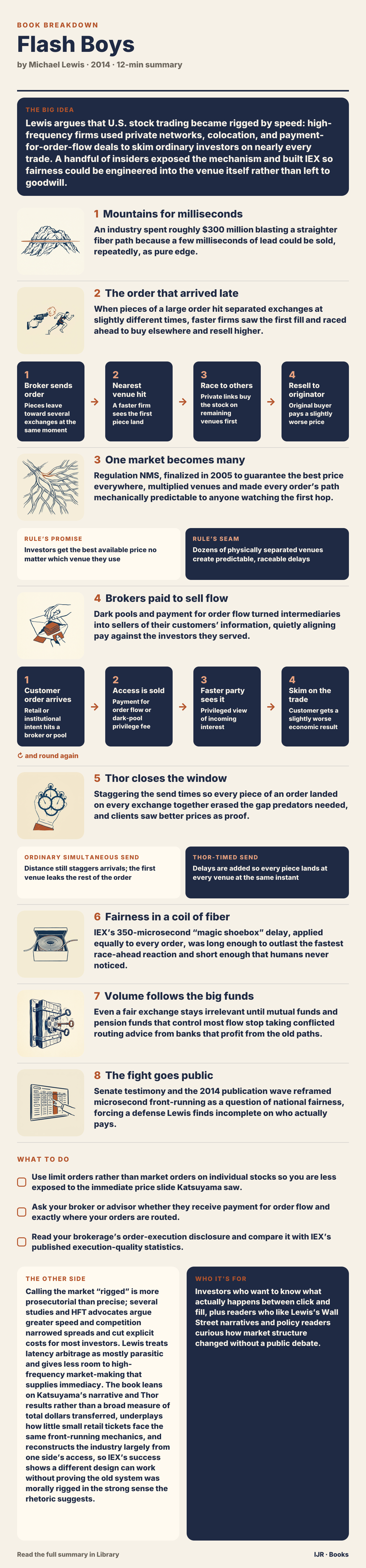
Lewis argues that U.S. stock trading became rigged by speed: high-frequency firms used private networks, colocation, and payment-for-order-flow deals to skim ordinary investors on nearly every trade. A handful of insiders exposed the mechanism and built IEX so fairness could be engineered into the venue itself rather than left to goodwill.
The book in brief
The story opens on a physical absurdity. An entire industry poured money into shaving tiny amounts of travel time between scattered exchanges, because whoever owned the fastest path owned a repeatable profit that had nothing to do with better research.
A trader then notices something wrong with his own desk. Large orders sent to many venues at once keep moving against him in the instant after he clicks. After months of ruling out internal bugs, he and his colleagues isolate a structural gap: orders do not arrive everywhere together, and anyone faster can see the first hit and front-run the rest.
The roots run through a well-meant rule that required brokers to chase the best displayed price across a growing list of public and private venues. Distance turned that requirement into a map predators could read. Exchanges, in turn, discovered they could sell speed, data, and exotic order types to the same firms.
Layered on top were dark pools and retail payment for order flow. Places sold as shelters from predators often sold privileged views of the very flow they claimed to hide. Brokers got paid for handing customer orders to wholesalers who traded against them.
Diagnosis led to a tool that synchronized arrivals, then to the harder choice of leaving a bank desk to found a new exchange built around equal delay and simpler fees. Winning volume meant persuading the big asset managers who control most real flow to ignore conflicted bank advice and inertia.
Public testimony and the book’s own release finally dragged the mechanics into Senate rooms and headlines. Industry defenders answered with liquidity and tighter spreads; the structural fight over the old rules was still largely open when the account ends.
Context
Michael Lewis published the book in 2014. It turned an obscure market-structure problem into a public scandal, pushing regulators, journalists, and investors to confront how electronic trading actually works.
The key ideas

1
Mountains for milliseconds
An industry spent roughly $300 million blasting a straighter fiber path because a few milliseconds of lead could be sold, repeatedly, as pure edge.
Lewis opens on the claim that speed itself, not insight, had become the dominant advantage. The market was no longer one place; it was a scatter of exchanges linked by cables, and the shortest cable won.
Construction crews cut a near-straight line through the Alleghenies between Chicago and New Jersey exchanges. Ridges were tunneled rather than routed around, because every bend cost time that traders would pay to avoid.
The line was sold to banks and trading firms for large annual fees. Each buyer’s choice was rational; in aggregate the race produced no new information, only a faster mirror of prices that already existed a few milliseconds away.
Ordinary investors never heard of the project, yet its existence quietly rewrote how professional trading worked. Control of the physical path became a reproducible source of profit.
In practice: Spread Networks spent roughly $300 million to cut the round-trip data time from about 16 milliseconds to 13, then leased the advantage to anyone who needed to arrive first.

2
The order that arrived late
When pieces of a large order hit separated exchanges at slightly different times, faster firms saw the first fill and raced ahead to buy elsewhere and resell higher.
- 1Broker sends orderPieces leave toward several exchanges at the same moment
- 2Nearest venue hitA faster firm sees the first piece land
- 3Race to othersPrivate links buy the stock on remaining venues first
- 4Resell to originatorOriginal buyer pays a slightly worse price
Brad Katsuyama at RBC watched prices move against him in the gap between click and execution whenever he tried to trade a sizable position across multiple venues at once. It felt as if the market already knew his intent.
He first assumed an internal bug and spent months eliminating desk and system explanations. The real cause was geography: an order sent “simultaneously” still reaches nearer exchanges before farther ones.
High-frequency firms colocated at or near every venue, with faster links than ordinary brokers, could detect the first arrival, infer the rest of the order was inbound, and step in front on the remaining exchanges. The edge was speed, not secret research.
That mechanism turned the earlier cable race into a concrete extraction from institutional desks—and, by extension, from the pension and mutual-fund money those desks represented.
In practice: Katsuyama’s team saw the pattern repeat on large stock positions until they proved the lag, not their own software, was moving the price.

3
One market becomes many
Regulation NMS, finalized in 2005 to guarantee the best price everywhere, multiplied venues and made every order’s path mechanically predictable to anyone watching the first hop.
Rule’s promise
Investors get the best available price no matter which venue they use
Rule’s seam
Dozens of physically separated venues create predictable, raceable delays
Lewis traces the structure to SEC rules meant to protect investors by forcing brokers to honor the best displayed quote across the market. The unintended result was a jump from a handful of exchanges to more than a dozen public ones plus dozens of private dark pools, each of which had to be checked.
Because those venues sit at real distances, true simultaneous checking is impossible; a small lag always remains. Best-price routing also made the sequence of an order legible once it began to move.
Exchanges earned fees from colocation and from selling faster private data feeds ahead of the public ones. They also rolled out specialized order types whose practical effect, critics said, was to let speed firms sniff incoming interest before others could react.
Fragmentation was sold as competition and protection. Lewis argues it created the exact seams that turned distance and delay into an extractive strategy the rule-writers never anticipated.
In practice: After the 2005 rules took hold, firms poured capital into servers inside exchange data centers and into private networks built solely to exploit the new lags.

4
Brokers paid to sell flow
Dark pools and payment for order flow turned intermediaries into sellers of their customers’ information, quietly aligning pay against the investors they served.
- 1Customer order arrivesRetail or institutional intent hits a broker or pool
- 2Access is soldPayment for order flow or dark-pool privilege fee
- 3Faster party sees itPrivileged view of incoming interest
- 4Skim on the tradeCustomer gets a slightly worse economic result
↻ and round again
Dark pools were marketed as private matching venues where large orders could hide from public view and avoid moving the market. Lewis shows many of them sold high-frequency firms privileged access to see the flow inside, recreating the information edge the pools were supposed to erase.
Separately, retail brokers sold ordinary customers’ orders to wholesale trading firms instead of sending them straight to an exchange. The broker collected a fee; the wholesaler traded against the flow and kept the difference after giving the customer a price only marginally better than the public quote.
Banks pitched institutional clients on dark-pool safety from predators while, in the same period, selling access to those same predators. No single actor had to be cartoonishly corrupt.
Each layer—exchange, dark pool, retail broker—followed incentives the fee structures and rules had created. The system became extractive through ordinary rational choices.
In practice: Lewis describes banks selling dark-pool safety to institutions while high-frequency firms paid for the right to see order flow inside those same pools.

5
Thor closes the window
Staggering the send times so every piece of an order landed on every exchange together erased the gap predators needed, and clients saw better prices as proof.
Ordinary simultaneous send
Distance still staggers arrivals; the first venue leaks the rest of the order
Thor-timed send
Delays are added so every piece lands at every venue at the same instant
Once the lag was understood, Katsuyama’s group, including Rob Park, built a tool that deliberately delayed some legs of an order. The goal was simple: identical arrival times everywhere, no first hop for anyone to observe.
When RBC offered the tool to institutional clients, execution improved in measurable ways. The losses that had looked like bad luck or market noise showed up as systematic and removable.
Institutional politics followed. Banks that ran their own speed desks or sold speed and data to others had little reason to celebrate a fix that shrank that profit pool. Some clients hesitated too, because enthusiastic adoption meant admitting the market had been broken and that parts of their own firms had benefited.
A single broker tool could not rewrite surrounding incentives. Money still preferred the status quo, which pushed the team toward a more radical step: an exchange that did not rely on anyone choosing to be fair.
In practice: Institutional clients using Thor received meaningfully better prices than they had on the same kinds of orders without it, evidence the earlier slippage was real.

6
Fairness in a coil of fiber
IEX’s 350-microsecond “magic shoebox” delay, applied equally to every order, was long enough to outlast the fastest race-ahead reaction and short enough that humans never noticed.
Katsuyama left RBC to found IEX around a physical rather than moral solution. A coil of extra fiber added a fixed delay to every inbound order, calibrated to exceed the reaction time of the quickest high-frequency links.
Because the delay was symmetric, colocation and private cables lost their edge inside the venue. IEX also refused the specialized order types and rebate designs Lewis ties to selling speed advantages, favoring a simpler fee model.
Staff had to be recruited from firms that still profited from the old architecture, and large asset managers had to be persuaded to send real flow to an unproven exchange. Early resistance from incumbent exchanges and banks underscored how much the prior design had been worth to them.
The working venue became a proof of concept: markets did not require exploitable speed differentials to function, attract volume, or improve execution.
In practice: The magic shoebox imposed exactly 350 microseconds of delay on every participant, neutralizing the lead that private cables and colocation had previously bought.

7
Volume follows the big funds
Even a fair exchange stays irrelevant until mutual funds and pension funds that control most flow stop taking conflicted routing advice from banks that profit from the old paths.
Technology alone did not finish the job. Without liquidity, institutional traders cannot move size, so IEX had to win the order flow of the managers who hold ordinary savers’ retirement money.
The team pitched heads of trading at major mutual-fund and pension organizations directly, arguing that the hidden costs Katsuyama first measured would fall if orders came to a venue without speed races. Progress was slow.
Many of those institutions still leaned on their banks for execution guidance, and those banks had clear reasons to keep flow inside arrangements they already monetized. Public criticism of the same banks raised reputational risk for a startup that still needed industry cooperation.
Reform therefore meant fighting inertia and misaligned advice, not only writing better code. Structural problems that arise from incentives do not dissolve when one new venue appears.
In practice: Katsuyama’s group spent long stretches winning commitments one large asset manager at a time while the banks those managers trusted still preferred the prior routing map.

8
The fight goes public
Senate testimony and the 2014 publication wave reframed microsecond front-running as a question of national fairness, forcing a defense Lewis finds incomplete on who actually pays.
The narrative peaks when the findings leave trading floors. Katsuyama testifies before a U.S. Senate subcommittee and debates an exchange representative on television; the book’s release coincides with announced FBI and New York Attorney General attention to high-frequency practices.
Defenders answer that high-frequency trading adds liquidity and narrows bid-ask spreads, lowering explicit costs for everyone including retail. Lewis puts that case on the page, then presses the distributional point: average spreads can tighten while fast, informed participants still extract value from slower large orders of the kind Katsuyama first watched slip.
Regulators, lawmakers, and financial media suddenly had to discuss mechanics most had never aired in public. The obscurity itself was gone.
At the time of writing, deep rewrites of Reg NMS and exchange fee structures remained largely unfinished. Visibility was the partial victory.
In practice: Around the 2014 release, Katsuyama’s congressional appearance and a wave of coverage pushed inquiries and industry rebuttals into the open.
Key terms
- High-frequency trading Automated firms that use speed, colocation, and private data to trade in tiny time slices, often reacting to others’ orders before those orders finish.
- Regulation NMS 2005 SEC rules meant to guarantee investors the best displayed price across venues; they also multiplied exchanges and made routing paths predictable.
- Dark pool Private trading venue run by a bank or broker where orders are matched away from public view, sometimes while privileged parties still pay to see the flow.
- Payment for order flow Practice in which a retail broker sells customers’ orders to a wholesaler that pays for the right to trade against them.
- Colocation Placing a firm’s servers inside or beside an exchange’s data center so its messages travel a shorter physical path than rivals’.
- Thor RBC tool that staggered outbound order pieces so they arrived at every exchange at the same instant, closing the race window.
- IEX Exchange founded to remove speed advantages through equal delay, simpler fees, and no special order types built for sniffing.
- Magic shoebox Coil of fiber that adds a fixed 350-microsecond delay to every order entering IEX, applied the same way to all participants.
- Front-running by speed Seeing one leg of an order hit a nearby venue and racing ahead to other venues to buy or sell before the rest of the order lands.
What to do
- Use limit orders rather than market orders on individual stocks so you are less exposed to the immediate price slide Katsuyama saw.
- Ask your broker or advisor whether they receive payment for order flow and exactly where your orders are routed.
- Read your brokerage’s order-execution disclosure and compare it with IEX’s published execution-quality statistics.
Questions to think with
- If average spreads got narrower, does that settle whether large institutional orders still systematically lose to faster firms?
- When every actor follows rational speed incentives, who owns the aggregate cost to pension and mutual-fund savers?
- Would you accept a short equal delay on every order if it removed the race inside the venue?
- How should best-price rules change once physical distance itself creates predictable winners?
- What would change in your next trade if every broker had to show, in plain language, who paid to see your order?
The other side
Calling the market “rigged” is more prosecutorial than precise; several studies and HFT advocates argue greater speed and competition narrowed spreads and cut explicit costs for most investors. Lewis treats latency arbitrage as mostly parasitic and gives less room to high-frequency market-making that supplies immediacy. The book leans on Katsuyama’s narrative and Thor results rather than a broad measure of total dollars transferred, underplays how little small retail tickets face the same front-running mechanics, and reconstructs the industry largely from one side’s access, so IEX’s success shows a different design can work without proving the old system was morally rigged in the strong sense the rhetoric suggests.
Who it's for
Investors who want to know what actually happens between click and fill, plus readers who like Lewis’s Wall Street narratives and policy readers curious how market structure changed without a public debate.